
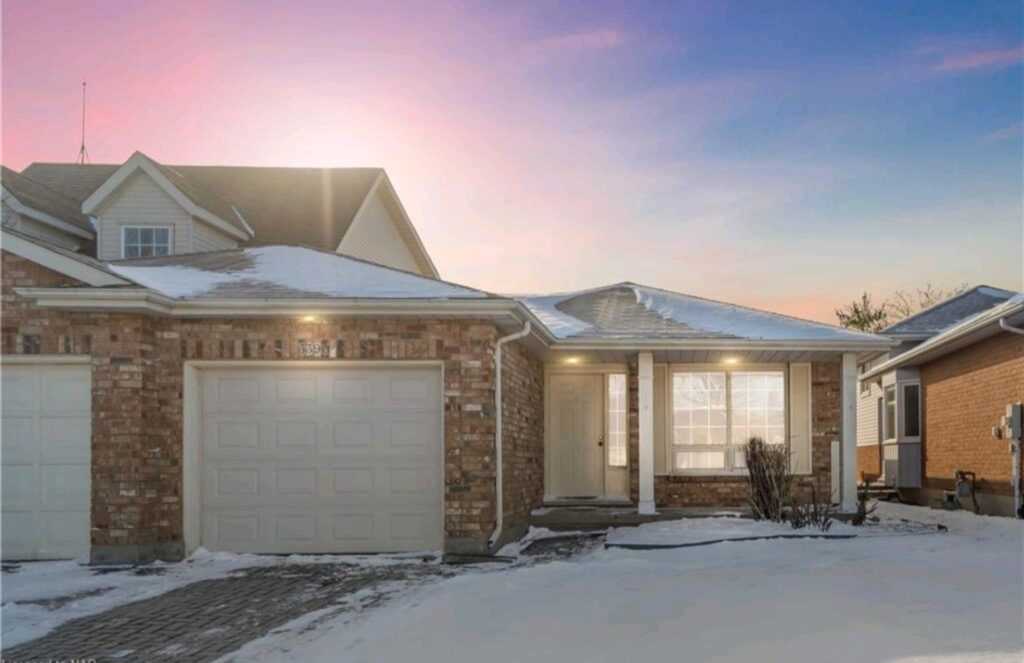
You only get one shot at a first impression of Rental Property, and in today’s rental market, that first impression usually happens on a phone screen before a tenant ever steps through your front door.
Ontario’s rental landscape has shifted. After years of landlords holding all the cards, 2026 has brought more balanced conditions across the province Rental Property. Vacancy rates have climbed in most major markets, new purpose-built supply is coming online, and tenants finally have options again. In the St. Catharines-Niagara region alone, the vacancy rate sat at 3.9% in 2025 – a more-than-decade high, with some Niagara Falls sub-markets recording even higher vacancy due to Rental Property fewer temporary foreign workers and softer tourism employment.
What does that mean for you as a landlord? It means a rental property preparation checklist isn’t optional anymore – it’s the difference between renting your unit in a week or watching it sit empty for a month while the mortgage payment still comes due.
This guide walks you through every step of preparing a rental property for the market, from the first repair to the final showing. Whether you own a single condo in downtown Niagara Falls or a small portfolio across the region, this rental property preparation checklist will help you list faster, attract stronger tenants, and avoid the costly mistakes that keep properties vacant longer than they need to be.
Why Property Preparation Matters Before Listing
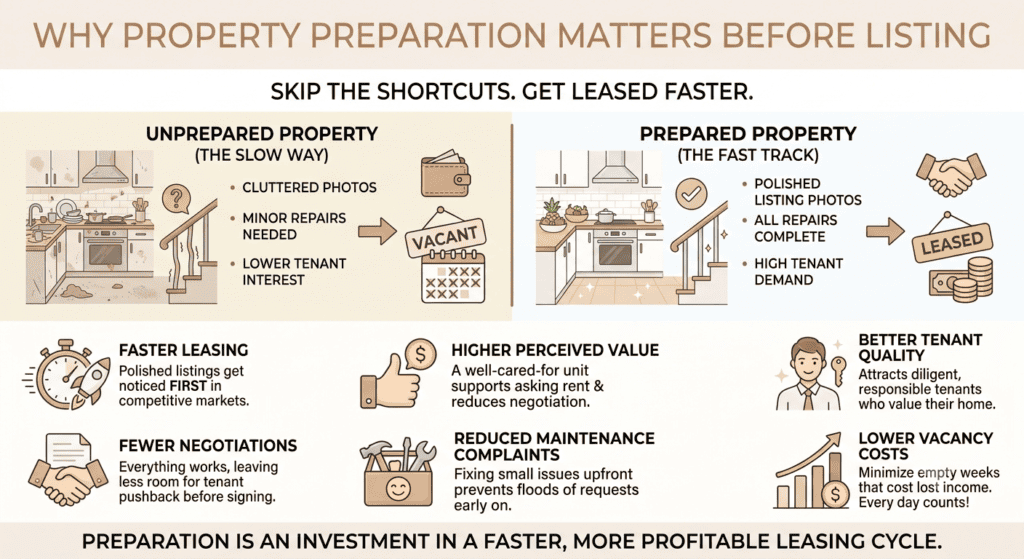
Skipping preparation feels like a shortcut. It’s actually the opposite.
A property that’s ready to show the moment you list it moves through the leasing process faster, from first inquiry to signed lease. When a listing photo shows a freshly cleaned kitchen instead of a cluttered counter, or a repaired railing instead of a wobbly one Rental Property, tenants notice – and they act faster.
Here’s what proper preparation actually buys you:
- Faster leasing. In a market where new purpose-built units are competing for the same tenant pool, a polished listing gets noticed first.
- Higher perceived value. Tenants form a price expectation based on what they see. A well-prepared unit supports the rent you’re asking, rather than making tenants negotiate you down.
- Better tenant quality. People who are diligent about their own living standards are drawn to properties that look cared for. A neglected listing tends to attract less careful applicants.
- Fewer back-and-forth negotiations. When everything works and looks good, there’s less for a tenant to push back on before signing.
- Reduced maintenance complaints later. Fixing small issues before move-in prevents a flood of maintenance requests in the first 90 days.
- Lower vacancy costs. Every week a unit sits empty is a week of lost income you don’t get back. In a softer 2026 market with more competing units, that cost adds up quickly.
With that context in mind, let’s get into the 15 steps of the rental property preparation checklist.
Step 1 – Complete All Necessary Repairs
Before you photograph a single room, walk through the property with fresh eyes – ideally the eyes of someone who has never seen it before.
Repairs to prioritize:
- Fix any leaking faucets or running toilets
- Repair damaged or scuffed flooring
- Replace broken light fixtures, cabinet handles, or door hardware
- Patch nail holes and touch up drywall
- Repair sticking doors and windows so they open and close smoothly
- Test every major appliance (stove, fridge, dishwasher, washer/dryer)
- Inspect plumbing under sinks and around the water heater for slow leaks
- Check electrical outlets and switches for function
None of this needs to be expensive. A weekend with a caulking gun, a tube of wood filler, and a basic toolkit resolves most of the small issues that make a rental feel unfinished Rental Property. What it does need is attention – tenants notice a loose cabinet hinge within the first thirty seconds of a showing, and it colours how they view everything else in the unit.
Step 2 – Deep Clean Every Area of the Property
There’s a difference between “cleaned” and “deep cleaned,” and tenants can tell.
Areas that need real attention:
- Kitchen (inside cabinets, behind appliances, range hood, grout)
- Bathrooms (grout, caulking, exhaust fans, under the sink)
- Bedrooms and closets
- Windows, tracks, and sills
- Baseboards and door frames
- Light fixtures and ceiling fans
- Garage
- Balcony or patio
- Any shared or outdoor spaces
Tip: Professional cleaning creates a noticeably stronger first impression during showings than a rushed self-clean. If you’re managing several units across NLLC’s service area or elsewhere in the Niagara Region, a professional cleaning pass between tenants is one of the most cost-effective investments you can make – it costs far less than a week of extra vacancy Rental Property.
Step 3 – Improve Your Property’s Curb Appeal
Tenants decide how they feel about a property before they’ve even parked the car.
Quick curb appeal wins:
- Mow the lawn and edge the walkways
- Trim overgrown shrubs and hedges
- Power wash the driveway and walkway
- Wash the exterior siding or brick where visible dirt has built up
- Paint or clean the front door
- Replace faded or mismatched house numbers
- Add or update outdoor lighting fixtures
- Plant a few seasonal flowers near the entrance
None of these steps require a major renovation budget. A clean, tidy exterior signals that the property – and by extension, the landlord – is well maintained, which matters enormously to a tenant deciding where to commit their next twelve months.
Step 4 – Refresh the Interior Without Overspending
You don’t need a full renovation to make a rental feel current. Small, targeted updates go a long way.
- Repaint walls in neutral tones (soft greys, warm whites, greige) – neutral colours photograph well and appeal to the widest range of tenants
- Replace outdated or worn curtains and blinds
- Update cabinet hardware for a quick, affordable style refresh
- Swap dated light fixtures for simple, modern options
- Address minor cosmetic issues: chipped tile, worn grout, faded caulking
- Touch up or refinish flooring where it’s showing wear
These upgrades are especially worth prioritizing given how competitive the 2026 rental market has become. With more purpose-built supply entering markets like Niagara Falls and St. Catharines, tenants are comparing your unit against newer buildings with modern finishes. A $300 paint job and updated hardware can meaningfully close that gap.
Step 5 – Perform a Complete Safety Inspection
Beyond making the unit look good, you’re legally responsible for making it safe. This is where the property preparation checklist becomes about more than aesthetics.
Check and confirm:
- Smoke detectors are installed and functioning on every level and near sleeping areas
- Carbon monoxide alarms are installed where required (near fuel-burning appliances or attached garages)
- Fire extinguishers are accessible, if applicable
- All door locks function properly and provide adequate security
- Window locks are intact
- Handrails on stairs are secure and stable
- Exterior lighting works at all entry points
- Emergency exits are clear and functional
Ontario landlords should ensure compliance with provincial fire code requirements and municipal property standards bylaws before listing a unit. Fire and safety inspections aren’t just good practice – in Niagara Falls, St. Catharines, and across the region, they’re enforceable standards that can result in fines or orders if ignored Rental Property.
Step 6 – Inspect Major Home Systems
A unit can look flawless in photos and still fall apart in the first month if the underlying systems haven’t been checked.
Have a qualified professional review:
- HVAC system (furnace and air conditioning)
- Water heater
- Plumbing throughout the unit
- Electrical panel and wiring
- Roof condition (for standalone properties)
- Foundation for cracks or moisture issues
- Drainage around the exterior
- Ventilation, especially in bathrooms and kitchens
This step protects you as much as it protects the tenant. A furnace that fails in the first cold snap of the season doesn’t just cost you a repair bill – it costs you a maintenance request, an unhappy new tenant, and potentially a dispute over habitability standards.
Step 7 – Remove Personal Items and Declutter
If you’re preparing a property you’ve lived in, or one that’s still partially furnished with your own belongings, decluttering is non-negotiable Rental Property.
Why it matters:
- It helps prospective tenants visualize themselves actually living there
- Empty or lightly staged rooms photograph as larger than cluttered ones
- Clean, simple spaces create cleaner, more professional listing photos
- Tenants move through showings faster and more comfortably in an uncluttered space
A cluttered listing photo does more damage than most landlords realize – potential tenants scroll past it before reading a single word of your description.
Step 8 – Stage the Property for Better Appeal
Staging doesn’t mean hiring a design firm. It means presenting the space in a way that helps tenants picture their own life in it.
- Arrange furniture (even minimal pieces) to show how rooms can be used
- Maximize natural light and add bright, warm-toned bulbs where needed
- Use fresh linens and towels for showing days
- Keep décor minimal and neutral
- Eliminate cooking odours, pet smells, or musty basement smells before every showing
- Organize closets and storage spaces so they appear spacious rather than cramped
Staged rentals consistently outperform empty or cluttered ones in both online engagement and in-person conversion. It’s a small investment of time that pays off in faster applications.
Step 9 – Set the Right Rental Price
Pricing is arguably the single biggest factor in how fast your unit rents in 2026 – more important than the paint colour, more important than the light fixtures.
The Niagara market has shifted meaningfully. While pockets of Niagara Falls – Stamford and Chippawa in particular – are still seeing vacancy rates sub-1%, other segments of the broader region are softening. St. Catharines issued over 1,025 new dwelling unit building permits in 2025 alone – nearly double its previous nine-year average, and multiple new rental apartment projects are expected to break ground in Niagara Falls through 2026. That new supply gives tenants more choice, which means overpricing is punished faster than it used to be.
How to price accurately:
- Compare similar local rentals currently listed (not units that rented a year ago)
- Factor in amenities: parking, in-unit laundry, updated finishes, included utilities
- Watch seasonal demand – spring and late summer typically see stronger tenant activity
- Avoid anchoring your price to 2022–2023 market highs; that ship has sailed in most Niagara submarkets
- Remember that a unit priced even slightly above market can sit for weeks, while an accurately priced unit often fills within days
If you already have a tenant in place rather than a vacant unit to lease, note that Ontario’s 2026 rent increase guideline is set at 2.1% – the lowest guideline in four years – for most units first occupied on or before November 15, 2018. Increases must be delivered using the official Form N1 with at least 90 days’ written notice, and rent can only be raised once every 12 months per tenant.
Step 10 – Gather Important Property Documents
Having your paperwork ready before you list saves everyone time once you find a qualified applicant.
Documents to prepare:
- Lease agreement (Ontario’s Standard Lease template, where applicable)
- Maintenance and repair records
- Appliance manuals or warranty information
- Utility account information and average costs
- Condo corporation rules, if the unit is part of a condo
- Parking details and any assigned spot documentation
- Move-in instructions and key/fob handoff procedure
Having this ready shows prospective tenants you run a professional operation – and it removes friction at exactly the moment you want the process to move quickly.
Step 11 – Take Professional Listing Photos
This is the step landlords underestimate most, and the data backs that up clearly. Listings with professional photos sell 32% faster and for more money than listings with amateur images, and research on rental listings specifically shows properties marketed with professional photography can see dramatically more inquiries and in-person tours compared to phone-snapped alternatives. In fact, photography has been found to matter nearly four times more to potential tenants than the neighbourhood description in the listing itself.
Photo best practices:
- Shoot during the day with as much natural light as possible
- Use wide-angle shots to show the full scope of each room
- Include exterior and curb appeal photos, not just interiors
- Capture any shared amenities (parking, laundry room, outdoor space)
- Avoid clutter in every frame – this is where Steps 2 and 7 pay off
- Photograph every room, not just the “best” ones – tenants get suspicious of missing rooms
- Aim for a well-rounded gallery rather than dozens of near-duplicate shots; a focused set that tells the full story of the unit outperforms an oversized, repetitive one
Provincial and municipal consumer protection guidance also encourages landlords to use accurate descriptions and quality photos so prospective tenants can properly evaluate a property before booking a viewing – which protects you from wasted showings with mismatched expectations just as much as it helps the tenant.
Step 12 – Write a High-Converting Rental Listing
Your photos get the click. Your listing copy gets the application.
What a strong listing includes:
- A clear, specific headline (avoid vague phrases like “great unit available”)
- Property highlights near the top: bedrooms, bathrooms, square footage, standout features
- Nearby schools and amenities
- Transit access and commute information
- Parking availability and type
- What’s included in rent (utilities, appliances) and what isn’t
- Pet policy, stated clearly to avoid wasted inquiries
- Rental terms: lease length, deposit requirements, move-in date
- A direct call-to-action telling tenants exactly how to apply or book a showing
Keep sentences short and specific. Tenants skim listings quickly, so front-load the details that matter most to their decision.
Step 13 – Prepare for Property Showings
Getting a lead to book a showing is only half the battle. The showing itself needs to close the deal.
- Offer flexible scheduling, including evenings and weekends where possible
- Turn on all lights before each showing, even during the day
- Set a comfortable temperature ahead of time
- Ensure the unit smells clean and neutral, not like cleaning products or air freshener overload
- Prepare a simple information sheet covering rent, utilities, parking, and lease terms
- Be ready to answer common tenant questions on the spot: pet policy, storage, laundry, internet providers in the area
Tenants in 2026 have more listings to compare than they did a few years ago, so the quality of the in-person or virtual showing experience directly affects whether they apply on the spot or keep looking.
Step 14 – Plan Your Tenant Screening Process
Once applications start coming in, a consistent screening process protects your investment and keeps you compliant with Ontario’s Human Rights Code.
What you can legally request under Ontario Regulation 290/98:
- A completed rental application
- Employment verification
- Proof of income
- A credit check or credit report, with the applicant’s written consent
- Rental history and references from previous landlords
A few important compliance notes for Ontario landlords: you cannot legally run a credit check without the applicant’s signed written consent, and while you don’t need their Social Insurance Number to pull a report, you generally only need their full legal name, current address, and date of birth. You also cannot use a rigid rent-to-income ratio (such as a strict 30% rule) as an automatic disqualifier – the Human Rights Tribunal has found that practice can constitute indirect discrimination, particularly against applicants receiving social assistance. If income information is requested, it must be requested alongside credit and rental history information, not on its own.
Best practices for screening:
- Use the same standardized application form for every applicant
- Document every decision and the reasoning behind it
- Contact the landlord before the current one when checking references – a current landlord may give a glowing review just to encourage a difficult tenant to move on
- Keep all applications and screening records on file, even for applicants you don’t select
Step 15 – Consider Professional Property Management
After walking through fourteen steps, it’s worth asking honestly: does this match the time you actually have available?
A professional property manager handles:
- Marketing across multiple listing platforms simultaneously
- Coordinating and conducting showings
- Full tenant screening and application processing
- Lease preparation in compliance with current Ontario regulations
- Ongoing maintenance coordination
- Day-to-day management once a tenant is in place
In a market like Niagara’s – where vacancy rates vary block by block, new supply is entering the pipeline, and tenant expectations keep rising – professional guidance can be the difference between a unit that rents in days and one that sits for weeks. The HAH Developments works with property owners across Niagara Falls, St. Catharines, Welland, and the surrounding Niagara Region to handle every part of this process, from pre-listing preparation through to lease signing and beyond, so owners get consistent income without the day-to-day workload.
Current Trends Shaping Rental Preparation in Ontario for 2026
A few broader shifts are worth understanding before you list, because they change how much preparation actually matters right now.
Supply is catching up to demand. After years of extremely tight vacancy across Ontario, 2025 and 2026 have brought a wave of new purpose-built rental construction. CMHC’s spring 2026 housing supply report noted that the number of rental units under construction nationally was almost twice the ten-year average, with Ottawa and Toronto posting some of the strongest rental starts on record. In the Niagara Region specifically, St. Catharines issued over 1,025 new dwelling unit building permits in 2025 – nearly double its previous nine-year average – and Niagara Falls exceeded 116% of its provincial housing target. A 362-unit purpose-built rental project at 4500 Park Street in downtown Niagara Falls is one of several new developments expected to add competing inventory through 2026. For existing landlords, this means your unit is no longer just competing against other individually owned rentals; it’s competing against brand-new buildings offering modern finishes and, in some cases, move-in incentives.
Rent growth has slowed considerably. Nationally, average asking rents declined for twenty consecutive months on a year-over-year basis heading into mid-2026, according to Rentals.ca data cited by CMHC. Ontario specifically saw asking rents drop roughly 3.3% year-over-year at the start of 2026. That doesn’t mean rents are falling everywhere – pockets of Niagara Falls like Stamford and Chippawa are still tight, with vacancy sub-1% and two-bedroom units averaging around $2,450 per month – but it does mean landlords can no longer assume automatic year-over-year rent growth. Pricing has to be checked against current comparables, not last year’s numbers.
Tenants are more selective, and they research before reaching out. With more listings to compare, prospective tenants increasingly rule out properties based on photos and descriptions alone, before ever requesting a showing. This raises the stakes on Steps 11 and 12 of this checklist – the quality of your photos and listing copy now does more of the filtering work than it used to, which means a weak listing costs you qualified leads you’ll never even know you lost.
Turnover incentives matter more than they used to. In softer markets, some landlords are offsetting slower rent growth with small incentives – a reduced deposit where permitted, minor move-in bonuses, or included parking – rather than competing purely on price. These small additions can be a cost-effective way to stand out without discounting the base rent long-term.
Professional presentation is doing more of the work. Because tenants are comparing more listings side by side than they were a few years ago, the gap between a professionally prepared, professionally photographed unit and a hastily listed one has widened. What used to be a “nice to have” – good lighting, decluttered rooms, a well-written description – has effectively become the baseline expectation for a competitive listing in 2026.
Taken together, these trends point to one conclusion: preparation isn’t just about making a good impression anymore. It’s about staying competitive in a Niagara rental market that finally has enough supply to give tenants real choices.
Common Mistakes Landlords Make Before Listing
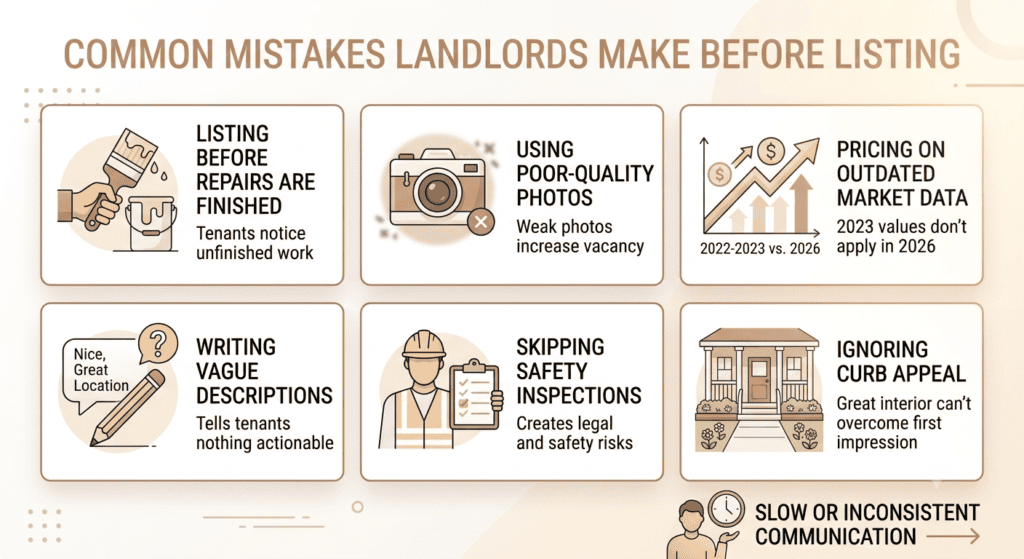
Even experienced landlords fall into these traps:
- Listing before repairs are finished. Tenants notice unfinished work, and it undermines trust in everything else about the listing.
- Using poor-quality photos. In a market this competitive, weak photos alone can add weeks to your vacancy.
- Pricing based on outdated market data. What a similar unit rented for in 2022 or 2023 tells you almost nothing about what it’s worth in 2026.
- Writing vague, generic descriptions. “Nice apartment, great location” tells a tenant nothing they can act on.
- Skipping safety inspections. This creates both legal exposure and tenant safety risk.
- Ignoring curb appeal. A great interior can’t overcome a first impression that already turned a tenant away.
- Slow or inconsistent communication with prospects. In 2026’s faster-moving rental market, applicants often move on to the next listing if a landlord takes days to respond.
Quick Property Preparation Checklist
Use this scannable version to track your progress before listing:
- ✅ All repairs completed
- ✅ Property deep cleaned
- ✅ Safety devices tested and functioning
- ✅ Fresh paint where needed
- ✅ Landscaping and curb appeal finished
- ✅ Professional photos taken
- ✅ Rental price researched against current comparables
- ✅ Documents ready (lease, records, manuals)
- ✅ Listing written and reviewed
- ✅ Showing schedule prepared and flexible
Conclusion
Preparing a rental property properly isn’t an expense – it’s an investment that pays for itself through faster leasing, stronger applicants, and fewer headaches down the road. In a Niagara rental market that’s more competitive than it’s been in years, the landlords who treat preparation as a priority are the ones filling vacancies in days rather than months.
A well-prepared property doesn’t just rent faster. It attracts tenants who take care of the space, pay on time, and stay longer – which is ultimately what protects your investment over the long run.
If walking through all fifteen steps feels like more than you have time for, that’s exactly where The HAH Developments comes in. Our team handles everything from property preparation and professional photography to tenant screening and lease management across Niagara Falls, St. Catharines, Welland, and the wider Niagara Region. Contact The HAH Developments today to find out how we can get your property rent-ready and in front of qualified tenants faster.
Frequently Asked Questions
How clean should my rental property be before listing?
It should be deep cleaned, not just tidied. That means inside cabinets, behind appliances, grout lines, and window tracks – areas a quick surface clean typically misses.
Should I repaint before renting out my property?
If the walls show visible wear, scuffs, or outdated colours, yes. Neutral tones photograph better and appeal to the broadest range of applicants.
How can I make my rental stand out in a competitive Niagara market?
Combine accurate pricing, professional photography, and a genuinely move-in-ready unit. With more new supply entering markets like St. Catharines and Niagara Falls in 2026, presentation matters more than it did a few years ago.
Is professional cleaning worth the cost?
For most landlords, yes. A single week of vacancy typically costs more than a professional deep clean, and a spotless unit shows better in photos and in person.
Should I stage a rental property?
Light staging – even just a few key furniture pieces and warm lighting – helps tenants picture themselves living there and photographs significantly better than an empty or cluttered space.
What documents should landlords prepare before listing?
At minimum: a lease agreement, maintenance records, utility information, and any condo or building rules that apply. Having these ready speeds up the process once you find a qualified applicant.
How do property managers help prepare rental properties?
They coordinate repairs, cleaning, and staging, price the unit accurately against current local data, market it across multiple platforms, and screen applicants in full compliance with Ontario’s Human Rights Code – reducing the vacancy period and the owner’s day-to-day workload.