

Owning a short-term rental in Canada used to be simple: list the property, set a price, and wait for bookings. That era is over.
Between new federal tax rules, a growing patchwork of provincial laws, and cities like Toronto and Niagara Falls tightening licensing enforcement, hosting an Airbnb in 2026 looks a lot more like running a small hospitality business than renting out a spare room. Property owners who treat it casually are the ones getting hit with fines, revoked licenses, and denied tax deductions.
The good news? The hosts who understand the rules and manage their properties professionally are still earning strong, stable income – in some cases nearly double what a traditional long-term lease would bring in. This guide walks through exactly what Airbnb property management in Canada looks like right now: the regulations you need to know, the numbers you can expect, and the systems that separate a profitable listing from a shut-down one.
Whether you’re a first-time host, a real estate investor scaling a portfolio, or a homeowner trying to decide if a full-service property manager is worth the fee, you’ll find a clear, current answer here.
We’ll cover what’s changed at the federal, provincial, and municipal level, what a realistic income and occupancy picture looks like across major Canadian markets, and the practical systems – pricing, insurance, hosting standards, taxes – that determine whether a listing thrives or struggles. By the end, you should have a clear sense of whether self-managing your property still makes sense, or whether it’s time to bring in professional help.
The State of Short-Term Rentals in Canada in 2026
Short-term rentals remain a legal and viable business across every Canadian province, but the market has matured. There’s no longer a single “just list it and go” approach that works everywhere.
A few numbers frame where things stand this year:
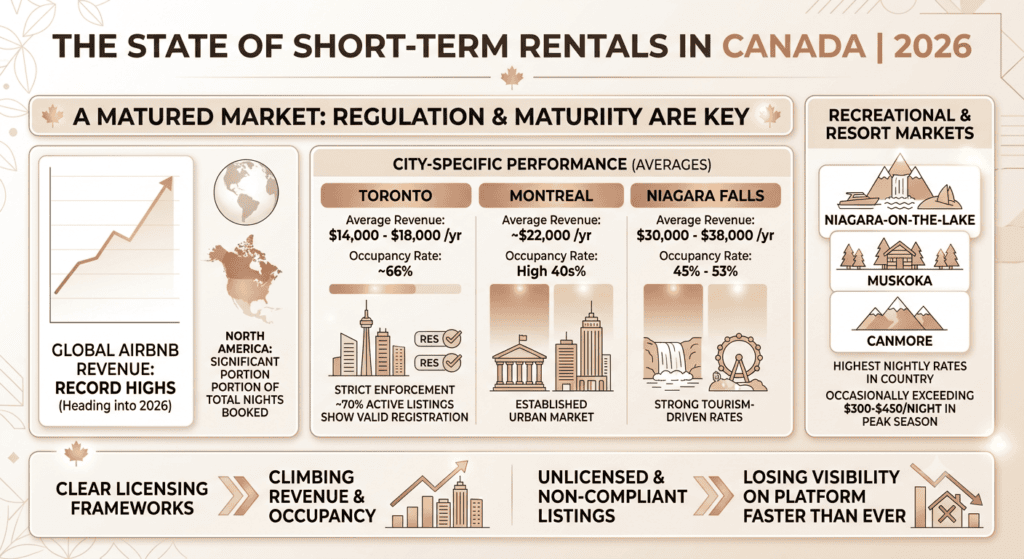
- Airbnb’s global platform posted record annual revenue heading into 2026, with North America still accounting for a meaningful share of total nights booked.
- Toronto hosts are earning in the range of $14,000 to $18,000 per year on average, with occupancy running close to two-thirds of available nights – a market where roughly seven in ten active listings now show valid registration, a sign that enforcement has real teeth.
- Montreal hosts average closer to $22,000 annually with occupancy in the high 40% range, while Niagara Falls listings run lower on occupancy (around 45–53%) but can still clear $30,000 to $38,000 a year thanks to strong tourism-driven nightly rates.
- Recreational and resort markets like Niagara-on-the-Lake, Muskoka, and Canmore post some of the highest nightly rates in the country, occasionally exceeding $300–$450 per night in peak season.
The pattern across almost every market is the same: revenue and occupancy are climbing in cities with clear licensing frameworks, while unlicensed and non-compliant listings are losing visibility on the platform faster than ever. Airbnb property management in Canada now rewards operators who treat compliance as a core part of the business, not an afterthought.
How Short-Term Rental Regulations Work Across Canada
There’s no single federal law governing Airbnb hosting in Canada. Instead, you’re dealing with three layers of rules that stack on top of each other: federal tax policy, provincial legislation, and municipal bylaws. Missing any one of them can cost you your license, your listing, or your tax deductions.
The Federal Layer: CRA Tax Rules
The most important federal change in recent years isn’t a hosting rule at all – it’s a tax rule. Since January 2024, the Canada Revenue Agency denies all income tax deductions on a short-term rental – including mortgage interest, utilities, insurance, and maintenance – if the property is operating without the required provincial or municipal registration, license, or permit. This rule is now fully in force for 2025 and 2026 filings, with no transition relief remaining.
In plain terms: if your listing isn’t properly licensed, you could owe tax on your full rental revenue with none of your normal expenses to offset it. That single rule has turned licensing compliance from a “nice to have” into a financial necessity.
Ottawa has also committed funding toward a short-term rental enforcement program that grants money to municipalities to crack down on unlicensed listings, part of a broader federal push to return more units to the long-term housing market.
The Provincial Layer
Provinces set the broader legal framework, and they vary significantly:
- British Columbia has some of the strictest rules in the country under its Short-Term Rental Accommodations Act, generally limiting hosts to their principal residence plus one secondary suite, with province-wide enforcement tools.
- Ontario has no single provincial short-term rental law – regulation is left almost entirely to individual municipalities, which is why rules can look completely different between Toronto, Ottawa, and Niagara Falls.
- Quebec requires provincial registration (a CITQ number) in addition to any municipal rules, plus QST tax collection.
- Several other provinces, including Nova Scotia, Newfoundland and Labrador, and Prince Edward Island, have introduced or are developing their own short-term rental frameworks.
The Municipal Layer
This is where most of the day-to-day rules actually live. A typical municipal framework will require:
- A registration or license number tied to the specific property
- Proof the unit is a principal residence (in many major cities) or falls within an approved zoning category
- Display of the license number on every online listing
- Collection and remittance of a local accommodation tax on every booking
- Compliance with fire safety, electrical, and occupancy standards
- Annual renewal and ongoing record-keeping (often three years of booking logs)
Toronto, for example, restricts short-term rentals to a host’s principal residence and has cut its process for revoking non-compliant registrations down to just ten days, while automatically flagging unregistered listings through direct integration with booking platforms. Cities across the country are moving in the same direction: tighter enforcement, faster penalties, and closer cooperation with Airbnb and Vrbo themselves to block non-compliant listings outright.
Airbnb Rules in Niagara Falls and the Niagara Region
For property owners in the Niagara Region – one of the strongest tourism-driven short-term rental markets in Ontario – local licensing rules deserve close attention, since they’re among the more detailed frameworks in the province.
Vacation Rental Unit (VRU) Licensing
Any short-term rental of 28 consecutive days or less operating in Niagara Falls generally needs a Vacation Rental Unit license. Key details:
- Initial license fee of $500, with a $250 annual renewal
- VRUs are only permitted in designated tourist, general commercial, and central business zones – most residential neighborhoods do not qualify
- A designated “responsible person” must be reachable 24/7 and able to reach the property within about an hour if a problem arises
- Properties must pass fire department, regional health, and electrical safety inspections before licensing
- The city applies a three-strike enforcement policy – three verified violations trigger an automatic license revocation with a six-month waiting period before you can reapply
Owner-Occupied Short-Term Rental (OOSTR) Pilot
Niagara Falls also runs a pilot program allowing homeowners to rent out a secondary dwelling unit on their property (such as a basement suite) while living on-site. This pilot is capped at 100 licenses and is scheduled to wrap up around the end of September 2026, after which council will decide whether to make it permanent.
Zoning, Tax, and Penalties
Operating without a valid license is a costly mistake in Niagara Falls – fines can reach $50,000 for a first offense and up to $100,000 for repeat violations, and unpaid penalties can be added directly to the property tax bill. Hosts are also required to collect and remit a local accommodation tax on top of HST; the exact structure of this tax has been revised more than once recently, so it’s worth confirming the current rate directly with the city before finalizing your pricing.
Neighboring municipalities like Niagara-on-the-Lake and St. Catharines run entirely separate licensing systems with their own fees and requirements, so a strategy that works on one side of the Niagara Region won’t necessarily transfer to the other.
DIY Hosting vs. Hiring a Property Manager
Once the compliance picture is clear, the next decision is who actually runs the property day to day.
What a Property Manager Actually Handles
A professional property manager typically takes on:
- Listing optimization across Airbnb, Vrbo, and Booking.com
- Dynamic pricing and calendar management
- Guest communication, screening, and check-in coordination
- Professional cleaning and turnover scheduling between every stay
- Maintenance coordination and emergency response
- Licensing renewals, MAT filing, and regulatory compliance tracking
- Performance reporting so owners can see exactly what their property is earning
The Real Cost of DIY Mistakes
Self-managing can work for a highly engaged owner with one property and plenty of spare time. But the risk profile is real. A single missed vacation rental license renewal, an unanswered 2 a.m. guest emergency, or a listing that isn’t updated for a fire code change can turn into thousands of dollars in fines or a canceled booking with a bad review attached.
Given that Ontario’s Fire Code now requires carbon monoxide alarms near every sleeping area and on every floor of a short-term rental as of the start of 2026, even seemingly small compliance details carry real financial consequences if missed.
For most owners – especially those who don’t live near the property, own more than one unit, or simply don’t want hosting to become a second job – a property management company earns its fee back through fewer vacancies, better pricing, and avoided penalties.
Choosing the Right Property Management Model
Not every management arrangement looks the same. Understanding the differences helps you pick the right fit for your goals – whether that’s rolling up your sleeves as a hands-on operator or aiming for genuinely passive rental income with minimal day-to-day involvement.
Full-Service Management
The property manager handles everything – pricing, guest communication, cleaning, maintenance, and compliance – typically in exchange for a percentage of booking revenue, often somewhere between 15% and 30% depending on the scope of service and local market.
This model tends to suit out-of-town owners, investors with multiple units, and anyone who wants rental income without becoming a part-time hospitality operator. Since the manager’s fee is tied to performance, a good full-service partner is also motivated to keep occupancy and nightly rates as high as the market will bear, rather than settling for “good enough.”
Handing Off Guest Communication (Co-Hosting)
A lighter-touch arrangement where the owner keeps the listing under their own account but hands off specific tasks – usually guest messaging and turnover coordination – to a partner. This setup, commonly known as Airbnb co-hosting, typically costs less than full management since the owner retains more of the day-to-day decision-making.
Leasing to Sublet (The Arbitrage Model)
Here, an operator leases a property from a landlord and re-lists it as a short-term rental with the landlord’s consent, profiting from the spread between the long-term lease payment and short-term rental income. Known as rental arbitrage, this model has grown in popularity among people who want to build a hosting business without owning real estate outright, though it depends heavily on finding landlords and municipalities that explicitly permit the practice.
Maximizing Revenue: Pricing, Occupancy, and the Guest Stay
Getting licensed is the price of entry. Turning that license into strong, consistent income depends on how the property is actually run.
Dynamic Pricing Tools
Flat, unchanging nightly rates leave money on the table during high-demand weekends and price you out of the market during slow periods. A dynamic pricing strategy – adjusting nightly rates automatically based on local events, seasonality, day of week, and booking lead time – is standard practice among top-performing hosts in 2026. In seasonal tourist markets like Niagara, where July and August can generate double the revenue of shoulder-season months, getting this right has an outsized impact on annual income.
Turnovers and Cleaning Standards
Guests notice cleanliness before almost anything else. A consistent, professional turnover process between every stay – with a standardized checklist covering linens, kitchen sanitation, and staging – protects both your review score and your ability to book back-to-back reservations without costly gaps.
Reviews and Repeat Bookings
Ranking algorithms on every major platform reward fast response times, accurate listings, and strong review scores. Small touches – a clear digital guest guide, thoughtful welcome amenities, and quick issue resolution – consistently translate into more five-star reviews, which in turn drive higher search placement and better occupancy.
Insurance, Safety, and Compliance Essentials
A standard homeowner’s insurance policy generally does not cover short-term rental activity. If a guest is injured or causes damage and your insurer later learns the property was being used for paid short-term stays without proper disclosure, they can deny the claim entirely – leaving you personally exposed.
Before listing a property, confirm:
- Your policy explicitly covers short-term rental use, or you’ve added a dedicated STR insurance rider
- Smoke and carbon monoxide detectors meet current provincial fire code requirements
- Your mortgage terms permit short-term rental use (some investment-property mortgages require separate disclosure of STR income)
- Any required inspections – fire, electrical, and health – are current and on file
Skipping any of these steps doesn’t just risk a fine; it risks an uninsured claim that could far exceed a year’s worth of rental income.
It’s also worth reviewing your coverage annually rather than treating the initial policy setup as a one-time task. Insurers periodically update their short-term rental terms, and a policy that was compliant when you first listed the property may no longer match current requirements – particularly as more insurers introduce dedicated short-term rental products in response to growing demand from hosts. A quick annual call to your broker to confirm coverage limits, liability protection, and any exclusions specific to short-term guest stays is a small time investment that can prevent a very expensive gap later.
Taxes and Financial Planning for Airbnb Hosts
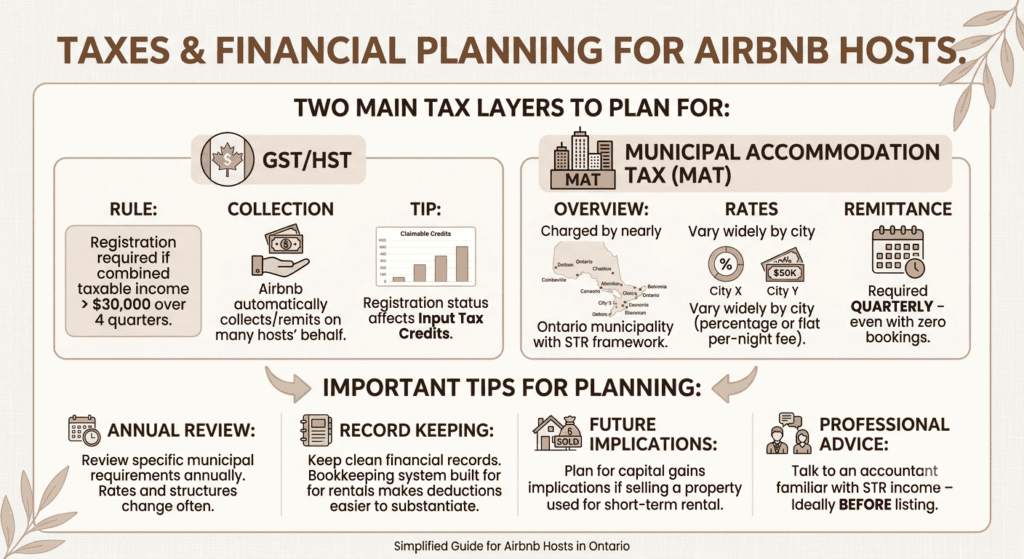
Beyond the CRA’s compliance-linked deduction rule, hosts need to plan for two main tax layers:
GST/HST: Once your rental income (combined with any other taxable business activity) exceeds $30,000 over four consecutive quarters, you’re generally required to register for and collect GST/HST. Airbnb automatically collects and remits this on many hosts’ behalf, but registration status still affects your ability to claim input tax credits.
Municipal Accommodation Tax (MAT): Nearly every Ontario municipality with a short-term rental framework charges a MAT, whether as a percentage of the nightly rate or a flat per-night fee. Rates vary widely by city, and remittance is typically required quarterly – even for periods with zero bookings.
Because these rates and structures are revised fairly often, it’s worth reviewing your specific municipality’s current requirements each year rather than assuming last year’s numbers still apply. Keeping clean financial records – ideally through a bookkeeping system built around rental income and expenses – also makes it far easier to substantiate deductions if the CRA ever asks questions.
It’s also worth planning ahead for capital gains implications if you ever sell a property that’s been used as a short-term rental, since the tax treatment can differ from a property that’s only ever served as your personal residence. A conversation with an accountant familiar with short-term rental income – ideally before you list the property, not after your first tax season – can save significant money and stress down the line.
Long-Term vs. Short-Term: Making the Right Call for Your Property
Short-term rentals typically generate more gross revenue than a comparable long-term lease – often close to double, according to industry benchmarking – but that higher ceiling comes with higher operating costs, more hands-on management, and direct exposure to regulatory risk.
Long-term rental management, by contrast, offers steadier, lower-maintenance income with far less regulatory complexity, since most provinces’ Residential Tenancies Acts (rather than municipal STR bylaws) govern leases of 28 days or longer.
The right choice depends on your goals:
- Choose short-term rental management if the property is in a strong tourist or business-travel market, you can secure the required license, and you want to maximize income potential.
- Choose a longer-term lease if you prefer predictable monthly cash flow, want to minimize active involvement, or your property sits in a municipality with restrictive or uncertain short-term rental rules.
Some owners even split the difference seasonally – operating as a short-term rental during peak tourist months and shifting to a mid-term or long-term tenant during the off-season.
Consider two similar homes near Niagara Falls: one operated as a licensed short-term rental might generate $35,000 to $40,000 in gross annual revenue but require active pricing management, frequent cleaning turnovers, and ongoing compliance work. The same home leased to a long-term tenant might bring in $24,000 to $30,000 a year with a single lease signing and minimal month-to-month involvement. Neither approach is objectively “better” – the right fit comes down to how much of your time you’re willing to trade for the higher revenue ceiling.
2026 Trends Every Canadian Host Should Watch
A few shifts are worth watching this year:
- Enforcement is getting faster and more automated. Cities are integrating directly with booking platforms to verify license numbers in real time, meaning unlicensed listings can be pulled down within days rather than months.
- Regulation is trending stricter, not looser. Markets with light rules today are increasingly likely to introduce licensing frameworks as housing affordability pressure continues, so buying in a market with clear, established rules is generally safer than betting on a loosely regulated one staying that way.
- Guest expectations are rising. Reviewers increasingly weigh the overall experience – thoughtful amenities, local recommendations, and responsiveness – as heavily as price and location.
- Professional management is becoming the norm in competitive markets. As compliance requirements pile up, more owners – even experienced ones – are outsourcing day-to-day operations to a dedicated management partner rather than trying to track every bylaw update themselves.
How to Choose the Right Management Partner
If you decide professional management is the right fit, look for a company that offers:
- Direct, documented experience with your specific municipality’s licensing process
- Transparent fee structure with no hidden charges
- A dynamic pricing approach backed by local market data, not guesswork
- In-house or vetted cleaning and maintenance teams
- Clear reporting so you always know what your property earned and why
- A track record of handling both Airbnb hosting and traditional long-term leasing, so your strategy can flex as regulations or market conditions change
A property manager who treats compliance, guest experience, and revenue optimization as equally important – rather than focusing only on booking volume – is the one most likely to protect your investment over the long run.
Common Hosting Mistakes That Cost Canadian Owners Money
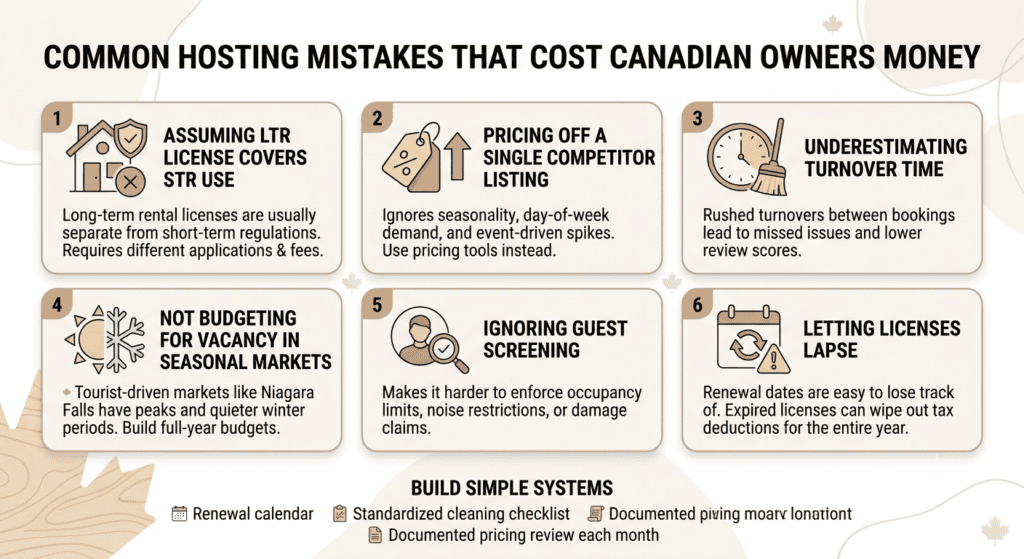
Even experienced landlords stumble when they move into short-term rentals for the first time. A few mistakes come up again and again:
- Assuming a long-term rental license covers short-term use. These are usually entirely separate regulatory categories, with different applications, fees, and inspection requirements. Holding one doesn’t automatically qualify you for the other.
- Pricing off a single competitor listing. Setting your nightly rate by copying one nearby property ignores seasonality, day-of-week demand, and event-driven spikes – all of which a proper pricing tool accounts for automatically.
- Underestimating turnover time. Back-to-back same-day bookings without enough buffer for cleaning and inspection lead to rushed turnovers, missed maintenance issues, and lower review scores.
- Not budgeting for vacancy in seasonal markets. Tourist-driven markets like Niagara Falls see real swings between peak summer months and quieter winter periods. Owners who build a full-year budget around July’s numbers are often caught off guard by January’s.
- Ignoring guest screening. Skipping identity verification or house-rule agreements makes it far harder to enforce occupancy limits, noise restrictions, or damage claims if something goes wrong.
- Letting licenses lapse. Renewal dates are easy to lose track of, especially across multiple properties – and as covered above, an expired license can wipe out your tax deductions for the entire year, not just the days you were technically unlicensed.
Most of these mistakes share a common thread: they’re the result of treating hosting as a side project rather than an operating business. Building simple systems – a renewal calendar, a standardized cleaning checklist, a documented pricing review each month – solves the vast majority of them before they become expensive.
The Bottom Line
Airbnb property management in Canada has changed. The days of listing a spare bedroom with no license and no plan are largely behind us – but for owners willing to do it properly, short-term rentals remain one of the more profitable ways to generate income from real estate, especially in tourism-driven markets like Niagara Falls and the broader Niagara Region.
The formula that works in 2026 is straightforward: stay licensed, price dynamically, deliver a genuinely good stay, and keep your compliance paperwork current. Owners who handle all of that themselves can succeed. Owners who’d rather hand it off to people who do this full-time tend to sleep a lot better.
Ready to turn your property into a stress-free, high-performing rental? The HAH Developments manages Airbnb hosting, co-hosting, and long-term rentals for property owners across the Niagara Region – handling licensing, pricing, guest communication, and maintenance so you don’t have to. Contact The HAH Developments today for a free rental income assessment.
Frequently Asked Questions
Is Airbnb hosting still profitable in Canada in 2026?
Yes, in most established tourist and urban markets. Revenue and occupancy have generally trended upward in cities with clear licensing frameworks, though profitability now depends heavily on staying compliant, since non-compliant listings lose both tax deductions and platform visibility.
Do I need a license to run an Airbnb in Ontario?
In almost every Ontario municipality with an active short-term rental bylaw, yes. Requirements vary by city – some restrict rentals to a principal residence, others allow investment properties in specific zones – so you’ll need to check the specific rules for where your property is located.
What happens if I operate an Airbnb without a license?
You risk municipal fines (often $500 to $100,000 depending on the city and violation), automatic delisting from booking platforms, and – under current federal tax rules – the complete loss of your income tax deductions for that property.
How much does an Airbnb property manager typically charge?
Full-service management generally runs between 15% and 30% of booking revenue, depending on the scope of service, local market, and number of properties managed. Lighter co-hosting arrangements often cost less.
Can I list an investment property as a short-term rental in Niagara Falls?
It depends on zoning. Standard Vacation Rental Unit licenses are limited to designated tourist and commercial zones, while the Owner-Occupied Short-Term Rental pilot requires the owner to live on-site. A pure investment property outside those zones generally can’t be legally listed as a short-term rental.
Is it better to run a short-term or long-term rental?
Short-term rentals typically generate higher gross income but require more active management and carry more regulatory complexity. Long-term rentals offer steadier, lower-effort income with simpler compliance. The right answer depends on your property’s location, your available time, and your risk tolerance.
Do I need special insurance for an Airbnb in Canada?
Yes. Standard homeowner’s insurance generally excludes short-term rental activity, and an insurer can deny a claim entirely if it later discovers undisclosed STR use. You’ll need a dedicated short-term rental policy or rider that explicitly covers paying guests.
How is short-term rental income taxed in Canada?
Short-term rental income is generally taxed as business or property income at your marginal rate, and you may need to register for and collect GST/HST once your revenue crosses $30,000 over four consecutive quarters. Compliant hosts can deduct eligible expenses like mortgage interest, utilities, and maintenance – but as noted above, non-compliant listings lose access to those deductions entirely under current CRA rules.