

If you own a rental property in Ontario, you already know the job doesn’t stop when the lease is signed. There’s rent to chase, repairs to coordinate, tenants to screen, and paperwork that seems to multiply every year. For a while, handling it all yourself feels manageable. Then one day it doesn’t property management company.
Maybe it’s the 11 p.m. text about a broken furnace. Maybe it’s the third month in a row your unit sits empty. Or maybe you just did the math on how many hours you spent last month being a landlord instead of living your life.
If any of that sounds familiar, you’re not alone. Surveys of self-managing landlords consistently show that owners spend roughly four to ten hours a month per property on day-to-day management alone, with leasing and turnover adding dozens more hours a year on top of that. That time adds up fast, especially once you own more than one unit or you’re juggling a short-term rental alongside a full-time job.
This guide walks through the ten clearest signs that it’s time to hand the keys to a property management company, what the current Ontario rental landscape looks like in 2026, and how to choose a partner who will actually protect your investment instead of just collecting a fee.
None of these signs are about being a bad landlord. Most self-managing owners are diligent, well-intentioned people who simply underestimated how many moving parts one rental property involves – and how much those parts multiply once regulations, tenant expectations, and seasonal demand all shift at once. Recognizing when the workload has outgrown what you can reasonably handle alone is a management decision, not a personal failing.
What Does a Property Manager Actually Do?
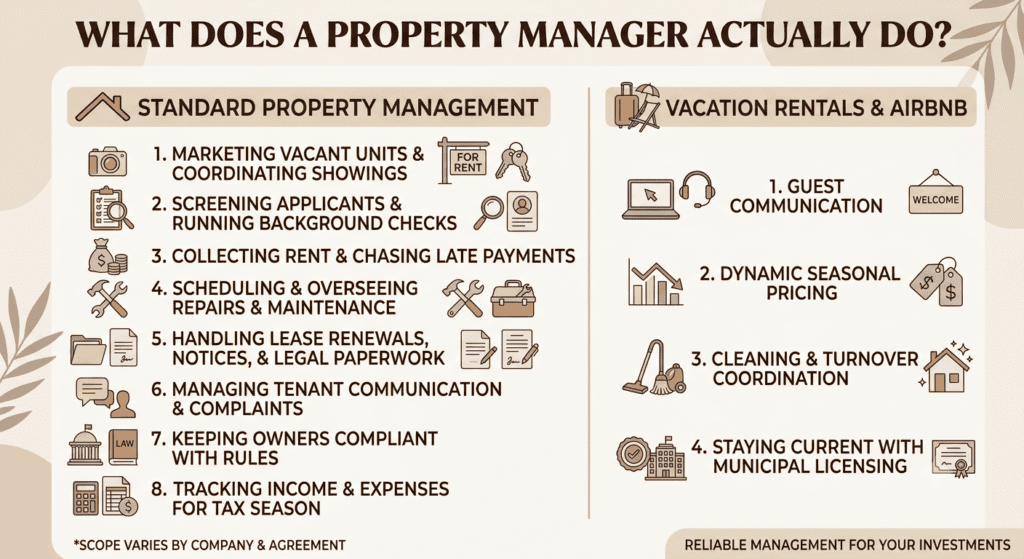
Before diving into the signs, it helps to know what you’re actually outsourcing. A property management company typically handles:
- Marketing vacant units and coordinating showings
- Screening applicants and running background checks
- Collecting rent and chasing late payments
- Scheduling and overseeing repairs and maintenance
- Handling lease renewals, notices, and legal paperwork
- Managing tenant communication and complaints
- Keeping owners compliant with provincial and municipal rules
- Tracking income and expenses for tax season
The scope varies from company to company, and it’s worth reading any management agreement carefully before signing, since that’s where you’ll find out exactly what protections you have if something goes wrong with a tenant placement or a maintenance issue.
For owners with vacation rentals or Airbnb properties specifically, the list expands even further to include guest communication, dynamic seasonal pricing, cleaning and turnover coordination between stays, and staying current with municipal licensing rules that can differ significantly from one neighbouring town to the next. With that groundwork in place, let’s get into the signs.
Sign #1: You’re Losing Sleep Over Midnight Maintenance Calls
Emergencies don’t wait for business hours. A burst pipe, a dead furnace in February, or a lockout at 2 a.m. – these calls come whenever they come, and if you’re the only line of defense, you absorb every single one.
This is one of the most common reasons landlords eventually decide they need a property management company. It’s not that the repairs themselves are complicated. It’s that being permanently on-call, with no backup and no days off, wears people down. A good management company runs a 24/7 emergency line, has vetted contractors on speed dial, and can dispatch help without waking you up at all.
Ask yourself: When was the last time you went a full weekend without checking your phone for a tenant message? If you can’t remember, that’s a sign worth taking seriously.
Sign #2: Your Vacancies Are Dragging On Too Long
Every empty week is money you’ll never get back. If your unit has been sitting vacant for longer than it should, the problem usually comes down to one of a few things: weak marketing exposure, pricing that doesn’t match the market, slow response times to inquiries, or listings that just don’t showcase the property well.
Professional managers typically have existing tenant pipelines, professional photography, and pricing data pulled from current local comparables – not guesswork. They also respond to inquiries within hours, not days, which matters enormously in a competitive rental market.
With CMHC reporting that vacancy rates across much of Ontario have climbed toward the 3% range in 2025 and into 2026 – the highest levels outside the pandemic in years – competition for good tenants has actually increased in some pockets, even as overall rents have softened. That means a mediocre listing strategy costs you more today than it did two years ago.
Here’s a simple way to think about it: if your one-bedroom unit rents for $1,800 a month and it sits empty for two extra months while you figure out pricing and photos, that’s $3,600 gone – money that a faster-moving listing strategy could easily have saved. Multiply that across a portfolio of two or three units, and the math starts to look a lot like the cost of a full year of professional management.
Turnover rents also tell an interesting story right now. In markets like Toronto, new tenants are paying meaningfully more than long-term tenants in the same building – sometimes over 20% more for an identical unit. That gap explains why some tenants are staying put longer than they otherwise would, which makes competing for the renters who are moving even more important. A property manager who understands current comparables in your specific neighbourhood will price your unit to move quickly without leaving money on the table.
Sign #3: You’re Not Sure You’re Following the Latest Rental Rules
Ontario’s rental rules change more often than most owners realize, and getting them wrong can be expensive. A few examples that catch self-managing landlords off guard in 2026:
- The rent increase guideline for 2026 is capped at 2.1%, the lowest cap in four years, and it only applies to units first occupied on or before November 15, 2018. Increases require 90 days’ written notice on the correct form, and rent can only go up once every 12 months per tenant.
- As of January 1, 2026, the Ontario Fire Code requires carbon monoxide alarms in all homes, including rentals.
- If a dispute ends up at the Landlord and Tenant Board, timelines vary wildly by application type – non-payment cases are typically scheduled in three to six months, while maintenance and harassment disputes can take eight to twelve months or longer to be heard.
If you’re not tracking changes like these, you risk invalid notices, disputed increases, or being caught flat-footed at a hearing. A property management company that specializes in your area stays on top of this so you don’t have to.
Sign #4: Choosing Tenants Feels Like Guesswork
A bad tenant placement is one of the most expensive mistakes a landlord can make. Missed rent, property damage, and a lengthy dispute process can wipe out a year of profit in one go.
If your current process for screening applicants is “gut feeling” plus a quick phone call, you’re taking on more risk than you probably realize. Professional managers run credit checks, verify income and employment, contact previous landlords, and follow a consistent tenant screening process for every applicant – which also protects you from human rights complaints that can arise from inconsistent criteria.
Beyond the paperwork, experienced managers also know what red flags actually matter. A slightly lower credit score paired with a stable job and strong references often makes for a better tenant than a high score with unexplained employment gaps. That kind of judgment comes from reviewing hundreds of applications a year, not just a handful.
Sign #5: You Live Far From Your Property
Distance changes everything about how a rental performs. If you’re an hour or more away – or you’ve relocated to another city or province entirely – responding quickly to emergencies like a security breach, a burst pipe, or an electrical hazard becomes genuinely difficult.
This is especially true for owners with vacation rentals or investment properties in tourist markets like Niagara Falls, where local knowledge of zoning, licensing zones, and seasonal demand patterns makes a real difference to performance. A property manager on the ground can do routine inspections, respond same-day to issues, and maintain the kind of tenant or guest relationship that’s nearly impossible to build from a distance.
Out-of-town and out-of-province ownership has actually become one of the clearest predictors of landlord burnout. Owners managing a property from another city are fighting time zones, unfamiliar contractors, and a total inability to simply drive over and check on something. What feels like a minor inconvenience in year one tends to become the exact reason an owner finally decides to bring in professional help by year two or three.
Sign #6: Rent Collection Is Inconsistent or Late
If you’re regularly chasing late payments, negotiating partial payments, or feeling awkward about enforcing your own lease terms, that’s a sign your relationship with your tenant has become too personal to manage objectively.
Self-managing owners often waive late fees “just this once,” let renewals happen without a proper market review, or let lease violations slide because confrontation feels uncomfortable. A management company enforces the lease as written, collects rent on a consistent schedule, and handles the uncomfortable conversations for you – which, over a year, usually pays for itself in recovered income alone.
There’s also a legal dimension here. Rent is considered late the moment it isn’t paid in full by the due date, and how you respond in those first few days matters. Serving notice too casually, or not at all, weakens your position if the situation eventually needs to go to a hearing. Consistent, well-documented rent collection isn’t just about cash flow – it’s the paper trail that protects you later.
Sign #7: You’re Managing Multiple Properties (or a Short-Term Rental)
Managing one unit is a part-time hobby. Managing several is a job. Once your portfolio grows past a property or two, the systems that worked fine at a small scale – a notebook, a spreadsheet, a few reminders on your phone – start to break down, and small mistakes start compounding.
Short-term rentals add another layer entirely. If you’re operating an Airbnb or vacation rental in Niagara Falls, you’re dealing with a licensing framework that includes zoning restrictions, a municipal accommodation tax, insurance minimums, three-strike enforcement policies for guest conduct, and detailed record-keeping requirements – on top of the usual guest turnover, cleaning schedules, and pricing adjustments that short-term hosting demands. Some municipalities in the Niagara region, like Niagara-on-the-Lake, run entirely separate licensing systems with their own fees and renewal deadlines, so a property just a few kilometres away can be governed by completely different rules.
If you’re spending your evenings updating calendars across multiple listing platforms instead of enjoying the passive income you signed up for, that’s a strong signal to bring in professional help.
It’s worth noting that licence limits and pilot programs can shift the math on how many units you’re even allowed to operate a certain way. A cap on owner-occupied short-term rental licences in a given municipality, for example, means timing and paperwork accuracy suddenly matter as much as the property itself. Missing a renewal window or misunderstanding which zone your property sits in can mean losing a licence entirely, sometimes with a waiting period before you can reapply. That’s a lot of regulatory detail to track manually across even two or three properties, let alone a growing portfolio.
Sign #8: You’re Dreading Compliance Paperwork
Notices, forms, inspection records, insurance documentation – none of it is hard on its own, but it adds up, and mistakes are costly. A single incorrectly calculated rent increase or a missed notice period can invalidate the whole process and send you back to square one.
With Ontario’s Landlord and Tenant Board still working through a backlog of tens of thousands of cases, having your paperwork right the first time matters more than ever. Landlords who show up to a hearing with a clean, well-documented file tend to fare far better than those hoping the board will overlook a technicality. A property management company that handles this daily will have templates, checklists, and staff who know the current forms inside and out.
Sign #9: Your Property’s Condition or Income Is Slipping
Deferred maintenance is a slow leak in your investment’s value. If small repairs keep getting pushed back because you don’t have time, or because finding a reliable contractor feels like more trouble than it’s worth, your property is quietly losing value and appeal to future tenants.
The same goes for income. If your rent hasn’t kept pace with the market, if turnover costs are eating into your margins, or if you genuinely don’t know your numbers month to month, it’s a sign that the “hands-off investment” you were promised has quietly become a source of financial stress instead.
Try this quick gut check: can you say, right now, what your net income was last month after every expense, or what your last three maintenance calls cost in total? If the honest answer is “not exactly,” that’s not a character flaw – it’s just a sign that your current system isn’t giving you the visibility you need to manage the asset properly. A management company’s monthly statements and expense tracking exist precisely to close that gap, so decisions get made from real numbers instead of a rough feeling.
Sign #10: You Just Want Your Time Back
Sometimes there’s no single crisis – just an accumulation of small frustrations that add up to burnout. You dread your phone buzzing. You’ve started ignoring maintenance requests longer than you should. You’ve caught yourself resenting a property that was supposed to build your wealth, not your stress levels.
That shift, from excitement to dread, tends to happen gradually – often somewhere between the first and third year of ownership – and it’s one of the clearest signs that self-management has stopped being worth the money you’re saving. Real estate is supposed to build long-term wealth. It’s not supposed to feel like an unpaid second job.
What’s Changing in Property Management Right Now
A few shifts happening across Ontario and the wider industry in 2026 are worth knowing about, whether you decide to self-manage or bring in help:
Rental markets are softening, but unevenly. National rent data shows average asking rents have fallen for close to two years straight, driven mainly by a wave of new purpose-built and condo supply. But softer averages hide big variation between neighbourhoods, unit ages, and building types – newer, higher-priced buildings are seeing the longest vacancies, while well-priced, well-maintained units in good locations are still renting quickly.
The LTB backlog is improving, slowly. Non-payment applications that once took eight to ten months to schedule are now typically heard within three to six months. That’s real progress, but other application types, especially tenant-filed maintenance and harassment complaints, still often take eight to twelve months or more. The lesson for landlords is the same either way: the strength of your documentation matters more than ever, because a thin paper trail is far more damaging when a hearing date is months away.
Short-term rental regulation keeps tightening. Municipalities across the Niagara region continue to refine their licensing frameworks, adding pilot programs, adjusting accommodation tax structures, and increasing enforcement around unlicensed listings. What was compliant a year ago isn’t automatically compliant today, which is exactly why hosts increasingly rely on local management partners to keep licenses current.
Technology is raising the baseline. Owners increasingly expect real-time dashboards, automated rent reminders, and digital maintenance tracking. A management company still using paper files and phone tag is falling behind what tenants and owners alike now consider standard.
The Real Cost of Self-Managing vs. Hiring a Property Manager
It’s tempting to view a property manager’s fee as pure overhead. But that framing misses half the picture. Every hour you spend showing units, screening applicants, or chasing a late payment is an hour that has a real dollar value, whether or not you’re tracking it.
Consider what self-management actually costs when you add it up:
- Lost income from extended vacancies because your marketing and pricing aren’t optimized
- Legal exposure from improperly served notices or inconsistent screening
- Deferred maintenance costs that compound over time and reduce resale value
- Below-market rent because you haven’t kept pace with local comparables
- Your own time, valued at whatever your hourly rate would be doing something else
Professional management fees typically run as a percentage of collected rent, plus leasing fees for new placements. For most owners, that cost is offset – often more than offset – by faster leasing, fewer vacancy days, better tenant retention, and avoided legal mistakes. The question isn’t really “can I afford a property manager?” It’s “what is my own time and peace of mind actually worth?”
It’s also worth being honest about where the money actually goes when self-management goes wrong. A single bad tenant placement can cost several months of rent in lost income, legal fees, and repair costs combined – often far more than a full year of management fees would have. That’s not a reason to panic about self-managing. It’s a reason to be clear-eyed about the actual trade-off you’re making.
A Few Myths Worth Retiring
“Property managers are only for people who own a lot of units.” Plenty of single-property owners hire management simply because they live far away, work demanding jobs, or just don’t want their weekends built around a rental.
“Hiring a manager means giving up control.” Most agreements let owners set the parameters – approval thresholds for repairs, rent pricing input, and how involved they want to stay. You’re delegating tasks, not decisions.
“It’s always cheaper to do it yourself.” It’s cheaper on paper, until a vacancy runs long, a lease dispute drags on, or a maintenance issue gets missed. The real comparison isn’t the management fee versus zero – it’s the management fee versus your own time plus the cost of the mistakes that time pressure tends to produce.
How to Choose the Right Property Manager
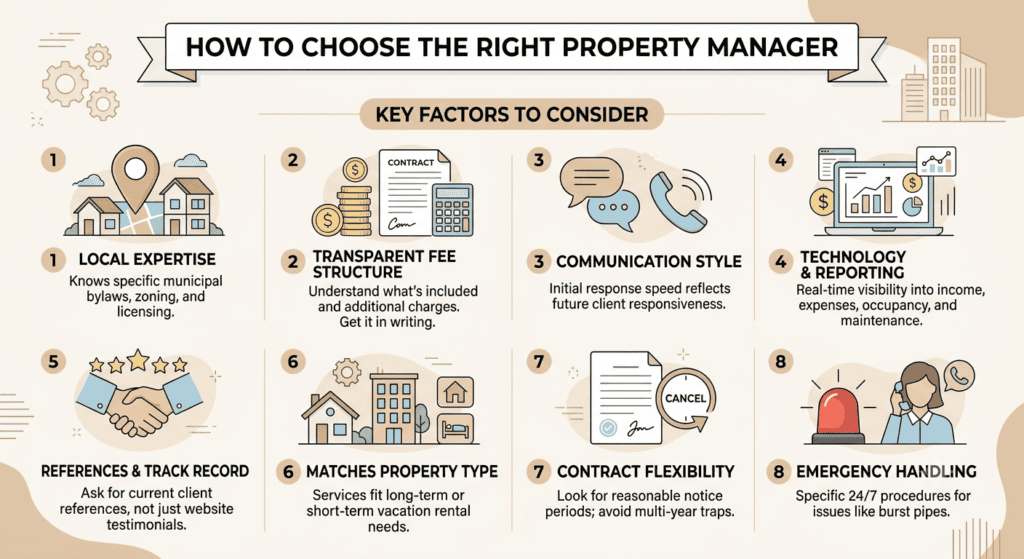
Not all management companies are equal, and the difference shows up fast once you’re a client. Here’s what to look for:
Local expertise. A company that knows your specific municipality’s bylaws – zoning restrictions, licensing requirements, inspection schedules – will save you from costly compliance mistakes that a generic national brand might miss.
Transparent fee structure. Ask exactly what’s included in the management fee and what triggers an additional charge. Get it in writing before you sign anything.
Communication style. How quickly do they respond to your questions during the sales process? That’s usually a preview of how responsive they’ll be once you’re a client.
Technology and reporting. You should have clear, real-time visibility into your property’s performance – income, expenses, occupancy, and maintenance history – without having to ask for it.
References and track record. Ask for current client references, not just testimonials on a website. A company confident in its service will happily connect you with owners they currently manage for.
Services that match your property type. If you own a short-term rental, make sure the company actually understands vacation rental licensing, dynamic pricing, and guest management – not just traditional long-term leasing.
Contract flexibility. Look for a reasonable notice period to exit the agreement if things don’t work out, rather than being locked into a multi-year commitment with no off-ramp. A company confident in its own service shouldn’t need to trap you into staying.
How they handle emergencies. Ask specifically what happens if a pipe bursts at 3 a.m. Who gets called, how fast, and who approves the repair cost? The answer tells you a lot about how the company actually operates day to day, versus what the sales brochure promises.
Why Niagara Falls Property Owners Choose The HAH Developments
Niagara Falls has its own rhythm. Tourist demand swings with the seasons, short-term rental rules differ block by block depending on zoning, and long-term rental performance depends heavily on local knowledge that a distant, generic management company simply doesn’t have.
The HAH Developments was built around that reality. We manage everything from Airbnb hosting and co-hosting to long-term rentals, rental arbitrage, and full property maintenance – all under one roof, with a team that lives and works in the Niagara region. Whether you’re trying to maximize occupancy on a vacation rental through a busy summer season or you just want a long-term tenant who pays on time and treats your property with respect, our job is to make property ownership feel the way it was supposed to feel: profitable, and largely hands-off.
The Bottom Line
Owning a rental property should move you toward financial freedom, not away from your evenings and weekends. If you recognized yourself in even two or three of the signs above, it’s worth having a conversation about what professional management would actually look like for your specific property.
The HAH Developments works with property owners across Niagara Falls and the surrounding region to take the stress out of ownership, whether that means full property management, short-term rental hosting, or a hybrid approach built around your goals.
You don’t have to wait until burnout forces the decision. If even one of the signs in this guide sounded familiar, that’s reason enough to start the conversation now, while you still have options and time on your side. Reach out today for a free consultation, and let’s talk about what stress-free property ownership could look like for you.
Frequently Asked Questions
How much does a property management company typically cost?
Fees vary by market and service level, but most companies charge a percentage of collected monthly rent, plus a separate leasing fee when a new tenant is placed. Short-term rental management often uses a different structure based on booking revenue. Always get a full fee breakdown in writing before signing an agreement.
Is it worth hiring a property manager for just one rental unit?
It depends on your time, location, and comfort level with tenant management. Owners living far from their property, juggling a demanding job, or feeling overwhelmed by compliance paperwork often find that even a single unit benefits from professional management once vacancy losses and time costs are factored in.
Can a property management company help with an existing problem tenant?
Yes. Most companies can step in mid-tenancy to handle communication, enforce lease terms, and manage any dispute process going forward, including navigating a Landlord and Tenant Board application if it comes to that.
Do property managers handle short-term rentals like Airbnb?
Many do, though it requires different expertise than long-term rental management – dynamic pricing, guest screening, cleaning turnover schedules, and municipal licensing compliance are all part of the job. Make sure any company you’re considering has specific short-term rental experience in your municipality.
What happens to my existing lease if I switch to a property management company?
Your existing lease terms stay in place. The management company simply takes over communication, rent collection, and administration on your behalf going forward – tenants don’t need to sign anything new unless the lease itself is being renewed.
How quickly can a property management company take over my rental?
Most transitions take anywhere from a few days to a few weeks, depending on how much documentation and history need to be transferred, and whether there are any open maintenance issues or tenant disputes to resolve first.
Will hiring a property manager mean I lose control over decisions like rent pricing or repairs?
No. Reputable companies work within parameters you set, such as an approval threshold for repair costs or input on rent increases within the legal guideline. You’re outsourcing the day-to-day workload, not your ownership decisions.
What should I look for in a management agreement before signing?
Pay close attention to the fee structure, the notice period required to end the agreement, what happens if a placed tenant defaults early, and exactly which services are included versus billed separately. A clear, detailed contract protects both sides.