

Owning an Airbnb sounds like passive income until the first 2 a.m. message from a locked-out guest. Suddenly you’re checking your phone between meetings, coordinating with a cleaner who cancelled last minute, and wondering if this “side income” is actually a second job.
This is the exact point where most hosts discover Airbnb co-hosting.
It’s the middle ground between doing everything yourself and handing your property over to a full-service management company. You keep ownership, you keep control, and you get someone else to carry the day-to-day weight.
This guide breaks down exactly what Airbnb co-hosting is, how the platform’s co-host tools work in 2026, what it costs, the risks nobody talks about, and how Ontario short-term rental rules – especially in Niagara Falls – fit into the picture. By the end, you’ll know whether co-hosting is the right move for your property, or whether you’re better off with full property management.
What Is Airbnb Co-Hosting?
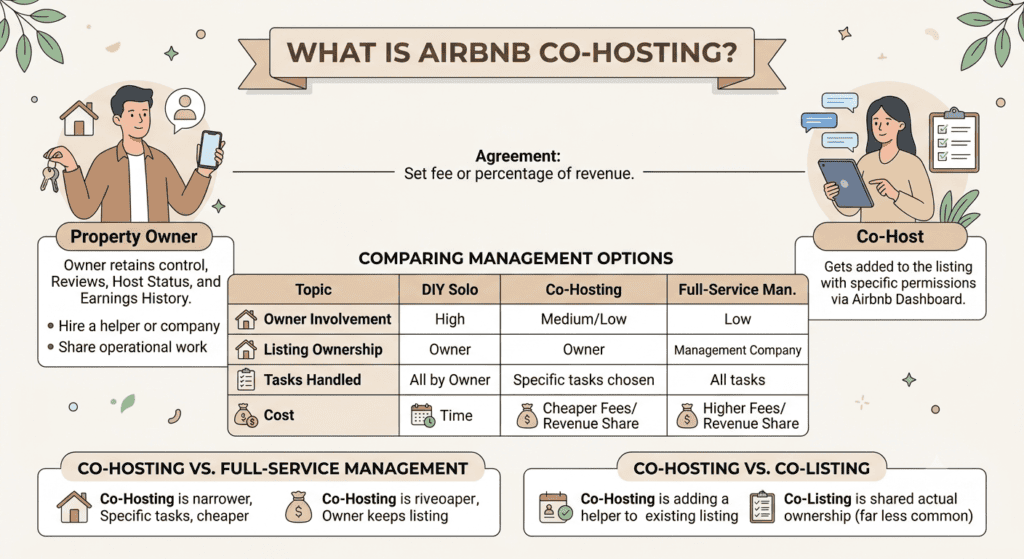
Airbnb co-hosting is an arrangement where a property owner brings in another person, or a company, to handle some or all of the operational work on their listing, in exchange for a fee or a share of the booking revenue.
The owner keeps their name on the listing. They keep their reviews, their host status, and their earnings history. The co-host simply gets added as a helper with a defined set of permissions inside the Airbnb dashboard.
This guide walks through every short-term rental management option available to owners today, from doing everything solo to co-hosting to handing the keys to a full-service company, so you can see exactly where co-hosting fits.
Think of it like hiring a property manager, but scoped to one platform and one listing, with the flexibility to grant as much or as little access as you’re comfortable with.
How Co-Hosting Differs from Full-Service Property Management
Full-service property management usually means handing over the entire operation. The management company often lists the property under its own multi-property Airbnb account, sets pricing across a portfolio, and takes a larger cut in exchange for owning the whole process.
Co-hosting keeps things narrower. You choose the tasks you want off your plate – guest messaging, check-ins, cleaning coordination – while staying the listing owner of record. It’s a lighter commitment, and it’s usually a lot cheaper.
Co-Hosting vs. Co-Listing
These two terms get mixed up constantly, so it’s worth separating them clearly.
- Co-hosting adds a helper to your existing listing. You remain the sole owner.
- Co-listing shares actual ownership of the listing itself, which is far less common and comes with more legal complexity around who’s responsible for what.
Almost every arrangement property owners enter into is co-hosting, not co-listing.
How Airbnb’s Co-Host Feature Actually Works
Airbnb built dedicated tools for this exact relationship, and they’ve gotten more detailed over the past couple of release cycles. As of 2026, you can add up to 10 co-hosts to a single listing, each with their own access level.
Step-by-Step: Adding a Co-Host to Your Listing
- Log in to your Airbnb account and open the listing you want help with.
- Go to your listing editor and find the “Your Space” or “Co-hosts” section.
- Select “Invite someone you know” and enter their email address or phone number.
- Choose the permission level you want to assign.
- Review the details and send the invite.
- Your co-host accepts from their own verified Airbnb account.
The whole process takes under five minutes. The part that actually matters is step four – choosing what they can and can’t touch.
Understanding Co-Host Permission Levels
Airbnb lets you customize access instead of forcing an all-or-nothing choice. Depending on your setup, you can grant:
- Messaging-only access – they reply to guest questions and handle check-in details, nothing else.
- Calendar-only access – they manage availability and block dates, but can’t message guests or touch pricing.
- Combined or full access – they manage pricing, respond to reviews, message guests, and view earnings, though payout details typically stay locked to the owner in most regions.
Setting the right co-host permissions matters more than people expect. Giving someone full access when you only needed calendar help is how disputes and confusion start.
What a Co-Host Can (and Can’t) Do
A co-host with full permissions can adjust nightly rates, accept or decline bookings, message guests, edit the listing description, and respond to reviews on your behalf.
What they generally can’t do is transfer ownership of the listing, change your payout account, or remove you as the primary host without your action. You stay the one legally and financially responsible for the property, no matter how much you delegate.
What Does an Airbnb Co-Host Actually Do Day to Day?
The exact scope depends on your agreement, but most co-hosting relationships cover some combination of:
- Answering guest questions and booking inquiries, often within minutes
- Coordinating check-in and check-out, including remote lock codes or in-person greetings
- Scheduling and confirming cleanings between guests
- Restocking supplies and flagging maintenance issues
- Adjusting pricing around events, seasons, and local demand
- Managing the review process after each stay
- Handling guest issues during the stay, from noise complaints to broken appliances
A good co-host essentially becomes your eyes and ears on the ground, especially valuable if you live out of town, work full-time elsewhere, or simply don’t want hosting eating into your evenings.
Tools and Systems That Make Co-Hosting Work Smoothly
Co-hosting relationships tend to break down when everything lives in someone’s head instead of a shared system. The ones that run smoothly usually have a few basics in place.
A shared calendar tool, whether that’s Airbnb’s own dashboard or a third-party channel manager, keeps pricing and availability synced if the property is also listed on VRBO or Booking.com. Without it, double bookings become a real risk.
A cleaning schedule that both owner and co-host can see removes the guesswork around turnover day. Most co-hosts use a simple shared spreadsheet or a dedicated app that automatically flags the next cleaning window after a checkout.
A messaging protocol matters too. Decide upfront how fast guest messages need a response, and what counts as urgent enough to call rather than text. Airbnb rewards hosts who reply quickly, so this isn’t just a nice-to-have.
Finally, a simple monthly reporting habit – even a short email summarizing bookings, revenue, and any issues – keeps owners in the loop without needing to check the dashboard daily themselves.
How Much Does an Airbnb Co-Host Cost?
Co-host pricing isn’t standardized, which is exactly why so many owners get surprised by it. Two structures dominate the market right now.
Percentage-Based Fees
Most co-hosts charge a percentage of booking revenue, typically somewhere between 10% and 30%, with 20% being the most common figure. The rate climbs with the level of service. A co-host handling in-person check-ins, 24/7 guest support, and full pricing strategy will sit at the higher end of that range.
Location matters too. Competitive markets, where guest expectations run higher, tend to push co-host rates up.
Flat-Fee Arrangements
Some co-hosts prefer a fixed monthly rate or a set fee per booking instead of a percentage. This tends to suit owners with steady, predictable occupancy, since the cost doesn’t scale up during your busiest months.
Sample Cost Breakdown
Picture a property earning $4,000 in a month with a co-host charging 20% of revenue. That’s $800 for the month, on top of whatever Airbnb itself takes from the booking subtotal. It’s not free help, but compared to the hours it would take an owner to manage every message and turnover personally, many find it pays for itself in time saved and better guest ratings.
Always get the fee structure in writing before a single booking comes in. Verbal agreements are where most co-hosting relationships start to unravel.
Here’s a real-world example of how this plays out. An owner with a two-bedroom property in a tourist zone near the falls was self-managing while working a full-time job. Guest response times slipped, a few reviews mentioned slow communication, and the listing’s ranking dropped. After bringing on a co-host at a 20% rate for full-service support, response times fell to under 15 minutes, occupancy climbed over the next two booking cycles, and the owner reclaimed roughly 10 hours a week. The fee cost more in absolute dollars, but the property earned enough extra revenue from improved occupancy and rate optimization to more than offset it.
What Airbnb Itself Takes, Separate From Your Co-Host’s Fee
It’s worth understanding what the platform itself takes, separate from what you pay your co-host. The Airbnb service fee has shifted toward a single host-only charge of roughly 15.5% of the booking subtotal, replacing the older split model where guests paid a separate fee at checkout.
That change matters for co-hosting math. If your co-host is paid a percentage of revenue, you need to be clear whether that’s calculated before or after Airbnb’s own cut. A 20% co-host fee on gross revenue looks very different from 20% on your actual payout after Airbnb takes its share.
Run the numbers both ways before you sign anything. It’s a five-minute conversation that prevents a much longer argument later.
Benefits of Co-Hosting for Property Owners
Done right, co-hosting solves the exact problems that make self-managing an Airbnb exhausting.
- You get your evenings back. No more scrambling to answer a guest message during dinner.
- Faster response times improve your ranking. Airbnb’s algorithm rewards quick replies, and a dedicated co-host usually beats an owner juggling a day job.
- Local presence for out-of-town owners. If your property is an hour away, or in another city entirely, a co-host bridges that physical gap.
- You keep more control than full management. You still approve major decisions, set the tone, and stay the face of the listing.
- Lower cost than full-service management. Since the scope is narrower, the fee is usually smaller too.
- Room to scale gradually. Start with messaging help, add more responsibilities as trust builds, or bring on a second co-host for cleaning coordination.
Risks and Common Pitfalls of Co-Hosting (and How to Avoid Them)
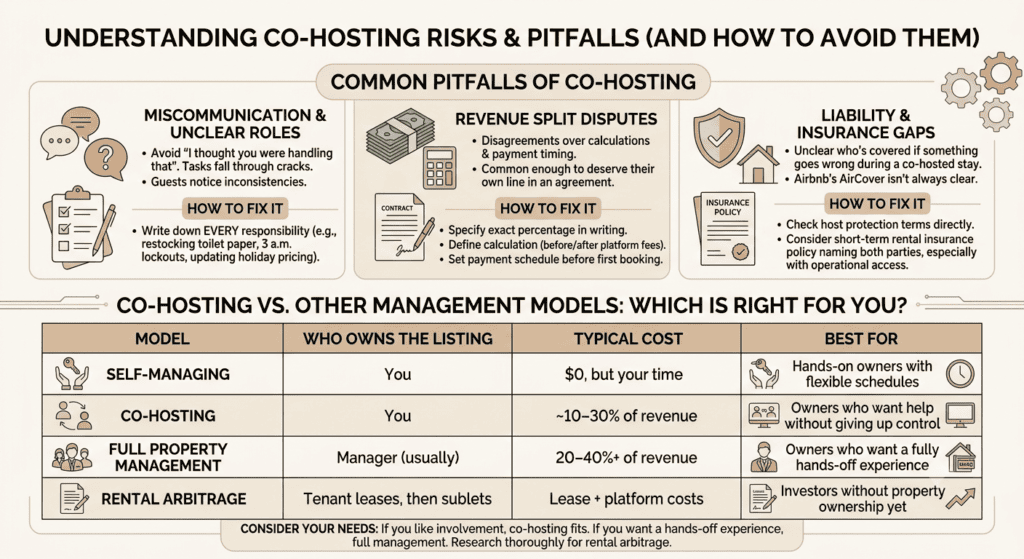
Co-hosting isn’t automatically smooth. The arrangements that fall apart almost always fail for the same handful of reasons.
Miscommunication and Unclear Roles
“I thought you were handling that” is the sentence that ends more co-hosting relationships than any pricing disagreement. Without a clear list of who does what, tasks fall through the cracks, and guests notice.
Fix it: write down every responsibility, no matter how small – who restocks toilet paper, who handles a 3 a.m. lockout, who updates pricing before a holiday weekend.
Revenue Split Disputes
Disagreements over how the fee is calculated, or when it gets paid, are common enough that they deserve their own line in your agreement.
Fix it: specify the exact percentage, whether it applies before or after platform fees, and the payment schedule, in writing, before the first booking.
Liability and Insurance Gaps
If something goes wrong during a stay your co-host was actively managing, who’s covered? Airbnb’s AirCover protects hosts, but the details around co-host actions aren’t always crystal clear.
Fix it: check your host protection terms directly and consider a short-term rental insurance policy that names both parties, especially if your co-host has full operational access.
Co-Hosting vs. Other Management Models – Which Is Right for You?
These three models get lumped together, but they solve different problems.
| Model | Who Owns the Listing | Typical Cost | Best For |
| Self-managing | You | $0, but your time | Hands-on owners with flexible schedules |
| Co-hosting | You | ~10–30% of revenue | Owners who want help without giving up control |
| Full property management | Manager (usually) | 20–40%+ of revenue | Owners who want a fully hands-off experience |
| Rental arbitrage | Tenant leases, then sublets | Lease + platform costs | Investors without property ownership yet |
If you like being involved but need the workload off your plate, co-hosting is the natural fit. If you want zero involvement and don’t mind paying more for it, full property management makes more sense. If you don’t own property yet and want to enter the space by leasing and subletting instead, that’s a different conversation entirely, and one worth researching thoroughly before committing to a lease.
Short-Term Rental Regulations Owners Must Know Before Co-Hosting
None of this matters if your property isn’t operating legally. Ontario has no single province-wide short-term rental law, which means every municipality writes and enforces its own rules. Niagara Falls, Niagara-on-the-Lake, and neighbouring towns each handle licensing differently.
Licensing Requirements in Niagara Falls
Niagara Falls requires a short-term rental license for any stay of 28 consecutive days or less. There are two paths: a Vacation Rental Unit license for properties you don’t live in, and an Owner-Occupied Short-Term Rental license for hosts renting out part of their primary residence.
That VRU license costs $500 to set up, with a $250 annual renewal. Your property also needs to sit within an approved tourist, general, or commercial zone, and you’re capped at renting out a maximum of three bedrooms.
Accommodation Taxes and HST
On top of the 13% HST, Niagara Falls applies a Municipal Accommodation Tax (MAT) on short-term stays, with recent updates moving toward a percentage-based structure tied to the property’s star rating rather than a flat nightly fee. Airbnb typically collects and remits HST automatically, but hosts stay responsible for confirming the numbers are accurate.
Regulations Vary by Municipality Across Niagara
Niagara-on-the-Lake runs its own separate licensing system with its own fees and renewal deadlines. What’s allowed in Niagara Falls might not be permitted a short drive away. Before you bring on a co-host, or list at all, confirm your specific municipality’s current bylaw rather than assuming regional rules apply uniformly.
Operating without the right license isn’t a minor technicality. Fines can run into the tens of thousands of dollars, and your listing can be suspended entirely.
If your co-host handles pricing or messaging on your behalf, they should also know your license number, since Niagara Falls requires it to appear on every advertisement and online listing. A co-host publishing a listing update without that number isn’t just an oversight; it’s a compliance gap that falls back on you as the owner.
It’s also worth building a habit of checking for bylaw updates a couple of times a year. MAT structures, zoning maps, and licensing caps in the Niagara Region have shifted more than once over the past couple of years, and a rule that applied when you first listed your property may not be the current one. This is exactly the kind of detail a co-host without local expertise can easily miss, and it’s one of the reasons many owners eventually bring in a property management company with direct knowledge of the region instead of relying on a co-host managing the compliance side alone.
2026 Short-Term Rental Market Trends Every Co-Host Should Know
The short-term rental industry isn’t slowing down, but it is maturing. A few shifts are worth knowing if you’re weighing co-hosting right now:
- Listing supply in the U.S. is growing at a much more moderate pace than the rapid expansion seen in 2021 and 2022, which means competition is less about who joined first and more about who runs the tightest operation.
- Guest expectations around response time keep climbing, which is a major reason co-hosting has grown into a formalized, platform-supported model rather than an informal side arrangement.
- Direct bookings are becoming a bigger slice of total revenue for well-run listings, rewarding hosts and co-hosts who build a real guest relationship rather than relying purely on the app.
- Dynamic pricing based on real-time demand is now table stakes rather than a nice-to-have, which is exactly the kind of task busy owners tend to outsource to a co-host first.
The properties pulling ahead in this more competitive landscape aren’t necessarily the newest or fanciest. They’re the ones with consistent guest experience and someone actively managing the details – which is precisely the gap co-hosting is built to fill.
Global short-term rental revenue has continued climbing steadily, even as growth in individual markets levels off compared to the rapid expansion of a few years ago. That steadier growth curve tends to reward operators who focus on execution rather than simply riding a wave of new demand.
Local, market-specific knowledge is also becoming more valuable than generic advice. What works for a downtown condo doesn’t necessarily work for a tourist-zone property near a landmark like Niagara Falls, where seasonality, event calendars, and visitor patterns look completely different. A co-host who understands your specific market tends to outperform one working from a generic playbook.
How to Find and Vet the Right Airbnb Co-Host
Where to Look
Airbnb’s own Co-Host Network connects owners with vetted local co-hosts in select regions. Beyond that, local property management companies, referrals from other hosts, and short-term rental Facebook groups are common sources.
Local knowledge tends to outweigh flashy marketing here. A co-host who already understands your region’s licensing rules, peak booking windows, and typical guest profile will usually outperform someone managing your property from a spreadsheet template built for a completely different market.
Questions to Ask Before Hiring
- How many other listings are you currently managing?
- What’s your average guest response time?
- How do you handle emergencies outside normal hours?
- Can you share references from current or past owners?
- How is your fee calculated, and when is it paid?
Why a Written Co-Hosting Agreement Is Non-Negotiable
Even if your co-host is a close friend or family member, put the terms in writing. A solid agreement covers the fee structure, exact responsibilities, the permission level granted, how disputes get resolved, and what happens if either side wants to end the arrangement. This single document prevents almost every common co-hosting conflict before it starts.
Setting Communication Expectations Between Owner and Co-Host
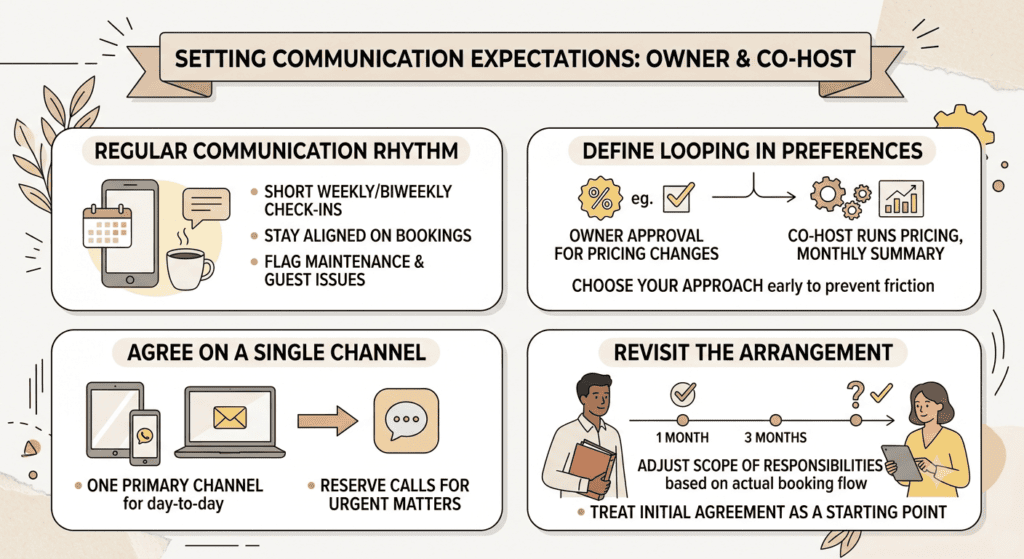
Even the best co-hosting agreement falls apart without a regular communication rhythm. Owners who stay hands-off but informed tend to have the smoothest experiences.
A short weekly or biweekly check-in, even a five-minute call or a quick message thread, keeps both sides aligned on upcoming bookings, maintenance needs, and any guest issues worth flagging. It doesn’t need to be formal. It just needs to happen consistently.
Decide early how you want to be looped in on decisions. Some owners want approval before any pricing change over a certain percentage. Others are happy letting the co-host run pricing entirely and just want a monthly summary. Neither approach is wrong, but leaving it undefined is where friction creeps in.
It also helps to agree on a single communication channel instead of scattering conversations across text, email, and the Airbnb app. Most owner-co-host pairs settle on one primary channel for day-to-day updates and reserve phone calls for anything urgent.
Finally, revisit the arrangement after the first few months. What felt like the right scope of responsibilities in month one might need adjusting once you both see how bookings actually flow. Treat the initial agreement as a starting point, not a permanent contract carved in stone.
When to Upgrade from Co-Hosting to Full Property Management
Co-hosting works well for one or two properties where you still want a hand on the wheel. It starts to strain once you’re managing multiple listings, dealing with more complex compliance requirements, or simply want to step away entirely.
If you’re spending more time managing your co-host than you would have spent managing the property yourself, that’s usually the signal it’s time for full-service property management instead.
A few other signs point in the same direction. If you’re adding a second or third property and your current co-host doesn’t have the capacity to take on more, that’s a scaling problem co-hosting alone won’t solve. If compliance requirements in your municipality keep changing and you don’t have the bandwidth to track them personally, a company with dedicated local knowledge removes that burden entirely. And if you find yourself wanting to step back from hosting altogether, rather than just delegating pieces of it, full management is built for exactly that level of hands-off ownership.
None of this means co-hosting was the wrong choice to begin with. Plenty of owners use it as a stepping stone, testing what delegation feels like before committing to a larger management relationship. It’s a perfectly reasonable way to figure out how much involvement you actually want long-term.
Actionable Checklist: Getting Started with Co-Hosting
- [ ] Confirm your property’s short-term rental license is current and valid
- [ ] Decide which specific tasks you want to delegate
- [ ] Choose between a percentage-based or flat-fee structure
- [ ] Interview at least two or three potential co-hosts
- [ ] Draft a written agreement covering fees, roles, and permissions
- [ ] Set the correct permission level inside your Airbnb dashboard
- [ ] Review performance after the first 30 days and adjust as needed
Final Thoughts
Airbnb co-hosting gives owners something the industry didn’t really offer a few years ago: a structured, platform-backed way to get real help without giving up the listing you built. It’s not automatically smooth sailing, but with the right permissions, a clear written agreement, and a co-host who actually communicates, it can turn a stressful side hustle back into the passive income it was supposed to be.
If your property sits in the Niagara Region, compliance adds another layer most co-hosting guides skip over entirely. Licensing, zoning, and tax rules vary from one town to the next, and getting them wrong is expensive.
That’s exactly where The HAH Developments comes in. We manage short-term rentals, long-term rentals, and everything in between across Niagara Falls and the surrounding region, handling compliance, guest communication, pricing, and maintenance so property owners don’t have to choose between staying involved and staying sane.
Ready to stop managing every message yourself? Contact The HAH Developments today for a free consultation and find out whether co-hosting, full-service management, or something in between is the right fit for your property.
Frequently Asked Questions About Airbnb Co-Hosting
Does a co-host need their own Airbnb account?
Yes. Anyone you invite must have a verified Airbnb account and complete identity verification before they can accept a co-host invitation.
Can I remove a co-host at any time?
Yes, you can adjust or revoke a co-host’s permissions on your listing whenever you choose, though your written agreement should also outline the notice period expected between both parties.
Is co-hosting the same as hiring a property manager?
Not exactly. Co-hosting is usually narrower in scope and platform-specific, while a property manager or management company often handles a broader range of responsibilities and may operate across multiple platforms.
Do I still need a short-term rental license if I use a co-host?
Yes. Licensing requirements apply to the property and the primary host, regardless of who’s handling day-to-day tasks. A co-host doesn’t change your compliance obligations.
How many co-hosts can I add to one listing?
Airbnb currently allows up to 10 co-hosts per listing, each with individually assigned permission levels.
What happens if my co-host and I disagree on fees?
This is exactly what a written agreement prevents. Without one, disputes typically come down to a “he said, she said” situation that’s difficult to resolve fairly.
Can a co-host manage more than one of my properties?
Yes, and many do. If you own multiple listings, you can invite the same co-host to each one, though it’s worth confirming the fee structure applies consistently across all of them.
Will a co-host affect my Superhost status?
Not directly. That status is tied to the listing’s performance metrics – response rate, cancellation rate, and review scores – so a co-host who improves those numbers can actually help you reach or maintain it faster than managing solo.