

If you own a rental property in Niagara Falls or anywhere in the Niagara Region right now, you’ve probably noticed something different about 2026. Units that used to rent within a week are sitting on the market for two, three, sometimes four weeks longer than they used to. Showings that once brought in a dozen interested applicants now bring in three or four. And landlords who haven’t adjusted to this shift are watching their bank accounts drain, one empty month at a time.
This isn’t bad luck. Rental property vacancy has specific, identifiable causes, and almost all of them are fixable. Whether you own a single condo you rent out long-term, a portfolio of investment properties, or a short-term Airbnb, understanding why units sit empty is the first step toward keeping yours consistently occupied.
In this guide, we’ll walk through exactly what’s driving vacancy rates higher across Ontario, what it’s actually costing landlords who don’t act, and the practical, proven strategies that keep good tenants coming through the door. By the time you finish reading, you’ll have a clear, actionable framework for pricing, marketing, screening, and maintaining your property so it stays occupied even as the local market continues to shift throughout 2026.
Understanding Rental Property Vacancy: How Common Is It in 2026?
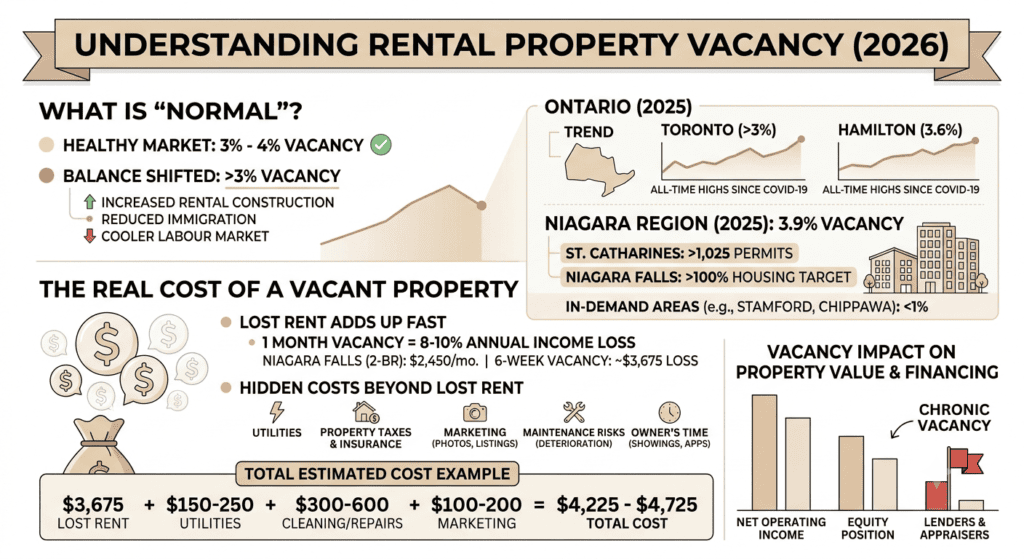
Before you can fix a vacancy problem, it helps to know what “normal” looks like. A healthy rental market typically sits somewhere between 3% and 4% vacancy, the point where landlords and tenants both have reasonable options without rents spiking or crashing.
Across Ontario, that balance has shifted. Every major Census Metropolitan Area in the province saw its vacancy rate climb in 2025, driven by a wave of new rental construction meeting softer demand from reduced immigration targets and a cooler labour market. Toronto’s vacancy rate crossed 3% for the first time since the pandemic. Hamilton hit 3.6%, its highest level since COVID-19 disrupted the market.
Here in Niagara, the shift has been just as sharp. The region’s vacancy rate reached 3.9% in 2025, a decade-high figure that caught plenty of local landlords off guard. St. Catharines alone issued more than 1,025 new dwelling unit permits in 2025, nearly double its typical yearly pace, backed by significant federal housing investment. Niagara Falls exceeded its provincial housing target by well over 100%, and multiple new rental apartment projects are expected to break ground in the city through 2026.
That said, rental property vacancy isn’t uniform across the region. Tighter, in-demand neighbourhoods like Stamford and Chippawa are still seeing vacancy rates under 1%, while older stock competing against brand-new, amenity-rich buildings is where most of the pain is concentrated. The takeaway for landlords is simple: rental property vacancy today is far more about how your specific unit is priced, presented, and managed than it is about the broader market being “bad.”
The Real Cost of a Vacant Rental Property
Landlords tend to think about vacancy in terms of a single missing rent cheque. In reality, the cost runs much deeper, and it compounds the longer a unit sits empty.
Lost Rent Adds Up Fast
The math here is simple but sobering. If your unit rents for $2,200 a month and it sits vacant for three weeks, you’ve lost roughly $1,540 in that period alone. Industry data suggests that a single month of vacancy can wipe out 8 to 10% of a property’s annual rental income. Property management researchers estimate that, once you factor in all the carrying costs and re-leasing expenses tied to an empty unit, each month of vacancy effectively costs an owner 1.5 to 2 times the monthly rent.
Two-bedroom units in Niagara Falls now average around $2,450 a month. At that rate, even a modest six-week vacancy gap can cost an owner well over $3,000 before a single dollar is spent on repairs or marketing.
Hidden Costs Beyond Lost Rent
Rent is just the headline number. While a unit sits empty, you’re still on the hook for:
- Utilities – heating, hydro, and water to keep the unit habitable and safe for showings
- Property taxes and insurance – these don’t pause because nobody’s living there
- Marketing and advertising – professional photos, listing fees, and paid promotion to attract applicants
- Increased maintenance risk – unoccupied homes deteriorate faster, and issues like frozen pipes or pest problems often go unnoticed without a tenant present
- Your own time – every hour spent on showings, applications, and follow-ups is time not spent growing your portfolio
Add turnover expenses like cleaning, painting, and minor repairs between tenants, and even a “quick” vacancy can easily cost a landlord several thousand dollars once everything is tallied.
A quick example: Say you own a two-bedroom unit in Niagara Falls renting for $2,450 a month. It sits vacant for six weeks while you find a new tenant.
- Lost rent: roughly $3,675
- Utilities during the vacancy: $150–$250
- Cleaning and minor touch-ups: $300–$600
- Photography and listing promotion: $100–$200
- Total real cost: somewhere between $4,225 and $4,725
That’s before accounting for your own time spent coordinating showings and reviewing applications. Run that same six-week gap across two or three units in a small portfolio, and the annual hit to your bottom line becomes significant fast. This is exactly why proactive vacancy prevention pays for itself many times over compared to reacting after a unit sits empty.
How Vacancy Impacts Property Value and Financing
Chronic vacancy doesn’t just hurt your cash flow this month, it affects how your property is valued long-term. Net operating income is a core input in how investment properties are appraised, and consistent gaps in occupancy directly reduce that figure. Lenders and appraisers view frequent vacancy as a red flag, which can make refinancing or expanding your portfolio more difficult. In short, every vacant month is quietly working against your equity position, not just your monthly cash flow.
Top Reasons Rental Properties Sit Vacant
Most vacancy problems trace back to one of a handful of root causes. Here’s what’s actually keeping units empty in today’s market.
Overpricing for Today’s Market
This is, by far, the most common culprit. Landlords who set rent based on 2022 or 2023 pricing are now competing against brand-new purpose-built buildings offering move-in incentives and modern finishes. A unit priced even $150 above current market value can sit for weeks, while a property priced accurately for current conditions often fills within days. Properties priced within a few percentage points of true market value lease significantly faster than those priced above it.
Poor First Impressions
The vast majority of rental inquiries happen within the first two weeks of a listing going live. If your photos are dark, blurry, or outdated, or if the property description reads like a legal document instead of a genuine pitch, prospective tenants scroll right past it. Curb appeal matters just as much online as it does in person – a listing with crisp, well-lit photos and a clear, honest description consistently outperforms a rushed one.
Slow or Ineffective Marketing
Listing a property on one platform and waiting isn’t a strategy anymore, especially with more competing inventory on the market. Properties that sit unmarketed for even a few extra days lose momentum, and by the time a landlord finally updates the listing or drops the price, the best applicants have already signed elsewhere.
Weak Tenant Screening
It might seem counterintuitive, but rushing to fill a vacancy with the first applicant who applies often creates a bigger vacancy problem down the road. Inadequate screening leads to late payments, property damage, and early lease terminations, all of which put the unit right back on the market, often with legal complications attached.
Neglected Maintenance and Repairs
Deferred maintenance is one of the single biggest drivers of tenant turnover. Slow response times, unresolved repair requests, and recurring equipment failures consistently rank as the top reason renters choose not to renew their lease. When a unit becomes vacant because of a preventable maintenance failure, that’s a cost landlords bring on themselves.
Poor Communication and Landlord Reputation
Renters today research landlords the way they research restaurants. A large share of tenants say they’ve passed on a property specifically because of concerns about the landlord’s reputation, and a similarly large share have declined to renew a lease over landlord-related issues. Slow responses, unclear expectations, and a lack of transparency all chip away at a tenant’s willingness to stay.
Outdated Amenities and Features
Tenants comparing your unit to newer buildings notice the difference immediately – in-suite laundry, updated appliances, better storage, and reliable internet access have shifted from “nice to have” to genuinely expected. A property that hasn’t been refreshed in years will struggle to compete on anything but price alone.
Lengthy Ontario LTB Processes When Things Go Wrong
For Ontario landlords specifically, there’s an added wrinkle: if a tenancy does go sideways, resolving it through the Landlord and Tenant Board takes time. Non-payment applications are currently being scheduled in roughly three to six months, while more complex applications, including those involving a landlord’s own use of the property, are often taking five to nine months or longer once backlog and adjournments are factored in. That reality makes preventing vacancy and tenancy problems upfront, through solid screening and clear lease terms, far more valuable than trying to fix them after the fact.
It’s also worth noting that recent legislative changes to the Residential Tenancies Act have added new procedural requirements around notices of termination, including those for landlord’s own use. Getting these details wrong doesn’t just risk a dismissed application, it can lock a landlord into an extended, unplanned vacancy while the process restarts. Working with a paralegal or an experienced property manager who stays current on these changes helps avoid costly procedural mistakes.
Location and Neighbourhood Fit
Sometimes a unit isn’t attracting applicants because of anything the landlord did wrong at all, it’s a mismatch between the property and who’s actually searching in that price range. A family-sized unit marketed primarily to students, or a unit near a busy commercial strip marketed as a quiet retreat, will struggle regardless of price or presentation. Understanding who genuinely wants to live in a given neighbourhood, and marketing accordingly, meaningfully shortens time-to-lease.
Common Vacancy Mistakes First-Time Landlords Make
Experienced landlords and property managers tend to spot the same avoidable mistakes over and over again, especially among owners managing a rental property for the first time.
Waiting Too Long to List
Some landlords wait until a tenant has already moved out to start marketing the unit. By the time photos are taken, listings are posted, and showings are scheduled, weeks have already passed with zero rental income coming in. Listing a unit 30 to 60 days before a current tenant’s move-out date, where the lease allows it, keeps the transition seamless.
Treating Every Applicant the Same
Not every applicant is equally likely to stay long-term, pay on time, or take care of the property. Skipping a consistent screening process to fill a vacancy quickly often leads to a much larger vacancy problem a few months later, along with the added stress and cost of managing a difficult tenancy.
Ignoring Small Maintenance Issues
A dripping faucet or a sticky door might not seem urgent, but tenants notice these details, and they factor heavily into renewal decisions. Small, deferred issues also tend to compound into larger, more expensive repairs the longer they’re ignored.
Setting Rent Emotionally Instead of Strategically
It’s natural to want top dollar for a property you’ve invested in, but pricing based on what you feel a unit is worth rather than what comparable units are actually renting for is one of the fastest ways to end up with a stubborn, months-long vacancy.
Underestimating the Value of Presentation
Landlords sometimes assume a good location or a fair price is enough on its own. In a market with more competing inventory, presentation, photos, staging, cleanliness, and an accurate, appealing description, often makes the difference between a unit that rents in days and one that lingers for weeks.
A Practical Vacancy-Prevention Checklist
Use this as a quick reference the next time a unit is coming up for turnover or sitting on the market longer than expected:
- Pull current comparable rental listings before setting or renewing your asking price
- Begin marketing 30–60 days ahead of an expected vacancy wherever your lease allows it
- Use bright, professional photos and a description that highlights genuine selling points
- Respond to rental inquiries within 24 hours; fast response time is often the deciding factor for serious applicants
- Run consistent credit, income, and reference checks on every applicant, no exceptions
- Address maintenance requests within 24 hours of being reported
- Complete a full turnover clean and repair pass between every tenancy
- Check in with tenants periodically, not just at renewal time, to catch small frustrations before they become a reason to leave
- Reassess your pricing strategy at least twice a year against current market data
- Consider professional management if self-managing is consistently resulting in longer vacancy periods
Seasonal and Market-Specific Trends Landlords Should Know
Vacancy in Niagara Falls doesn’t move in a straight line throughout the year, and understanding the rhythm of the local market helps landlords time their listings more effectively.
For long-term rentals, demand typically peaks in late spring through early fall, aligning with lease turnover cycles, student move-ins tied to Brock University and Niagara College, and general household formation. Basement apartments and detached homes have both seen rising demand recently, as remote workers look for more space and budget-conscious renters get priced out of pricier unit types.
For short-term and vacation rentals, the picture looks different. Niagara Falls’ Airbnb market currently carries a median occupancy rate of roughly 52%, with strong seasonal peaks tied to tourism and noticeably softer stretches in the off-season months. That gap between peak and shoulder season is exactly where professional short-term rental management earns its value, through dynamic pricing, cross-platform listing, and marketing that keeps calendars filled even outside the busiest travel months.
The bigger structural trend to watch is new supply. With multiple rental apartment projects slated to break ground in Niagara Falls through 2026, competition for tenants is only going to intensify. Landlords who treat their properties like a product that needs to be actively marketed and maintained will pull ahead of those who assume tenants will simply show up.
How to Prevent Rental Vacancy: Proven Strategies for Landlords
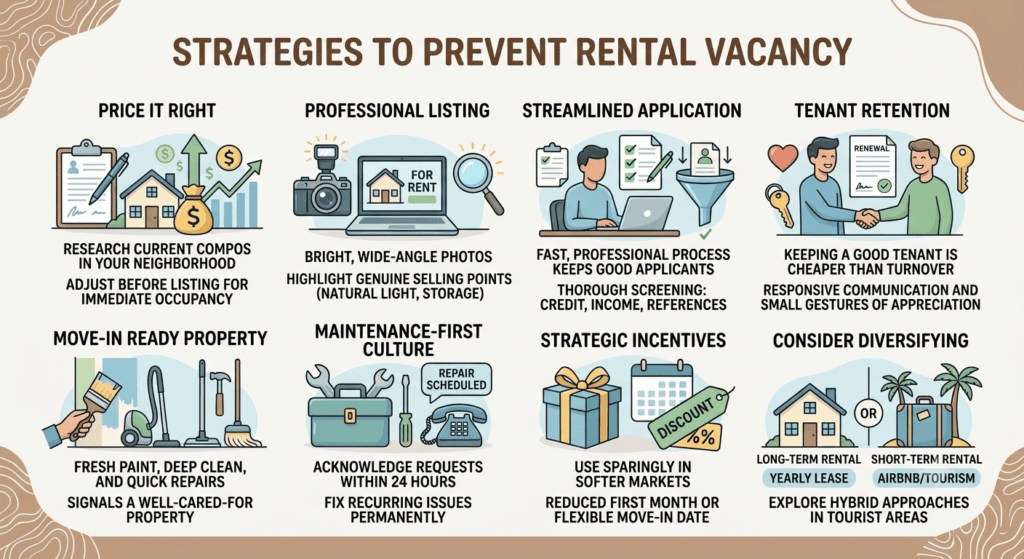
Reducing rental property vacancy comes down to treating occupancy as something you actively manage, not something you passively hope for. Here’s what actually works.
Price It Right From Day One
Before listing a unit, pull current comparable listings for your neighbourhood and unit type, not last year’s numbers. If a similar unit down the street is renting for less with better finishes, adjust before you list rather than after three weeks of silence. A slightly lower asking rent that fills immediately almost always outperforms a higher one that sits empty for a month.
Invest in Professional Photography and Listings
Given that most inquiries happen in the first two weeks, your listing needs to perform immediately. Bright, wide-angle photos, a floor plan if possible, and a description that highlights genuine selling points (natural light, storage, proximity to transit or downtown) make a measurable difference in how quickly a property attracts serious applicants.
Streamline the Application and Screening Process
A fast, professional application process keeps good applicants from wandering off to a competing listing while you’re still processing paperwork. At the same time, thorough screening, credit checks, income verification, rental history, and references, protects you from the far more expensive problem of a bad tenancy. The goal is speed and rigor together, not one at the expense of the other.
Prioritize Tenant Retention Over Constant Turnover
It’s almost always cheaper to keep a good tenant than to find a new one. Retaining a satisfied tenant even modestly can meaningfully raise the odds they renew, while cutting the odds they start shopping around. Reasonable renewal increases, responsive communication, and small gestures of appreciation cost far less than a full turnover cycle.
Keep the Property Move-In Ready
Between tenants, don’t let a unit sit in “as-is” condition while you search for the next applicant. A fresh coat of paint, a deep clean, and quick repairs to anything worn signal to prospective tenants that the property is well cared for, and they’re more likely to sign quickly and stay longer once they do.
Build a Maintenance-First Culture
Since poor maintenance response is consistently cited as the top reason tenants don’t renew, this is one of the highest-leverage fixes available to landlords. Acknowledging repair requests within 24 hours, keeping tenants updated on timelines, and fixing recurring issues permanently rather than patching them repeatedly all directly protect your occupancy rate. Even something as simple as a text update saying “your repair is scheduled for Thursday” goes a long way toward reassuring a tenant that their concerns are being taken seriously, which directly supports renewal decisions down the line.
Offer Incentives Strategically
In a softer market, small, targeted incentives, a reduced first month, a minor upgrade, or a flexible move-in date, can be the difference between a unit sitting empty and getting signed within days. Used sparingly and only when needed, incentives are far cheaper than an extra month of vacancy.
Diversify Between Short-Term and Long-Term Rental Strategies
Not every property performs best under a single rental model. In tourist-heavy areas of Niagara Falls, a property that struggles to find long-term tenants at a competitive rate may perform significantly better as a professionally managed short-term or Airbnb rental, particularly during peak travel season. Some owners even find success with a hybrid approach, running a property as a short-term rental during peak tourist months and shifting to a longer-term lease during the slower winter season, though this requires careful planning around licensing, cleaning turnaround, and local regulations to execute smoothly.
Stay Ahead of Local Regulatory Changes
Niagara Falls, like many Ontario municipalities, continues to refine its rules around short-term rental licensing, property standards, and zoning as the market matures. A property that falls out of compliance, whether through an expired licence, a missed inspection, or an outdated fire safety requirement, can be pulled off the market entirely while the issue is resolved, creating an entirely avoidable vacancy gap. Building a habit of reviewing municipal requirements at least once a year protects against this kind of disruption.
When to Consider Airbnb Co-Hosting Instead
If your property is well-located near the Falls, Clifton Hill, or the tourist corridor, and you’re finding long-term vacancy stubborn despite competitive pricing, co-hosting with an experienced short-term rental manager can unlock stronger returns. Professional co-hosts handle dynamic pricing, guest communication, and turnover cleaning, all of which are the biggest barriers keeping self-managed short-term rentals from reaching their full occupancy potential.
The Role of Professional Property Management in Reducing Vacancy
Every strategy above works, but executing all of them consistently, market pricing, professional marketing, fast screening, responsive maintenance, and tenant retention, is a full-time job on its own. That’s precisely the gap professional property management fills.
At The HAH Developments, we manage the entire vacancy-prevention process for property owners across Niagara Falls and the surrounding region, from accurate market pricing and professional listing creation through to tenant screening, lease administration, and ongoing maintenance coordination. Whether you’re managing a single long-term rental, a portfolio of investment properties, or a short-term Airbnb that needs consistent, professional co-hosting, our goal is the same: keep your property occupied by qualified, reliable tenants and protect the income you’ve worked to build.
For owners who are self-managing, the biggest advantage professional management offers isn’t just time saved, it’s consistency. A property manager tracks local market rent on an ongoing basis, maintains a pipeline of pre-screened prospective tenants, and has established maintenance vendors who can respond quickly rather than being scheduled around a single owner’s availability. That consistency is often the difference between a portfolio that stays reliably occupied and one that experiences the same avoidable vacancy gaps year after year.
This matters just as much for short-term rentals. Professional Airbnb co-hosting includes dynamic pricing that adjusts to local demand day by day, coordinated cleaning turnovers between every guest stay, and guest communication that keeps ratings, and therefore future bookings, strong. Given that Niagara Falls’ short-term rental occupancy currently averages around 52% across the market, the gap between an average-performing listing and a well-managed one often comes down almost entirely to how actively the calendar and pricing are being managed.
Frequently Asked Questions
What is considered a “normal” vacancy rate for a rental property? A healthy, balanced rental market typically falls between 3% and 4% vacancy. Rates significantly above that suggest oversupply or pricing issues in a specific area, while rates well below it point to high demand and limited available inventory.
How long should it take to re-rent a vacant property? In a competitive but balanced market, a well-priced, well-marketed unit should attract serious applicants within the first two weeks of listing. If a property sits vacant for a month or longer, that’s usually a signal that pricing, presentation, or marketing needs to be reassessed.
Does raising rent too aggressively increase vacancy risk? Yes. Tenants generally begin reconsidering renewal once an increase crosses roughly 8%, and unreasonable rent increases are consistently cited as one of the top reasons tenants choose not to renew. A modest, well-communicated increase protects your income without pushing good tenants toward the market.
Is it better to lower rent or offer an incentive to fill a vacancy faster? Both can work, but incentives (a partial month free, a flexible move-in date, or a small upgrade) often preserve your long-term asking rent better than a permanent rent reduction, while still creating urgency for prospective tenants.
How does the Ontario Landlord and Tenant Board backlog affect vacancy prevention? Because Landlord and Tenant Board applications, particularly more complex ones, can currently take anywhere from several months to close to a year to resolve, landlords have a strong incentive to prevent problem tenancies upfront through careful screening rather than relying on the Board to resolve issues quickly after the fact.
Should I convert my long-term rental to a short-term rental to reduce vacancy? It depends heavily on location. Properties near high-traffic tourist areas in Niagara Falls can perform very well as professionally managed short-term rentals, particularly during peak season, while properties in primarily residential neighbourhoods often see more consistent returns as long-term rentals.
What’s the fastest way to tell if my vacancy problem is about pricing or presentation? Track how many inquiries and showing requests your listing generates in the first week. A strong number of inquiries but few applications usually points to a presentation or condition issue once people see the unit in person. Very few inquiries from the start almost always points back to pricing.
How much should I budget annually for vacancy as a landlord? Many experienced landlords budget for at least one month of vacancy per year per unit as a standard planning assumption, even in a strong market, since tenant turnover is a normal part of owning rental property rather than a sign that something has gone wrong.
Conclusion
Rental property vacancy in 2026 isn’t something landlords can afford to treat as bad luck or bad timing. With Niagara’s vacancy rate at a decade high and new rental supply continuing to enter the market throughout the year, the properties that stay consistently occupied are the ones priced accurately, marketed professionally, maintained proactively, and managed with genuine attention to tenant experience.
The good news is that every cause of vacancy covered in this guide is fixable. You don’t need to guess at market rent, chase down maintenance issues after tenants have already started looking elsewhere, or navigate LTB backlogs alone. Small, consistent adjustments, checking your pricing against real comparables, responding quickly to repair requests, keeping communication open, add up to a property that consistently outperforms the market average, rather than one that’s constantly playing catch-up.
If you’re ready to stop losing income to preventable vacancy, The HAH Developments can help. From accurate pricing and professional marketing to tenant screening, maintenance coordination, and full-service short-term rental management, our team handles the details that keep your Niagara Falls property occupied and profitable. Contact The HAH Developments today to talk through your property and build a vacancy-prevention plan tailored to it.