

Owning a rental property in the Niagara Region sounds simple on paper. You buy a place, you find a tenant, rent comes in every month, and you sit back and watch your investment grow. Reality tends to look different.
The 2 a.m. call about a burst pipe. The tenant who stops answering texts the same week rent is due. The three-hour afternoon lost to writing a Landlord and Tenant Board (LTB) application because you used the wrong form. None of this shows up in the property listing when you first fall in love with a duplex on a quiet St. Catharines street.
This is the question every landlord eventually asks themselves: should I manage this property myself, or hand it to a professional?
There’s no universal right answer, but there is a right answer for your situation, your schedule, and your risk tolerance. This guide breaks down exactly what a property management company does, what self-management actually costs in time and money, how Ontario’s rental laws are shaping the decision in 2026, and what the Niagara rental market looks like right now for landlords weighing their options.
What Does a Property Management Company Actually Do?
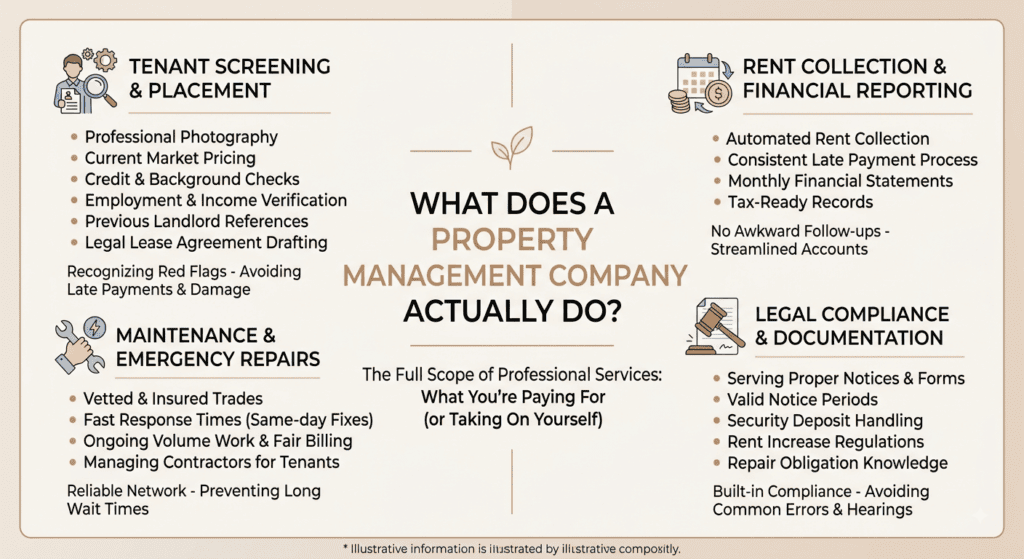
Before comparing costs, it helps to understand the full scope of what you’re paying for – or what you’re taking on yourself.
Tenant Screening and Placement
Finding a tenant isn’t just posting a listing and waiting for applications. A thorough process includes professional photography, pricing the unit against current market comparables, running credit and background checks, verifying employment and income, calling previous landlords, and drafting a lease that protects you legally.
Skip any of these steps and you increase your odds of ending up with a tenant who pays late, damages the unit, or becomes difficult to remove. Property managers run dozens of these placements a year, which means they recognize red flags – inconsistent pay stubs, vague references, rushed move-in requests – that a first-time landlord might miss entirely.
Rent Collection and Financial Reporting
A management company sets up automated rent collection, chases late payments according to a consistent, documented process, and gives you monthly statements you can actually use for tax season. This sounds minor until you’re the one sending an awkward follow-up text to a tenant who also happens to be a decent human being you don’t want to alienate.
Maintenance and Emergency Repairs
Every rental eventually needs a plumber, an electrician, or a same-day fix for a broken furnace in January. Property managers maintain a roster of vetted, insured trades who respond quickly and bill at reasonable rates because of the ongoing volume of work they send. A landlord managing one or two units is often stuck calling around for a contractor while a tenant waits without heat.
Legal Compliance and Documentation
This is where DIY landlords get into the most trouble. Notices have to be served the right way, on the right form, with the right amount of notice. Security deposits, rent increase timing, and repair obligations are all governed by provincial law, and a small paperwork error can cost you months at a hearing. A property manager builds compliance into the process from day one instead of learning it the hard way.
Property Management Trends Shaping 2026
The rental industry looks different than it did even two or three years ago, and it’s worth understanding what’s changing before you decide how to manage your own unit.
Technology adoption in professional rental property management has accelerated sharply. Recent industry benchmarking shows roughly a third of property management firms now use AI-assisted tools for tasks like maintenance triage, tenant communication, and financial reporting, up from around a fifth just a year earlier. Firms using this technology report meaningful operational efficiency gains, translating into faster response times and fewer administrative errors reaching the owner’s desk.
For an individual landlord, the practical effect is a widening gap. A self-managing owner juggling a spreadsheet and a stack of paper receipts is now competing, in terms of tenant experience, against management companies offering online portals, automated maintenance requests, and same-day communication. Tenants increasingly choose and stay in units based on how responsive and organized the management feels, not just location and price.
At the same time, staying current on Ontario rental laws is only getting more demanding. Between the LTB’s ongoing backlog, the annually adjusted rent increase guideline, and municipality-specific short-term rental bylaws across the Niagara Region, the regulatory side of owning a rental property has become a part-time research project on its own. This combination – rising tenant expectations and rising compliance complexity – is a major reason more owners are shifting toward professional management heading into the second half of 2026.
The Real Cost of Self-Managing a Rental Property in 2026
Landlords who choose to self-manage almost always underestimate one thing: time.
The Time Commitment Landlords Underestimate
Industry data on single-family rental self-management shows owners typically spend somewhere between 5 and 20-plus hours a month on their property, which works out to roughly 60 to 240-plus hours a year depending on tenant turnover, maintenance needs, and vacancy cycles. A stable month with a reliable tenant might only take a few hours. A turnover month, with marketing, showings, screening, and lease prep landing all at once, can easily eat 20 to 30 hours by itself.
Most self-managing landlords never actually track their hours, which means they can’t fairly compare that time against what professional management would cost. Once you start logging it, the math often looks very different than it did in your head.
Broader surveys of rental owners back this up. Roughly 70 percent of individual landlords across North America still choose to manage their own properties, and one widely cited owner survey put the average time spent per unit at close to 47 hours for leasing activities alone – screening, showings, paperwork – plus another 46-plus hours a year on ongoing day-to-day management. That’s before a single maintenance emergency or legal dispute enters the picture.
Hidden Costs of DIY Mistakes
A vacancy that sits for even two extra weeks because the unit was priced wrong costs more than most people expect once you add up lost rent, utilities, and continued mortgage payments on an empty unit. A rushed tenant screening that goes wrong can mean months of missed rent and a legal process to remove someone who never should have been approved in the first place.
Then there’s the emotional cost. National landlord surveys suggest a meaningful share of self-managing owners report increased stress and lower satisfaction with their investment after a few years of handling everything solo – the midnight maintenance texts and the constant low-grade worry about compliance add up even when nothing has technically gone wrong yet.
There’s also a quieter cost that rarely gets discussed: decision fatigue. Every self-managing landlord eventually has to decide, in the moment, whether a tenant’s excuse for late rent is genuine or a pattern forming, whether a maintenance request is urgent or can wait until the weekend, and whether a lease violation is worth documenting or letting slide. Made once, these are easy calls. Made dozens of times a year across every property you own, they become a steady mental load that competes with everything else in your life. A property manager absorbs that decision-making using a consistent, documented standard instead of a gut call made at the end of a long workday.
Opportunity Cost: What Your Time Is Worth
Every hour spent chasing a late payment or researching a legal notice is an hour not spent at your job, with your family, or sourcing your next real estate investment. If you value your own time at even a modest hourly rate, the math on “free” self-management starts to look a lot less free.
Why Hire a Property Management Company? The Core Benefits
Once the time and risk picture is clear, the case for hiring a property management company usually comes down to four practical advantages.
Faster Tenant Placement and Lower Vacancy
Professional managers already have a marketing system, a list of pre-screened prospective tenants, and a pricing strategy based on live local data. In a market where a unit priced even slightly above market can sit empty for weeks, that speed translates directly into income you’d otherwise lose.
Professional Handling of Difficult Situations
Late payments, noise complaints, lease violations, and eviction proceedings are uncomfortable for anyone to handle directly, especially with someone you may see in the hallway or driveway. A property manager acts as a buffer, keeping the relationship professional and reducing the chance a disagreement turns personal or, worse, ends up costing you at a hearing.
Access to Vetted Trades and Maintenance Networks
Because property managers coordinate maintenance across many units, they typically get faster response times and better pricing from contractors than an individual owner calling one-off jobs. That matters most in an emergency, when a tenant without heat or water needs a same-day fix.
Consistent Rent Increases and Market-Rate Pricing
Many self-managing landlords fall behind on rent increases simply because raising the rent on someone you know personally feels awkward. A property manager applies increases consistently, within legal limits, which protects your long-term rental income instead of letting it quietly erode against inflation and rising costs.
Navigating Ontario’s Rental Laws Without Getting Burned
Ontario’s rental rules are not simple, and getting them wrong is one of the most expensive mistakes a self-managing landlord can make.
Your Legal Obligations as a Landlord
The Residential Tenancies Act (RTA) governs nearly every part of the landlord-tenant relationship in Ontario: how much notice is required for entry, how rent increases must be calculated and communicated, what counts as a legal reason for eviction, and how maintenance requests must be handled. For 2026, Ontario’s guideline rent increase is set at 2.1 percent, the lowest level in four years, which means landlords need to plan their income projections more conservatively than they may have in recent years.
LTB Wait Times in 2026
If a dispute does end up at the LTB, patience is now a requirement. As of early 2026, non-payment of rent applications are typically taking roughly three to six months to reach a hearing, while applications involving landlord’s own use or tenant-fault evictions are commonly running five to nine months or longer. A written decision is usually issued within about 30 days after the hearing itself, but simply getting to that hearing date is the real bottleneck.
A single filing mistake, an improperly served notice, or an incomplete application can push a landlord to the back of that queue and add months to an already long wait. Property managers who file LTB applications regularly know exactly how to avoid the errors that cause the most delays.
Common DIY Landlord Legal Mistakes
The most frequent errors self-managing landlords make include serving the wrong notice form, miscalculating a legal rent increase, entering a unit without proper notice, and failing to keep a clear paper trail of communication and repair requests. Any one of these can weaken your position significantly if a dispute ever reaches the LTB.
The Niagara Region Rental Market: What Landlords Are Up Against in 2026
Local market conditions change the self-management calculation, and Niagara’s market has shifted noticeably over the past year.
What’s Happening With Vacancies and Rent in St. Catharines–Niagara
According to the Canada Mortgage and Housing Corporation’s most recent rental market data, the average vacancy ratein the St. Catharines–Niagara area held at 3.9 percent, a more-than-decade high for the region. Niagara Falls specifically saw more vacant units than the surrounding sub-regions, driven by a decline in temporary foreign worker permits, softer tourism and hospitality employment, and a meaningful increase in new rental supply. CMHC’s broader 2026 outlook projects Ontario vacancies staying in the 3 to 5 percent range provincewide, with rent growth staying modest as new construction continues to come online.
For landlords, that means the days of a unit renting itself within 48 hours of listing are largely over in this market. A vacant unit now competes against genuinely attractive alternatives, including new buildings offering move-in incentives, and pricing it correctly the first time matters more than it used to.
St. Catharines alone issued over 1,000 new dwelling unit building permits in a single recent year, nearly double its typical pace, while both Niagara Falls and Welland have exceeded their provincial housing targets. More supply is good news for tenants and, over time, for the long-term health of the region, but it means self-managing landlords are now pricing and marketing their units into a genuinely more competitive environment than the one many bought into a few years ago.
Short-Term Rental Licensing in Niagara Falls and Niagara-on-the-Lake
Landlords considering the short-term rental route face a genuinely complicated regulatory picture. Niagara Falls restricts vacation rental units to designated tourist and commercial zones, requires a business license with an annual renewal fee, mandates minimum liability insurance, and enforces a three-strike system that can result in license revocation for repeated violations. The city also introduced a capped pilot program allowing owner-occupied short-term rentals in select residential zones, but it’s limited to a fixed number of licenses and requires the owner to be present during every stay.
Niagara-on-the-Lake runs an entirely separate licensing system with its own fees, renewal deadlines, and inspection requirements, and licenses in that municipality cannot be transferred between owners. Because Ontario has no single provincial short-term rental law, every Niagara municipality writes and enforces its own rules, which means an owner with properties in more than one city is effectively managing two or three different compliance systems at once. Operating without a valid short-term rental license in either city is one of the fastest ways to turn a promising investment into a costly enforcement problem.
Why Local Market Knowledge Matters
A landlord unfamiliar with these zone-by-zone restrictions can unknowingly list a property illegally, face fines that run into the tens of thousands of dollars, or lose a license entirely. A property manager who works in the Niagara Region daily already knows which zones qualify, what documentation each municipality requires, and how to keep a listing compliant as the rules continue to evolve.
Cap Rates and Investment Fundamentals in Niagara
Beyond vacancy and licensing, the underlying investment case for the region still holds up for owners who manage it well. Niagara Falls residential multifamily properties, away from the tourist core, are currently trading in the 5.5 to 6.8 percent cap rate range, supported by steady healthcare and manufacturing employment rather than tourism seasonality alone. That kind of fundamentals-driven demand is exactly the sort of detail a hands-off owner can miss without someone locally monitoring neighbourhood-level trends, zoning shifts, and upcoming supply on their behalf.
DIY vs Professional Property Management: A Side-by-Side Comparison
| Factor | Self-Managing | Property Management Company |
| Time commitment | 5–20+ hours/month per unit | Minimal – hands-off ownership |
| Tenant screening | Owner-dependent, variable quality | Standardized, professional process |
| Rent collection | Manual, often inconsistent | Automated with documented follow-up |
| Maintenance response | Owner sources tradespeople as needed | Established vetted contractor network |
| Legal compliance | Owner responsible for staying current | Built into standard operating process |
| LTB application accuracy | Higher risk of costly errors | Filed by professionals with experience |
| Vacancy turnaround | Often slower, priced by guesswork | Data-driven pricing, faster placement |
| Emotional/personal cost | High – direct tenant conflict | Manager acts as a buffer |
| Cost | “Free” but with real hidden costs | Ongoing management fee |
How Much Does a Property Management Company Cost in Ontario?
Typical Fee Structures
Across Ontario, full-service property management fees generally run between 8 and 12 percent of collected monthly rent, with some markets seeing rates as low as 6 percent and others closer to 12 percent depending on portfolio size, property type, and local competition. Beyond the monthly percentage, most companies also charge a separate tenant placement or leasing fee – commonly 50 to 100 percent of one month’s rent – each time a new tenant is secured, along with occasional charges for specific services like additional inspections or lease renewals.
Is the Fee Worth It? A Simple ROI Check
Run the numbers on a $2,200-a-month unit. A 10 percent management fee works out to $220 a month, or $2,640 a year. Against that, weigh the cost of even one extended vacancy from mispriced rent, one missed legal notice that delays an LTB hearing by months, or simply the market value of the 60 to 240 hours a year you’d otherwise spend managing the property yourself. For many owners, especially those with full-time jobs, multiple units, or properties outside their immediate neighbourhood, the fee ends up costing less than the mistakes and lost time it prevents.
When DIY Management Makes Sense (and When It Doesn’t)
Self-management can work well for an owner who lives close to the property, has genuine spare time and a calm temperament for handling tenant issues directly, owns just one or two units, and is willing to stay current on Ontario’s rental laws as they change. It tends to break down once an owner adds a second or third property, lives outside the area, works a demanding job, or simply wants their monthly income to feel passive rather than like a second part-time job.
If you’re honest with yourself about which category you fall into, the decision usually becomes clear fairly quickly.
It’s also worth revisiting the decision periodically rather than treating it as permanent. A landlord who self-manages comfortably with one unit close to home may find the equation changes entirely after buying a second property across town, taking on a more demanding job, or simply realizing after a rough tenant turnover that the time and stress no longer feel worth the savings. Property management isn’t an all-or-nothing commitment either – some owners start by hiring a manager for the properties that are hardest to reach or most complex to run, like a licensed short-term rental, while continuing to self-manage a straightforward long-term unit nearby.
How to Choose the Right Property Management Company
Questions to Ask Before You Sign
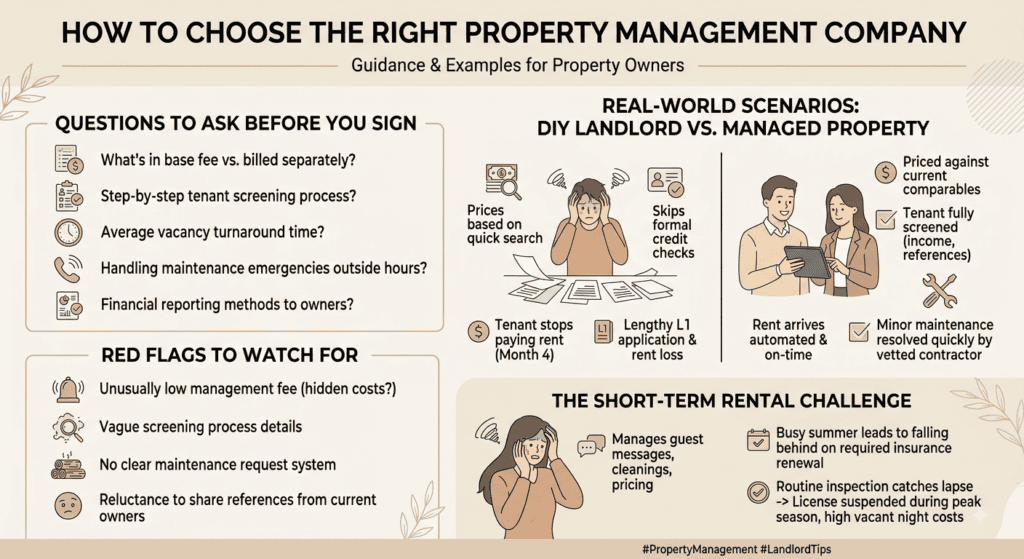
Ask exactly what’s included in the base management fee versus billed separately, how their tenant screening process works step by step, what the average vacancy turnaround time has been for their current portfolio, how maintenance emergencies are handled outside business hours, and how they report financials to owners.
Red Flags to Watch For
Be cautious of a management fee that looks unusually low, since it often means the company makes up the difference through high leasing fees or frequent add-on charges. Also watch for vague answers about their screening process, no clear system for documenting maintenance requests, and a reluctance to share references from current property owners.
Real-World Scenarios: DIY Landlord vs Managed Property
Consider two landlords who each own a single-family rental in Niagara Falls. The first self-manages: he prices the unit based on a quick online search, skips a formal credit check because the applicant “seems nice,” and ends up with a tenant who stops paying rent by month four. By the time his L1 application reaches a hearing months later, he’s lost several months of rent along with the time spent preparing the paperwork himself.
The second hands the same type of property to a management company. The unit is priced against current comparables, the tenant is fully screened including income verification and past landlord references, and rent arrives on the same date every month through automated collection. When a minor maintenance issue comes up in month six, it’s resolved by a vetted contractor within a day, without a single call to the owner. The difference isn’t luck – it’s process.
Now picture a third owner running a licensed short-term rental in a Niagara Falls tourist zone. Self-managing, she keeps up with guest messages, cleaning turnovers, and dynamic pricing for a while, but falls behind on a required insurance renewal during a busy summer stretch. A routine inspection catches the lapse, and her license is suspended until she can get compliant again – during peak season, when every vacant night costs the most. A management company tracking her renewal dates alongside dozens of other licensed properties would have flagged the deadline weeks in advance.
Conclusion
Self-managing a rental property isn’t wrong, but it is a real job, whether or not you’re currently accounting for it as one. Between Ontario’s tightening compliance requirements, LTB wait times that now stretch into months, a Niagara rental market seeing the most vacancies it’s had in over a decade, and short-term rental rules that shift by municipality, the margin for error has narrowed considerably in 2026.
Hiring a property management company doesn’t just buy back your time. It buys you a documented process for screening tenants, a faster response when something breaks, and a partner who already knows exactly what Ontario’s rental laws require before a small mistake becomes an expensive one.
If you own a rental property in Niagara Falls, St. Catharines, or anywhere across the Niagara Region and you’re tired of being on call for your own investment, The HAH Developments handles the entire process – from tenant placement and rent collection to maintenance coordination and full compliance with Ontario’s rental laws. Contact The HAH Developments today for a free property assessment and find out what your returns could look like with professional management behind it.
Frequently Asked Questions
Is it worth hiring a property management company for just one rental unit? It depends on your proximity to the property, your available time, and your comfort handling tenant conflict directly. Many owners with a single unit still choose professional management simply to protect their time and reduce legal risk, especially if they live outside the immediate area.
How much does property management typically cost in Ontario? Most full-service property management fees in Ontario range from 8 to 12 percent of collected monthly rent, plus a separate leasing fee – often 50 to 100 percent of one month’s rent – each time a new tenant is placed.
What happens if I make a mistake with an eviction notice as a DIY landlord? An improperly served notice or an incorrectly completed form can significantly delay your LTB application, sometimes by months, and may require you to restart the process entirely.
Can a property management company help with short-term rentals like Airbnb? Yes. In municipalities like Niagara Falls and Niagara-on-the-Lake, where licensing, zoning, and tax requirements vary significantly, a property manager familiar with local short-term rental bylaws can keep a listing compliant and help avoid fines or license revocation.
How long does it currently take to get a hearing at Ontario’s LTB? As of early 2026, non-payment of rent applications generally take about three to six months to be scheduled, while landlord’s own use or tenant-fault applications commonly take five to nine months or longer.
Will a property manager get my unit rented faster than I could on my own? Generally yes. Professional managers price units against live local comparables and market to a wider pool of prospective tenants, which matters more now that Niagara vacancies sit at a more-than-decade high and units are taking longer to fill than they did a few years ago.
Do I still have to worry about property maintenance if I hire a management company? No, not directly. A management company coordinates repairs, schedules routine inspections, and handles emergency calls through its own contractor network, so you’re informed of major issues without being the one fielding the after-hours phone call.
Can I switch from self-managing to a property management company mid-lease? Yes. A management company can typically take over an existing tenancy at any point, picking up rent collection, communication, and compliance going forward without requiring the current tenant to move out or sign a new lease.