

Owning rental property in Ontario used to be simple: find a tenant, collect rent, fix things when they broke. That version of landlording is gone.
Between a rent increase guideline that just hit its lowest level in four years, a Landlord and Tenant Board still working through tens of thousands of backlogged cases, and a wave of new purpose-built rentals changing what tenants expect, property management Ontario landlords rely on has become a genuinely different job than it was even three years ago.
If you own one condo in Niagara Falls or a portfolio of ten units across the region, the rules you’re playing by have shifted. This guide walks through what property management Ontario actually looks like in 2026 – the market data, the legal landscape, the short-term rental rules, and the practical decisions that separate landlords who are thriving from landlords who are constantly putting out fires.
What Property Management in Ontario Actually Involves
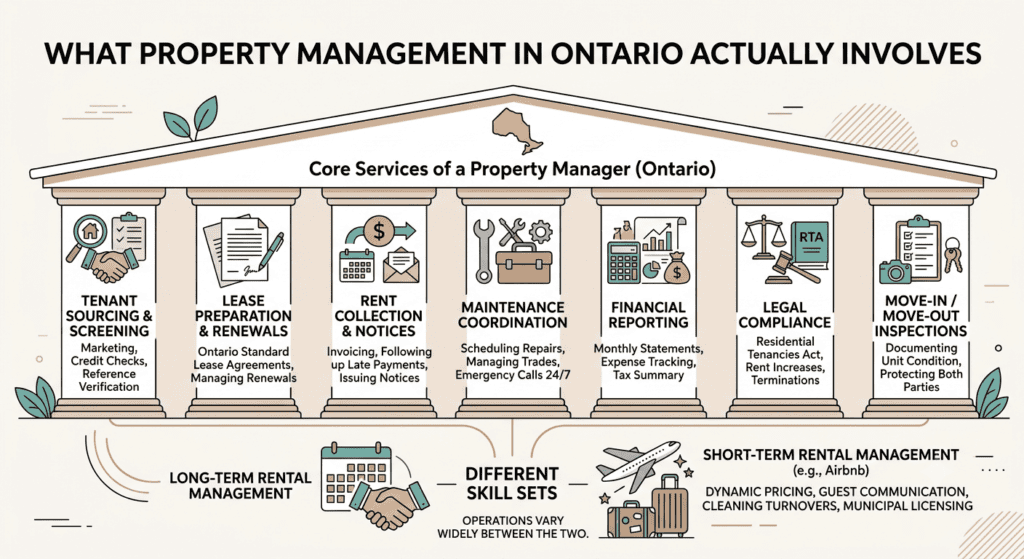
“Property management” gets used loosely, so it’s worth being precise about what it covers before diving into the market conditions shaping it.
Core Services a Property Manager Provides
A full-service Ontario property manager typically handles:
- Tenant sourcing and screening – marketing the unit, running credit and reference checks, and verifying employment and rental history
- Lease preparation and renewals – drafting Ontario Standard Lease agreements and managing renewal timing
- Rent collection – invoicing, following up on late payments, and issuing proper notices when needed
- Maintenance coordination – scheduling repairs, managing trades, and handling emergency calls
- Financial reporting – monthly statements, year-end summaries, and expense tracking for tax purposes
- Legal compliance – keeping notices, increases, and terminations aligned with the Residential Tenancies Act
- Move-in and move-out inspections – documenting unit condition to protect both parties
For short-term rental owners, the list expands to include dynamic pricing, guest communication, cleaning turnovers, and municipal licensing – a very different skill set from managing a year-long lease.
The distinction matters because a lot of owners assume “property management” is a single service with a single price tag. In practice, a company managing long-term residential rentals and a company managing Airbnb-style short-term properties are often running two entirely different operations under one roof – one built around lease cycles measured in months, the other built around turnovers measured in days. Understanding which category your property falls into, or whether it could realistically support both, is the first real decision an owner needs to make before comparing management options.
Who Actually Needs a Property Manager
Not every landlord needs to outsource. But a few situations make professional management close to essential: owning property outside the city you live in, managing more than two or three units, running a short-term rental in a municipality with strict licensing rules, or simply not having the time to respond to a maintenance call at 11 p.m. on a Tuesday.
The owners who struggle most tend to be the ones managing solo while also working a full-time job – they’re the ones most likely to miss a notice deadline or fall behind on documentation, which matters more than ever given where the Landlord and Tenant Board currently stands.
The State of Ontario’s Rental Market in 2026
Understanding property management Ontario-wide starts with understanding what’s actually happening in the rental market right now, because the strategy that worked in 2022 can lose you money in 2026.
Rising Vacancy Rates Are Changing the Landlord’s Job
For years, Ontario landlords operated in a market so tight that units rented themselves. That’s no longer the baseline. National vacancy rates for purpose-built rental apartments climbed noticeably through 2025, driven by a wave of new construction reaching completion alongside softer demand from lower international student and newcomer arrivals. CMHC’s outlook for 2026 points to vacancy rates staying elevated before stabilizing later in the forecast window, with rent growth expected to stay modest as a result.
That shift matters practically. A vacant unit today can sit for weeks rather than days, especially in newer buildings competing against move-in incentives from big purpose-built developments. Pricing a unit at last year’s rate, rather than this year’s market rate, is now one of the most common – and most expensive – mistakes Ontario landlords make.
The 2026 Rent Increase Guideline, Explained
Every year, the Ontario government sets a rent increase guideline: the maximum percentage most landlords can raise rent on an existing tenancy without applying to the Landlord and Tenant Board. For 2026, that guideline is 2.1% – the lowest it’s been in four years, down from 2.5% in each of the three years before it.
In dollar terms, a tenant paying $2,000 a month can see a legal increase of up to $42, bringing rent to $2,042. The guideline applies only to units first occupied on or before November 15, 2018; anything built and occupied after that date is exempt from the cap entirely, though landlords still owe 90 days’ written notice using the proper form.
A few rules stay constant regardless of the percentage: rent can only be increased once every 12 months per tenant, the notice must use the correct Landlord and Tenant Board form, and increases can’t be applied retroactively if a landlord forgot to raise rent the year before. For landlords hoping to exceed the guideline, an Above Guideline Increase application is possible for circumstances like major capital improvements, but it requires a formal filing and can take time to process given current Board workloads.
A Regional Snapshot: Niagara
The Niagara Region tells its own version of this provincial story. St. Catharines issued a wave of new housing permits through 2025, and Niagara Falls exceeded its provincial housing targets as new purpose-built rental projects – including a large development slated for downtown Niagara Falls – move toward completion. CMHC’s outlook flags Niagara as a market where the purpose-built rental vacancy rate is expected to stay elevated in the near term before easing, largely tied to lower non-permanent resident migration feeding into demand.
At the same time, Niagara Falls’ rental market away from the tourist core tells a steadier story: the city’s residential rental demand is heavily supported by healthcare and manufacturing employment rather than tourism alone, which tends to insulate it from the seasonal swings that hit purely vacation-driven markets. For landlords weighing long-term rental against short-term hosting, that distinction between the tourist zone and the residential neighbourhoods around it is worth understanding before you commit to a strategy.
Ontario Landlord-Tenant Law Every Property Owner Must Know
No conversation about property management Ontario landlords need to understand is complete without the legal framework underneath it. This is the area where good intentions and missing paperwork cost owners the most money.
The Residential Tenancies Act: The Foundation
The Residential Tenancies Act, 2006 governs nearly every residential landlord-tenant relationship in the province. It sets out notice periods, rent rules, maintenance obligations, and the process for ending a tenancy. A few provisions trip up new landlords more than any others:
- 90 days’ notice is required for any guideline rent increase, using the correct LTB form
- Maintenance obligations apply regardless of what a lease says – a landlord can’t contract out of the duty to keep a unit in a good state of repair
- Entry rules require 24 hours’ written notice for most non-emergency entries, with a specified time window
- Security deposits for rent are capped at last month’s rent; Ontario doesn’t allow separate damage deposits for most residential tenancies
Getting any of these wrong doesn’t just risk a dispute – it can invalidate an eviction application entirely and send a landlord back to the start of the process.
Bill 60, the Backlog, and What It Means for Enforcement
The Landlord and Tenant Board has been under significant strain for years, and while recent reforms – including Bill 60, passed in late 2025 – aim to speed up hearings, the practical reality in 2026 is still one of long waits. Tribunals Ontario’s own service standards show non-payment applications (L1) being scheduled roughly three months out, while most other application types, including tenant-filed maintenance and rights complaints, are running closer to five to seven months. Personal-use and tenant-fault evictions frequently land in the six-to-nine-month range once adjournments are factored in.
The reported case backlog, which peaked above 53,000 files, has come down meaningfully but remains substantial. For landlords, that translates into a simple operating principle: paperwork discipline isn’t optional anymore. A rent increase notice served on the wrong form, a termination notice with an incorrect date, or a missing service record can add months to an already slow process. This is exactly the kind of detail a professional property manager is built to catch – and exactly the kind of detail that’s easy to miss when you’re managing a property solo, on evenings and weekends, around a full-time job.
Common Compliance Mistakes Ontario Landlords Make
A few mistakes show up again and again:
- Charging a separate “damage deposit” – not permitted under Ontario law for most residential tenancies
- Entering a unit without proper written notice, even for legitimate reasons like a scheduled repair
- Increasing rent above the guideline on a unit that isn’t actually exempt from rent control
- Using an outdated lease template that doesn’t reflect the current Ontario Standard Lease requirements
- Failing to document unit condition at move-in, which becomes critical if a damage dispute ever reaches the Board
Each of these is avoidable with the right systems in place – which is precisely where a lot of self-managing landlords lose time, money, or both.
Why Landlord Insurance Matters More Than It Used To
With Ontario’s rental household count now well past 1.7 million and the LTB backlog making disputes slower to resolve, insurance has shifted from a nice-to-have to a core part of risk management. A policy that specifically covers malicious damage, extended vacancy, and loss of rental income can be the difference between absorbing a bad tenancy and facing a genuine financial setback while a case sits in the queue waiting for a hearing date. Standard homeowner policies typically don’t cover a tenant-occupied property adequately, so confirming a policy is actually written for rental use – not just carried over from when the owner lived there – is worth double-checking annually.
Short-Term Rentals and Airbnb Management in Ontario
Long-term tenancy law is only half the picture. For owners running Airbnb or vacation rental properties, Ontario adds a second, entirely separate layer of regulation – one that’s set municipality by municipality rather than provincially.
A Municipal Patchwork, Not a Provincial Standard
As of 2026, Ontario still has no single province-wide short-term rental law. Each municipality writes and enforces its own bylaw, which means a property that’s perfectly legal to list in one city may be flatly prohibited a few kilometres away in the next. Toronto, Hamilton, and the municipalities across Niagara have each taken a different regulatory approach – some restricting short-term rentals to a host’s principal residence, others allowing dedicated investment properties within specific commercial zones.
This patchwork is exactly why so many hosts and investors get into trouble unintentionally. Buying a property because the numbers work on paper, without first confirming the zoning and licensing rules for that specific address, is one of the most expensive mistakes an Ontario short-term rental owner can make.
Niagara Falls: Licensing, Zones, and the OOSTR Pilot
Niagara Falls’ rules illustrate how granular this can get. The city permits Vacation Rental Units – whole-home listings with no owner on-site – only within designated Tourist, General, or Commercial zones, not in ordinary residential neighbourhoods. Licensing requires a $500 initial fee, a $250 annual renewal, minimum $2 million liability insurance, and inspection sign-off covering fire, building, and property standards. Operators must also collect and remit the Municipal Accommodation Tax, which shifted in April 2026 to a 4% charge on the total room rate, on top of standard HST.
Separately, the city has been running a 14-month pilot allowing Owner-Occupied Short-Term Rentals in residential zones – a narrower category capped at 100 licenses citywide, requiring the owner to actually live on the property during every guest stay. That pilot is scheduled to wrap up in late September 2026, after which City Council will decide whether to continue it. For anyone considering an owner-occupied listing, the timing of that decision is worth watching closely.
Enforcement has real teeth: operating an unlicensed Vacation Rental Unit in Niagara Falls can carry fines reaching into the tens of thousands of dollars, and a licensed operator who accumulates repeat violations risks having that license suspended entirely.
Balancing Short-Term and Long-Term Strategies
With vacancy rates rising in the traditional long-term rental market and short-term rental compliance growing more complex, more Niagara property owners are asking a fair question: which strategy actually performs better for their specific property? The honest answer depends heavily on zoning, location relative to tourist demand, and how much time (or professional support) the owner has for the operational side of short-term hosting – guest turnovers, dynamic pricing, and compliance tracking look nothing like managing a 12-month lease.
This is one of the areas where working with a property manager who operates across both models pays off, because the right call often isn’t obvious from the outside – it comes down to running the numbers for a specific address against current local demand.
Choosing a Property Management Company in Ontario
Once an owner decides self-managing isn’t sustainable, the next challenge is choosing the right partner. Not all property management companies operate the same way, and the wrong choice can cost more than doing it yourself.
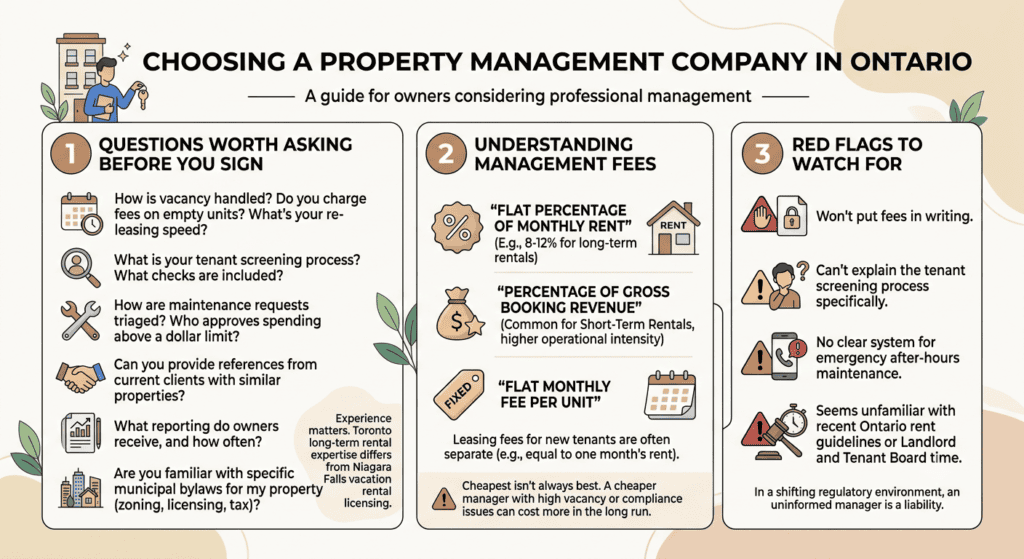
Questions Worth Asking Before You Sign
- How is vacancy handled – do you charge management fees on empty units, and how quickly do you typically re-lease a vacancy?
- What’s your process for tenant screening, and what specific checks are included?
- How are maintenance requests triaged, and who approves spending above a certain dollar amount?
- Can you provide references from current clients with similar property types?
- What reporting do owners receive, and how often?
- Are you familiar with the specific municipal bylaws – zoning, licensing, tax – that apply to my property?
That last question matters more than it might seem. A manager experienced with long-term rentals in Toronto isn’t automatically equipped to navigate Niagara Falls’ Vacation Rental Unit licensing process, and the reverse is equally true.
Understanding Management Fees
Fee structures vary, but most Ontario property managers charge one of a few common models: a flat percentage of monthly rent collected (commonly in the 8–12% range for long-term rentals), a percentage of gross booking revenue for short-term rental management (often higher, given the operational intensity), or a flat monthly fee per unit. Leasing fees for finding a new tenant are usually charged separately, often equal to one month’s rent.
Cheapest isn’t always best here. A manager charging a lower percentage but leaving units vacant longer, or missing a compliance deadline that leads to a fine, can end up costing an owner far more than the fee difference over a year.
Red Flags to Watch For
Be cautious of any property manager who won’t put fees in writing, can’t explain their tenant screening process in specific terms, has no clear system for emergency maintenance after hours, or seems unfamiliar with recent changes to Ontario’s rent guideline or the Landlord and Tenant Board’s current timelines. In a regulatory environment that’s shifted this much in the past year alone, a manager who isn’t current on the changes is a liability, not an asset.
Technology Trends Reshaping Property Management in Ontario
The tools available to landlords and property managers have changed substantially, and owners who ignore this shift are increasingly at a competitive disadvantage against buildings and portfolios using them.
AI-Driven Leasing and Screening
One of the more consequential shifts in 2026 is how quickly leasing inquiries get answered. Historically, a prospective tenant might message on a Tuesday evening and not hear back until Wednesday morning – by which point they’ve already toured a competing unit. AI-powered leasing tools now handle initial inquiries in real time across text, email, and web chat, qualifying leads and booking showings without a delay. Screening tools have moved in step, adding automated fraud checks as document forgery and identity fraud attempts have risen industry-wide.
The Rise of Resident Experience Platforms
A newer category of software, often called a Resident Experience Platform, bundles onboarding, communication, and amenity management into a single system that sits alongside traditional property accounting software. Industry surveys suggest a strong majority of renters now weight resident benefits and communication quality when deciding whether to renew a lease – which means the softer side of property management, not just rent and repairs, increasingly affects retention.
Automated and Preventive Maintenance
Rather than waiting for something to break, more property managers are shifting toward scheduled, data-driven maintenance – tracking appliance age, HVAC service intervals, and seasonal inspection checklists to catch problems before they become expensive emergencies. This shift matters directly to an owner’s bottom line: a $200 furnace inspection is a very different expense than an emergency mid-winter replacement, and preventive scheduling is one of the more reliable ways an Ontario property manager protects an owner’s long-term returns.
Maximizing ROI as an Ontario Property Owner
Good property management isn’t just about avoiding problems – it’s about actively protecting and growing the return on an investment property.
Preventive Maintenance Pays for Itself
A consistent maintenance schedule – gutters cleared before fall, HVAC systems serviced before extreme weather hits, weatherstripping checked before winter – costs relatively little and prevents the kind of deferred maintenance that turns into major capital expenses. Property owners who treat maintenance as a recurring line item, rather than a reactive cost, consistently see lower total repair spending over the life of a property.
Tenant Retention Beats Constant Turnover
With portfolio managers nationally reporting that far more firms plan to grow their portfolios than actually succeed in doing so, retention has become a bigger lever than acquisition for a lot of Ontario owners. A vacancy doesn’t just cost lost rent – it costs marketing spend, cleaning, potential unit updates, and the risk of sitting empty longer than expected in a softer market. Clear communication, responsive maintenance, and fair renewal terms consistently outperform aggressive rent increases as a retention strategy, particularly in a market where tenants have more options than they did a few years ago.
Renovation ROI: What’s Actually Worth Doing
Not every upgrade pays for itself. Kitchen and bathroom refreshes tend to have the strongest return because they directly influence what a unit can rent for and how quickly it leases. Cosmetic updates like fresh paint and updated lighting are low-cost and high-impact. Larger structural renovations, by contrast, should generally be evaluated against actual achievable rent increases for the area rather than assumed value – a $30,000 renovation only makes sense if the local market will actually support the higher rent it requires.
DIY vs. Professional Property Management: Making the Right Call
There’s no universally correct answer here – it depends on portfolio size, location, and how much of an owner’s own time is realistically available. Self-management can work well for a single, nearby property with a reliable tenant and an owner who has both the time and the comfort level to handle Ontario’s legal requirements directly.
Professional management tends to make more financial sense once an owner has multiple units, owns property outside their local area, operates a short-term rental subject to municipal licensing, or has been burned before by a missed notice deadline or an LTB filing that had to be redone. Given how much the regulatory landscape has shifted in just the past year – a new rent guideline, Bill 60 changes at the Board, and updated short-term rental tax rules in cities like Niagara Falls – the ongoing cost of staying current is itself a factor worth weighing honestly.
The Bottom Line
Property management Ontario landlords navigate today looks meaningfully different from even two or three years ago. Vacancy rates are higher, the rent guideline is lower, the Landlord and Tenant Board is still working through a substantial backlog despite recent reforms, and short-term rental rules keep tightening at the municipal level. None of that means owning rental property in Ontario is a bad bet – it means the margin for error on compliance, pricing, and tenant relationships has gotten thinner.
That’s exactly the gap The HAH Developments exists to close. Whether you’re managing a long-term rental in St. Catharines, running an Airbnb near the Falls, or weighing which strategy makes sense for a property you haven’t purchased yet, our team stays current on every regulatory shift covered in this guide – so you don’t have to track it yourself while also running a business or a career. From tenant screening and lease compliance to short-term rental licensing and day-to-day maintenance, we handle the operational weight of property ownership so your investment actually performs the way you expected it to when you bought it.
If you’re ready to stop guessing and start managing your Niagara Region property with a partner who knows the current rules inside and out, reach out to The HAH Developments today for a conversation about what stress-free property ownership could look like for your specific property.
Frequently Asked Questions
What is the Ontario rent increase guideline for 2026? The 2026 guideline is 2.1%, the lowest cap in four years. It applies to most rental units first occupied on or before November 15, 2018, and requires 90 days’ written notice using the proper Landlord and Tenant Board form.
How long does it currently take to get a hearing at the Landlord and Tenant Board? It depends on the application type. Non-payment of rent applications are typically scheduled around three months out, while most other application types – including tenant-filed complaints – are currently running closer to five to seven months, with some contested cases taking longer.
Do I need a license to run an Airbnb in Niagara Falls? Yes. A whole-home Vacation Rental Unit requires a license from the City of Niagara Falls and must be located in an approved Tourist, General, or Commercial zone – residential zones are excluded unless the property qualifies under the separate, capped Owner-Occupied Short-Term Rental pilot.
How much does property management typically cost in Ontario? Long-term rental management fees commonly fall in the 8–12% range of monthly rent collected, with a separate leasing fee – often one month’s rent – charged when a new tenant is placed. Short-term rental management fees are usually calculated as a percentage of booking revenue and tend to run higher given the added operational work.
Is it better to rent long-term or list as a short-term rental in Niagara? It depends heavily on the property’s specific zoning, its proximity to tourist demand, and the owner’s tolerance for the operational side of short-term hosting. A property zoned for long-term rental only, or located outside a designated tourist zone, may not have a legal short-term option at all – which makes confirming zoning the essential first step before comparing potential returns.
Can a landlord raise rent by more than the guideline in 2026? Only in specific circumstances, primarily through an Above Guideline Increase application to the Landlord and Tenant Board, typically tied to major capital improvements, or if the unit is exempt from rent control because it was first occupied after November 15, 2018.
What’s the difference between an N4 and an N12 notice in Ontario? An N4 is used when a tenant has fallen behind on rent and starts the process toward an L1 application if the arrears aren’t resolved. An N12 is used when a landlord, a purchaser, or a close family member intends to move into the unit themselves, and it comes with its own notice period and compensation requirements under the Residential Tenancies Act. Using the wrong form for the wrong situation is one of the most common reasons an eviction application gets thrown out and has to restart.