
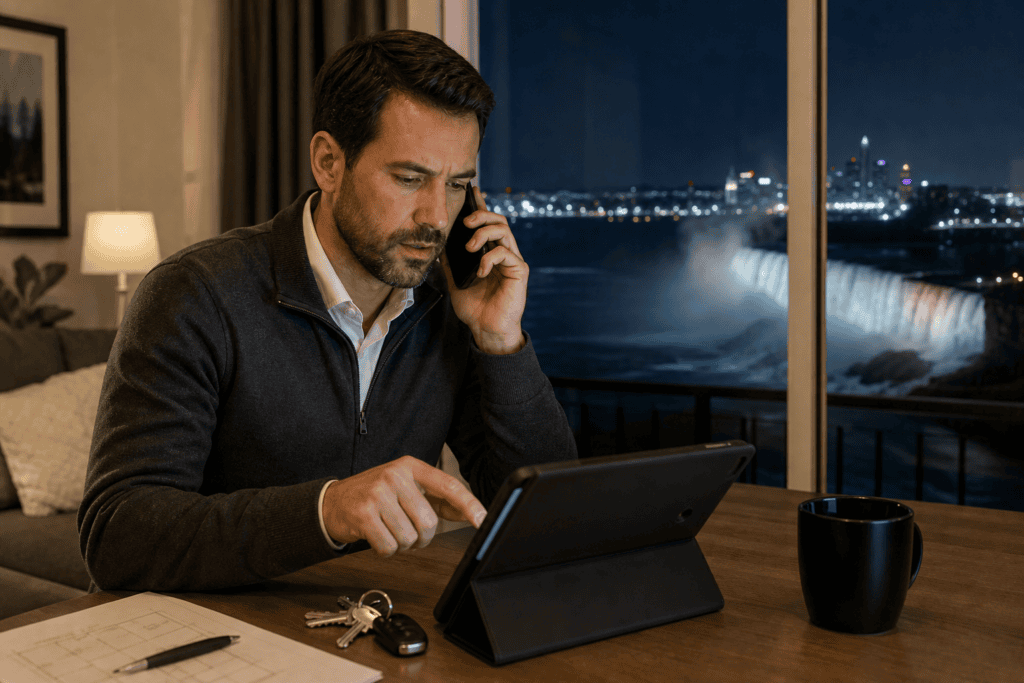
A 24/7 handyman SOP is a written process for receiving, assessing, assigning, documenting, and closing rental-property maintenance requests at any hour. It explains what happens when a guest, tenant, owner, or property manager reports a problem outside normal business hours.
Availability alone is not a complete maintenance system. A useful process also defines safety triage, communication, authorization, dispatch, temporary measures, record-keeping, and follow-up. The Home Away From Home Developments Inc. publicly states that it offers 24/7 handyman services as part of its Niagara Falls property management and maintenance offering, but owners should confirm the exact workflow, coverage, escalation rules, and fees before engagement.
What is a 24/7 handyman SOP?
SOP means “standard operating procedure.” In a rental setting, a 24/7 handyman SOP is the repeatable set of instructions used to manage maintenance requests during evenings, overnight hours, weekends, and holidays as well as regular business hours.
A well-defined SOP answers practical questions such as:
- Who receives the request after hours?
- What information must be collected before dispatch?
- How is the issue classified according to safety and urgency?
- When are the guest, tenant, owner, or emergency services contacted?
- Who can authorize a repair or temporary mitigation?
- What happens if a handyman is not the right person for the work?
- How are photographs, notes, invoices, and unresolved risks recorded?
The framework below is general rental-management guidance. It is not presented as HAH Developments’ internal SOP because no publicly documented HAH SOP was supplied.
The core stages of an after-hours maintenance SOP

1. Request intake and basic facts
The first stage is capturing enough information to make a safe decision. The person reporting the issue should identify the property, provide a callback number, describe where the problem is located, and explain whether anyone is in immediate danger.
Depending on the situation, the intake record may also include:
- The guest’s or tenant’s name and preferred contact method.
- When the problem was discovered and what happened beforehand.
- Whether water, smoke, gas, electricity, broken glass, heat, or access is involved.
- Photos or video, where collecting them is safe and practical.
- Whether the issue affects one room, the whole property, or neighboring units.
Intake should not require a guest or tenant to investigate a dangerous condition. Its purpose is to gather useful facts without asking an unqualified person to take risks.
2. Safety triage and issue classification
Triage determines what should happen next. A rental maintenance SOP will usually benefit from three broad categories, although the exact definitions should be agreed with the property manager:
- Immediate hazard: A condition that may threaten life, safety, or significant property damage, such as an uncontrolled leak, fire-related concern, dangerous electrical condition, or serious security problem. The process should explain when occupants must leave the area or contact emergency services.
- Urgent rental issue: A problem that may make the property materially unusable or insecure, such as a lock problem, heating failure during cold conditions, significant water intrusion, or broken glass. The SOP should define temporary measures and escalation.
- Routine repair: A non-urgent issue, such as a minor fixture problem or cosmetic defect, that can be scheduled without creating an immediate safety or habitability concern.
These are recommended planning categories, not HAH Developments’ specific policy. “24/7” should not mean every request receives the same response. A leaking pipe, a failed door lock, and a loose cabinet handle require different decisions.
3. Communication with guests, tenants, and owners
Communication is part of maintenance. A process should explain how the person reporting the issue receives confirmation, what information they are given, and how access will be arranged.
For short-term rentals, the process may need to account for a guest’s comfort, alternative access instructions, and the effect of a repair on the stay. HAH Developments describes short-term rental services that include guest communication, housekeeping and turnover cleaning, compliance management, and owner oversight and financial records on its short- and long-term rental services page.
For long-term rentals, communication may involve tenant access, lease-related responsibilities, repair updates, and documentation. HAH also describes long-term rental services that include leasing and lease management, rent collection, tenant relations, maintenance, and repairs on its long-term rental properties page.
A provider should explain how an after-hours request is acknowledged, who receives updates, how access is coordinated, when the owner is informed, and how unresolved work is handed over. These details should be confirmed without assuming an undocumented response-time promise.
4. Authorization, dispatch, and temporary mitigation
Once an issue is assessed, the SOP should guide the decision to dispatch a handyman, schedule a routine visit, arrange a qualified trade, or escalate to emergency services. It should also state who can authorize work and how owner approvals are handled.
Temporary mitigation may include isolating a water source, securing an access point, protecting an area from further damage, or providing safe instructions until the appropriate professional arrives. Each temporary measure should be documented and followed by a decision about permanent repair.
Owners should not assume every problem is suitable for a handyman. The provider should explain how it identifies work requiring a licensed or specialized trade, building access coordination, an insurer, utility provider, or emergency responders. Exact approval limits and escalation rules must be confirmed directly.
5. Repair documentation and follow-up
Closing a work order should mean more than sending someone to the property. The record should show what was reported, how it was classified, who attended, what was done, what materials or services were used, and whether further work is required.
Useful documentation may include:
- Time-stamped intake notes and photographs.
- The diagnosis or observed cause, when known.
- Work completed and temporary measures taken.
- Invoices, receipts, or cost estimates.
- Outstanding risks, parts, approvals, or specialist referrals.
- Confirmation that the guest or tenant was informed.
- A follow-up inspection or preventive-maintenance recommendation where appropriate.
HAH Developments publicly describes maintenance and repairs, preventive maintenance, property inspections, and owner oversight and financial records among its services. Owners should ask how those services connect to after-hours work and where resulting records can be reviewed. Its property management and maintenance information provides context for the company’s stated scope.
Emergency repairs versus routine maintenance
The following comparison is a general planning framework, not HAH Developments’ published response policy.
| Process point | Emergency or urgent issue | Routine repair |
|---|---|---|
| Primary concern | Safety, security, habitability, or rapidly increasing property damage | Condition, convenience, or maintenance that can safely wait |
| Initial action | Immediate triage and escalation | Record the request and arrange an appointment |
| Communication | Give clear safety and access instructions and keep affected people informed | Confirm the planned visit or next decision |
| Temporary measures | Contain risk until permanent work is possible | Usually unnecessary unless the condition worsens |
| Close-out | Document the response, remaining risk, costs, and follow-up | Record the repair and future maintenance needs |
How the process applies to short- and long-term rentals
The physical repair may be similar, but the operating context differs. In short-term rentals, a maintenance issue can affect an active reservation, guest experience, access instructions, cleaning schedules, and the next turnover. The manager may need to coordinate with a guest quickly while protecting the property and documenting its condition.
In long-term rentals, the process must also account for tenant communication, access arrangements, the lease relationship, recurring maintenance, and the condition of the home over time. A strong workflow should show which issues are recorded for preventive work rather than treated as isolated calls.
HAH Developments states that it supports both short-term and long-term rentals in Niagara Falls and the broader Niagara Region. Its published descriptions connect short-term management with guest and booking support and long-term management with leasing, rent collection, tenant relations, maintenance, and repairs.
Questions to ask before choosing 24/7 handyman coverage
- Who receives after-hours requests? Ask whether calls, texts, emails, or platform messages are monitored and what happens if the first contact is unavailable.
- What is treated as an emergency? Request examples of hazards, urgent rental issues, and routine repairs.
- How are emergency services or qualified trades involved? Confirm how work outside a handyman’s scope is handled.
- When are owners contacted? Ask about approval thresholds and what happens when an owner cannot be reached.
- How is access arranged? Clarify procedures for occupied short-term rentals, tenant homes, vacant properties, and controlled-access buildings.
- What records will the owner receive? Confirm whether work notes, photos, invoices, inspection findings, and unresolved items are available.
- How are preventive maintenance and inspections connected? Find out whether repeated repairs trigger a broader property review.
- How are fees handled? Ask about management charges, after-hours charges, materials, emergency call-outs, subcontracted work, and approval requirements.
HAH Developments provides contact and service information for owners considering property management and maintenance support. Owners can use the company’s contact page to ask for the coverage and terms available for a particular property.
What HAH Developments publicly confirms
The Home Away From Home Developments Inc. is a Niagara Falls-based property management company serving short-term and long-term rental properties. Its public service information states that the company offers 24/7 handyman services as part of its property management and maintenance offering.
The company also publicly describes maintenance-related services including maintenance and repairs, preventive maintenance, property inspections, cleaning and turnover support, glass repair, and lawn care and landscaping.
HAH describes its service area as Niagara Falls and the broader Niagara Region. These facts establish the company’s stated service categories, but they do not establish a specific response time, staffing arrangement, emergency guarantee, approval threshold, or detailed internal SOP. Those details should be confirmed directly through its services page, property management and maintenance page, or about page.
What a handyman SOP cannot replace
A written maintenance process improves consistency, but it does not replace judgment or specialist support. An SOP should direct occupants to emergency services when there is an immediate threat to life or safety. It should also identify work needing a qualified or licensed trade, insurer, utility provider, building manager, or other appropriate professional.
It cannot remove the need for property-specific safety decisions, clear owner authorization terms, suitable insurance arrangements, or compliance with applicable legal and building requirements. Nor can “24/7 handyman” establish that every repair will be immediate or that every type of work is included.
Frequently asked questions
Does 24/7 handyman service mean repairs happen immediately?
No. It generally describes availability for receiving or responding to requests. The actual response, dispatch, escalation, and repair timing should be confirmed with the provider.
Should a 24/7 handyman SOP include owner approval rules?
Yes. Owners should understand which work can proceed without prior approval, how urgent costs are handled, and what happens when the owner cannot be reached.
When should a maintenance issue be escalated beyond a handyman?
Escalation may be appropriate for immediate safety threats, specialized or licensed work, significant damage, utility problems, insurance matters, or situations requiring emergency responders.
What should rental owners ask about after-hours maintenance records?
Ask whether the provider records the original report, triage decision, attendance, work completed, photographs, costs, unresolved risks, and required follow-up.
Conclusion: evaluate the process, not just the promise
A 24/7 handyman SOP is the operating structure behind after-hours maintenance coverage. It should show how requests are received, triaged, communicated, authorized, dispatched, documented, and followed up. The most useful test is whether the process distinguishes a safety emergency from a routine repair and gives owners a clear record of what happened.
For Niagara rental owners, the next step is to ask for the provider’s actual workflow and confirm its response boundaries, escalation arrangements, owner approvals, records, qualified-trade referrals, preventive maintenance, inspections, and fees. HAH Developments publicly confirms 24/7 handyman services and related property-management and maintenance offerings, while precise coverage for an individual property should be discussed directly.
Owners in Niagara Falls and the Niagara Region can contact The Home Away From Home Developments Inc. to ask about available handyman coverage, maintenance services, and support for their short-term or long-term rental.