

You open your Airbnb calendar and see three empty weeks staring back at you. Your first instinct is to slash the price. It feels logical – lower the rate, get more bookings, right?
Here’s the problem. That instinct is costing hosts real money in 2026, and the data proves it.
Across the United States, short-term rental supply has grown faster than guest demand for two years running. The national average occupancy rate has slid from roughly 57% in 2024 to somewhere between 50% and 54% today. More listings are chasing a demand pool that isn’t growing at the same pace, and the easiest reaction – cutting your nightly rate – usually makes things worse, not better.
Property owners in Niagara Falls are watching this play out locally too. With over 1,100 active short-term rental listings and a median occupancy rate hovering around 52%, the market has matured. The wineries, the Falls, and 12 million annual visitors still create strong demand, but the easy money era of “list it and it books itself” is over.
The good news is that the hosts who are thriving right now aren’t the ones with the cheapest listings. They’re the ones running a disciplined Airbnb pricing strategy that treats every dollar and every night as something to protect, not give away. This guide walks through exactly how to do that – with current data, practical tools, and the specific regulatory context that Niagara Falls hosts need to know before they touch a single price setting.
Why Lowering Your Airbnb Rates Isn’t the Answer in 2026
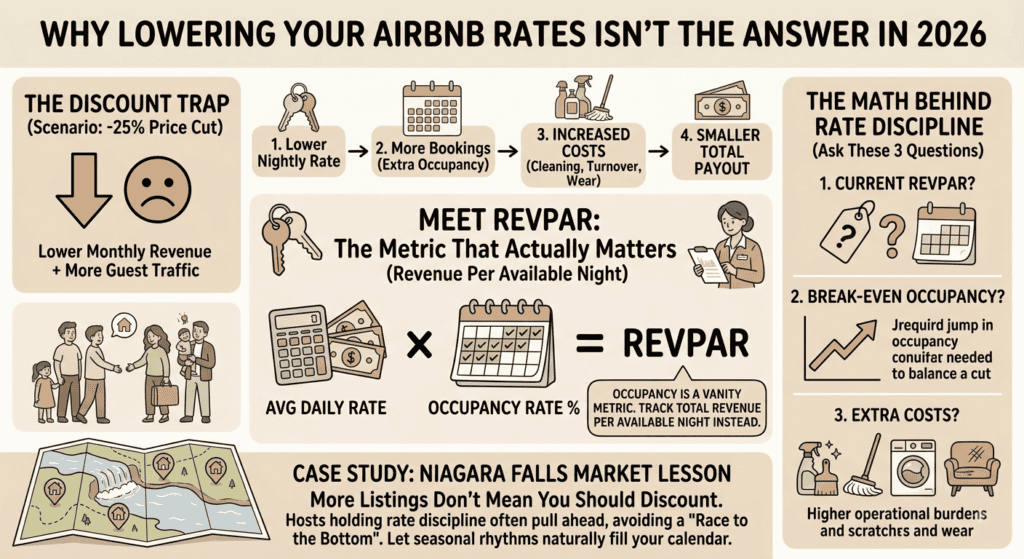
Discounting feels safe because it’s simple. Drop the price, watch the calendar fill in. But the math rarely works out the way hosts expect.
Take a listing with a $350 average nightly rate running at 47% occupancy. A host who discounts by 25% to chase an extra 15 percentage points of occupancy typically ends up earning less per month, not more, once you account for the lower rate across every booked night. Add in cleaning and turnover costs – which usually run somewhere between $85 and $150 per stay – and that gap widens further. More bookings at a lower price often means more turnovers, more cleaning fees out of your pocket, and more wear on the property, all for a smaller total payout.
This is why experienced hosts and revenue managers have shifted their thinking. Occupancy alone is a vanity metric. What actually matters is total revenue per available night.
What Is RevPAR and Why It Matters More Than Occupancy
RevPAR stands for Revenue Per Available Night (sometimes called Revenue Per Available Room, borrowed from the hotel industry). You calculate it by multiplying your average daily rate by your occupancy rate.
A property earning $300 a night at 60% occupancy generates roughly the same RevPAR as a property earning $200 a night at 90% occupancy. On paper, the second listing looks busier and more “successful.” In reality, both are performing about the same – except the $200 listing is absorbing three times the guest turnover, wear, and operational workload for that result.
Tracking RevPAR instead of occupancy alone changes how you think about every pricing decision. Suddenly, a quiet week isn’t automatically a crisis that needs a discount. Sometimes it’s simply a normal part of the seasonal rhythm, and the smarter move is to hold firm and let the calendar catch up.
The Math Behind Discounting vs Holding Rate
Before you touch your rates, run the numbers on paper. Ask three questions:
- What is my current RevPAR at today’s price and occupancy?
- What occupancy increase would I actually need to break even on a rate cut?
- What would that extra occupancy cost me in cleaning fees, wear, and guest turnover?
In most cases, the occupancy increase required to justify a meaningful discount is larger than what actually shows up. That’s the trap. Hosts discount expecting a flood of bookings and get a trickle, while their existing bookings now pay less than they would have anyway.
Some markets illustrate this shift clearly. In one well-supplied U.S. market with nearly 7,000 active listings, average daily rate climbed close to 30% year-over-year even as new competition flooded in, because operators held their nerve on rate instead of racing each other to the bottom. The lesson translates directly to Niagara Falls: more listings on the market doesn’t automatically mean you need to discount. It often means the hosts willing to hold rate discipline pull ahead of everyone else who panics and cuts price at the first sign of a quiet week.
Understanding the Airbnb Pricing Strategy That Actually Works
A genuinely effective Airbnb pricing strategy isn’t about finding the lowest price that fills your calendar. It’s about finding the highest price the market will bear on any given night, then filling the remaining gaps intelligently instead of broadcasting a blanket discount across your whole calendar.
This approach rests on four pillars:
- A well-researched base price built on real market data, not guesswork.
- Dynamic pricing that adjusts daily based on demand signals.
- Smart minimum-stay rules that block low-value bookings without blocking good ones.
- Targeted, temporary discounts aimed only at the specific nights that need help – not your entire calendar.
Get the first two right, and you’ll rarely need the fourth. Let’s break down how to build each piece.
Building a Smart Base Price Before You Touch Dynamic Pricing
Every pricing tool, algorithm, and strategy in this guide depends on one thing: an accurate base price. Set it too high, and dynamic pricing tools will constantly discount you back down to reality, training your listing to look desperate. Set it too low, and you leave money on the table every single night, even during your busiest weeks.
Benchmark Against Your Niagara Falls Market
Start by pulling data on comparable listings in your specific zone. In Niagara Falls, this matters more than in most cities because short-term rentals are legally restricted to designated tourism, commercial, and general commercial zones. Your true competitive set isn’t “Niagara Falls” broadly – it’s the specific cluster of licensed vacation rental units operating near the Falls, Clifton Hill, or the wine route, depending on where your property sits.
Look at:
- Average daily rate for similar bedroom counts and property types in your zone
- Occupancy rates for those comparable listings
- How rates shift across shoulder season, peak summer, and winter
Third-party tools like AirDNA, Airbtics, and PriceLabs’ Market Dashboard can pull this neighborhood-level data for you, saving hours of manual research.
Common Base Price Mistakes
The most frequent error hosts make is copying a neighbor’s listed price instead of their actual booked rate. A competitor showing $250 a night might really be booking at $190 after built-in discounts. Chase the wrong number and you’ll systematically underprice your own property.
The second common mistake is setting a base price once, at launch, and never revisiting it. Markets shift. Insurance costs rise. New competing listings launch nearby. A base price review should happen at least quarterly, ideally at the start of each season.
A third mistake worth naming: pricing your entire property type the same regardless of unit size, view, or amenities. A two-bedroom unit near Clifton Hill with a Falls-adjacent view and in-suite laundry is not competing in the same tier as a comparable unit three streets back with neither feature. Segment your comp set as tightly as you can, even if that means a smaller sample size, because a base price built on the wrong comparables will be wrong in either direction – too aggressive or too conservative – for the entire season.
Dynamic Pricing Tools That Do the Heavy Lifting
Manually updating your rates every day isn’t realistic once you own more than one listing – and honestly, it’s inefficient even with just one. This is where dynamic pricing tools come in, automatically adjusting your nightly rate based on booking pace, local events, competitor availability, and seasonality.
Airbnb Smart Pricing vs Third-Party Tools
Airbnb’s built-in Smart Pricing feature is free and easy to turn on, but it’s designed to optimize for one outcome: getting a booking to happen on Airbnb’s platform. That’s a different goal than maximizing your personal revenue, and the two only fully align during slow periods. During high-demand stretches, Smart Pricing tends to undersell your listing’s real value.
Third-party platforms such as PriceLabs, Beyond Pricing, and Wheelhouse go further. They let you layer your own rules – event pricing, day-of-week adjustments, seasonal overrides – on top of algorithmic demand forecasting, while keeping you in control of the floor and ceiling.
Setting Price Floors and Ceilings
Whichever tool you choose, never let an algorithm run without guardrails. Set a firm minimum price below which you’d genuinely rather leave a night empty than book it, factoring in your cleaning costs, mortgage or management fees, and desired margin. Set a ceiling too, so a sudden demand spike doesn’t push your rate so high it scares off otherwise-strong bookings.
Review these guardrails monthly. Tools occasionally reset to default settings after software updates, so a quick check protects you from silently drifting back to underpriced nights.
Minimum Stay Strategy: The Overlooked Occupancy Lever
Most hosts obsess over nightly rate and completely ignore minimum-stay settings, even though this single toggle can be worth thousands of dollars a year.
The Lead-Time Ladder Approach
Instead of a flat minimum stay year-round, use a lead-time ladder that tightens far out and loosens as the date approaches:
- 30+ days out: three-night minimum, protecting your calendar from low-value single-night bookings
- 14 to 29 days out: two-night minimum
- Inside 7 days: one-night minimum, but only on dates that are already isolated between two other bookings
This structure keeps your calendar oriented toward higher-value, longer stays while still capturing last-minute demand instead of losing it entirely to an empty night.
Data on 3-4 Night Minimums vs 1-Night Minimums
A large-scale 2026 analysis of millions of Airbnb listings found that properties running a three-to-four-night minimum earned meaningfully more per year on average than listings using a one-night minimum – a gap worth several thousand dollars per property annually. The reasoning makes sense once you consider the full picture: every extra turnover means another cleaning fee out of pocket, more wear on furniture and linens, and a higher share of higher-risk, lower-quality single-night bookings.
A one-night minimum feels flexible, but across a full year it quietly erodes your bottom line.
Fixing Gap Nights and Orphan Dates Without Crashing Your Rate
What Are Gap Nights and Why They Cost You
A gap night – sometimes called an orphan night – is a short, isolated vacancy created by the timing of two separate reservations. A guest checks out Tuesday morning and the next guest checks in Thursday, leaving a single unbookable-looking Wednesday sitting empty because it doesn’t meet your minimum-stay requirement.
Most hosts find somewhere between eight and twenty of these gap nights per listing every quarter. Left unaddressed, industry estimates suggest gap nights alone can cost property managers 5% to 15% of potential annual revenue.
Automated Gap-Night Discount Rules
The fix isn’t discounting your whole calendar – it’s targeting only the specific orphaned nights. Most dynamic pricing tools can automatically detect these gaps and apply a temporary 10% to 20% discount only on those isolated dates, while your minimum-stay rule temporarily drops to one or two nights just for that window.
The logic here matters: a discounted night that books still generates revenue. An empty night generates zero. Targeted, temporary discounts on true gap nights don’t cheapen your overall pricing strategy – they simply prevent guaranteed losses.
Manual Tactics for Solo Hosts
If you’re managing your listing without dynamic pricing software, you can still apply the same logic manually. Once a month, scan your calendar for isolated single-night or two-night gaps between confirmed bookings. Message previous guests whose checkout created the gap directly – they already know and like your property, and this often converts better than a public discount ever will. If that doesn’t fill the date within 48 hours, apply a temporary promotion through Airbnb’s built-in discount settings under Pricing & Availability, specifically for that date range.
Length-of-Stay Discounts That Protect Your Nightly Rate
Weekly and Monthly Discount Structures
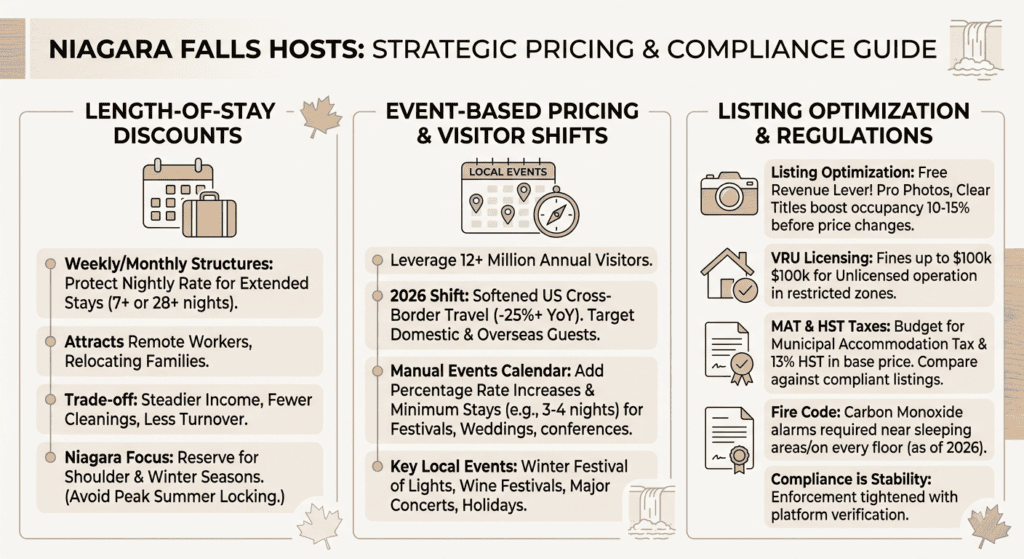
Extended-stay discounts – typically applied to bookings of seven or more nights (weekly) or twenty-eight or more nights (monthly) – serve a different purpose than gap-night discounts. They’re aimed at attracting remote workers, relocating families, and long-stay travelers who want a lower per-night rate in exchange for guaranteeing you an extended, low-turnover booking.
This trade-off can be genuinely worth it: fewer cleanings, less guest turnover, and steadier income, even at a reduced nightly rate.
When Extended Stays Make Sense for Niagara Falls Properties
For a destination like Niagara Falls, where demand skews heavily toward short leisure trips tied to the Falls and wine country, weekly and monthly discounts are best reserved for shoulder season and winter months, when short-stay leisure demand naturally drops. During peak summer, when short-stay ADR is at its highest, extended-stay discounts can actually cost you money by locking in a lower rate during the exact window you’d otherwise command premium pricing.
Event-Based and Seasonal Pricing for Niagara Falls Hosts
Leveraging Niagara’s 12+ Million Annual Visitors
Niagara Falls draws more than 12 million visitors a year, giving hosts a demand base that few other Ontario markets can match. That said, 2026 has brought a notable shift: cross-border travel from the United States has softened, with data showing Canadian-resident return trips to the U.S. dropping over 25% year-over-year, prompting the region’s tourism boards to lean harder into domestic and overseas visitor campaigns.
For hosts, this means diversifying your guest acquisition strategy – highlighting multi-day itineraries, off-peak travel value, and appeal to non-U.S. international travelers – rather than assuming cross-border demand alone will fill your calendar the way it once did.
Building a Local Events Calendar
Dynamic pricing algorithms are good at reading broad market signals, but they routinely miss smaller local events: festivals, wedding-heavy weekends, wine industry events, and regional tournaments that can spike demand within a 25-mile radius. Build your own twelve-month calendar of every notable event near your listing and manually apply a percentage rate increase on those dates rather than relying solely on automated tools to catch them.
For Niagara Falls specifically, that calendar should include the Winter Festival of Lights, Canada Day and Victoria Day long weekends, major wine festival dates in Niagara-on-the-Lake, concerts at the Fallsview and Rapidsview venues, and any large conferences booking out downtown hotel blocks. Once you’ve mapped these dates, apply a firm minimum-stay override – three or four nights on the biggest weekends – rather than just a price bump. A higher minimum stay on a high-demand weekend does two things at once: it filters out low-value single-night bookings and it protects your ability to capture a full-weekend booking at premium pricing instead of two smaller ones stitched together at a discount.
Review each event date the week after it passes. If you sold out easily at your override rate, raise it slightly for next year. If demand was softer than expected, ease off. This kind of year-over-year calibration is what separates a pricing strategy that improves annually from one that stays static and slowly falls behind the market.
Listing Optimization: The Free Lever Before You Touch Price
Photos, Titles, and Guest Experience Signals
Before adjusting a single price setting, make sure your listing itself is doing its job. Professional photography, a clear and specific title, and a well-written description can shift booking behavior significantly – some hosts see a 10 to 15 percentage point swing in occupancy purely from stronger visual presentation, without changing price at all.
This matters because a strong listing lets you hold a higher base price with confidence. Guests pay more for a property that visually signals quality and trustworthiness before they’ve read a single review.
Ontario and Niagara Falls Regulations That Affect Your Pricing Strategy
No Airbnb pricing strategy works if your listing isn’t legally allowed to operate, so compliance has to come first.
VRU Licensing and MAT Tax Considerations
In Niagara Falls, short-term rentals are regulated as Vacation Rental Units (VRUs) and are permitted only in designated tourism, commercial, and general commercial zones – not standard residential neighborhoods. Operating without a valid license, or advertising an unlicensed property, can bring fines ranging from $50,000 for a first offense up to $100,000 for repeat violations, and non-compliant listings can now be flagged and blocked directly through platform-level enforcement.
Hosts also need to budget for Ontario’s 13% Harmonized Sales Tax alongside Niagara Falls’ Municipal Accommodation Tax, which is applied per night and helps fund regional tourism infrastructure. As of January 1, 2026, the Ontario Fire Code also requires carbon monoxide alarms near sleeping areas and on every floor of a short-term rental, regardless of municipality.
It’s worth factoring these costs directly into your base price calculation rather than treating them as an afterthought. A host who benchmarks against a competitor’s advertised nightly rate without accounting for whether that competitor is fully compliant, licensed, and remitting the correct taxes may end up underpricing their own fully compliant listing. Build your MAT and HST obligations into your minimum acceptable rate from the start, so your price floor already reflects your true cost of doing business legally.
It’s also worth noting that Ontario currently has no single province-wide short-term rental law – every municipality in the Niagara Region sets its own zoning, licensing, and tax rules independently. A pricing and management approach that works for a property in Niagara-on-the-Lake won’t necessarily transfer directly to a property in Niagara Falls, so hosts operating across multiple municipalities need to track each jurisdiction’s requirements separately.
Staying Compliant While Maximizing Revenue
Regulatory compliance and revenue optimization aren’t in conflict – a licensed, compliant listing is simply a more stable one. Enforcement in Ontario has tightened significantly across 2025 and 2026, with several municipalities now integrating directly with booking platforms to verify license numbers before a listing can even go live. Building your pricing strategy on top of a fully compliant operation protects the income you’re working to grow.
Common Pricing Mistakes That Quietly Kill Revenue
Even hosts who understand the theory behind a strong Airbnb pricing strategy often fall into a handful of avoidable traps in practice.
Stacking multiple discounts on the same night. A gap-night discount, a last-minute discount, and a length-of-stay discount can all apply to the same date if you’re not careful, quietly cutting your rate by 30% or more without you realizing it. Check your settings for overlap at least once a season.
Reacting to a single slow week. One quiet week isn’t a trend. Before adjusting your base price, compare the current stretch against the same period last year and against your local market’s typical seasonal pattern. A short lull in early spring, for example, is often completely normal for Niagara Falls and doesn’t call for a rate cut.
Copying competitor discounts instead of competitor demand. If every other host in your area is offering 20% off last-minute stays, matching that discount doesn’t protect your booking pace – it just resets the market’s expectations lower for everyone, including you. Sometimes the more profitable move is holding your price while a thin, discount-heavy market works itself out.
Ignoring day-of-week patterns. Many hosts apply the same pricing logic to every night of the week. Pull your own booking history and check occupancy by day. If Friday and Saturday consistently outperform Tuesday and Wednesday, your pricing tool should be doing far more than the default day-of-week adjustment – you may need custom, larger swings that reflect your specific property’s actual demand curve.
Forgetting to revisit price floors after cost increases. If your cleaning fees, property taxes, or management costs rise, your price floor needs to rise with them. A floor set two years ago may now guarantee you’re losing money on every discounted or gap-night booking that hits it.
How Professional Property Management Improves Occupancy Without Discounting
Running a disciplined pricing strategy – daily rate adjustments, gap-night monitoring, minimum-stay ladders, event calendars, and regulatory compliance – is a genuinely demanding, ongoing job. Most independent hosts start strong and gradually let it slide once life gets busy, which is exactly when occupancy and revenue quietly start to slip.
This is where working with an experienced property manager changes the equation. At The HAH Developments, we combine local Niagara Falls market data with dynamic pricing tools, gap-night monitoring, and full regulatory compliance management, so your rates stay competitive every single day, not just when you remember to check them. Our Airbnb hosting and co-hosting services are built specifically around protecting your nightly rate while keeping your calendar full – the exact balance this guide has walked through.
Conclusion
A strong Airbnb pricing strategy in 2026 isn’t about finding the lowest price on the block – it’s about protecting the value of every night on your calendar while intelligently filling the specific gaps that actually need help. Build your base price on real local data, layer in dynamic pricing with firm guardrails, use a lead-time ladder for your minimum stays, and target discounts only at true orphan nights and off-peak stretches. Combined with full regulatory compliance in a market like Niagara Falls, this approach consistently outperforms blanket discounting over the long run.
If managing all of this feels like more than you have time for, The HAH Developments is here to help. Our team handles pricing strategy, compliance, and day-to-day management for Airbnb hosts across the Niagara Region, so your property stays fully booked and fully compliant, without you having to check your calendar every day.
Ready to maximize your rental income without racing to the bottom on price? Contact The HAH Developmentstoday for a free consultation on your property’s pricing and management strategy.
Frequently Asked Questions
What is a good Airbnb occupancy rate in 2026?
Generally, 55% or higher is considered healthy, 65% or higher is strong, and 75% or higher signals a high-demand market. However, “good” varies significantly by city, so compare your listing against your specific local market average rather than a national benchmark.
Should I lower my Airbnb price if my calendar looks empty?
Not automatically. Run the RevPAR math first. In many cases, a rate cut requires a larger occupancy increase than actually materializes, leaving you with lower total revenue despite a fuller-looking calendar.
What is the difference between Airbnb Smart Pricing and third-party dynamic pricing tools?
Airbnb Smart Pricing is free and optimizes for getting a booking on Airbnb’s platform specifically. Third-party tools like PriceLabs, Beyond Pricing, and Wheelhouse let you layer in your own rules, price floors, and event-based adjustments, generally giving hosts more control over maximizing personal revenue rather than platform bookings.
How do I fix gap nights in my Airbnb calendar?
Use a dynamic pricing tool to automatically detect isolated one or two-night gaps between bookings and apply a temporary 10% to 20% discount only on those specific dates, alongside a temporarily lowered minimum stay. Avoid discounting your entire calendar to fix what is usually a handful of isolated dates.
Do I need a license to run an Airbnb in Niagara Falls?
Yes. Niagara Falls requires a Vacation Rental Unit license for entire-home short-term rentals, and these are only permitted in designated tourism, commercial, and general commercial zones. Operating without a license can result in fines up to $100,000 for repeat violations.
Is professional Airbnb management worth it for maximizing occupancy?
For many owners, yes. Professional management brings daily pricing oversight, gap-night monitoring, compliance management, and local market expertise that’s difficult to maintain consistently as an independent host, particularly across multiple properties.