
If you own – or you’re thinking about buying – a short-term rental near the Falls, you already know the opportunity is real. Millions of visitors pour into Niagara Falls every year, hotel rates stay stubbornly high during peak season, and travelers increasingly want a home-like stay with a kitchen, a living room, and a little more privacy than a hotel corridor offers. On paper, it looks like easy money.
In practice, it’s not that simple. Niagara Falls has tightened its short-term rental rules over the past two years, guest expectations have climbed, and pricing a property correctly now requires real data instead of guesswork. Hosts who treat their Airbnb like a part-time hobby are watching their occupancy and their margins slide, while hosts who treat it like a small hospitality business are pulling ahead.
This guide breaks down exactly what Airbnb property management Niagara Falls looks like in 2026 – the licensing rules you need to follow, what a property manager actually does day to day, how much it costs to self-manage versus hire out, and the strategies that are working right now to grow revenue in this market. Whether you’re a first-time host or you already own a few units, you’ll walk away with a clear picture of what it takes to run a profitable, compliant short-term rental in this city.
Why Niagara Falls Is One of Ontario’s Best Short-Term Rental Markets in 2026
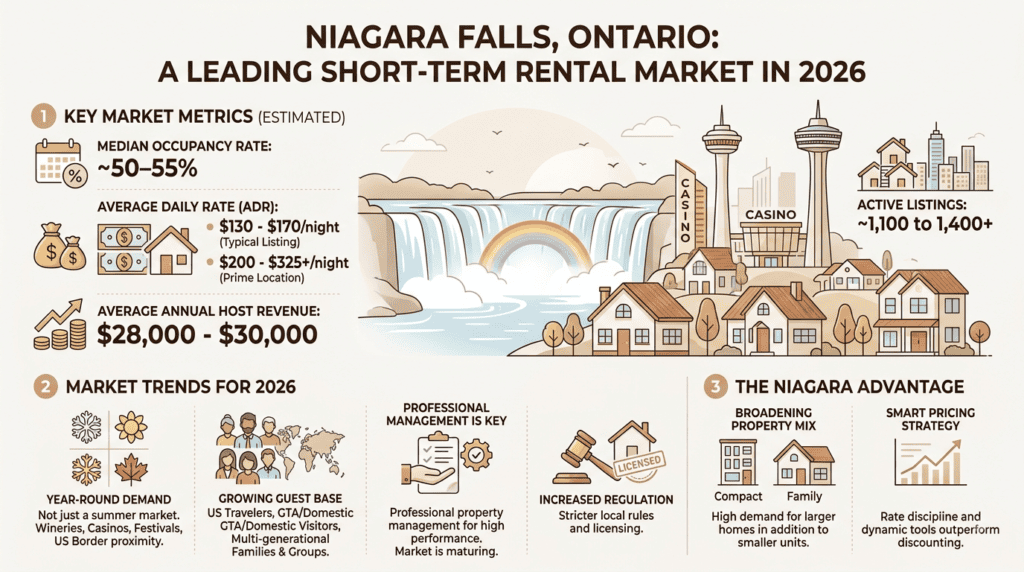
Niagara Falls isn’t a seasonal novelty market anymore – it’s a year-round tourism engine. The Falls themselves draw visitors in every month of the year, and the region’s wineries, casinos, festivals, and proximity to the U.S. border keep demand steady even outside the classic summer rush.
The numbers back this up. Recent market data shows the median Airbnb occupancy rate in Niagara Falls sitting around 50–55%, with roughly 1,100 to 1,400 active listings competing across the city at any given time. Average daily rates vary widely by property type and location, but typical listings earn somewhere between $130 and $170 per night, while top-performing properties in prime tourist zones regularly command $200 to $325 or more per night. Average annual host revenue in the market currently lands in the $28,000 to $30,000 range per listing, though well-managed, well-located properties can significantly outperform that figure.
A few trends are shaping the market heading into the rest of 2026:
- Seasonality is real but not extreme. July and August remain the strongest months for both occupancy and rate, but shoulder seasons (spring and fall) are increasingly bookable thanks to wine tourism, fall foliage travel, and holiday getaways.
- Rate discipline is outperforming occupancy chasing. Hosts who hold their nightly rates and let dynamic pricing tools work the calendar are generally outearning hosts who discount aggressively to fill every night.
- The market isn’t oversaturated, but it is maturing. With well over a thousand active listings, generic, poorly photographed, or overpriced properties are getting buried in search results. Guests have more choice than ever, which raises the bar on presentation and service.
- Regulation is tightening. The days of running an unlicensed short-term rental quietly in a residential neighborhood are effectively over in Niagara Falls (more on this below).
None of this means the opportunity has disappeared – it means the bar for doing it well has gone up. That’s exactly where structured Airbnb property management Niagara Falls comes in: turning a property with strong fundamentals into one that actually captures the revenue the market is offering.
It also helps to understand who’s actually staying in these properties. A meaningful share of Niagara Falls guests come from outside Canada, with U.S. travelers forming one of the largest visitor segments, alongside strong domestic demand from the Greater Toronto Area and other parts of Ontario looking for a quick weekend getaway. That mix matters for how you plan your calendar: American long weekends, Canadian statutory holidays, and school breaks all create separate demand spikes worth pricing around, rather than treating the calendar as one uniform season.
The property mix in the market is broadening too. Where the earliest wave of Niagara Falls short-term rentals leaned heavily on small condos and hotel-style suites close to Clifton Hill, there’s now growing demand for larger homes that can host multi-generational families or groups splitting the cost of a trip to the Falls. Larger properties with more bedrooms tend to carry higher nightly rates and, when priced correctly, a better revenue-per-square-foot outcome than smaller units competing purely on price.
Understanding Niagara Falls Short-Term Rental Rules Before You List
Before you post a single listing, you need to understand the city’s Vacation Rental Unit (VRU) bylaw. Niagara Falls has one of the more actively enforced short-term rental frameworks in the region, and getting this wrong can be expensive.
VRU Licensing Requirements and Fees
Every short-term rental in Niagara Falls – defined as a stay of 28 consecutive days or less – needs a valid Vacation Rental Unit license issued by the City. The initial license application fee is $500, with an annual renewal fee of $250 after that.
To get licensed, hosts typically need to provide:
- Proof of ownership of the property
- Commercial insurance with a minimum of $2 million in liability coverage
- Site and floor plans
- A Fire Department inspection covering your fire safety plan, smoke and carbon monoxide detectors, and extinguishers
- A Niagara Region Health inspection for sanitation and water safety
- An Electrical Safety Authority (ESA) certificate
Once approved, your license number has to be displayed on every listing and advertisement, across every platform you use – Airbnb, Vrbo, Booking.com, and any others.
Zoning Restrictions: Where You Can (and Can’t) Operate
This is where a lot of new hosts get tripped up. VRUs are only permitted in designated Tourist Commercial (TC), General Commercial (GC), and Central Business (CB) zones. Most standard residential neighborhoods do not allow short-term rentals at all, regardless of whether the owner lives there or not.
Before you buy a property with Airbnb income in mind – or before you list a property you already own – check the zoning designation directly with the City. A beautiful house on a quiet residential street might be a fantastic long-term rental, but it may be legally off-limits for short-term guests.
The Owner-Occupied Short-Term Rental (OOSTR) Pilot Program
For owners who live on-site, the City introduced a 14-month Owner Occupied Short-Term Rental pilot program, capped at 100 licenses citywide and set to run through the end of September 2026. This allows an owner to rent out an additional dwelling unit on their property – like a basement suite or laneway unit – as a short-term rental, provided they:
- Live on the property as their principal residence (generally 183+ days per year)
- Are present during the full duration of every guest stay
- Rent to a single group per booking, not individual rooms
- Hold Canadian permanent residency status
- Follow all applicable zoning rules
This route works well for house-hacking-style investors who want short-term rental income from a secondary unit without buying a separate commercial-zoned property. It’s not a substitute for a straightforward investment property strategy, since it requires the owner’s physical presence during stays, and the pilot’s future beyond September 2026 will depend on a council decision.
Municipal Accommodation Tax and Other Costs
Niagara Falls charges a Municipal Accommodation Tax (MAT) on short-term stays, and the structure has shifted recently – moving from a flat per-night fee toward a percentage-based or star-rating-based model depending on the property type, with HST applied on top. Airbnb generally collects and remits this automatically for bookings made through its platform, but VRU and OOSTR operators are still responsible for quarterly remittance on any bookings taken outside major platforms. Because this figure has been actively revised, always confirm the current rate directly with the City before finalizing your pricing model or investment pro forma.
Penalties for Operating Without a License
The City takes enforcement seriously. Operating an unlicensed VRU can result in fines of up to $50,000 for a first offence and up to $100,000 for repeat violations, plus unpaid fines being added directly to your property tax bill. Niagara Falls also uses a three-strike enforcement system: three valid violations or convictions – commonly tied to noise or nuisance complaints – result in automatic license revocation and a mandatory six-month wait before you can reapply.
Licensed VRU operators must also designate a “responsible person” who is reachable 24/7 and able to reach the property within one hour if a problem arises. This requirement alone is a major reason many owners choose to work with a property management company rather than trying to be on call around the clock themselves.
What Does Airbnb Property Management Niagara Falls Actually Involve?
“Property management” can mean very different things depending on who you ask. For a short-term rental specifically, professional Airbnb property management Niagara Falls typically covers six core areas.
Listing Creation and Optimization
Your listing is your storefront. A strong listing includes professional photography, a compelling title and description built around what guests are actually searching for, an accurate and complete amenities list, and a pricing structure that reflects your property’s real position in the market. Small details – like highlighting proximity to the Falls, Clifton Hill, or the wine route – make a measurable difference in click-through and booking rates.
Dynamic Pricing and Revenue Management
Static, “set it and forget it” pricing is one of the fastest ways to leave money on the table in a seasonal market like this one. Professional management uses dynamic pricing tools that adjust nightly rates in real time based on demand, local events, competitor pricing, and booking pace. Industry data suggests the gap between static and algorithmic pricing can run 15–25% in annual revenue – a meaningful difference on a property already earning $28,000-plus per year. The best approach layers human judgment on top of the algorithm, since software alone won’t always catch a major local event, a wine festival weekend, or a shift in booking pace that calls for holding your rate rather than discounting.
Guest Communication and Booking Management
Guests expect fast responses – often within minutes, not hours. That means managing inquiries, confirming bookings, sending check-in instructions, answering questions during the stay, and handling any issues that come up, all without letting a slow response tank your response-rate metrics (which directly affects your search ranking on Airbnb).
Cleaning and Turnover Coordination
Every guest expects a hotel-clean space, and turnovers in a high-occupancy market can happen same-day, back-to-back. This requires a reliable cleaning team, a consistent quality-control checklist, restocking of consumables, and a system for catching maintenance issues before the next guest walks in the door.
Maintenance and Property Care
Short-term rentals see more wear and tear than long-term tenancies simply because of turnover frequency. Professional management includes routine inspections, prompt repairs, seasonal maintenance (winterizing pipes, eavestrough cleaning, landscaping), and a trusted network of local contractors who can respond quickly when something breaks mid-stay.
Compliance and Licensing Support
Given everything outlined in the section above, staying compliant with the City’s VRU bylaw is its own ongoing job – tracking renewal dates, keeping insurance current, maintaining booking records for the required three years, and staying current on the “responsible person” requirement. This is one of the most valuable – and most overlooked – parts of professional management, because the financial risk of falling out of compliance is significant.
Self-Managing vs. Hiring a Professional Airbnb Property Manager
There’s no universally “right” answer here – it depends on your time, your proximity to the property, your experience level, and how many units you own or plan to own.
The True Cost of Self-Management
Self-management looks free on paper, since there’s no management fee coming off your revenue. In reality, it costs significant time: listing setup, daily pricing adjustments, guest messaging at all hours, coordinating cleaners, handling maintenance calls, and managing your own bookkeeping. Owners who self-manage but never build real pricing discipline commonly leave 15–25% of potential revenue on the table in their first year simply because they’re reacting to bookings instead of proactively managing rate strategy. If you don’t live near the property, or you own more than one unit, the time cost compounds quickly.
What Professional Management Fees Typically Cover
Full-service Airbnb property management fees generally run in the range of 15% to 35% of gross booking revenue, depending on the scope of service, with most full-service models bundling dynamic pricing, guest communication, cleaning coordination, and reporting into that fee. In exchange, you’re paying for a team that already has cleaning crews, maintenance contractors, and pricing tools in place – infrastructure that would otherwise take significant time and money to build on your own.
Signs You Need Professional Support
Consider bringing in a property manager if any of the following sound familiar:
- You don’t live in or near Niagara Falls, or you can’t be reachable within an hour as the bylaw’s “responsible person” requires
- You own multiple properties and pricing/guest communication is becoming a full-time job
- Your occupancy or nightly rate is noticeably below comparable listings in your area
- You’re finding compliance paperwork (renewals, inspections, tax remittance) genuinely difficult to keep on top of
- You want to treat your rental as an investment, not a second job
How to Choose the Right Airbnb Property Management Company in Niagara Falls
Not all property managers offer the same level of service, and the fee percentage alone doesn’t tell you much. Here’s what actually matters.
Questions to Ask Before Signing
- Do you hold or manage active VRU licenses for other Niagara Falls properties, and can you help with the application and renewal process?
- What dynamic pricing tool do you use, and how often are rates adjusted?
- Who handles guest messaging, and what’s your average response time?
- Is your cleaning team in-house or subcontracted, and what’s your quality-control process for turnovers?
- Can you provide references or performance data from properties similar to mine?
- What’s included in your management fee, and what costs extra?
- How do you handle emergency maintenance outside business hours?
Red Flags to Watch For
Be cautious of any manager who is vague about local licensing requirements, unwilling to share performance data from existing clients, locked into a long, hard-to-exit contract, or relying entirely on “set and forget” automated pricing with no human oversight. A property manager who genuinely knows the Niagara Falls market should be able to speak specifically about zoning, the OOSTR pilot, and MAT requirements – not just general Airbnb hosting advice that could apply anywhere.
It’s also worth understanding the difference between a company that offers full-service management and one that only handles a single piece of the puzzle, like pricing or cleaning. Some operators focus purely on revenue management and expect the owner to still coordinate cleaners, maintenance, and compliance separately. Others bundle everything – licensing support, guest communication, turnovers, maintenance, and pricing – under one roof. Neither model is inherently wrong, but you should know exactly what you’re buying before you sign anything, and you should ask what happens operationally if you want to add a second property down the line. A manager who can scale with you as you grow your portfolio is generally a better long-term fit than one built around handling a single unit.
Maximizing Airbnb Revenue in Niagara Falls: Proven Strategies for 2026
Whether you self-manage or work with a property manager, these are the levers that are actually moving the needle in this market right now.
Seasonal Pricing and Local Events
Rates in Niagara Falls typically peak in the summer months and dip in February, but event-driven demand spikes – festivals, wine events, holiday weekends – can push rates up significantly for short windows. A pricing strategy that accounts for these fluctuations, rather than charging a flat rate year-round, consistently outperforms static pricing.
Amenities Guests Actually Pay For
Data across short-term rental markets consistently shows properties with hot tubs, strong Wi-Fi, in-suite laundry, and Falls-adjacent views or walkability commanding higher rates and better occupancy than comparable units without them. Even smaller upgrades – a well-stocked kitchen, blackout curtains, a coffee station – meaningfully improve guest reviews, which in turn improve your search ranking.
Professional Photography and Listing Presentation
With well over a thousand competing listings, photography is often the single biggest factor in whether a guest clicks on your property at all. Bright, wide-angle, professionally shot photos consistently outperform phone snapshots, even on otherwise identical properties.
Multi-Platform Distribution
Relying on Airbnb alone limits your visibility. Listing across Airbnb, Vrbo, and Booking.com – synced through a channel manager to avoid double bookings – expands the pool of potential guests without adding meaningful extra work once the systems are set up properly.
Rate Discipline Over Discounting
It’s tempting to slash your nightly rate the moment a week looks slow, but the data suggests holding your price and adjusting minimum-stay requirements or targeting last-minute bookers is often more profitable than chasing occupancy through discounts. Protecting your rate protects your margin, especially once cleaning and turnover costs are factored in.
A Simple Way to Think About the Numbers
It helps to run a rough scenario rather than thinking about percentages in the abstract. Take a typical Niagara Falls property earning close to the market median: around $150 a night at roughly 53% occupancy, which works out to close to 194 booked nights a year and roughly $29,000 in gross annual revenue.
Now layer in a few realistic adjustments. If professional photography, an optimized listing, and dynamic pricing lift the average nightly rate by even 10% and occupancy climbs a few points through better response times and stronger reviews, that same property can move into the mid-$30,000s in gross revenue without changing anything structural about the home itself. Subtract a management fee in the 15–25% range from that higher revenue figure, and the owner can still come out ahead of where they started – while doing far less of the day-to-day work themselves.
The reverse is also true. A property priced flat year-round, with mediocre photos and slow guest responses, will often sit below the market median even in a strong tourism year, simply because guests have so many comparable options to choose from instead. In a market with well over a thousand active listings, the properties that win aren’t necessarily the newest or the most expensive – they’re the ones that are priced intelligently and presented well, consistently, month after month.
This is the core argument for treating Airbnb property management Niagara Falls as an active discipline rather than a one-time setup task. The market rewards attention, and it quietly penalizes properties that are left on autopilot.
Common Mistakes First-Time Niagara Falls Airbnb Hosts Make
- Buying or listing a property before confirming zoning. A gorgeous residential property can turn out to be legally ineligible for short-term rental use.
- Skipping the VRU license application timeline. Inspections and approvals take time – don’t assume you can list the week you close on a property.
- Underpricing out of fear of vacancy. Chronic underpricing trains the algorithm and your guests to expect a bargain, making it hard to raise rates later.
- Ignoring the “responsible person” requirement. Being unreachable within an hour of a guest issue is both a compliance risk and a guest-experience problem.
- Treating cleaning as an afterthought. Cleanliness is consistently the top driver of negative reviews in short-term rentals – cutting corners here costs you far more in lost future bookings than it saves.
- Not budgeting for the Municipal Accommodation Tax. Building your pro forma without accounting for MAT and HST on top of it can quietly erode your expected margins.
- Assuming one platform is enough. Hosts who list exclusively on a single site cap their own visibility. Guests shop across platforms, and a property that’s only discoverable in one place is invisible to everyone searching elsewhere.
- Overlooking insurance gaps. A standard homeowner’s policy typically won’t cover short-term rental activity. Without proper commercial coverage, a single guest incident can turn into a significant financial and legal problem on top of the licensing risk.
- Trying to manage everything solo while living far from the property. Beyond the bylaw’s one-hour response requirement, out-of-town owners without local support tend to react slowly to maintenance issues, which shows up quickly in guest reviews and future booking rates.
Most of these mistakes share a common thread: they come from treating a short-term rental as a passive purchase rather than an active, regulated small business. The owners who do best in this market – whether self-managing or working with a property manager – are the ones who plan for compliance, pricing, and guest experience from day one instead of fixing problems after they’ve already cost bookings.
The Bottom Line
Niagara Falls remains one of Ontario’s strongest short-term rental markets – but running a profitable, compliant Airbnb here in 2026 takes more than listing a spare property and hoping for bookings. Between VRU licensing, zoning restrictions, the OOSTR pilot, MAT remittance, and a guest market that expects hotel-level polish, there’s a real gap between owners who are merely hosting and owners who are running a genuine hospitality business.
That gap is exactly where professional Airbnb property management Niagara Falls makes the biggest difference – turning a property with good bones and a great location into one that’s fully licensed, competitively priced, consistently booked, and genuinely hands-off for the owner.
If you own a short-term rental in Niagara Falls – or you’re planning to buy one – The HAH Developments can handle the full picture: licensing and compliance, dynamic pricing, guest communication, professional cleaning, and ongoing maintenance, all under one roof. Reach out to The HAH Developments today for a free property assessment and find out what your Niagara Falls Airbnb could actually be earning.
Frequently Asked Questions
Do I need a license to run an Airbnb in Niagara Falls? Yes. Every short-term rental – a stay of 28 consecutive days or less – needs a Vacation Rental Unit (VRU) license from the City of Niagara Falls, unless it qualifies under the separate Owner Occupied Short-Term Rental pilot program. Operating without one can result in fines up to $50,000 for a first offence.
Can I run an Airbnb out of a residential property in Niagara Falls? Generally, no. Standard VRU licenses are restricted to Tourist Commercial, General Commercial, and Central Business zones. Owner-occupied properties may qualify under the separate OOSTR pilot program if the owner lives on-site and meets the program’s requirements, but this pilot is capped at 100 licenses and runs through September 2026.
How much does Airbnb property management cost in Niagara Falls? Full-service management typically runs 15% to 35% of gross booking revenue, depending on what’s included – pricing, guest communication, cleaning coordination, maintenance, and compliance support are usually bundled into that fee.
How much can I realistically earn from an Airbnb in Niagara Falls? Market averages currently sit around $28,000 to $30,000 in annual revenue per listing, with a median occupancy rate near 50–55%. Well-located, well-managed properties with strong amenities regularly outperform this average significantly.
What’s the difference between a VRU license and the OOSTR pilot program? A standard VRU license is for commercially zoned properties and doesn’t require the owner to be present. The OOSTR pilot is specifically for owner-occupied properties, requires the owner to live on-site and be present during every guest stay, and is currently capped at 100 licenses citywide.
Is it better to self-manage or hire a property manager for a Niagara Falls Airbnb? It depends on your proximity to the property, how many units you own, and how much time you can realistically dedicate to pricing, guest communication, and compliance. Owners who don’t live nearby or who own multiple properties generally see better returns and far less stress with professional management.