

Most landlords become self-managers for one simple reason: the math looks good on paper. Skip the management fee, keep the extra 8% to 12% of monthly rent, and pocket the difference. It’s a reasonable instinct, especially for a first rental property Hidden Costs of Managing Rental Properties Yourself.
But ask any landlord who has been self-managing for three or four years, and you’ll usually hear a different story. The management fee they avoided rarely disappears. It just changes shape. It shows up as a month of lost rent while a vacant unit sits unmarketed. It shows up as a $3,000 repair bill for a leak that started as a $150 fix. It shows up as a Saturday afternoon spent arguing with a tenant instead of being with family.
This is the part of DIY property management that spreadsheets don’t capture. The hidden costs of managing rental properties yourself are real, they are common, and they tend to grow the longer a landlord waits to recognize them. Some are financial. Some are legal. Some are simply the toll of never fully switching off.
This guide walks through where those hidden costs actually come from – your time, your vacancies, your tenant screening, your maintenance decisions, your legal compliance, and your evenings and weekends. By the end, you’ll have a much clearer answer to a question every landlord eventually asks: is self-managing really saving money, or just deferring the cost?
The “Free” Cost That Isn’t Free – Your Time
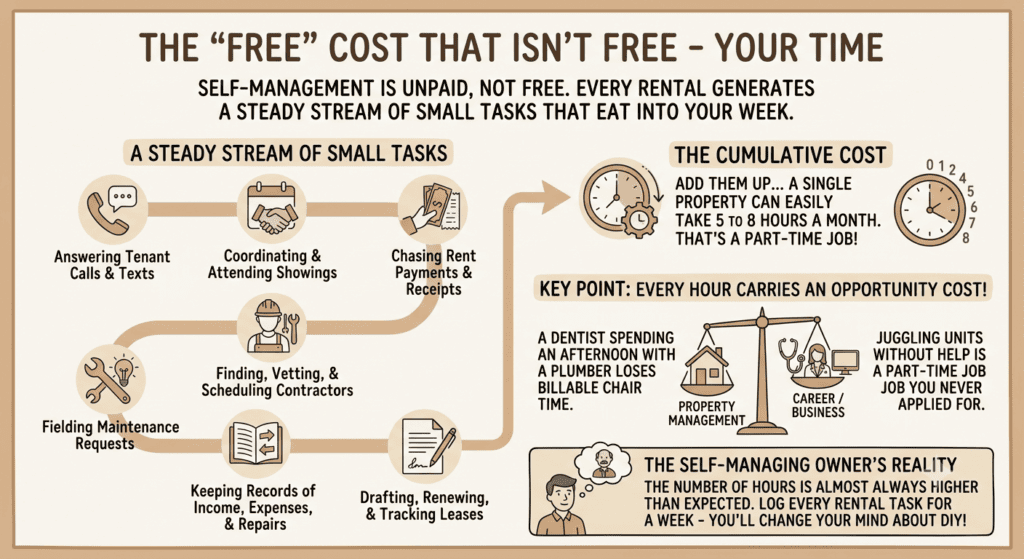
Self-management is often described as “free,” but it isn’t. It’s unpaid. There’s a difference.
Every rental property, no matter how well-behaved the tenant, generates a steady stream of small tasks that eat into a landlord’s week:
- Answering tenant phone calls and texts, often outside business hours
- Coordinating and attending showings for vacant units
- Chasing down rent payments and issuing receipts
- Fielding maintenance requests and figuring out whether they’re urgent
- Finding, vetting, and scheduling contractors
- Keeping records of income, expenses, repairs, and communications
- Drafting, renewing, and tracking lease agreements
None of these tasks take an enormous amount of time individually. A showing might take 45 minutes. A maintenance call might take 15. But add them up across a single property, and a landlord can easily spend 5 to 8 hours a month on management work that never shows up on any expense report – because it’s paid for in time, not dollars.
Key point: every hour spent managing a property carries an opportunity cost. For a landlord holding down a full-time career, running a business, or managing more than one investment property, that opportunity cost climbs fast. A dentist who spends a Tuesday afternoon meeting a plumber isn’t just losing an afternoon – they’re losing billable chair time. A landlord juggling three units without help is effectively running a part-time job they never applied for.
The self-managing rental property owner who tracks their actual hours for a month is often the one who changes their mind about DIY the fastest. The number is almost always higher than they expected.
Try this exercise for a week: log every rental-related task, no matter how small. The five-minute call about a squeaky door. The twenty minutes spent comparing quotes from two different handypeople. The Sunday evening spent updating a spreadsheet of rent payments. On their own, none of these feel significant. Added together over a month, they routinely total the equivalent of a part-time shift – and that’s for a single property in good standing, with no active disputes or major repairs underway.
Now factor in a second or third property. Time doesn’t scale in a straight line. Coordinating three separate maintenance calls, three separate lease renewals, and three separate sets of tenant communications takes noticeably longer than three times the effort of managing one property. Context-switching between units – remembering which one needs a filter change, which tenant asked about a lease renewal, which contractor still hasn’t sent an invoice – adds its own quiet tax on a landlord’s attention, even before any actual work begins.
Longer Vacancies Can Cost More Than Management Fees
Vacancy is the single most underestimated cost in DIY property management, and in today’s market, it deserves close attention.
According to CMHC’s most recent Rental Market Report, the average vacancy rate in the St. Catharines–Niagara area sat at 3.9% – a more-than-decade high – with Niagara Falls posting some of the sharpest increases in the region due to softer tourism-driven demand and a rise in available rental supply. That’s a meaningful shift from the ultra-tight conditions landlords got used to a few years ago. When vacancy rates rise, tenants have more options, and slow, amateur marketing gets punished harder than it used to.
A handful of common DIY mistakes stretch out vacancy periods:
- Slow response times to inquiries, especially in the first 24 hours
- Poor-quality listing photos that undersell the unit
- Incorrect rental pricing – either too high to attract interest, or too low to maximize return
- Weak marketing that only reaches one or two listing sites
- Limited exposure compared to professionally syndicated listings
- Delayed tenant placement because showings only happen on evenings and weekends
Here’s the math that changes minds. If a two-bedroom unit in Niagara Falls rents for roughly $1,527 a month – the current purpose-built average reported by CMHC – a single extra month of vacancy costs more than an entire year of a typical management fee at many local rates. One additional slow month, caused by underpriced marketing photos or a listing that only went up on one site, can wipe out months of “savings” from skipping professional management altogether.
This is where DIY property management quietly becomes expensive. The fee a landlord avoids is visible. The vacancy cost caused by weak marketing is invisible until the bank statement tells the real story.
The math gets more uncomfortable when it’s broken down further. A rental sitting empty for even three extra weeks past its ideal turnover date doesn’t just mean lost rent for those three weeks – it also means the mortgage, property taxes, insurance, and any condo or maintenance fees keep coming due regardless. A landlord covering those carrying costs out of pocket, with no rent coming in to offset them, feels the vacancy far more acutely than the percentage-based management fee they were trying to avoid.
Pricing is often the quiet culprit behind a long vacancy. Landlords without daily visibility into local comparables tend to either overprice a unit – chasing a number from a year or two ago, before the market softened – or underprice it out of nervousness about sitting vacant. Both mistakes cost money. Overpricing extends the vacancy while the unit sits ignored online. Underpricing fills the unit faster but leaves income on the table for the length of the entire tenancy, not just one month. A property manager who tracks comparable rents across dozens of active listings is typically far better positioned to price a unit correctly on day one – which matters even more in a softening market where tenants increasingly have the upper hand.
Poor Tenant Screening Can Become Your Most Expensive Mistake
Screening is the step most self-managing landlords rush, and it’s usually the step with the highest financial exposure if it goes wrong.
A bad tenant placement can lead to:
- Missed or late rent payments
- Property damage beyond normal wear and tear
- Eviction costs, including lost rent during the process
- Legal disputes and Landlord and Tenant Board (LTB) filings
- Frequent turnover, which resets the vacancy and marketing cycle
The scale of this risk has grown, not shrunk. Ontario’s LTB continues to work through a significant backlog. As of early 2026, non-payment of rent applications (L1) are generally being scheduled in roughly 3 to 6 months, while applications tied to landlord’s-own-use or tenant-fault evictions (N12/N5) are commonly taking 5 to 9 months, and some contested applications are still stretching well beyond a year. Every one of those months is a month a landlord may be covering a mortgage without rental income to offset it.
Professional screening processes typically go deeper than a quick credit check: income verification, employment confirmation, rental history checks with previous landlords (not just the most recent one, who may be motivated to get rid of a problem tenant), and consistent application of screening criteria to stay compliant with human rights law. A landlord managing solo, especially under time pressure to fill a vacancy, is far more likely to skip a step – and that one skipped step is usually the one that would have flagged the problem.
This is why experienced landlords treat screening as protection for profitability, not just a formality. One bad tenant can cost more than several years of management fees combined.
Consider what a single problematic tenancy actually costs when every piece is added together. Three months of missed rent on a $1,500 unit is $4,500 before any legal process even begins. Add filing fees, potential paralegal or legal costs if the case is contested, and the cost of restoring the unit after move-out – new flooring, paint, appliance repairs – and it’s not unusual for a single bad placement to run well past $10,000 once lost rent, repairs, and legal costs are combined. Compare that to a typical annual management fee on the same unit, and the math becomes very clear very quickly.
There’s also a compliance dimension that self-managing landlords sometimes overlook. Ontario’s Human Rights Code prohibits screening tenants based on protected grounds, and applying inconsistent criteria from one applicant to the next – even unintentionally – can expose a landlord to a human rights complaint. A documented, repeatable screening process protects both the landlord’s finances and their legal standing, and it’s one of the areas where a rushed, informal approach carries risk that isn’t always obvious until it becomes a problem.
Small Maintenance Problems Become Major Repairs
Maintenance is where DIY landlords often lose money slowly, one deferred repair at a time.
Common examples:
- A small leak under a sink left unaddressed becomes a subfloor replacement
- Skipped annual HVAC servicing leads to a mid-winter furnace failure
- A slow drain ignored for months turns into a full plumbing backup
- Minor electrical issues, left unchecked, become fire-safety hazards
- Seasonal maintenance – eavestrough cleaning, weatherproofing, filter changes – gets missed entirely without a system to track it
The pattern is consistent across the industry: most landlords don’t lose money on maintenance itself. They lose money on maintenance they postponed. A $400 repair deferred for six months has a way of becoming a $4,000 repair, and the difference isn’t bad luck – it’s the absence of a preventive schedule.
Preventive maintenance requires two things a solo landlord often doesn’t have: a recurring inspection calendar and a trusted contractor who will respond quickly to small issues before they escalate. Emergency repair costs, by contrast, come with rush pricing, limited contractor availability, and – if a tenant is displaced or a unit becomes uninhabitable – potential compensation obligations on top of the repair bill itself.
There’s also a documentation gap that tends to catch self-managing landlords off guard. If a maintenance issue ever becomes a dispute – a tenant claims a repair was ignored, or a unit is deemed to have fallen below the maintenance standards required under the RTA – the landlord’s ability to show a consistent history of inspections and repairs becomes their strongest defence. Landlords who handle maintenance reactively, responding only when something breaks, often have no such record to point to. Landlords who follow a structured seasonal schedule – furnace servicing every fall, eavesthrough checks every spring, appliance inspections annually – build that record automatically, simply as a byproduct of doing the work on a schedule rather than in response to a crisis.
Legal Compliance Mistakes Can Be Costly
Ontario’s rental laws are detailed, and they change more often than most landlords expect.
Areas where self-managing landlords commonly slip up:
- Residential Tenancies Act (RTA) requirements around notice periods and unit entry
- Correct use of LTB forms, including the N1 for rent increases
- The province’s annual rent increase guideline, which for 2026 is set at 2.1% – the lowest cap in four years, down from 2.5% in 2025 – and applies to most units first occupied on or before November 15, 2018
- The 90-day minimum written notice requirement before any rent increase takes effect, and the rule that rent can only be raised once every 12 months per tenant
- Security deposit and last month’s rent rules, which differ from many other provinces
- Record-keeping obligations that matter enormously if a dispute ever reaches the LTB
Landlord responsibilities Canada-wide vary meaningfully by province, and Ontario’s rules are among the more detailed in the country. Getting a rent increase notice wrong – using the wrong form, giving less than 90 days’ notice, or raising rent twice within 12 months – can make the increase unenforceable and open the door to a tenant filing a claim to recover the difference. Multiply one small paperwork error across a growing portfolio, and the exposure adds up fast.
Rules also shift from year to year, and a landlord who set up their lease templates five years ago may be operating on outdated assumptions without realizing it.
The LTB backlog makes these mistakes more costly than they used to be. Tribunals Ontario has added adjudicators and worked to reduce scheduling delays in recent years, and wait times for non-payment applications have genuinely improved compared to the peak backlog years Hidden Costs of Managing Rental Properties Yourself. But a landlord who files a rent increase notice incorrectly, or who tries to end a tenancy without the right form, doesn’t just face a paperwork correction – they face months of delay while the file gets resolved, sorted, or refiled. In a system where even a straightforward, well-documented application can take several months to be heard, an avoidable procedural error is a cost measured in months, not minutes.
A related risk that catches many self-managing landlords off guard: units first occupied after November 15, 2018 are generally exempt from the annual rent increase guideline, meaning a landlord of a newer building can raise rent by more than 2.1% with proper notice. Landlords who don’t know their unit’s exemption status sometimes leave money on the table year after year – another quiet cost of managing without current, specific knowledge of how the rules apply to their specific property Hidden Costs of Managing Rental Properties Yourself.
Emergency Calls Don’t Follow Business Hours
Property emergencies are indifferent to a landlord’s schedule.
Some of the most common late-night and weekend calls include:
- Burst or leaking pipes at midnight
- Tenants locked out after hours
- Heating failures in the middle of a Niagara winter
- Basement flooding during heavy rain
- Power outages affecting food safety, medical equipment, or heating
Self-managing landlords are, by default, on call every day of the year. There’s no backup, no rotation, no one else to pick up the phone if a pipe bursts during a family vacation. Over time, that constant low-grade availability becomes its own cost – not one that shows up on a P&L statement, but one that shapes how a landlord plans holidays, weekends, and even a quiet Sunday morning.
Winters in the Niagara Region add a particular layer of urgency to this. A heating failure isn’t just inconvenient – depending on outdoor temperatures, it can become a habitability issue within hours, and Ontario law requires landlords to respond to urgent repair needs promptly. A landlord who is unreachable, out of town, or simply asleep when that call comes in isn’t just risking tenant frustration Hidden Costs of Managing Rental Properties Yourself. They’re risking a legitimate maintenance complaint that could escalate to the LTB if the response is too slow. A professional management company typically has an after-hours emergency line and a rotation of on-call contractors specifically so that a burst pipe at 2 a.m. doesn’t depend on one person’s phone being charged and within reach.
Vendor Management Isn’t as Easy as It Looks
Having a reliable network of contractors sounds simple until a landlord actually needs one on short notice.
Vendor management involves:
- Finding contractors who are licensed, insured, and actually reliable
- Comparing quotes without the leverage of repeat business
- Scheduling repairs around tenant availability
- Monitoring work quality, especially for jobs done while the landlord isn’t present
- Absorbing emergency pricing when a job can’t wait for a competitive quote
A property manager with dozens of units typically has standing relationships with plumbers, electricians, and general contractors – relationships built on repeat volume, which usually means faster response times and better pricing. A solo landlord calling a plumber for the first time, at 9 p.m., for a single unit, is negotiating from a much weaker position. Trusted vendor networks reduce both cost and delay; building one from scratch, one emergency at a time, is expensive in both.
Administrative Work Adds Up Quickly
The paperwork side of rental property management multiplies with every unit added to a portfolio.
That includes:
- Lease renewals and amendments
- Rent tracking and payment records
- Expense records for every repair, supply, and service call
- Tax preparation documentation
- Insurance paperwork and claims history
- Maintenance history for each unit
One rental property is manageable with a spreadsheet and a shoebox of receipts. Three or four properties turn that same system into a genuine liability, especially at tax time or if a dispute requires organized documentation on short notice Hidden Costs of Managing Rental Properties Yourself. Rental property expenses that aren’t tracked properly don’t just create headaches – they can mean missed deductions or a weaker position if a claim is ever challenged by the CRA or contested at the LTB.
The Hidden Emotional Cost of DIY Property Management
This is the cost landlords talk about least, and feel the most.
Self-management brings:
- Ongoing background stress, even when nothing is actively wrong
- Constant interruptions – a call during dinner, a text during a meeting
- Difficult conversations about late rent, property damage, or noise complaints
- A slow build toward burnout, especially across multiple properties
- Reduced work-life balance, since being a landlord never fully switches off
Landlords balancing rentals with a career and a family often describe the emotional weight as heavier than the financial one. It’s not any single phone call – it’s the possibility of one, at any hour, that keeps a portion of attention permanently reserved for the property. That’s a real cost, even if it never appears on a spreadsheet Hidden Costs of Managing Rental Properties Yourself.
What Professional Property Management Actually Helps You Avoid
Hiring a property manager isn’t just about handing off tasks. It’s about avoiding entire categories of risk before they happen.
Professional management typically covers:
- Professional marketing with better photography and wider listing exposure
- Structured tenant screening applied consistently across every applicant
- Coordinated maintenance with pre-vetted, responsive contractors
- Legal compliance built around current RTA rules and LTB procedures
- Reliable rent collection with clear escalation processes
- Regular inspections that catch small issues early
- Financial reporting that simplifies tax season
- Vendor management backed by volume relationships
- Emergency response coverage outside business hours
- Vacancy reduction through faster, more competitive placement
Ontario property management fees generally range from about 6% to 12% of collected rent, with many single-unit residential arrangements landing near 8% to 10%, depending on the market and service scope. On a $1,527 monthly rent, that’s roughly $120 to $185 a month – a cost that’s visible, predictable, and easy to weigh against the far less visible cost of one extended vacancy, one deferred repair, or one legal misstep Hidden Costs of Managing Rental Properties Yourself. The value isn’t just in the services themselves. It’s in the outcomes: fewer vacant months, fewer legal headaches, and a lot fewer 11 p.m. phone calls.
Is DIY Property Management Right for Every Landlord?
Not always – and it doesn’t have to be all-or-nothing.
DIY self-management may work well when a landlord has:
- One property, located nearby
- Genuinely available free time, not just theoretical time
- Solid working knowledge of Ontario tenancy law
- An established, reliable contractor network already in place
Professional management is often the better fit when a landlord has:
- Multiple properties across different areas
- A property located far from where they live
- A full-time job or business that limits availability
- A growing investment portfolio
- A goal of building passive, not active, income
There’s no universal right answer here – the honest answer depends on the landlord’s time, location, risk tolerance, and long-term goals for the portfolio.
Questions Every Landlord Should Ask Before Choosing DIY Management
Before deciding to self-manage, it’s worth answering honestly:
- How much is my personal time actually worth per hour?
- Can I realistically respond to emergencies at any hour, any day?
- Am I current on Ontario’s tenancy laws, including this year’s rent increase rules?
- Do I have reliable contractors I can call on short notice?
- Can I screen tenants thoroughly, not just quickly?
- How much could one bad tenant placement actually cost me?
- Is the management fee I’d save really worth the hidden risks I’d be taking on?
These aren’t rhetorical questions. Landlords who answer them honestly – with real numbers, not gut feelings – tend to make much better decisions about how to Hidden Costs of Managing Rental Properties Yourself manage their properties going forward.
Conclusion: The Cheapest Option Isn’t Always the Most Profitable
DIY property management can work. Plenty of landlords manage a single, nearby property successfully for years. But it only works when the full picture is accounted for – not just the monthly management fee that gets avoided, but everything that fee would have covered.
The hidden costs of managing rental properties yourself rarely show up as one big expense. They show up as a slightly longer vacancy here, a slightly worse tenant screen there, a repair that waited two months too long, a rent increase notice that missed the 90-day window. Individually, each one seems small. Together, they can quietly erase the “savings” of skipping professional management altogether.
Before deciding how to manage your next rental year, it’s worth calculating the total cost of self-management honestly – time, vacancies, legal risk, maintenance delays, and tenant issues included. Not just the fee you’d pay to avoid them.
Thinking through whether self-managing your Niagara Region property still makes sense? The team at The HAH Developments works with property owners across Niagara Falls and the surrounding area to reduce vacancies, protect property value, and take the day-to-day stress off landlords’ plates. Contact The HAH Developments today for a no-pressure conversation about what professional property management could look like for your investment.
Frequently Asked Questions
1. What are the biggest hidden costs of managing a rental property yourself?
The largest hidden costs are typically lost time, extended vacancies from weak marketing, poor tenant screening leading to missed rent or damage, deferred maintenance turning into major repairs, and legal compliance mistakes that can lead to disputes at the Landlord and Tenant Board.
2. How much does property management cost in Ontario?
Most Ontario property managers charge between 6% and 12% of monthly collected rent, with many single-unit residential arrangements landing around 8% to 10%. Additional fees, such as tenant placement charges, are often billed separately.
3. Is it cheaper to self-manage a rental property?
It can be, but only if a landlord accounts for the full cost of their time, avoids extended vacancies, screens tenants carefully, and stays fully compliant with Ontario’s rental laws. Many landlords find that one costly mistake – a bad tenant, a long vacancy, or a missed legal step – outweighs years of saved management fees.
4. What is the current rent increase guideline in Ontario?
For 2026, Ontario’s rent increase guideline is 2.1%, the lowest cap in four years. It applies to most units first occupied on or before November 15, 2018, and requires at least 90 days’ written notice using the proper LTB form.
5. How long does it take to evict a tenant in Ontario right now?
Timelines vary by application type. Non-payment of rent applications are generally being scheduled in roughly 3 to 6 months as of early 2026, while landlord’s-own-use or tenant-fault applications often take 5 to 9 months, and some contested cases run well beyond a year.
6. When does it make sense to hire a property manager instead of self-managing?
Professional management tends to make the most sense for landlords with multiple properties, properties located far from home, limited free time due to work or family commitments, or a goal of earning passive rather than active rental income.