

If you own a rental property in Niagara Falls, 2026 is not the year to wing it. The rules changed. The market shifted. And the landlords who are winning right now are not the ones working harder – they’re the ones working smarter, with better systems and better information.
Here’s the situation. Ontario’s Landlord and Tenant Board just rolled out some of the biggest procedural changes in years. Vacancy rates in the Niagara Region hit their highest point in more than a decade. And short-term rental rules in Niagara Falls keep shifting under hosts’ feet, with licensing fees, tax rates, and zoning restrictions that change almost every few months.
None of this means Niagara Falls is a bad place to own property. Quite the opposite. But it does mean that property management Niagara Falls landlords choose today looks a lot different than it did even two years ago. This guide walks through everything you need to know: the current market data, the legal changes, the real costs of management, and how to decide whether self-managing your rental still makes sense in 2026.
Whether you own a single house near Clifton Hill, run a handful of long-term rentals in the Chippawa neighbourhood, or operate a licensed vacation rental unit near the falls, this article will help you make sharper decisions about your property this year.
Why Niagara Falls Is Still a Strong Rental Market in 2026
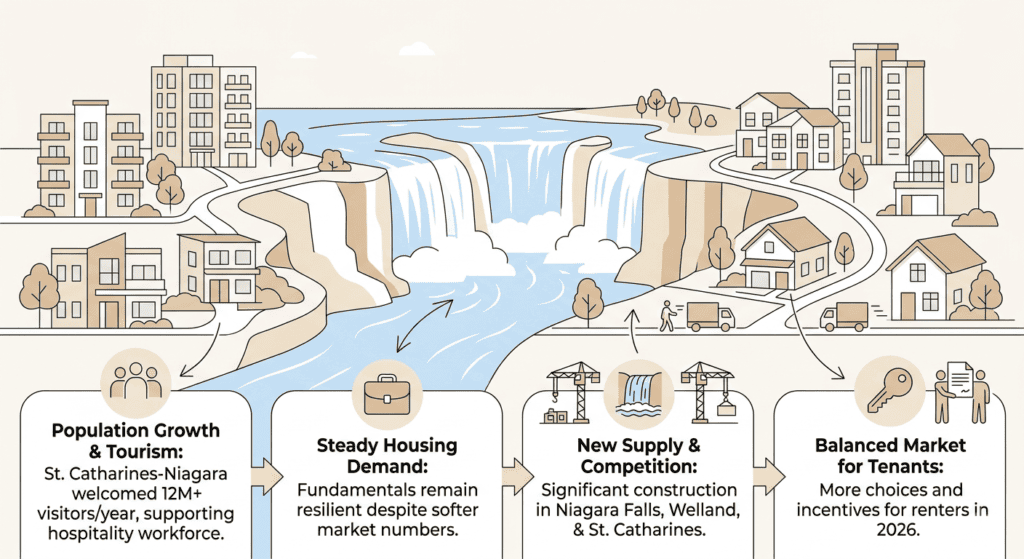
Despite softer numbers this year, Niagara Falls remains one of the more resilient rental markets in Ontario. The fundamentals – tourism, population growth, and steady housing demand – haven’t gone anywhere. What’s changed is the balance between supply and demand, and that balance now favours tenants more than it has in years.
Current Vacancy Rates and Rent Trends
The Canada Mortgage and Housing Corporation’s Fall 2025 Rental Market Report put the vacancy rate for the St. Catharines–Niagara census metropolitan area at 3.9%, a level not seen in more than ten years. Niagara Falls itself posted some of the sharpest increases within the region, driven partly by the expiry of temporary foreign worker permits and softer tourism and hospitality employment tied to broader economic pressure.
For context, that 3.9% figure sits well above the national purpose-built rental vacancy rate of 3.1%, which itself climbed from 2.2% the year before. It’s the highest national vacancy rate has been in a decade, driven by a wave of new construction combined with slower population growth.
What does this mean if you’re a landlord? Units are sitting empty longer than they used to, and tenants have more choice. Rent growth has cooled too – CMHC’s national data shows average two-bedroom rents climbing roughly 5% in the past year, down from the double-digit jumps landlords got used to a few years ago. If you’re still pricing a unit based on 2022 or 2023 comparables, you’re likely overpriced, and that gap is exactly what’s stretching out vacancy periods across the Niagara Region rental market right now.
Population Growth and Tourism Demand
The demand side of the equation is still strong, even if it’s grown more slowly than the supply of new units. Niagara welcomes more than 12 million visitors every year, and that tourism base supports a hospitality workforce that needs somewhere to live – whether that’s a short-term stay or a full-time rental.
Housing construction has also picked up sharply. Niagara Falls exceeded 116% of its 2024 provincial housing target, and neighbouring Welland surpassed 114% of its own target. St. Catharines issued over 1,025 new dwelling unit building permits in 2025 alone, nearly double its nine-year average, helped along by tens of millions of dollars in federal Housing Accelerator Fund investment.
That new supply is exactly why vacancy rates are rising even as the region keeps growing. More units, plus more competition from newly built buildings offering move-in incentives, means owners of older units have to work harder to stand out.
New Construction and What It Means for Landlords
New purpose-built rentals across Ontario are sitting at vacancy rates near 7%, and roughly three-quarters of new buildings are now offering one to two months of free rent just to fill units. That’s a direct competitive threat if your property is priced or presented like it’s still 2022.
The practical takeaway: condition, presentation, and pricing accuracy matter more in 2026 than they have in years. A property that’s professionally marketed, competitively priced, and well maintained will still lease quickly. One that isn’t will sit – and every extra week of vacancy is money out of your pocket.
What Does Property Management in Niagara Falls Actually Include?
“Property management” gets used loosely, so it’s worth breaking down what a professional management company is actually responsible for. A good property manager isn’t just someone who collects rent cheques – they’re running four distinct functions at once.
Tenant Screening and Leasing
This starts with marketing the unit, fielding inquiries, running showings, and screening applicants. Screening should include credit checks, income verification, employment confirmation, rental history, and reference calls. In a softer market like this one, screening standards matter even more – a bad tenant placed out of desperation to fill a vacancy can cost far more than the vacancy itself.
Rent Collection and Financial Reporting
This covers monthly rent collection, late payment follow-up, and clear monthly or quarterly financial statements so you always know exactly where your investment stands. It also includes handling last month’s rent deposits correctly under provincial rules – including the mandatory interest payment landlords owe tenants on that deposit each year.
Maintenance and Repairs
A management company should have a vetted network of contractors for everything from emergency plumbing to routine HVAC servicing. The best operators are shifting toward preventive maintenance – scheduled inspections and servicing that catch small problems before they become expensive emergencies – rather than waiting for something to break.
Legal Compliance and Risk Management
This is the piece that trips up most self-managing landlords. It means serving the right notices, following correct timelines, staying current on Landlord and Tenant Board procedure, and keeping documentation clean enough to hold up if a dispute ever goes to a hearing. Given how much changed in Ontario tenancy law this year, this function alone is worth the cost of professional management for a lot of owners.
Ontario Landlord-Tenant Law Every Niagara Falls Owner Must Know in 2026
This is the section every Niagara Falls landlord needs to read carefully. Ontario’s rental laws went through their biggest procedural overhaul in years, and getting the timing wrong on a notice or application can invalidate your entire case at the Landlord and Tenant Board.
Bill 60 and the New Eviction Timelines
Bill 60, the Fighting Delays, Building Faster Act, 2025, received Royal Assent on November 24, 2025, and amends 16 different laws, including the Residential Tenancies Act. Its changes are rolling out in stages through 2026, with major provisions taking effect on July 1, 2026, and further changes proclaimed for September 2026.
Here’s what’s changing in practice. The grace period for unpaid rent – the window before a landlord can serve an N4 notice – has been shortened from 14 days to 7 days. The deadline to request a review of an LTB order has been cut from 30 days to 15 days. And for N12 personal-use evictions where the landlord gives at least 120 days’ notice, compensation to the tenant is no longer required.
One important caveat: many of these amendments only take effect once Cabinet formally proclaims them, and enforcement dates have shifted more than once already this year. Before you act on any specific timeline, confirm the current status with the Landlord and Tenant Board or a licensed paralegal – acting on a rule before it’s actually in force can invalidate your notice or application entirely.
The 2026 Rent Increase Guideline
The provincial rent increase guideline for 2026 is set at 2.1%, down slightly from 2.5% in 2025. This is the maximum a landlord can raise rent on an existing tenancy without applying to the Landlord and Tenant Board for an above-guideline increase, and it applies once every 12 months with 90 days’ written notice. Units first occupied on or after November 15, 2018 remain exempt from rent control, which matters if you’re weighing new construction against an older property for your next purchase.
Rising Fines Under the RTA
Bill 97 and Bill 60 together are also raising the financial stakes for non-compliance. Maximum fines for Residential Tenancies Act offences are climbing from $50,000 to $100,000 for individuals, and from $250,000 to $500,000 for corporations. If your rental is held inside a corporation, that exposure just got a lot more serious – which makes clean documentation of every notice, entry, repair, and tenant communication non-negotiable.
How Property Management Niagara Falls Firms Keep You Compliant
This is exactly the kind of shifting legal landscape where professional property management Niagara Falls owners rely on earns its fee many times over. A management company tracks proclamation dates, updates its notice templates the moment rules change, and keeps a paper trail that protects you if a dispute ever reaches a hearing. For a self-managing landlord juggling a full-time job, staying on top of staged legislative rollouts on top of everything else is a lot to ask.
Short-Term Rental (Airbnb) Management in Niagara Falls
Niagara Falls remains one of the few Ontario municipalities that still allows short-term rentals on investment properties, not just owner-occupied homes – but the licensing system is detailed, and getting it wrong is expensive.
VRU vs. OOSTR Licenses Explained
The city recognizes two license types. A Vacation Rental Unit (VRU) license is for non-owner-occupied properties and can operate up to 90 days a year in designated commercial zones. An Owner-Occupied Short-Term Rental (OOSTR) license requires the property to be the operator’s principal residence – meaning they live there at least 183 days a year – but allows operation for up to 180 days annually. The OOSTR pilot program is capped at 100 licenses and is scheduled to wrap up at the end of September 2026, after which city council will decide whether to continue it.
Both license types require a valid short-term rental license, and both restrict rentals to a maximum of three bedrooms per property. There’s no cap on how many VRU licenses one investor can hold, so some owners run several units as a genuine hospitality business rather than a side project.
Licensing Fees, Zoning, and the Municipal Accommodation Tax
The license itself costs $500 to set up, plus a $250 annual renewal. Your property has to sit inside a Tourist Commercial, General Commercial, or Central Business zoning designation – VRUs are not permitted in standard residential neighbourhoods, and operating without a license can trigger fines of up to $50,000 for a first offense.
On top of the license, hosts collect a Municipal Accommodation Tax from guests. This has shifted more than once this year: rates moved from a flat per-night charge toward a percentage-based structure, and further changes tied to property star ratings have been introduced in some formats. MAT remittance is generally due quarterly, and hosts must file a report for every period even when no bookings occurred. Hosts must also carry a minimum of $2 million in liability insurance and post their license number on every listing and advertisement.
Because these figures move quickly, always confirm the current fee and tax structure directly with the City of Niagara Falls before setting your pricing or filing a remittance.
Should You Choose Short-Term or Long-Term Rental?
Short-term rentals can generate stronger revenue per night, especially near the falls and Clifton Hill, but they come with licensing overhead, seasonal demand swings, and hands-on guest turnover that most owners underestimate. Long-term rentals offer steadier, more predictable income and far less day-to-day management, which matters more in a softer rental market where every vacancy day counts.
There’s no universal right answer here – it depends on your property’s location, your appetite for hands-on involvement, and how much risk you’re comfortable carrying through the shoulder seasons. A property management company that runs both models can walk you through the real numbers for your specific address rather than a generic average.
Long-Term Rental Management: What Sets Good Management Apart
Long-term rentals are still the backbone of most Niagara Falls portfolios, and the difference between an average manager and a great one shows up most clearly here.
Tenant Screening Best Practices
Good tenant screening goes well beyond a quick credit pull. It should verify income against the asking rent – most managers look for income at roughly three times the monthly rent – confirm employment directly with the employer, check rental history with previous landlords (not just the current one, who may be motivated to get rid of a problem tenant), and run a background check where legally permitted. In a market where vacancies last longer, the temptation to rush an application through is real. Resist it. One bad tenancy costs far more in lost rent, damage, and LTB time than a few extra weeks of vacancy ever will.
Preventive Maintenance vs. Reactive Repairs
The industry is moving decisively toward scheduled, preventive maintenance instead of waiting for something to fail. Regular HVAC servicing, seasonal gutter and roof checks, and routine plumbing inspections catch small issues while they’re still cheap to fix. This isn’t just about saving money – it also protects your relationship with tenants, since a property that’s proactively maintained sees fewer emergency calls and higher renewal rates.
Handling Vacancies in a Softening Market
With vacancy rates at their highest point in over a decade, how you handle a vacancy matters more than it used to. That means pricing to current market data rather than last year’s rent roll, turning units around quickly with efficient cleaning and repair schedules, and marketing on multiple platforms rather than a single listing site. Properties that sit vacant for an extra month aren’t just losing rent – they’re often the reason an otherwise solid investment underperforms for the year.
How Much Does Property Management Cost in Niagara Falls?
Management fees in the Niagara Region typically run in a similar range to the rest of Ontario, though exact pricing varies by company and by service level.
Typical Management Fee Structures
Most companies charge a percentage of collected rent, generally landing somewhere between 8% and 12% for long-term rental management, with short-term rental and Airbnb co-hosting typically running higher – often in the 15% to 25% range – because of the added guest communication, cleaning coordination, and turnover work involved. Many companies also charge a one-time leasing or tenant placement fee, often equal to half a month’s to a full month’s rent, when a new tenant is placed.
What’s Included vs. What Costs Extra
A transparent management agreement should spell out exactly what’s bundled into the base fee – usually rent collection, tenant communication, routine inspections, and basic administrative work – versus what’s billed separately, like major repairs, eviction proceedings, or after-hours emergency call-outs. Before signing anything, ask for a full breakdown in writing. The lowest advertised percentage isn’t always the lowest total cost once add-on fees are factored in.
Self-Managing vs. Hiring a Property Manager
Every landlord asks this question at some point, and the honest answer depends on your time, your risk tolerance, and how many units you own.
The Real Time Cost of DIY Management
Self-managing looks free on paper, but it rarely is in practice. Between marketing a vacancy, screening applicants, handling maintenance calls at inconvenient hours, tracking rent payments, and staying current on legislative changes like Bill 60, most self-managing landlords underestimate the hours involved by a wide margin. That time has a real dollar value, especially if you’re managing a rental alongside a full-time job.
When Professional Management Pays for Itself
Professional management tends to pay for itself in a few clear situations: when you live far from the property, when you own multiple units, when you’ve had a difficult tenant experience before, or when the current legal complexity around evictions and notices feels like more risk than you want to carry personally. In a market with rising fines for RTA violations and shortened, more technical LTB timelines, the cost of getting a single notice wrong can quickly exceed a year’s worth of management fees.
Technology and AI Trends Reshaping Property Management in 2026
Property management is changing fast, and the tools driving that change are worth understanding even if you never touch the software yourself.
AI-Powered Tenant Screening and Maintenance Triage
Across the industry, AI-driven tools are now handling real-time leasing inquiries, qualifying prospective tenants, and triaging maintenance requests before a human ever gets involved. Predictive maintenance systems that flag likely equipment failures before they happen are showing meaningful results – some reports cite reductions in downtime of 35% to 45% and lower overall maintenance costs. A recent industry survey found that a majority of landlords are now comfortable with their property manager using AI tools to support day-to-day operations, and most expect to use AI themselves when researching or evaluating a property manager.
What This Means for Niagara Falls Landlords
None of this replaces human judgment – the relationships, negotiation, and complex decision-making that make a good property manager valuable are still firmly human tasks. But it does mean faster response times, more accurate pricing, and fewer missed maintenance issues for owners who work with a management company that’s investing in these tools. When you’re evaluating a property manager in 2026, it’s fair to ask how they’re using technology to keep your property competitive.
How to Choose the Right Property Management Company in Niagara Falls
Not every management company operates at the same standard, and in a market this competitive, the right partner makes a measurable difference to your bottom line.
Questions to Ask Before Signing
Ask how they price vacant units and how often they review pricing against current market data. Ask what their average vacancy period looks like across their current portfolio. Ask how they handle maintenance requests after hours, how quickly they respond to tenant communication, and how they’re staying current on the Bill 60 and Bill 97 changes rolling out this year. Ask for references from current property owners, not just testimonials on their website.
Red Flags to Watch For
Be cautious of companies that won’t provide a clear, itemized fee schedule in writing, that can’t explain their tenant screening process in detail, or that seem unfamiliar with recent changes to Ontario tenancy law. A management company that’s vague about compliance is a liability, not an asset – especially with RTA fines now reaching $500,000 for corporate offenders.
Common Property Management Mistakes Niagara Falls Landlords Make
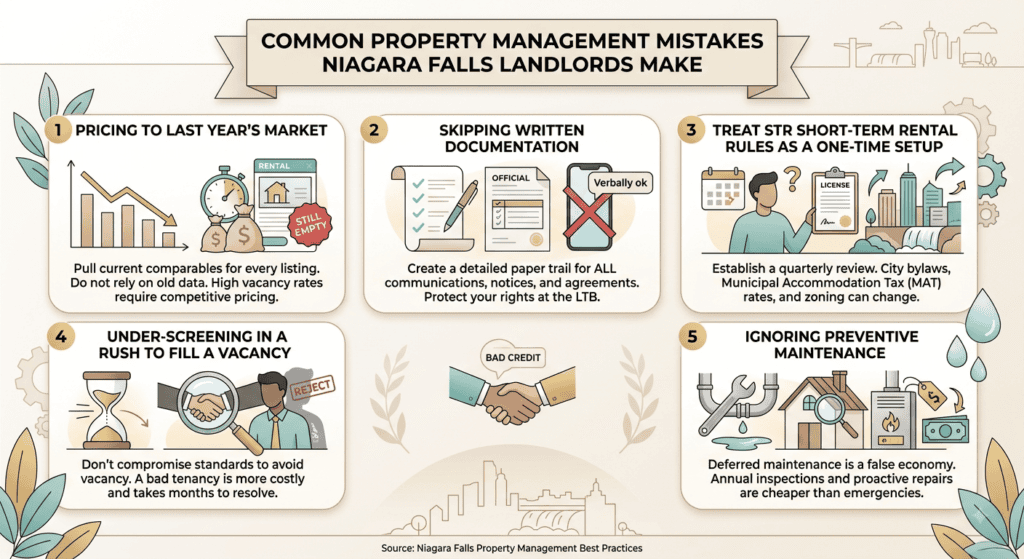
Even experienced owners fall into the same traps, especially in a market that’s shifted as much as this one has in the past year. Here are the mistakes that show up most often.
Pricing to Last Year’s Market
The single biggest mistake right now is pricing a unit based on rents from a year or two ago. With vacancy rates at a decade-plus high and new buildings offering free-rent incentives, a unit priced even 5% to 10% above current market value can sit empty for months. Every extra week of vacancy usually costs more than the rent premium was ever worth. Pull current comparables before every listing, not just once a year.
Skipping Written Documentation
Verbal agreements, texted notices, and informal understandings don’t hold up well at the Landlord and Tenant Board. With appeal windows now shortened and fines climbing, every notice, repair request, and tenant communication needs a paper trail. This is one of the simplest habits to build and one of the most commonly skipped.
Treating Short-Term Rental Rules as a One-Time Setup
Niagara Falls has adjusted its Municipal Accommodation Tax structure more than once in the past year alone, and zoning enforcement has tightened across the province. Hosts who set up their license once and never check back risk falling out of compliance without realizing it. Build a quarterly habit of confirming current fees, tax rates, and license status directly with the city.
Under-Screening in a Rush to Fill a Vacancy
Longer vacancy periods create real pressure to accept the first applicant who shows interest. This is exactly when screening standards tend to slip – and exactly when a bad tenancy does the most damage, since a problem tenant now takes longer and costs more to replace given current market conditions. A thorough screening process takes a few extra days. A bad tenancy can take months to unwind.
Ignoring Preventive Maintenance
Deferred maintenance is a false economy. A furnace that isn’t serviced annually, a roof that isn’t inspected before winter, or plumbing that only gets attention after it leaks all end up costing more in emergency repairs, tenant turnover, and potential liability than a modest annual maintenance budget ever would. Owners who build a preventive maintenance schedule into their operating costs consistently spend less over the life of the property.
The Bottom Line for Niagara Falls Landlords in 2026
Niagara Falls is still a market worth investing in – the tourism base, population growth, and construction activity all point to long-term strength. But 2026 is not a year to manage on autopilot. Rising vacancy rates mean pricing has to be sharper. Bill 60 and Bill 97 mean legal compliance has to be tighter. And short-term rental rules keep shifting in ways that catch unprepared hosts off guard.
Whether you’re weighing a long-term tenant against a licensed short-term rental, trying to figure out if your current rent is still competitive, or simply tired of fielding maintenance calls at 11pm, the right property management partner takes that weight off your shoulders and protects your investment while the market keeps evolving.
The HAH Developments manages long-term rentals, short-term rentals, and full-service Airbnb co-hosting across Niagara Falls and the wider Niagara Region. If you want a clear, honest look at what your property could be earning – and a team that’s already tracking every regulatory change covered in this guide – reach out to The HAH Developments today for a free property assessment.
Frequently Asked Questions About Property Management in Niagara Falls
What does a property management company in Niagara Falls typically charge? Most long-term rental management fees fall between 8% and 12% of collected rent, plus a separate leasing fee when a new tenant is placed. Short-term rental and Airbnb management usually costs more due to the added workload of guest turnover and cleaning coordination.
Is Niagara Falls a good market for rental property investment in 2026? The fundamentals are still solid – strong tourism, steady population growth, and significant new construction – but vacancy rates are at a decade-plus high and rent growth has slowed. Success now depends more on accurate pricing and property condition than it did a few years ago.
Do I need a license to run an Airbnb in Niagara Falls? Yes. You need either a Vacation Rental Unit (VRU) or Owner-Occupied Short-Term Rental (OOSTR) license, your property must sit in an approved commercial zone, and you must carry a minimum of $2 million in liability insurance. Operating without a license risks fines of up to $50,000.
How much can I legally raise my tenant’s rent in 2026? The provincial rent increase guideline for 2026 is 2.1%, applied once every 12 months with 90 days’ written notice. Units first occupied after November 15, 2018 are exempt from this guideline.
What is Bill 60 and how does it affect landlords? Bill 60 is the Fighting Delays, Building Faster Act, 2025. It shortens several Landlord and Tenant Board timelines – including the grace period for unpaid rent and the window to appeal an order – and raises maximum fines for Residential Tenancies Act violations. Many provisions are rolling out in stages through 2026, so confirm current proclamation status before relying on a specific rule.
Should I self-manage or hire a property manager for my Niagara Falls rental? It depends on your time, your distance from the property, and your comfort with Ontario’s current legal complexity. Owners with multiple units, out-of-town owners, or anyone uneasy navigating the new LTB timelines generally see the clearest value from professional management.