

Owning a rental property in Niagara used to be simple. You bought a house, found a tenant, cashed the rent cheque, and called it passive income.
That version of landlording doesn’t really exist anymore.
Between a shifting vacancy rate, a new 2.1% rent increase guideline, a Landlord and Tenant Board that can take the better part of a year to hear a case, and short-term rental bylaws that vary block by block in Niagara Falls, owning a property in this region now comes with a full-time job attached to it – whether you asked for one or not.
This guide breaks down what rental property management in Niagara actually looks like in 2026: the market conditions, the legal landscape, the real cost of doing it yourself, and what a professional management partner does differently. If you own a single condo in St. Catharines or a small portfolio of short-term rentals near the Falls, the goal here is the same – help you keep more of your rental income with less of the stress.
Whether you’re a first-time landlord who inherited a property, a long-time owner watching the market shift under you, or an investor weighing a first purchase in the region, understanding how rental property management in Niagara actually works right now will shape every decision that follows – from what you charge, to how you screen a tenant, to whether you manage the property yourself at all.
Why Rental Property Management Niagara Looks Different in 2026
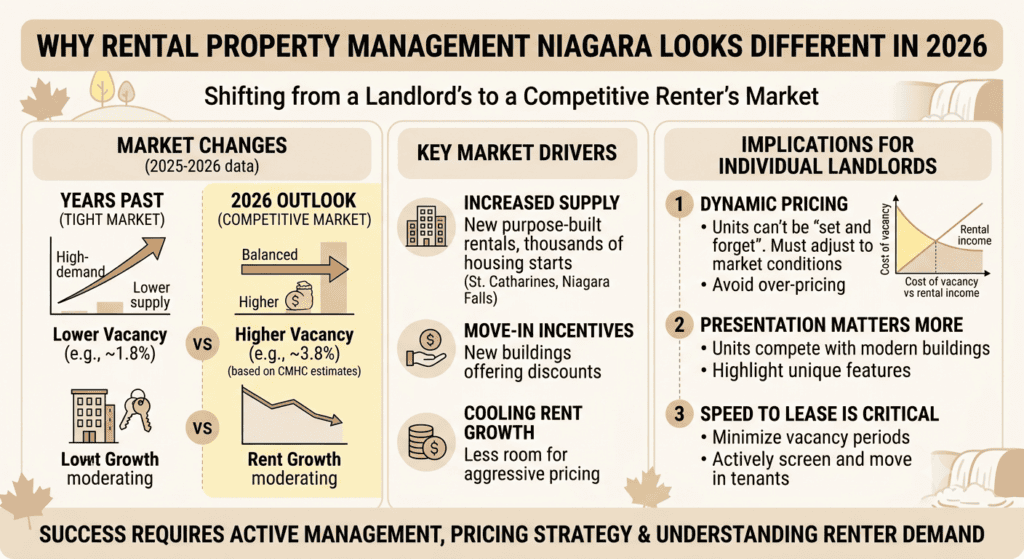
The Niagara rental market has quietly flipped from a landlord’s market to something far more competitive, and most owners haven’t caught up yet.
For years, low vacancy meant landlords could list a unit and fill it within days, often above asking. That’s no longer a safe assumption. CMHC’s October 2025 rental market survey put the overall apartment vacancy rate for St. Catharines–Niagara at 3.8%, with average rent sitting around $1,445 – a meaningful jump from the ultra-tight conditions of a few years ago, when the region’s vacancy rate sat closer to 1.8%.
Supply is a big part of the story. St. Catharines issued over 1,000 new dwelling unit building permits in 2025 alone, and Niagara Falls exceeded its provincial housing target by more than 116%. New purpose-built rental buildings – including a 362-unit tower planned for downtown Niagara Falls – are entering the market with move-in incentives that older buildings simply can’t match. CMHC’s 2026 outlook expects the vacancy rate to stay elevated through the year before stabilizing in 2027, with rent growth cooling to roughly 2% annually.
None of this means Niagara real estate is a bad investment. It means the easy years of “list it and forget it” are over. Effective rental property management in Niagara now requires active pricing decisions, faster turnover, and a much sharper understanding of what today’s renters actually want – because a unit priced even $150 above market can now sit empty for weeks, and every week of vacancy costs more than a year of modest under-pricing would have.
What This Means for Individual Landlords
If you’re managing a property yourself, this shift changes your math in three ways:
- Pricing has to be dynamic, not set-and-forget. What rented instantly in 2022 might sit for a month in 2026.
- Presentation matters more. Renters comparing your unit against a brand-new building with a move-in incentive need a reason to choose yours.
- Speed to lease matters more than ever, since every vacant week now competes against buildings actively discounting to fill units.
The Real Cost of Self-Managing a Niagara Rental Property
Most landlords who manage their own property don’t track the true cost of doing so. They see the management fee they’re avoiding, but not the hours, the risk, or the missed rent they’re absorbing instead.
The Time Cost
Between advertising a vacancy, screening applicants, coordinating maintenance calls, tracking rent payments, and handling the paperwork for a rent increase or lease renewal, most self-managing landlords spend somewhere between five and ten hours a month per unit – more if something goes wrong. For an owner with two or three properties, that’s a part-time job with none of the systems a professional team already has in place.
The Legal Risk Cost
This is where self-management gets expensive fast. Ontario’s Landlord and Tenant Board is still working through a significant backlog, and a single mistake on a notice – a wrong date, a missing form, an improperly served document – can send an already slow case back to square one. As of early 2026, roughly 80% of LTB cases are being heard somewhere between about three and sixteen months after filing, and non-payment applications alone typically take three to six months just to reach a hearing. Applications involving personal use or tenant-fault evictions often take six to nine months, and tenant-initiated maintenance complaints can take even longer.
A property manager who files paperwork correctly the first time, and who understands exactly how much notice each form requires, is often the difference between a two-month disruption and a year-long one.
The Vacancy Cost
With vacancy rates climbing across the region, a poorly marketed or overpriced listing can sit empty for a month or more. On a $1,700-a-month unit, that’s $1,700 in lost income before you’ve even accounted for utilities and carrying costs on an empty property – often more than an entire year of professional management fees.
A Quick Snapshot of the Niagara Rental Landscape
Before diving into strategy, it helps to see the numbers side by side. Here’s roughly where things stood heading into 2026:
- Overall vacancy rate (St. Catharines–Niagara): approximately 3.8%, up sharply from the 1.8% range seen just a year or two earlier
- Average rent: around $1,445 for the region as a whole, with significant variation by city
- New building permits (St. Catharines, 2025): over 1,000, nearly double the nine-year average
- Housing target performance: Niagara Falls exceeded 116% of its 2024 provincial target; Welland surpassed 114%
- 2026 rent increase guideline: 2.1%, the lowest in four years
Put together, these numbers describe a market that’s loosening for tenants and tightening the margin for error for landlords. Owners who understand this shift – and price and market accordingly – are still doing well. Owners who don’t are the ones watching listings sit.
Short-Term vs. Long-Term Rental Management in Niagara
One of the first decisions every Niagara property owner has to make is which rental model actually fits their property, their location, and their tolerance for hands-on involvement.
Short-Term and Airbnb Rentals
Niagara Falls remains one of Ontario’s most active short-term rental markets, but it’s also one of the most tightly regulated. Every short-term rental in the city needs a Vacation Rental Unit (VRU) license, and VRUs are only permitted in designated tourist and commercial zones – most residential neighbourhoods are off-limits entirely. The initial license runs $500 with a $250 annual renewal, and operating without one can trigger fines up to $50,000 for a first offence and $100,000 for repeat violations.
The city has also launched a 14-month pilot program for Owner Occupied Short-Term Rentals (OOSTRs), allowing up to 100 residential hosts to rent an accessory unit while living on-site, running from August 2025 through September 2026. Unlike a standard VRU, an OOSTR requires the owner to be present during every stay, limits bedrooms and occupancy, and enforces a strict three-strike system – three valid violations mean automatic license revocation with a six-month wait before reapplying.
Hosts also need to collect and remit a Municipal Accommodation Tax on every booking, on top of HST, and keep booking records for at least three years. Getting this wrong isn’t a minor paperwork issue; it’s the kind of mistake that can shut a listing down entirely.
Long-Term Rentals
Long-term rentals trade the higher nightly income potential of short-term stays for more predictable, lower-maintenance cash flow. A long-term tenancy is governed by the Residential Tenancies Act rather than municipal licensing bylaws, which means different rules around notice periods, rent increases, and how a tenancy can be ended.
Which Model Fits Your Property
Location is usually the deciding factor. A condo near Clifton Hill or the tourist core can command premium nightly rates as a short-term rental, provided it sits in an approved zone and the licensing costs pencil out. A single-family home in a quiet residential neighbourhood is far better suited to a stable, long-term tenant – both because that’s often what the zoning allows, and because it avoids the turnover and guest-management workload that comes with short stays.
A City-by-City Look at Short-Term Rental Rules
Short-term rental regulation isn’t uniform across the region, and treating Niagara Falls rules as a stand-in for the whole area is a common – and costly – mistake.
- Niagara Falls: VRU licensing required, restricted to tourist and commercial zones, plus a limited OOSTR pilot for owner-occupied residential rentals.
- Niagara-on-the-Lake: One of the strongest short-term rental markets in the region thanks to its wineries and tourism draw, but licensing is strictly enforced, with a $600 annual fee and mandatory insurance naming the town as an additional insured.
- St. Catharines: Moving toward a formal licensing model but without the same framework as Niagara Falls or NOTL yet. Non-owner-occupied short-term rentals are generally restricted in residential zones.
- Welland and Fort Erie: Each municipality sets its own rules, so confirming the current bylaw before purchasing is essential rather than optional.
Ontario Landlord Laws Every Niagara Property Owner Must Know in 2026
Whether you self-manage or hire help, you’re still legally responsible for compliance. Here’s what’s changed and what still matters most.
The Residential Tenancies Act and Bill 60
Ontario passed Bill 60 in November 2025, introducing changes to how the Landlord and Tenant Board processes applications, with the stated goal of speeding up hearings. Whether the changes achieve that in practice is still playing out, but landlords should expect procedural shifts around how tenant-raised issues are handled at arrears hearings and how cases move through the system.
The 2026 Rent Increase Guideline
Ontario set the 2026 rent increase guideline at 2.1% – the lowest it’s been in four years. On the region’s average rent of around $1,445, that translates to roughly $30 a month for a tenant whose rent is at guideline. Landlords raising rent within the guideline must give at least 90 days’ written notice, and a full 12 months must have passed since the tenant’s last increase or move-in date.
LTB Timelines and How to Avoid Them
The LTB’s backlog has come down from over 53,000 active cases to roughly 41,000, but wait times are still long by any reasonable standard. Non-payment applications (L1) are the priority stream and typically move in three to six months. Personal-use and tenant-fault evictions (L2) usually take six to nine months. Tenant-filed maintenance and rights applications often sit even longer, sometimes over a year.
The practical takeaway: the paperwork has to be right the first time. A landlord who files an N4 too early, miscounts a notice period, or fails to properly serve a document risks having the entire application thrown out – meaning the clock restarts from zero.
The Forms That Matter Most
- N4 – Notice to end a tenancy for non-payment of rent
- N12 – Notice to end a tenancy for landlord’s own use
- L1 – Application to evict for non-payment and collect rent owed
- L2 – Application to evict for reasons other than non-payment
Insurance and Risk Management
Legal compliance is only half the picture – the other half is making sure a single bad event doesn’t wipe out a year of rental income. Landlord insurance policies differ meaningfully from standard homeowner coverage, and gaps are common among self-managed properties. A few areas worth reviewing every year:
- Liability coverage sufficient to cover a guest or tenant injury claim, particularly important for short-term rentals where the VRU application already requires $2,000,000 in commercial liability coverage
- Loss-of-rent coverage, which protects income if the property becomes temporarily uninhabitable
- Umbrella coverage for owners with multiple properties, since a single claim on one unit shouldn’t threaten the entire portfolio
Core Services of Professional Rental Property Management in Niagara
A good Niagara property management company earns its fee by handling the parts of ownership that are hardest to do well from a distance – or even from up close, without the right systems.
Tenant Screening and Placement
Careful tenant screening is the single best predictor of a smooth tenancy. That means credit checks, employment and income verification, rental history, and reference calls – not just a quick look at a rental application. A thorough screening process filters out the tenants most likely to cause arrears or LTB disputes down the line, before they ever sign a lease.
Rent Collection and Financial Reporting
Automated rent collection, late-payment follow-up, and monthly financial statements remove the awkward, time-consuming parts of being a landlord – chasing a payment, tracking who paid what, and reconciling expenses at tax time.
Maintenance and Inspections
Preventive maintenance schedules, seasonal inspections, and a reliable network of contractors protect the property’s condition and catch small problems – a slow leak, a failing furnace – before they become expensive ones.
Airbnb and Short-Term Rental Co-Hosting
For short-term rental owners, this includes dynamic pricing, guest communication, cleaning turnover coordination, and – critically in Niagara Falls – keeping the VRU or OOSTR license current, the Municipal Accommodation Tax remitted, and the property compliant with fire, health, and zoning inspections.
Legal Compliance and LTB Support
Serving notices correctly, tracking notice periods, and representing an owner’s interests through the LTB process are where professional management pays for itself most directly – especially with hearing timelines stretching past six months for many application types.
Vendor and Contractor Management
A property manager with an established network of licensed plumbers, electricians, and general contractors can usually get a repair scheduled faster and priced more fairly than an individual owner calling around on short notice. This matters most during emergencies – a burst pipe or a failed furnace in January doesn’t wait for a convenient time, and having a trusted contractor on call already is what keeps a small emergency from becoming a tenant relations problem.
Owner Reporting and Communication
The best Niagara property management companies don’t just handle the work – they make it visible. Monthly statements, digital portals for reviewing maintenance history, and clear year-end tax documentation turn property ownership from a black box into something an owner can actually monitor and plan around.
Choosing the Right Property Management Company in Niagara
Not all Niagara property management companies operate the same way, and the difference shows up fastest during a maintenance emergency or a difficult tenancy.
Questions Worth Asking Before You Sign
- How is your management fee structured – flat rate or a percentage of rent?
- Who handles LTB filings and hearings if a dispute happens?
- What’s your average time to fill a vacancy in the current market?
- Do you have in-house or contracted staff for short-term rental compliance?
- Can I see a sample monthly financial report?
Red Flags to Watch For
- No clear answer on how maintenance requests are prioritized
- Vague or bundled fee structures with hidden charges
- No experience with Niagara-specific short-term rental licensing
- Poor communication during the sales process – a preview of what’s ahead
Typical Fee Structures in Ontario
Most Ontario property managers charge somewhere between 8% and 12% of monthly rent for long-term rental management, often with a separate leasing fee equal to one month’s rent when a new tenant is placed. Short-term rental co-hosting fees run higher, typically 15% to 25% of booking revenue, reflecting the additional guest communication and turnover work involved.
It’s worth asking exactly what’s included at each tier. A lower percentage fee that excludes maintenance coordination, LTB support, or financial reporting can end up costing more in add-on charges than a slightly higher all-inclusive rate. The goal isn’t to find the cheapest option – it’s to find the company whose fee structure matches how hands-on, or hands-off, you actually want to be.
Maximizing ROI on Your Niagara Rental Property
Rising vacancy doesn’t have to mean falling returns – it just means the owners who adapt their strategy come out ahead of the ones who don’t.
Price to the Current Market, Not Last Year’s
With new purpose-built rentals entering the market and offering incentives, pricing a unit based on 2022 or 2023 comparables is a fast way to sit vacant. Reviewing comparable listings monthly, not annually, keeps a property competitive without leaving money on the table.
Prioritize Renovations With Real Payback
Not every upgrade pays for itself. Kitchen and bathroom refreshes, in-suite laundry, and improved lighting tend to shorten vacancy periods and support higher asking rents. Cosmetic upgrades with no functional benefit rarely move the needle the same way.
Reduce Turnover Through Tenant Retention
Every turnover costs money – cleaning, advertising, screening, and the vacancy gap in between. Responsive maintenance and fair, consistent communication are still the cheapest retention tools available, and they matter more in a market where good tenants have more options.
Diversify Across Rental Models Where Possible
Some Niagara owners with multi-unit or accessory-dwelling properties are blending strategies – keeping a primary unit on a stable long-term lease while operating a secondary suite as a licensed short-term rental. Done correctly, and fully within local zoning and licensing rules, this can smooth out seasonal income swings without adding much additional workload, provided the right systems are already in place.
Track Performance Like a Business, Not a Side Project
Owners who review monthly financial statements, compare their unit’s performance against similar listings, and revisit their pricing quarterly tend to outperform owners who check in once a year. In a market moving as quickly as Niagara’s is right now, that discipline is what separates a rental that stays profitable from one that quietly underperforms for months before anyone notices.
Niagara Rental Market Trends to Watch in 2026 and Beyond
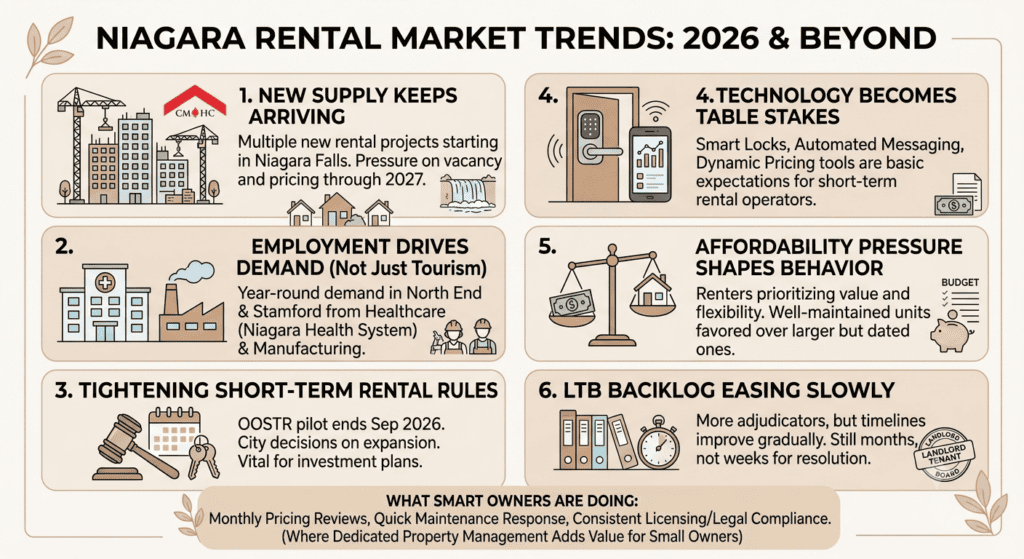
A few forces will shape how rental property management in Niagara evolves over the next few years:
- New supply keeps arriving. CMHC’s 2026 outlook flags multiple new rental apartment projects starting in Niagara Falls this year, which will keep pressure on vacancy rates and pricing through 2027.
- Employment, not just tourism, is driving demand. Away from the tourist core, healthcare and manufacturing employment – anchored by Niagara Health System – are sustaining steady, year-round rental demand in neighbourhoods like the North End and Stamford.
- Short-term rental rules keep tightening and evolving. The OOSTR pilot wraps up in September 2026, after which the city will decide whether to expand it – a decision worth watching closely for anyone considering a short-term rental investment.
- Technology is becoming table stakes. Smart locks, automated guest messaging, and dynamic pricing tools are shifting from a competitive edge to a basic expectation for short-term rental operators.
- Affordability pressure is shaping renter behaviour. As affordability tightens across most of Ontario, more renters are prioritizing value and flexibility over square footage, which favours well-maintained, fairly priced units over larger but dated ones.
- The LTB backlog is easing, but slowly. With the province funding additional adjudicators and the case backlog dropping from roughly 53,000 to around 41,000, timelines should continue to improve gradually – but “gradually” still means months, not weeks, for the foreseeable future.
What Smart Owners Are Doing Differently This Year
The owners weathering this shift best share a few habits: they review pricing monthly instead of annually, they respond to maintenance requests quickly enough that small issues never become disputes, and they treat licensing and legal paperwork as a standing responsibility rather than a one-time task. None of that requires a large portfolio – it just requires consistency, which is exactly where a dedicated property manager tends to add the most value for a single-property owner juggling a full-time job of their own.
Common Mistakes Niagara Landlords Make
Even well-intentioned owners run into the same handful of problems. Recognizing them early is usually cheaper than fixing them later.
Pricing Based on Outdated Comparables
With new supply entering the market throughout 2026, a rent that was competitive eighteen months ago can now be well above market. Owners who skip a regular rent review often don’t realize their unit is overpriced until it’s been vacant for weeks.
Treating Every Notice as a Formality
A rent increase notice, an N4, or an N12 each has specific timing and content requirements. Missing a detail as small as an incorrect termination date can get an application dismissed at the LTB, forcing the entire process to restart – often adding months to an already slow timeline.
Underestimating Short-Term Rental Compliance
Some owners assume that once a VRU license is issued, the work is done. In reality, license renewals, MAT remittance, inspection readiness, and record-keeping are ongoing obligations. Falling behind on any of them can put an active listing at risk.
Skipping Preventive Maintenance
Reactive maintenance – waiting for something to break – almost always costs more than a seasonal inspection schedule would have. A small roof leak caught early is a repair; the same leak ignored for a season can become a full remediation project.
Going It Alone During a Dispute
Self-represented landlords at the LTB are at a real disadvantage against experienced adjudicators and, increasingly, tenants working with legal clinics. Professional representation – even for a single hearing – often pays for itself in a faster, cleaner outcome.
Conclusion: Let Niagara’s Rental Market Work For You, Not Against You
Rental property management in Niagara has never been “set it and forget it,” but 2026 makes that clearer than ever. Rising vacancy, a still-slow Landlord and Tenant Board, and shifting short-term rental rules all reward owners who manage proactively – and quietly punish the ones who don’t.
You don’t have to navigate all of it alone, and you don’t need a large portfolio to benefit from getting this right. The HAH Developments handles the entire picture for Niagara property owners – from tenant screening and rent collection to short-term rental licensing and LTB compliance – so your property stays occupied, protected, and profitable without eating up your time.
Ready to see what stress-free rental property management in Niagara actually looks like? Contact The HAH Developments today for a free, no-obligation property consultation and find out exactly what your property could be earning.
Frequently Asked Questions About Rental Property Management in Niagara
How much does rental property management cost in Niagara? Most long-term rental management runs 8% to 12% of monthly rent, plus a one-time leasing fee. Short-term rental co-hosting typically costs 15% to 25% of booking revenue, given the added workload of guest turnover and dynamic pricing.
Do I need a license to run an Airbnb in Niagara Falls? Yes. Every short-term rental needs a Vacation Rental Unit license, and the property must be in an approved commercial or tourist zone. Operating without one risks fines up to $50,000 for a first offence.
How long does an eviction take in Ontario right now? It depends on the reason. Non-payment applications typically take three to six months to reach a hearing. Personal-use or tenant-fault evictions often take six to nine months, and the process can run longer if a hearing gets adjourned.
What is Ontario’s rent increase guideline for 2026? It’s 2.1%, the lowest guideline in four years. Landlords must give at least 90 days’ written notice and wait a full 12 months since the last increase.
Is Niagara still a good market for rental property investment? Yes, but the strategy has shifted. Vacancy rates have risen and new supply is entering the market, which rewards owners who price competitively and manage actively over those relying on the tight-market conditions of a few years ago.
Can a property manager help with Landlord and Tenant Board applications? Yes. A professional manager can prepare and file notices correctly, track legal timelines, and represent an owner’s interests through the hearing process – reducing the risk of a case being delayed or dismissed over a paperwork error.