

Owning a rental property in Ontario is one of the most reliable ways to build long-term wealth. But that reliability only holds up if the person living in your unit pays rent on time, takes care of the property, and follows the lease. One bad tenant can undo years of careful planning in a matter of months.
Here’s the part many landlords underestimate: in Ontario, a bad tenant isn’t just expensive. It’s slow to fix. The province’s Landlord and Tenant Board (LTB) is still working through a serious backlog of cases, which means a landlord who ends up with a non-paying or destructive tenant could be stuck waiting the better part of a year before anything changes. During that entire stretch, the mortgage, taxes, and insurance don’t pause.
That’s why tenant screening Ontario landlords rely on has become less about ticking a box and more about protecting the entire investment before a lease is ever signed. This guide walks through why screening matters more in 2026 than it did even a few years ago, what Ontario law actually allows you to do, and how a professional screening process pays for itself many times over.
Think of it this way. Every hour spent verifying an applicant’s income, checking a reference, or confirming a document is real is an hour spent avoiding a problem that could otherwise take months to unwind through the Landlord and Tenant Board. That trade-off is the entire argument for taking screening seriously, and it’s why more Ontario landlords are either building a rigorous process themselves or handing the work to a property manager who already has one in place.
Why a Bad Tenant Costs More in Ontario Than Almost Anywhere Else
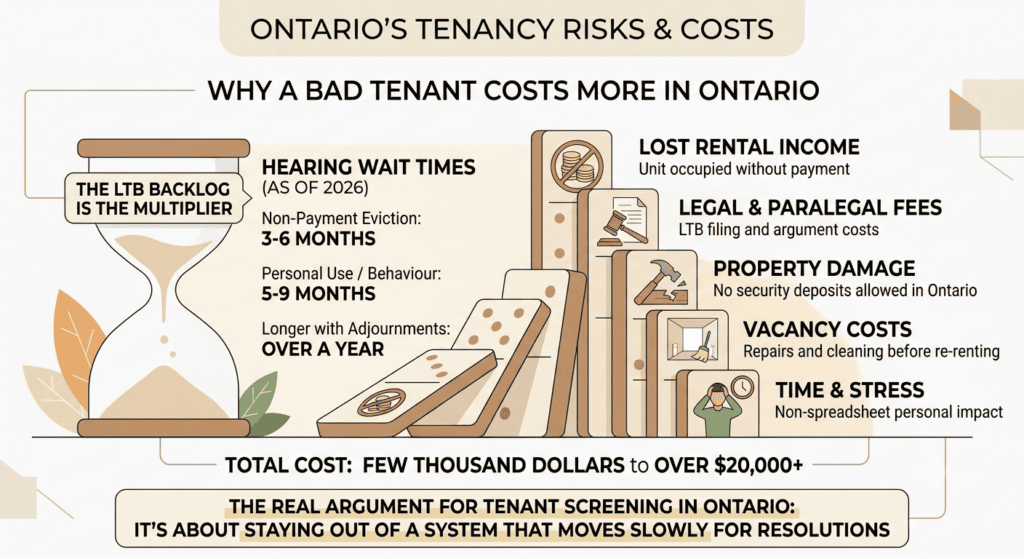
Every province has landlord-tenant rules. Ontario’s are among the most protective of tenants in the country, which is good for housing stability but means landlords carry more of the risk when a tenancy goes wrong.
Here’s what a bad tenant can actually cost:
- Lost rental income while the unit sits occupied by someone who isn’t paying
- Legal and paralegal fees to file and argue an LTB application
- Property damage that Ontario law won’t let you recover through a security deposit, because damage deposits aren’t legal here in the first place
- Vacancy costs after the tenant finally leaves and the unit needs repairs or cleaning before it can be re-rented
- Time and stress, which rarely show up on a spreadsheet but are very real for landlords managing this alongside a full-time job or a growing portfolio
Industry estimates place the total cost of a problem tenant anywhere from a few thousand dollars to well over $20,000, depending on how long the situation drags on and how much repair work is needed afterward. In Ontario specifically, the timeline is the multiplier. The longer a dispute takes to resolve, the higher every one of those costs climbs.
The LTB Backlog Makes Screening Non-Negotiable
This is the piece that turns “screening is a good idea” into “screening is essential.” As of early 2026, hearing wait times at the Landlord and Tenant Board vary widely depending on the type of application, but none of them are fast.
Applications to evict a tenant for non-payment of rent are generally prioritized, with current wait times running somewhere in the range of three to six months before a hearing is even scheduled. Applications based on personal use or tenant behaviour typically take longer, often five to nine months. And recent data shows that a meaningful share of cases stretch well beyond that, with some landlords waiting over a year for a resolution once adjournments are factored in.
None of this includes the time before you file. You still have to serve the correct notice, wait out the response period, and only then submit your application. Add an adjournment, which happens more often than landlords expect, and a straightforward non-payment case can easily consume the better part of a year from the missed rent payment to a final order.
This is the real argument for tenant screening in Ontario. It’s not about avoiding paperwork. It’s about staying out of a system that, however necessary it is for tenant protection, moves slowly for landlords trying to resolve a bad situation.
What’s Changing for Ontario Landlords in 2026
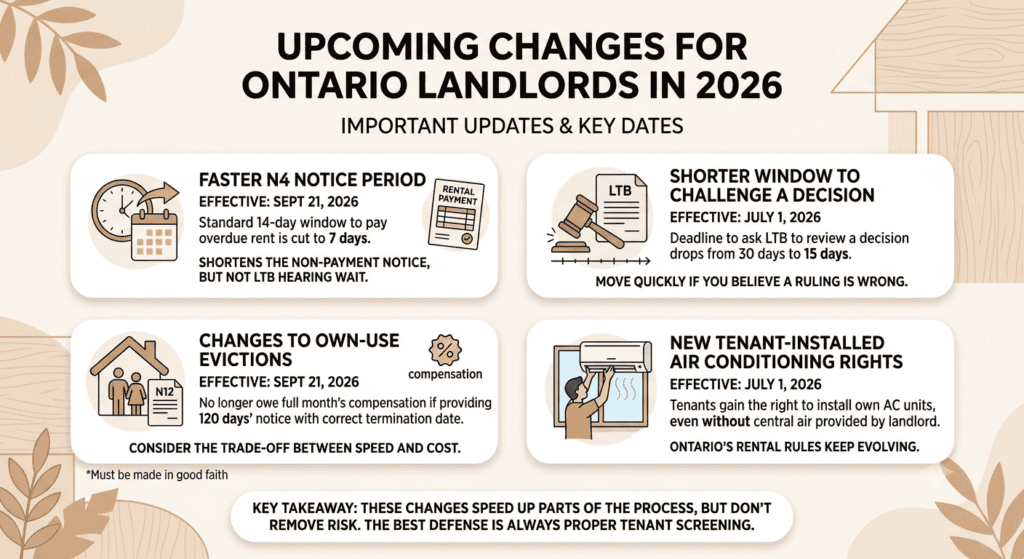
Ontario’s rental rules don’t sit still, and 2026 brings a meaningful set of updates that every landlord should understand before they’re deep into a tenancy.
A Faster N4 Notice Period
Under Bill 60, the Fighting Delays, Building Faster Act, the standard 14-day window a tenant has to pay overdue rent after receiving an N4 notice is being cut to 7 days, effective September 21, 2026. This shortens the front end of a non-payment case, but it doesn’t touch the actual bottleneck, which is the wait for an LTB hearing once an application is filed. A faster notice period helps, but it’s not a substitute for choosing a reliable tenant in the first place.
A Shorter Window to Challenge a Decision
Starting July 1, 2026, the deadline to ask the LTB to review one of its own decisions drops from 30 days to 15 days. If a ruling goes against you and you believe it’s wrong, you’ll need to move quickly. The Board can extend this in some situations, but landlords shouldn’t plan around that discretion.
Changes to Own-Use Evictions
Also effective September 21, 2026, landlords using an N12 notice to move into their own property, or move in an eligible family member, may no longer owe a full month’s compensation if they provide at least 120 days’ notice and the termination date lines up with the end of a rental period. This creates a genuine trade-off between speed and cost that owners considering this route should think through carefully, and it comes with real consequences if the LTB later finds the move wasn’t made in good faith.
New Tenant-Installed Air Conditioning Rights
As of July 1, 2026, tenants gain the right to install their own air conditioning units, even in buildings where the landlord doesn’t provide central air. This isn’t directly about screening, but it’s a reminder that Ontario’s rental rules keep evolving, and a landlord who isn’t tracking these updates is at a disadvantage regardless of how good their tenant is.
Taken together, these changes speed up parts of the process, but they don’t remove the underlying risk. If anything, they reinforce the same lesson: the fastest, cheapest way through Ontario’s rental system is never having to use it in the first place.
Rental Market Trends Shaping Screening in 2026
A few broader shifts in Ontario’s rental market are pushing screening from “nice to have” to “essential” for landlords who want to stay ahead.
Rising cost of living is stretching tenant budgets. With everyday expenses climbing faster than wages for many renters, income verification matters more than it did five years ago. A pay stub that looked comfortable against a rent amount a few years back might not tell the same story today. This is exactly why professional screening looks at debt load and payment history alongside income, not income in isolation.
Application fraud is getting harder to spot with the naked eye. Editing software and readily available templates make it easier than ever to produce a convincing fake pay stub or bank statement. Landlords who eyeball a PDF and move on are taking on more risk than they realize. This is part of why AI-assisted verification tools, which cross-check documents against real financial data rather than just checking whether a PDF looks legitimate, are becoming more common among property managers.
Rent control changes are affecting turnover incentives. The 2026 provincial rent increase guideline sits at 2.1%, the lowest in four years. In a low-guideline environment, landlords have less room to offset a bad tenancy with rent growth elsewhere in the portfolio, which makes avoiding costly turnover even more important.
Public access to LTB decisions is expanding. As part of the broader reforms moving through the system, public access to Board decisions is increasing. This is a double-edged development. It gives landlords a better tool for checking an applicant’s eviction history, but it also means landlords need to use that information carefully and consistently, rather than treating a single past filing as an automatic disqualifier without looking at the context behind it.
Each of these trends points in the same direction: the applicants who look fine on paper aren’t always the applicants who are fine in practice, and the gap between the two is where professional screening earns its value.
What Is Professional Tenant Screening, Really?
A lot of landlords think tenant screening starts and ends with a credit check. That’s a mistake. A credit score tells you whether someone has paid bills in the past. It doesn’t tell you whether their income can actually support your rent, whether they’ve been evicted before, or whether the pay stub they handed you is real.
Professional tenant screening pulls together several pieces of information and, just as importantly, verifies that information rather than taking it at face value:
- Rental application review – checking for consistency and completeness
- Credit history – payment patterns, not just a single score
- Income verification – confirmed against actual pay records, not just stated
- Employment verification – a call or written confirmation with the employer
- Previous landlord references – ideally from a landlord before the current one
- Eviction history – searchable through public LTB decisions
- Identity verification – confirming the applicant is who they say they are
The difference between an amateur process and a professional one usually comes down to verification. Anyone can ask for a pay stub. A professional screener confirms it’s genuine.
What Ontario Law Actually Allows You to Ask
Tenant screening in Ontario doesn’t happen in a legal vacuum. It sits under the Ontario Human Rights Code, a specific regulation under that Code, and federal privacy law, all operating at once.
Ontario Regulation 290/98, made under the Human Rights Code, sets out exactly which tools landlords may use when screening applicants: credit references, rental history, credit checks, income information, and guarantees. There’s an important limit built into this rule. Income information can only be requested if you’re also asking for credit references and rental history. You can’t use income alone as your screening criterion.
On the privacy side, federal law requires informed, written consent before you pull a credit report or share an applicant’s personal information with a third-party screening company. This isn’t optional paperwork. The Office of the Privacy Commissioner has taken enforcement action in cases where landlords failed to properly explain how applicant information would be collected, used, and stored.
What Landlords Cannot Do
This is where good-faith landlords sometimes run into trouble without realizing it.
A blanket minimum-income requirement or a fixed rent-to-income ratio, applied as the sole basis for rejecting applicants, has been found by Ontario’s human rights tribunal to indirectly discriminate against people who receive social assistance. Ontario is one of the few provinces that explicitly protects “receipt of public assistance” as a housing ground under its Human Rights Code. That means a landlord cannot turn down an applicant simply because their income comes from ODSP, Ontario Works, or a similar program. The focus has to stay on the applicant’s actual ability to pay, not the source of their income.
There’s also a duty to accommodate. If an applicant’s disability explains a thin rental or credit history, the landlord is expected to consider alternative verification, such as a guarantor or personal references, rather than applying the same bar that would exclude them automatically.
None of this means landlords have to accept every applicant. It means the criteria have to be applied consistently, documented clearly, and focused on legitimate financial and behavioural indicators rather than shortcuts that happen to exclude protected groups.
7 Ways Professional Tenant Screening Protects Your Investment
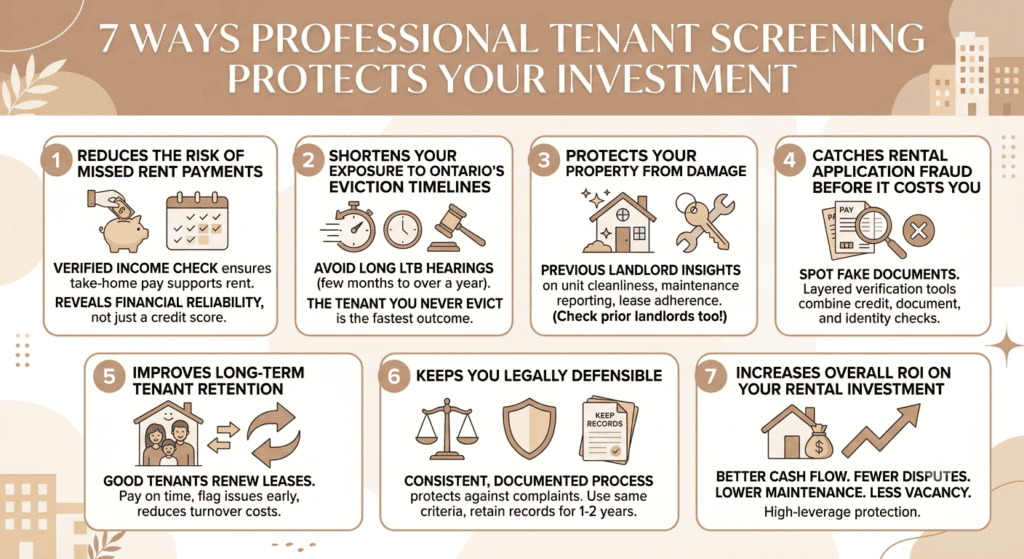
1. Reduces the Risk of Missed Rent Payments
A verified income check tells you whether the applicant’s actual take-home pay supports the rent you’re asking. Combined with a look at their payment history on existing debts, you get a real picture of financial reliability, not just a number on a credit report.
2. Shortens Your Exposure to Ontario’s Eviction Timelines
This is the point worth repeating: with LTB hearings still running anywhere from a few months to well over a year depending on the application type, the tenant you never have to evict is the fastest possible outcome available to you. Screening isn’t a substitute for the legal process. It’s how you avoid needing it.
3. Protects Your Property From Damage
A previous landlord can tell you things an application form never will. Did the tenant keep the unit clean? Did they report maintenance issues early, or let small problems become expensive ones? Did they follow the lease, or push against it?
One practical tip experienced landlords use: try to reach the landlord before the current one, not just the current one. A current landlord dealing with a difficult tenant sometimes gives a glowing reference simply to encourage that tenant to move out and become someone else’s problem.
4. Catches Rental Application Fraud Before It Costs You
This is a growing concern, and it’s one competitor blogs on this topic often underplay. Fake pay stubs, edited bank statements, and fabricated identities are becoming more sophisticated, not less. A basic credit check alone won’t catch a well-made forgery. This is why more property managers are turning to layered verification tools that combine credit data with document and identity checks, rather than relying on a single data point to make a leasing decision.
5. Improves Long-Term Tenant Retention
Good tenants tend to renew leases, pay on time without reminders, and flag maintenance issues before they turn into bigger repairs. Every renewal is a turnover cost you don’t have to absorb, and every early maintenance report is a repair bill you catch while it’s still small.
6. Keeps You Legally Defensible
A consistent, documented screening process is your best protection if a rejected applicant ever files a human rights complaint. This means using the same criteria for every applicant, keeping records of how each decision was made, and retaining that documentation for a reasonable period. As a general guideline, rejection documentation should be kept for one to two years from the decision date, roughly aligned with the window in which a human rights complaint could be filed. A landlord who can show a clear, consistent process has a much stronger position than one relying on memory.
7. Increases Overall ROI on Your Rental Investment
Every point above rolls up into the same outcome: better cash flow, fewer legal disputes, lower maintenance costs, and less vacancy. Tenant screening isn’t an added expense. It’s one of the highest-leverage things a landlord can do to protect the return on their property.
What a Professional Ontario Tenant Screening Process Includes
| Screening Step | Why It Matters | Ontario Compliance Note |
| Identity Verification | Confirms the applicant is who they say they are | Can request date of birth or SIN, not both |
| Credit Report | Reveals payment history and debt load | Requires written applicant consent |
| Income Verification | Confirms the applicant can actually afford the rent | Must be requested alongside credit and rental history, not alone |
| Employment Verification | Confirms income stability | Focus on ability to pay, not source of funds |
| Rental History | Shows how the applicant treated past tenancies | Contact a landlord before the current one when possible |
| Eviction Search | Flags prior LTB eviction filings | Public LTB decisions are searchable |
| Background Check | Assesses relevant records where legally permitted | Cannot be used as a blanket exclusion policy |
| Reference Checks | Confirms reliability and communication style | Ask direct, specific questions |
DIY Screening vs. Professional Screening
| DIY Screening | Professional Screening |
| Limited to what the applicant provides | Draws on verified third-party data sources |
| Time-consuming, especially across multiple applicants | Faster turnaround with standardized checks |
| Higher risk of missing fraud | Identity and document verification built in |
| Manual, inconsistent reference calls | Structured, repeatable reference process |
| Greater legal exposure from inconsistent criteria | Documented, consistent process across every applicant |
The Hidden Risk of DIY: Getting the Human Rights Code Wrong
Most landlords who run into human rights complaints aren’t acting in bad faith. They’re applying a rule inconsistently, phrasing a question in a way that inadvertently touches a protected ground, or leaning on an income cutoff without realizing it can be considered discriminatory. A professional screening process reduces this risk simply by applying the same criteria, in the same order, to every applicant, every time.
A common scenario: Picture two applicants for the same unit. One has a steady paycheque from a full-time job. The other receives income through a disability support program but has a strong rental history and a willing guarantor. A landlord screening informally might lean toward the first applicant without really weighing the second one’s actual ability to pay. That instinct, even without any intent to discriminate, is exactly the kind of pattern that Ontario’s human rights framework is designed to catch. A structured process forces the landlord to evaluate both applicants against the same documented criteria, which protects the landlord as much as it protects the applicant.
This is also where the cost of DIY screening tends to hide. It’s not just the time spent chasing documents. It’s the legal exposure that builds up quietly when there’s no consistent record of how and why each applicant was evaluated.
Red Flags Every Landlord Should Watch For
- Reluctance or delays when asked for references or pay stubs
- Pay stub details that don’t match the stated employer or pay period
- References that sound rehearsed, overly positive, or vague on specifics
- Pressure to skip steps in the process or move faster than normal
- A rental history that jumps between short tenancies without a clear explanation
None of these automatically disqualify an applicant, but they’re worth a closer look before you sign a lease.
Signs It’s Time to Hand Screening Over to a Property Manager
- Your portfolio is growing faster than your available time
- You’re managing property from outside the city or country
- You’ve already been through a bad tenant experience and don’t want a repeat
- You’re finding it hard to verify documents or track down references
- You’re struggling to keep up with 2026’s RTA changes on top of everything else
If any of these sound familiar, the cost of professional screening is almost always lower than the cost of getting it wrong. A single missed red flag, whether it’s an unverified pay stub or a reference call that never happened, can cost far more in lost time and legal fees than a full year of professional management fees would.
How The HAH Developments Protects Niagara-Region Landlords
The HAH Developments works with property owners across the Niagara region who want the returns of rental ownership without carrying every piece of the risk alone. Our tenant screening process is built around the same principles covered in this guide: verified income and employment checks, real rental history, consistent criteria applied to every applicant, and full documentation that holds up if it’s ever questioned.
We also help owners think through the bigger picture. Some properties make more sense as long-term rentals, and others perform better under short-term Airbnb hosting and co-hosting. If you’re weighing that decision, or if you’re just tired of chasing references and verifying pay stubs yourself, that’s exactly the kind of work we take off your plate. From screening through to ongoing property management and maintenance, our goal is the same one you have: protect the investment and keep it producing income without the stress.
For owners who split their time between property types, this matters even more. A landlord juggling a long-term rental in one part of the region and a short-term Airbnb unit elsewhere doesn’t have the bandwidth to manually verify every applicant’s employment or chase down a former landlord for a reference call. Our team builds that consistency in from the start, so every applicant across every property is evaluated against the same documented standard, whether the unit is being leased for a year or hosted for a weekend.
We also stay on top of exactly the kind of regulatory shifts covered in this guide, from the 2026 Bill 60 changes to updates in the Human Rights Code’s screening rules, so you’re not left trying to track legislation on top of running your business.
The Bottom Line
Tenant screening isn’t a formality standing between you and a signed lease. In Ontario, where the eviction process can stretch well past the length of most leases’ notice periods, it’s the single most effective tool a landlord has to avoid the entire situation altogether. A verified, consistent, well-documented screening process protects your rental income, keeps you on the right side of the Human Rights Code, and preserves the long-term value of your property.
The landlords who come out ahead in Ontario’s 2026 rental market aren’t the ones who react fastest after something goes wrong. They’re the ones who never have to react at all, because the person they chose to rent to was the right fit from the start. That outcome isn’t luck. It’s the direct result of a screening process built to catch problems before they become tenancies.
If you’d rather not carry that responsibility alone, The HAH Developments is here to help. Reach out to our team to learn how our tenant screening and property management services can protect your Niagara-region investment from application to move-out.
Frequently Asked Questions for Tenant Screening Ontario
Landlords can request credit references, a credit check, rental history, income information, and guarantees, but income information can only be requested alongside credit and rental history, not on its own.
No. Receipt of public assistance is a protected ground under the Ontario Human Rights Code. Rejecting an applicant solely because their income comes from a government program is discriminatory.
It depends on the application type. Non-payment cases are currently taking roughly three to six months to reach a hearing, while personal use or behaviour-based applications often take five to nine months or longer, not including time for adjournments.
Yes. Federal privacy law requires informed, written consent before a landlord or a third-party screening service can pull an applicant’s credit report.
Relying on a single data point, usually a credit score, instead of verifying income, checking real rental history, and confirming documents are genuine.
No. Ontario law does not allow damage deposits. Landlords can only collect first and last month’s rent plus a refundable key deposit where applicable, which is part of why thorough upfront screening matters so much here.
It’s not outright prohibited, but it’s risky. Browsing a social media profile can expose protected characteristics like religion, family status, or disability, which makes it harder to prove those factors played no role in your decision. Most property managers avoid it for this reason.
As a general practice, keep documentation of how each rejected application was evaluated for at least one to two years. This roughly aligns with the window in which a human rights complaint could be filed and gives you a clear record if your process is ever questioned.