

Property management used to move at a predictable pace. A landlord collected rent by cheque, fixed things when they broke, and renewed leases with a handshake and a signature. That world is gone. Walk into any conversation with a rental investor in Ontario today and you’ll hear about AI leasing assistants, predictive maintenance sensors, and tenant portals that residents now simply expect. Rental Investing The pace of change in this industry has picked up so quickly that AI tool adoption among property management professionals nearly tripled in a single year, jumping from 20% to 58%.
Tenants are driving a lot of this shift. They no longer compare their rental experience to the building next door – they compare it to the apps on their phone. Renters increasingly weigh the technology and service layer around a rental as much as the unit itself, with the vast majority of renters saying resident benefits matter when choosing a new place to live. If a competitor’s building answers questions in seconds and yours takes three days, guess where the good tenants go.
Technology is changing daily operations too, not just the marketing brochure. Maintenance requests, rent payments, lease signing, and even fraud detection increasingly run through software rather than a filing cabinet. And here in Niagara, the stakes are real: CMHC reported the Niagara region vacancy rate at just 1.8% as of the fourth quarter of 2025, well below the national average of 3.1%, meaning well-run properties in this market are commanding strong rents and low downtime, while poorly run ones bleed money through inefficiency.
The investors who adapt early to these property management trends 2026 aren’t just keeping up with fashion. They’re protecting their cash flow. Vacancy days, maintenance emergencies, bad tenants, and compliance mistakes are the things that quietly erode an investor’s return year after year. The tools and practices below exist specifically to close those leaks. Let’s walk through the ten trends reshaping rental investing this year, and what they actually mean for your property, your tenants, and your bottom line.
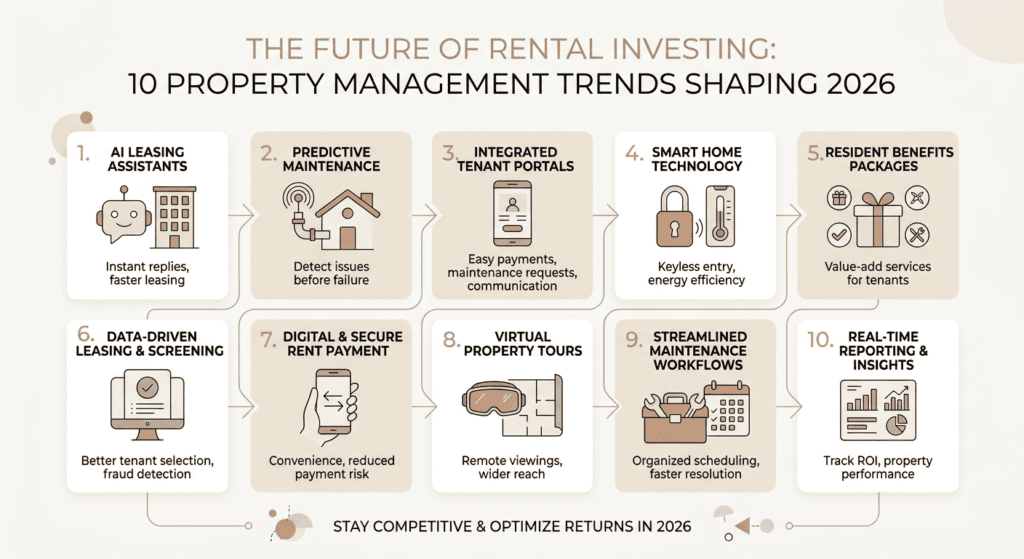
1. AI Is Becoming Every Property Manager’s Assistant
AI in property management stopped being a buzzword around the same time it started actually saving people time. According to AppFolio’s 2026 Property Management Benchmark Report, rising costs across insurance, taxes, and materials have pushed operators to lean harder on technology just to protect margins, and AI has become the tool of choice for absorbing that pressure without cutting corners on service.
Tenant communication is the clearest example. Instead of a prospective tenant emailing at 9 p.m. and waiting two days for a reply, AI-powered leasing assistants now respond within seconds, answer routine questions, and even schedule showings automatically. These systems can respond to inquiries within seconds, answer common questions, qualify prospects, and schedule tours automatically, which helps convert more leads into residents and shortens vacancy periods. For a landlord juggling a full-time job and a rental portfolio, that alone can be the difference between a unit sitting empty for three weeks versus three days.
Automated rent reminders and lease management follow the same logic. Late payments often happen simply because a tenant forgot, not because they can’t pay. A system that sends a friendly reminder two days before rent is due, and again the morning it’s due, prevents a huge share of “late” payments before they ever become a problem. Lease renewal dates, insurance certificate expirations, and inspection schedules can all be tracked automatically instead of relying on someone’s memory.
Maintenance scheduling is where AI is proving most practical right now. Automating maintenance triage and request categorization has become one of the most practical, proven applications of AI in property management today. Instead of a tenant’s message sitting in an inbox until someone has time to read it, AI can immediately classify the urgency of a leaking pipe versus a squeaky door, and route the right vendor automatically.
None of this means the human touch disappears. Industry researchers are consistent on this point: success with these tools depends on using them thoughtfully, especially where a business’s reputation and relationships are on the line, and the companies getting the most value combine tech-driven efficiency with a human touch. The goal isn’t to replace your property manager with a chatbot. It’s to free your property manager from repetitive admin work so they can spend more time on the judgment calls that actually require a person – handling a difficult tenant conversation, negotiating a renewal, or walking a unit before turnover.
What this means for you as an investor: Time savings compound. A property manager who isn’t drowning in routine emails and rent reminders has more bandwidth to catch small problems before they become expensive ones, and more time to actually know your property and your tenants.
2. Smarter Tenant Screening Is Reducing Investment Risk
If there’s one area where 2026 has forced landlords to level up fast, it’s tenant screening. The reason is blunt: fraud has exploded. Industry data shows AI-generated fraudulent rental documents increased 500% between April and December of 2025 alone, and generative AI can now produce a pay stub, bank statement, or employment verification letter that looks completely legitimate to an untrained eye – the old tells, like mismatched fonts or math that didn’t add up, have largely disappeared.
This isn’t a hypothetical risk. A growing share of landlords now report being victims of rental fraud, and property managers who once caught the vast majority of fraudulent applications now catch a shrinking share as forgery techniques improve. The consequences of getting it wrong aren’t small either – a bad tenant placement often doesn’t reveal itself on day one. A fraudulent applicant typically pays the first month or two, then rent stalls, communication turns defensive, and lease violations begin, with a resulting eviction commonly costing $8,000 to $15,000 in legal fees, lost rent, and property damage.
Better verification tools are the direct response. Modern screening now goes beyond a single credit pull. Income and identity verification increasingly draws from direct-source data (payroll platforms, bank connections) rather than documents supplied by the applicant, because anything the applicant hands over first can be altered before it reaches you.
Rental history analysis matters more than people realize. A credit score tells you whether someone pays bills; it doesn’t tell you whether they take care of a property or respect a lease. Calling previous landlords directly – using contact information you look up independently, not the number the applicant provides – remains one of the most reliable, low-tech fraud checks available.
Fraud detection software is increasingly essential rather than optional. These tools scan uploaded documents for signs of tampering, cross-reference employment claims against databases, and flag identity inconsistencies that a human reviewer would likely miss on a first pass.
Why does quality matter more than ever right now? Because the Niagara market has shifted. For the first time in years, high-quality tenants have more options, and a unit priced or managed poorly can sit for weeks while a well-run comparable fills in days. In a market where good tenants can afford to be selective, landlords need to be equally selective on their end – and that starts with knowing exactly who is moving in.
What this means for you as an investor: Every dollar spent on rigorous screening is cheap insurance against a five-figure eviction. This is one trend where cutting corners almost never pays off.
3. Predictive Maintenance Is Replacing Reactive Repairs
For decades, property maintenance has been reactive by default: something breaks, the tenant calls, you scramble to find a plumber. That model is expensive and stressful, and it’s being replaced by a proactive one built on data.
Smart sensors are the foundation. Devices that monitor water flow, humidity, temperature, and appliance performance can flag abnormal patterns before they become a burst pipe or a failed furnace. An AI platform might detect unusual patterns in water usage that signal a leak, prompting maintenance before it escalates into costly water damage, while also tracking long-term performance trends to help owners plan capital expenditures more accurately.
Preventive maintenance built around this data means work orders get scheduled before failure, not after. AI can analyze thousands of data points from sensors across a property portfolio, enabling property managers to schedule repairs before a tenant even experiences the issue – improving satisfaction and operational efficiency at the same time.
Reducing emergency repairs has a direct financial impact, because emergency calls always cost more than scheduled ones – after-hours rates, rush parts, and the risk of consequential damage (a small leak that becomes a ruined ceiling) all add up. Predictive systems catch the small leak while it’s still small.
Lower long-term maintenance costs and extended property lifespan follow naturally. HVAC systems, water heaters, and roofing all degrade faster when small issues go unaddressed. Catching wear patterns early doesn’t just prevent a single repair bill; it extends the useful life of the whole system, which matters enormously for an investor thinking in ten-year horizons rather than ten-month ones.
For Ontario landlords specifically, predictive maintenance also has a compliance angle. Properties covered under municipal bylaws – for instance, Toronto’s newly expanded indoor temperature standards – face real accountability for keeping systems functional. Starting June 1, 2026, certain apartment buildings under Toronto’s RentSafeTO program must maintain a cooled indoor amenity space kept at 26°C or below through the summer months. Predictive HVAC monitoring makes hitting standards like this far easier than hoping nothing breaks during a heat wave.
What this means for you as an investor: Predictive maintenance turns your maintenance budget from a source of anxiety into a predictable line item, and it protects the asset itself – not just this year’s cash flow, but the property’s value a decade from now.
4. Tenant Experience Is Becoming a Competitive Advantage
Retention is the quiet financial engine of a healthy rental portfolio, and 2026 has made tenant experience the main lever for pulling it. Acquiring a new resident costs significantly more than keeping one, and between marketing, vacancy days, turnover maintenance, and leasing admin, losing a resident can cost an owner thousands of dollars.
Online portals have become the baseline expectation, not a premium feature. Tenants want to view their lease, submit a request, and check their payment history without calling anyone. Digital leasing and self-service tools – viewing properties virtually, applying online, signing leases electronically, moving in without unnecessary in-person touchpoints – have shifted from a perk to a baseline expectation.
Mobile maintenance requests remove friction at the exact moment a tenant is frustrated (something in their home just broke). Submitting a request through an app, with a photo attached, and getting an immediate confirmation goes a long way toward defusing that frustration before it turns into a bad review or a non-renewal.
Digital payments matter for the same reason. Tenants want flexibility in how and when they pay rent – mobile app, auto-pay, credit card, ACH – and properties accepting flexible payment options tend to see higher on-time payment rates.
Faster communication consistently ranks as one of the top drivers of tenant satisfaction. Instant communication channels – texting, mobile apps, and chatbots for routine questions – aren’t perks anymore; they’re baseline expectations, and response time matters more than which channel a tenant prefers.
The payoff shows up at renewal time. Tenants who feel heard and well-served are dramatically more likely to sign again rather than shop the market, which matters enormously given how competitive the current Niagara rental landscape has become for landlords chasing quality applicants.
What this means for you as an investor: Every dollar spent improving the tenant experience is really a retention investment. A tenant who renews saves you the marketing costs, the vacancy days, and the turnover maintenance of finding someone new.
5. Data-Driven Decisions Are Replacing Guesswork
Pricing a rental used to mean checking a few Kijiji listings and picking a number that felt right. That approach leaves money on the table in a rising market and creates painful vacancy in a softening one – and Niagara has recently experienced both.
Rental pricing analysis tools now pull comparable listings, historical lease data, and local demand signals to recommend a price that balances speed of leasing against maximum rent. Machine learning applications process thousands of variables – location, amenities, local market supply, and tenant behavior – to recommend pricing that balances competitiveness and profitability, and property owners using these systems often see higher occupancy rates and more stable cash flow.
Vacancy forecasting is especially valuable in a market like ours right now. CMHC’s own forecasting shows the purpose-built rental vacancy rate expected to rise through 2026 due to rental supply growth, before stabilizing later in the forecast period. Landlords who track this data can time renewals, plan for turnover, and adjust pricing ahead of the curve instead of reacting after a unit has already sat empty for a month.
Market analytics and occupancy tracking give investors with more than one unit a real edge. Instead of guessing which property is underperforming, a dashboard view shows exactly which unit has the highest turnover, the slowest lease-up time, or the most maintenance calls – the kind of pattern that’s nearly invisible when you’re managing spreadsheets by hand.
Portfolio performance dashboards consolidate all of this into one view. Portfolio managers benefit from dashboards that consolidate data across multiple assets, providing real-time visibility into performance metrics such as operating expenses, turnover rates, and net operating income.
What this means for you as an investor: Data doesn’t replace judgment – it sharpens it. Instead of deciding based on a gut feeling about what rent “seems fair,” you’re deciding based on what the market is actually doing right now, in your specific neighbourhood.
6. Sustainability Is Driving Property Value
Sustainability has quietly moved from a values-based nice-to-have to a financial strategy, and the numbers back that up clearly.
Energy-efficient upgrades pay for themselves faster than most landlords expect. Better insulation, LED lighting, and smart thermostats reduce utility costs immediately, and those savings compound every month a tenant lives in the unit.
Green buildings command real premiums. Green-certified buildings command 6–10% higher rents and sell for 10–15% more than comparable non-certified properties, while also achieving 15–25% lower operating costs due to energy and water efficiency improvements. Even outside formal certifications, the underlying efficiency gains translate directly to a healthier net operating income.
Water-saving systems – low-flow fixtures, smarter irrigation, leak-detection sensors – reduce a cost line that’s easy to overlook but adds up meaningfully across a portfolio, especially combined with the predictive maintenance tools discussed earlier.
Lower operating costs are the most direct benefit for a landlord who isn’t chasing a formal certification. Even modest upgrades reduce the monthly overhead of running a property, which improves cash flow regardless of what rent you’re charging.
Growing tenant demand for eco-friendly homes is the demand-side half of the equation. Energy-saving properties tend to let more quickly, leading to better financial returns and shorter vacancy periods, while attracting reliable tenants who value both environmental impact and financial stability. In practical terms, tenants are increasingly weighing their total monthly cost – rent plus utilities – rather than rent alone, so an efficient unit can justify a higher asking rent while still coming out cheaper for the tenant overall.
What this means for you as an investor: Sustainability upgrades aren’t charity. They’re one of the few improvements that simultaneously lower your costs, raise your ceiling on achievable rent, and shorten vacancy periods.
7. Digital Leasing Is Becoming the New Standard
The days of a prospective tenant driving across town for a fifteen-minute walkthrough, then doing the same thing at three other properties, are fading fast.
Virtual tours let prospects self-select before ever setting foot in the building, which saves everyone’s time – including yours. A well-produced video walkthrough filters out people who wouldn’t have liked the layout anyway, leaving your in-person showings for genuinely interested applicants.
E-signatures have become entirely standard for lease documents, and for good reason: they remove the scheduling friction of getting two or three parties into the same room at the same time, especially when a co-signer or guarantor is involved.
Online applications speed up the entire front end of leasing. A prospect who can apply from their phone the same night they viewed a listing is far more likely to follow through than one asked to print, sign, and mail a paper form.
Remote onboarding extends this convenience past the signature. Move-in instructions, key pickup logistics, and welcome documentation can all be handled digitally, reducing the administrative back-and-forth in the days before a tenant actually moves in.
The upshot is a faster leasing process overall, and speed genuinely matters right now. A unit priced even $150 above market can sit for weeks, while a unit priced and marketed accurately for current conditions fills in days – and two weeks of vacancy costs more than a year of modest under-pricing. Every day a unit sits vacant is a day of pure lost income, so anything that compresses the leasing timeline has a measurable dollar value.
What this means for you as an investor: Digital leasing isn’t about looking modern for its own sake. It directly shortens the single most expensive gap in a rental’s lifecycle – the days between one tenant leaving and the next one moving in.
8. Investors Are Outsourcing More Property Management Tasks
As the regulatory and technological demands on landlords have grown, more investors are concluding that DIY management no longer makes financial sense.
Growing complexity of regulations is a major driver. Ontario’s rental rules changed substantially heading into this year. Bill 97 and Bill 60 amendments to the Residential Tenancies Act take effect on July 1 and September 21, 2026, touching air conditioning rights, rent arrears agreements, RTA fines, N12 personal-use notices, N13 renovation evictions, and the N4 non-payment process. On top of that, maximum fines for RTA offences are rising sharply – individual fines from $50,000 to $100,000, and corporate fines from $250,000 to $500,000. For a self-managing landlord juggling a full-time job, staying current on changes like these is a real burden, and the cost of getting it wrong just went up significantly.
Time savings remain the most obvious benefit of professional management. Tenant screening, maintenance coordination, rent collection, and compliance paperwork add up to real hours every month – hours most investors would rather spend on their careers, their families, or finding their next investment property.
Professional expertise matters most in the moments that go wrong. Knowing exactly which LTB form applies to a given situation, and exactly how many days’ notice is legally required, is the difference between a clean resolution and a costly dispute.
Better tenant retention tends to follow professional management almost automatically, simply because a dedicated manager responds faster, follows up more consistently, and treats tenant relationships as an ongoing responsibility rather than something squeezed in between other commitments.
Higher ROI is the cumulative result of all of the above. Lower vacancy, fewer costly mistakes, better-screened tenants, and more efficient maintenance all show up directly in an owner’s net return, even after accounting for a management fee.
What this means for you as an investor: Outsourcing isn’t an admission that you can’t manage a property. It’s a recognition that a specialist, working full-time on exactly this, will almost always produce a better financial outcome than a part-time landlord trying to do it all.
9. Integrated Property Management Platforms Are Replacing Multiple Tools
For years, running a rental property meant stitching together separate tools: one for accounting, another for maintenance requests, a third for tenant messages, and a shared drive somewhere for documents. That patchwork approach is disappearing fast.
The biggest shift in property management technology this year is consolidation – operators are replacing six-tool stacks built around accounting with platforms built around the entire resident lifecycle instead.
Accounting integrated directly with rent collection means income and expenses reconcile automatically, instead of someone manually cross-checking bank deposits against a separate ledger every month.
Maintenance built into the same platform means a work order created from a tenant’s message doesn’t need to be re-entered somewhere else – it flows straight through from request to vendor assignment to completion, with a timestamped record the whole way.
Communication centralized in one system means nothing gets lost between a text message, an email, and a phone call. Every conversation with a tenant lives in one searchable place.
Document storage consolidated in the platform keeps leases, inspection reports, and compliance records together and instantly retrievable – which matters enormously if a dispute ever ends up in front of the Landlord and Tenant Board and you need to produce a clear paper trail.
Reporting becomes far more useful when it pulls from a single source of truth rather than three disconnected spreadsheets that never quite agree with each other.
The result is one dashboard for everything – a single place where an owner or manager can see occupancy, cash flow, open maintenance items, and upcoming lease expirations at a glance, instead of logging into four different systems to piece the picture together.
What this means for you as an investor: Consolidated platforms reduce the risk of something falling through the cracks between systems, and they make it dramatically easier for an owner to get a clear, honest picture of how their property is actually performing.
10. Regulatory Compliance Is Becoming More Important Than Ever
If there’s one theme tying every trend on this list together, it’s that the cost of getting things wrong has risen sharply in Ontario, while the path to getting things right has become more available through technology and professional management.
Provincial landlord-tenant regulations have shifted meaningfully for 2026. Ontario’s 2026 rent increase guideline is 2.1%, the lowest cap in four years, and it applies to rent increases taking effect on or after January 1, 2026. This 2.1% figure applies only to units first occupied for residential purposes on or before November 15, 2018; units first occupied after that date are exempt from the guideline entirely, and landlords of those units may raise rent by any amount with proper 90-day written notice. Landlords also need to track eviction and notice changes: under Bill 60, landlords may now evict tenants for unpaid rent after seven days’ notice instead of the previous fifteen, and the window to appeal an eviction order has shortened from 30 days to 15.
Record keeping has always mattered at the Landlord and Tenant Board, but it matters more now that timelines are compressed and fines are higher. Every notice, every maintenance request, and every piece of tenant correspondence should be dated, stored, and easy to retrieve on short notice.
Fair housing compliance protects both tenants and landlords when screening criteria are applied consistently and documented clearly. Having clear, written tenant screening criteria applied uniformly to every applicant not only helps identify fraud, it also protects a landlord from Fair Housing violations, because an owner can demonstrate the objective criteria an applicant failed to meet.
Privacy protection is increasingly non-negotiable given how much sensitive tenant data – income documents, identification, banking details – now flows through digital screening and payment systems. Choosing platforms and partners with genuine data-security practices isn’t optional anymore; it’s part of a landlord’s basic due diligence.
Why professional management reduces legal risk comes down to this: the rules changed twice in a matter of months this year alone, and the financial penalty for a mistake, as noted above, has doubled. Property owners holding rentals in a corporation now face up to $500,000 in maximum corporate fines for RTA offences such as illegal entry, harassment, or improper interference with tenant rights. A property manager who lives inside these regulations every day is simply far less likely to make an expensive procedural mistake than an investor managing compliance as a side project.
What this means for you as an investor: Compliance isn’t paperwork for its own sake anymore – it’s risk management with real financial teeth behind it in 2026’s Ontario.
Common Mistakes Investors Make in 2026
Even experienced investors fall into a few recurring traps as the industry shifts this quickly:
- Ignoring technology entirely. Sticking with paper leases and phone-tag communication in a market where tenants expect instant digital service puts a property at a real competitive disadvantage.
- Delaying maintenance. Deferred repairs almost always cost more later, and they erode tenant satisfaction in the meantime.
- Weak tenant screening. With nearly one in three rental applications now containing some fraudulent information, skipping rigorous verification is one of the costliest shortcuts a landlord can take.
- Underestimating compliance. Assuming last year’s rules still apply, especially with Bill 97 and Bill 60 changes rolling out mid-2026, is a fast route to an invalid notice or an unenforceable rent increase.
- Managing properties without reliable systems. Relying on memory and scattered spreadsheets works fine – until it doesn’t, usually right when a dispute lands at the LTB.
- Focusing only on rent instead of tenant retention. Squeezing every possible dollar out of a rent increase can cost far more in turnover, vacancy, and marketing than it gains.
How Investors Can Stay Ahead of These Trends
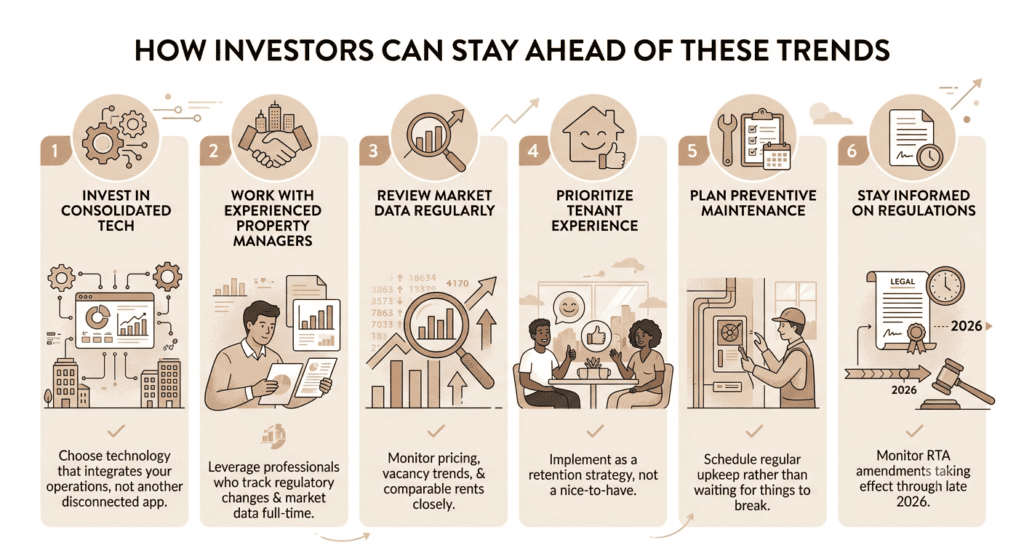
- Invest in technology that consolidates your operations rather than adding another disconnected app to the pile.
- Work with experienced property managers who track regulatory changes and market data as their full-time job, not an occasional task.
- Review market data regularly – pricing, vacancy trends, and comparable rents shift faster than most self-managing landlords realize.
- Prioritize tenant experience as a retention strategy, not a nice-to-have.
- Plan preventive maintenance on a schedule, rather than waiting for something to break.
- Stay informed about regulatory changes, particularly the RTA amendments taking effect through the second half of 2026.
Why Professional Property Management Matters More Than Ever
Pulling all ten trends together, one thing becomes clear: the gap between well-managed and poorly-managed rental properties has never been wider. Experienced property managers help investors:
- Increase occupancy by pricing accurately and marketing effectively from day one.
- Reduce vacancies through faster digital leasing and stronger tenant retention.
- Handle maintenance efficiently using predictive tools instead of reactive scrambling.
- Screen reliable tenants using verification methods built to catch modern, AI-assisted fraud.
- Stay compliant with regulations that are changing twice within a single calendar year.
- Maximize long-term returns by protecting the asset itself, not just this month’s cash flow.
This is exactly the kind of work The HAH Developments does every day for property owners across Niagara Falls and the surrounding region – combining local market knowledge with the technology and systems described throughout this article.
Conclusion
Successful investors in 2026 won’t simply own rental properties – they’ll leverage technology, data, and professional management to protect their assets, enhance tenant satisfaction, and improve profitability in an increasingly competitive market. AI-assisted screening and maintenance, data-driven pricing, sustainability upgrades, and integrated platforms aren’t separate trends happening in isolation. They’re all part of the same shift: rental investing is becoming a more disciplined, more professional business, and the investors who treat it that way are the ones pulling ahead.
Whether you’re managing a single condo or a growing portfolio across Niagara Falls, St. Catharines, or Welland, staying current with these property management trends 2026 isn’t optional anymore – it’s the difference between a rental that quietly compounds in value and one that quietly drains it.
Ready to put these trends to work for your property? The HAH Developments helps Niagara-area investors turn all ten of these trends into real results – stronger occupancy, protected asset value, and stress-free ownership. Contact The HAH Developments today for a complimentary rental portfolio assessment.