

A vacant unit is a headache. A bad tenant is a financial crisis.
An empty apartment costs you rent for a few weeks. A tenant who stops paying, damages your property, or drags you through a Landlord and Tenant Board hearing can cost you months of income, thousands of dollars in repairs, and a level of stress that keeps you up at night. The math is simple once you have lived through it: it is almost always cheaper to leave a unit empty for an extra week than to fill it with the wrong person.
Here is the part most landlords do not realize until it is too late. Nearly every eviction, every unpaid rent notice, and every damage dispute has a paper trail that started long before the lease was signed. The applicant who rushed through the paperwork. The reference who sounded a little too vague. The income documents that almost, but not quite, added up. These are tenant screening red flags, and they are usually visible weeks before the first missed payment.
This guide is not about becoming stricter or rejecting more applicants. Good tenants are harder to find in some markets and easier to find in others, and turning away qualified renters over minor issues does nothing for your bottom line. This is about learning to spot genuine risk early, asking better questions, and following a screening process that protects you legally while still treating every applicant fairly. Whether you self-manage a single property or work with a property management partner, the goal is the same: sign leases with confidence, not crossed fingers.
Below, you will find ten specific tenant screening red flags worth watching for, an honest look at which warning signs deserve context rather than an automatic rejection, and a practical, legally grounded process you can apply to every applicant from here forward.
Why Tenant Screening Matters More Than Ever
Rental markets shift, but the cost of getting tenant selection wrong has only gone up.
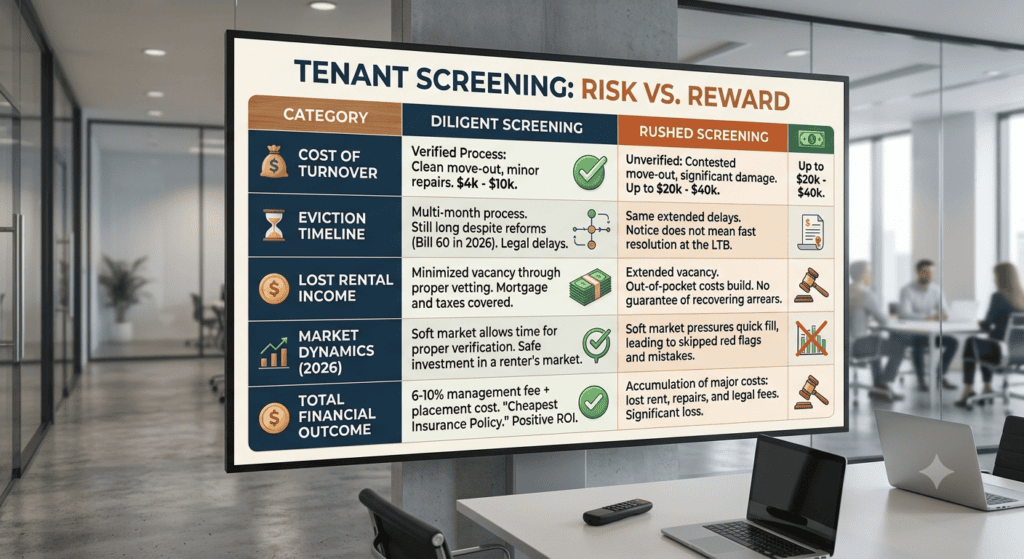
Repair and turnover costs have climbed sharply. A realistic tenant turnover in a major Ontario market now runs between $4,000 and $10,000 once you account for lost rent during the vacancy, cleaning, painting, minor repairs, and a locator or marketing fee. That number assumes a normal, cooperative move-out. A contested tenancy with damage or unpaid rent pushes the total much higher, often into the $20,000 to $40,000 range once legal costs, lost rent, and repairs are added together.
Eviction timelines remain long, even with recent reforms. Ontario’s Residential Tenancies Act sets out the process for ending a tenancy, and while Bill 60 has shortened some notice periods effective in 2026, the underlying bottleneck has not disappeared. Landlords should still plan for a multi-month process from the day a notice is served to the day an order is enforced, particularly when a hearing date, evidence disputes, or an appeal are involved. A faster notice period does not mean a faster resolution once a case reaches the Landlord and Tenant Board.
Lost rental income adds up fast. Every month a non-paying tenant remains in a unit is a month of mortgage, taxes, insurance, and maintenance costs you are covering out of pocket, with no guarantee of recovering the arrears afterward.
Informed decisions beat gut instinct. Landlords who screen consistently and document their process are in a far stronger position, both financially and legally, than those who rely on a good first impression. A structured process protects you from bad tenancies and from human rights complaints, which brings us to the heart of this guide: the specific warning signs worth watching for during the application process.
There is also a market dynamic worth understanding. Vacancy rates in many Canadian rental markets rose through 2025, and asking rents in several major cities softened into 2026, giving renters more choice and more negotiating room than they have had in years. For landlords, that shift cuts both ways. A softer market means it can take a little longer to fill a vacancy, which puts pressure on owners to fill units quickly. That same pressure is exactly what leads to rushed screening decisions, and rushed decisions are where tenant screening red flags get missed. A slightly longer vacancy while you properly verify an applicant is almost always cheaper than a fast lease with a tenant who turns out to be unreliable.
It is also worth remembering that professional management fees, tenant placement costs, and screening tools are a fraction of what a bad tenancy costs. Property management fees in Ontario typically run in the range of 6% to 10% of monthly rent, and even a dedicated tenant placement fee equal to a portion of one month’s rent is a small price next to the tens of thousands of dollars a serious dispute can generate. Viewed that way, thorough screening is not an added cost. It is the cheapest insurance policy available to a landlord.
10 Tenant Screening Red Flags You Should Never Ignore
Spotting tenant screening red flags is not about suspicion for its own sake. It is about noticing patterns that, taken together, tell you something meaningful about how a tenancy is likely to go. No single red flag should automatically disqualify an applicant, but several occurring at once deserve a closer look.
1. Incomplete or Inconsistent Rental Application
A rushed or partial application is one of the earliest tenant screening red flags a landlord will encounter, and it is also one of the easiest to miss.
Watch for:
- Missing employment history. An applicant who leaves the employer field blank, or lists “self-employed” with no further detail, has given you nothing to verify.
- Different addresses on different documents. A driver’s license, a pay stub, and the application itself should generally point to the same recent address. A mismatch is not automatically a problem, but it is worth a direct question.
- Blank sections. Applicants sometimes skip questions they would rather not answer, such as reasons for leaving a previous rental.
- Contradicting information. If the stated move-in date, income, or household size changes between the phone call, the showing, and the written application, treat that as a signal to slow down and confirm the details in writing.
A standardized rental application form, used identically for every applicant, makes these inconsistencies far easier to spot and gives you a defensible, uniform process if a decision is ever questioned.
2. Frequent Address Changes
A rental history showing several moves in a short period is worth understanding, not judging.
There are a few common explanations:
- Lease disputes. An applicant who has been asked to leave more than one tenancy may have a pattern worth investigating through references.
- Financial instability. Frequent moves sometimes track with periods of job loss or income disruption.
- Ordinary lifestyle reasons. Students, contract workers, military families, and people relocating for new jobs move often for entirely legitimate reasons that have nothing to do with reliability.
The point is not to assume the worst. It is to ask a follow-up question and let the previous landlord references confirm whether the moves were voluntary, amicable, and rent-current. Judging by the number of moves alone, without context, risks penalizing renters for circumstances that have no bearing on how they will treat your property.
3. Income That Doesn’t Match the Rent
Verifying that an applicant can actually afford the rent is one of the most important, and most legally sensitive, parts of screening.
Many landlords use a general guideline of rent representing roughly 30% of gross income as a starting point for affordability. In Ontario, however, this figure cannot be applied as a rigid cutoff. The Ontario Human Rights Commission has been clear that a strict rent-to-income ratio, used as the sole basis for rejecting an applicant, can amount to discrimination against people relying on fixed or assistance-based income, since it screens out otherwise qualified renters based on the source rather than the sufficiency of their income. Use income as one factor among several, not as an automatic pass-or-fail test.
Practical steps:
- Ask for recent pay stubs, a letter of employment, or bank statements showing consistent deposits.
- For self-employed applicants, request a Notice of Assessment, T1 General, or accountant-prepared financial statement, since a standard pay stub will not exist.
- Weigh income alongside credit history, rental references, and any guarantor offered, rather than relying on income figures in isolation.
It also helps to think about what income verification is actually trying to accomplish. You are not trying to find the applicant with the highest possible income relative to rent. You are trying to confirm that the money coming in each month is steady, documented, and enough to cover the rent along with the applicant’s other obligations. An applicant earning exactly enough to cover rent with a spotless payment history and strong references can be a far better bet than someone earning twice the rent but showing several recent late payments elsewhere. Treat income as a floor to clear, not a ranking system to optimize.
4. Employment Can’t Be Verified
An applicant’s stated job should hold up to a phone call or an email.
Red flags in this category include:
- Employers that don’t exist, or a business name that returns no results in a basic search.
- HR departments or supervisors who never respond, despite repeated attempts over several days.
- Offer letters with no supporting documentation, such as a start date months in the future with no pay history to confirm it.
A short delay in verification is normal, especially with larger companies. A pattern of avoidance, changed stories, or unreachable references is not.
5. Poor Communication During the Application
How an applicant behaves during the process is often a preview of how they will behave once they hold a key.
Watch for:
- Missed showings or appointments without notice
- Slow-walked paperwork that takes days to return
- Vague or evasive answers to direct questions
- A general lack of professionalism in emails, texts, or calls
None of these guarantee a difficult tenancy, but a pattern of unreliability before move-in rarely improves after the lease is signed.
6. Negative References from Previous Landlords
A previous landlord’s honest account is one of the most reliable tools in tenant screening, provided you ask the right questions.
Ask specifically about:
- Late payments – how often, and by how much
- Property damage – beyond normal wear and tear
- Lease violations – unauthorized occupants, pets, or subletting
- Frequent complaints – from neighbours or other tenants in the building
A single late payment eighteen months ago tells you very little. A landlord who describes repeated issues, in specific and consistent detail, tells you a great deal. Where possible, speak with the current landlord and, if available, the one before that, since a landlord eager to be rid of a difficult tenant may offer an unusually positive reference just to move them along.
A short, structured phone call works better than an open-ended question. Ask whether rent was paid on time each month, whether proper notice was given at move-out, whether the unit was left in good condition, and whether they would rent to the applicant again without hesitation. That last question tends to be the most revealing. A landlord who pauses, hedges, or gives a lukewarm answer is telling you something even if the words themselves sound neutral.
7. Background Check Reveals Concerning Patterns
Background and criminal record checks are permitted in Ontario with the applicant’s consent, but they must be used carefully.
- Focus only on legally permissible screening criteria and information directly relevant to the tenancy.
- Evaluate patterns of relevant, recent conduct rather than isolated or dated incidents.
- Comply with Ontario’s human rights protections, which prohibit blanket policies that automatically reject anyone with any record, regardless of its nature or relevance. Each situation should be assessed individually, with documented reasoning tied to the specific tenancy rather than a general policy.
When in doubt, apply the same criteria to every applicant and keep a written record of how the decision was made.
8. Credit Report Shows Ongoing Financial Stress
A credit score alone is a poor predictor of tenancy outcomes. What matters more is the pattern underneath it.
Look at:
- Collections accounts, especially recent or numerous ones
- Multiple unpaid accounts across different creditors
- Bankruptcies, only where legally relevant and considered alongside other factors, not as an automatic disqualifier
- Consistent late payments over time, rather than a single missed payment years ago
Remember that a thin or absent credit file, common among newcomers to Canada, students, and younger renters, is not the same as a poor one. Ontario’s human rights guidance is explicit that a lack of credit history should not count against an applicant. A tenant credit check should always be paired with other verification methods, particularly for applicants who simply have not had time to build a file yet.
9. Applicant Pressures You to Skip the Screening Process
Urgency is one of the more subtle tenant screening red flags, largely because it can feel flattering rather than alarming.
Be cautious of applicants who:
- Offer an unusually large deposit to speed things along (note that Ontario law does not permit damage deposits, and only first and last month’s rent may be collected)
- Ask for immediate approval before you have completed your standard checks
- Push back on contacting references or landlords
- Claim urgent circumstances that require bypassing your normal process
A genuine timing constraint is common and understandable. A request to skip verification entirely is not. Keep your process identical for every applicant, regardless of how urgently they need to move.
10. Something Doesn’t Add Up
Sometimes there is no single smoking gun, just a feeling that the pieces do not fit together.
- Stories that shift slightly between the showing, the application, and a follow-up call
- Documents that look altered, mismatched, or oddly formatted
- Noticeable hesitation when answering simple, factual questions
- A gap between what the applicant says and what the paperwork shows
When something feels off, trust the documented facts over assumptions or first impressions. Ask the applicant directly, give them a chance to explain, and make your decision based on what you can verify rather than on a hunch.
Red Flags That Aren’t Always Deal Breakers
Not every warning sign points to a bad tenant. Context changes everything, and some of the most commonly misread signals actually reflect systemic gaps rather than personal risk.
- Low credit alone is not enough. A below-average score paired with strong income, solid references, and a willing guarantor can still represent a very reliable tenant.
- New immigrants often have little or no Canadian credit history. This reflects how recently they arrived, not their reliability, and should never be treated as a red flag on its own.
- Students frequently have limited rental history simply because they have not rented long. A guarantor or co-signer, applied consistently across all applicants in similar situations, is a fair way to address this gap.
- Self-employed applicants need different documentation, not automatic suspicion. Tax filings and bank statements can verify income just as reliably as a pay stub.
- Evaluate the whole picture. The strongest screening decisions weigh income, references, credit, and communication together, rather than rejecting an applicant over a single data point in isolation.
What’s Changing for Ontario Landlords in 2026
Screening does not happen in a vacuum. It works alongside a legal framework that is currently shifting, and every landlord should understand the direction of that shift before finalizing a lease.
Ontario’s Bill 60, the Fighting Delays, Building Faster Act, brings several changes into effect in 2026 that touch the tenant lifecycle from move-in to move-out. Starting September 21, 2026, the notice period on an N4 for non-payment of rent shortens from 14 days to 7 days for monthly and yearly tenancies, which means the formal eviction process for arrears can begin roughly a week sooner than before. At the same hearing stage, tenants who want to raise maintenance complaints as a defence against a non-payment application will generally need to provide advance written notice and pay a portion of the disputed arrears first, a change intended to prevent unrelated issues from derailing straightforward rent cases. The window to request a review of a Landlord and Tenant Board decision has also been cut from 30 days to 15 days, effective July 1, 2026.
None of these changes reduce the importance of screening. If anything, they raise the stakes on getting it right the first time, since a faster notice period does not shrink the months-long wait many landlords still face for an actual hearing date once a dispute reaches the Board. A tighter legal timeline rewards landlords who avoid ending up in that process altogether.
At the same time, several rental markets across Canada have softened. Vacancy rates in purpose-built rental buildings rose through 2025, and asking rents eased in a number of major cities into 2026, giving prospective tenants more choice than they had a few years earlier. In a more competitive rental market, it becomes tempting to skip steps to secure a tenant quickly. Resist that instinct. A slightly slower, properly verified lease-up will almost always outperform a fast one with an unscreened tenant, particularly given how much a contested tenancy still costs relative to a few extra days of vacancy.
Best Practices for Fair and Effective Tenant Screening
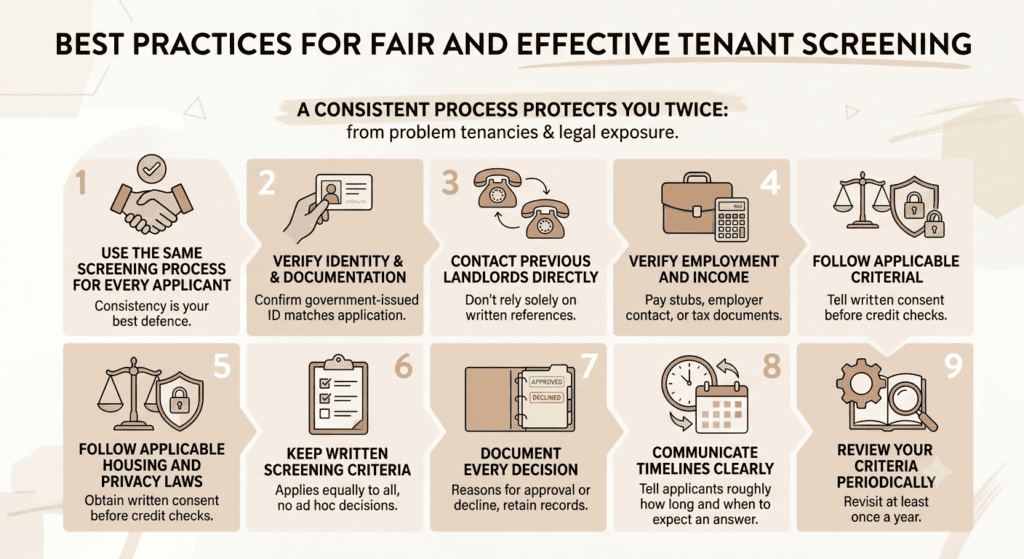
A consistent process protects you twice: once from problem tenancies, and once from legal exposure if a declined applicant questions your decision. The goal is not a longer application form. It is a shorter list of steps, applied without exception, every single time.
- Use the same screening process for every applicant. Consistency is your best defence if a decision is ever challenged.
- Verify identity and documentation. Confirm government-issued ID matches the name on the application and supporting paperwork.
- Contact previous landlords directly, rather than relying solely on written references provided by the applicant.
- Verify employment and income through pay stubs, employer contact, or tax documents for self-employed applicants.
- Follow applicable housing and privacy laws, including obtaining written consent before running any tenant credit check or background check.
- Keep written screening criteria that apply equally to every applicant, and avoid ad hoc decisions made case by case.
- Document every decision, including the reasons an applicant was approved or declined, and retain those records in case they are needed later.
- Communicate timelines clearly. Tell every applicant roughly how long the process will take and when they can expect an answer. This reduces pressure to rush and sets realistic expectations on both sides.
- Review your criteria periodically. Rental laws and human rights guidance evolve. A screening checklist built five years ago may no longer reflect current requirements, so revisit it at least once a year.
How Professional Property Managers Reduce Screening Risks
Many landlords manage screening well on their own, particularly with a clear checklist and the discipline to follow it every time. Others find that the process takes more time, legal awareness, and consistency than they can reasonably maintain alongside a full-time job, a growing portfolio, or a property located some distance from home.
This is where professional property management earns its keep. Standardized screening systems remove guesswork by applying the same verification steps, the same forms, and the same criteria to every applicant, every time. Verification procedures for income and employment happen faster and more thoroughly when a team is doing it daily rather than occasionally. Reference checks carry more weight when they are made by an experienced screener who knows which questions actually reveal risk. Legal compliance becomes far less stressful when someone with hands-on experience in Ontario’s Human Rights Code and the Residential Tenancies Act is managing the paperwork trail.
The result is a fair, consistent application review for every renter and a meaningfully reduced risk of the costly tenant issues that keep property owners up at night. For owners working with a team offering property management in Niagara Falls and the surrounding region, this kind of structured screening is built into the process from the very first inquiry, not added as an afterthought once something has already gone wrong.
Conclusion
Every successful tenancy starts long before move-in day. It starts with a screening process that treats every applicant consistently, looks at the full picture rather than a single number, and takes the time to verify what really matters: income, rental history, and communication.
Spotting tenant screening red flags early does not mean rejecting more people. It means reducing the odds of a costly, drawn-out dispute and increasing the odds of a stable tenancy that benefits both you and the person moving in. A structured, fair, and legally compliant approach protects your investment while giving good applicants the fair shot they deserve, and it holds up regardless of which way the rental market moves in a given year.
If building and maintaining that kind of process feels like more than you want to take on alone, The HAH Developments can help. Our team handles tenant sourcing, screening, and full property management for owners across Niagara Falls and the surrounding area, so every applicant is reviewed consistently and every lease starts on solid ground. Reach out to talk about what a reliable, professionally managed screening process could look like for your property.
FAQs
The most common warning signs include incomplete or inconsistent applications, income that does not match the rent, unverifiable employment, negative references from previous landlords, and pressure from an applicant to skip standard verification steps. No single flag is automatically disqualifying, but several appearing together deserve a closer look.
Many landlords use a general guideline of rent representing around 30% of gross income, but in Ontario this cannot be applied as a strict, automatic cutoff. Income should be considered alongside credit history, rental references, and any guarantor offered, rather than as the sole deciding factor.
Common methods include recent pay stubs, a signed letter of employment, direct contact with an employer or HR department, and bank statements showing regular deposits. Self-employed applicants can provide a Notice of Assessment, T1 General, or accountant-prepared financial statement instead.
A landlord can consider background check results, but only in a way that complies with the Ontario Human Rights Code. Blanket policies that automatically reject anyone with a criminal record are not permitted. Each situation should be assessed individually and tied to a specific, relevant concern about the tenancy.
Most thorough screenings can be completed within two to five business days, assuming references and employers respond promptly. Building in enough time to verify documentation properly is worth the short delay compared to the cost of a poorly vetted tenancy.
A complete rental application form, government-issued photo ID, recent pay stubs or proof of income, written consent for a credit and background check, and contact information for at least one or two previous landlords covers the essentials for most applications.