

If you own a rental property in Niagara Falls, St. Catharines, or anywhere else in Ontario, you already know that not every renovation dollar comes back to you. Some upgrades pay for themselves within months. Others sit there looking pretty while your bank account slowly regrets the decision of rental value.
The difference isn’t luck. It’s strategy.
Home upgrades that increase rental value are not about turning your property into a showroom. They’re about making smart, targeted improvements that tenants actually notice, actually want, and are willing to pay more for. A freshly painted wall costs a few hundred dollars and can help you justify a higher rent. A luxury custom kitchen island might cost you $15,000 and get you nothing but a shrug from prospective renters.
This guide walks through exactly which home upgrades that increase rental value are worth your money in 2026, which ones to skip, and how to budget for them based on what you can actually afford right now. Whether you’re a first-time landlord with a single unit or you’re managing a growing portfolio across the Niagara Region, this is the playbook.
Why Home Upgrades Matter for Rental Properties
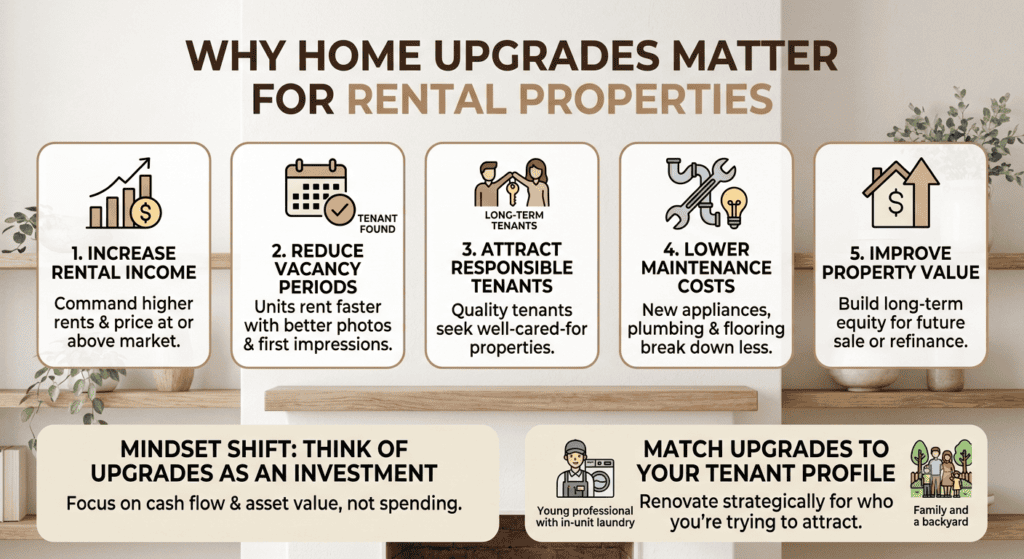
Every dollar you spend on your rental property should be working for you in one of five ways. If it isn’t, it’s probably not worth spending.
It increases monthly rental income. Renovated rental units in competitive Canadian markets are commanding noticeably higher rents than comparable unrenovated units. A property that looks and feels current gives you leverage to price at or above market rate, instead of underpricing just to attract interest.
It reduces vacancy periods. An outdated, tired-looking unit sits on the market longer. Every extra week without a tenant is a week of lost income plus continued mortgage, insurance, and utility costs. Renovated units typically rent faster because they photograph better online and make a stronger first impression during showings.
It attracts responsible, long-term tenants. Quality tenants tend to have options. They can afford to be selective, and they gravitate toward properties that feel well cared for. A unit with fresh paint, working appliances, and no visible wear signals that the landlord is engaged and responsive – which is exactly the kind of landlord good tenants want.
It lowers ongoing maintenance costs. Newer flooring, updated plumbing fixtures, and efficient appliances break down less often than aging originals. You’ll spend less time and money on emergency repairs and mid-lease service calls.
It improves overall property value. Even if you’re not planning to sell anytime soon, every upgrade that increases functionality or reduces deferred maintenance adds to your property’s long-term equity. Should you ever decide to sell or refinance, that value is already built in.
The key mindset shift here: think of upgrades as investment in cash flow and asset value, not as spending. A landlord who upgrades strategically almost always comes out ahead of one who either neglects the property or over-renovates it.
Consider the rental market in the Niagara Region right now. Average rents in Niagara Falls and St. Catharines have shifted over the past year, with houses commanding a noticeable premium over apartments. In a market like this, a well-renovated house has real pricing power over a comparable unrenovated one, while an outdated apartment can quietly slip toward the lower end of its price bracket. Landlords who understand where their property sits relative to local comparables – and who invest just enough to move it into a stronger bracket – tend to see the fastest, most reliable payback on their renovation dollars.
It also helps to think about upgrades in terms of who you’re trying to attract. A young professional renting a one-bedroom apartment cares about different things than a family renting a three-bedroom house. The former is often drawn to smart features, in-unit laundry, and modern finishes like updated flooring and lighting. The latter is more likely to prioritize storage, yard maintenance, and safety features like exterior lighting. Matching your renovation choices to your realistic tenant profile – rather than upgrading generically – helps you avoid spending on features that won’t actually move the needle for the people most likely to rent your unit.
Refresh the Kitchen Without a Full Renovation
The kitchen is the room tenants judge hardest, and it’s also the room where landlords most often overspend. You don’t need a full gut renovation to make a strong impression – you need a smart refresh.
Replace cabinet hardware. Swapping out dated knobs and pulls for modern brushed nickel or matte black hardware is one of the cheapest upgrades you can make, often under $200 for an entire kitchen. It instantly modernizes cabinetry that would otherwise look years behind.
Install modern countertops. You don’t need to spend on high-end natural stone. Quartz-look laminate or mid-range quartz remnants deliver the same visual payoff as premium stone at a fraction of the cost, and they hold up well to daily tenant use.
Upgrade the backsplash. A peel-and-stick or simple tile backsplash behind the stove and sink area is one of the highest-impact, lowest-cost visual upgrades available. It draws the eye and makes the whole kitchen feel finished.
Add energy-efficient appliances. Tenants increasingly expect ENERGY STAR-rated appliances. Beyond the visual upgrade, efficient appliances lower shared utility costs (a real consideration if utilities are included in rent) and reduce the odds of an appliance failure mid-lease.
Improve lighting fixtures. Swap out a single dated overhead fixture for layered lighting – a modern flush-mount plus under-cabinet LED strips – and the entire kitchen reads as brighter, cleaner, and more current.
Key takeaway: Small kitchen updates often create the biggest visual impact relative to cost. A $3,000-$5,000 refresh using these five changes can transform a dated kitchen into one that photographs beautifully and shows well in person, without the six-figure price tag of a full renovation.
Modernize Bathrooms for Better Tenant Appeal
Bathrooms are the second most scrutinized space after the kitchen, and small imperfections here are disproportionately off-putting to prospective tenants.
Install new faucets and fixtures. Chrome or matte black faucets in a modern silhouette cost relatively little and instantly signal an updated bathroom, even if the rest of the layout stays the same.
Update the vanity. A single-vanity swap – especially moving from a builder-grade unit to something with a clean, contemporary profile – can transform the whole room’s feel for a moderate investment.
Add low-flow toilets. Beyond water savings (a genuine selling point for eco-conscious renters), newer toilets are less prone to running, clogging, or requiring service calls.
Improve mirrors and lighting. A larger mirror and brighter, warmer lighting make bathrooms feel bigger and cleaner. This is an underrated upgrade that costs very little but shows up clearly in listing photos.
Refresh caulking and grout. This is arguably the single most important – and most overlooked – bathroom fix. Cracked, discoloured caulking or grimy grout lines make an entire bathroom look neglected regardless of everything else you’ve done. Re-caulking is inexpensive and can be done in an afternoon.
Replace Old Flooring with Durable Materials
Flooring takes more day-to-day abuse than almost anything else in a rental unit, which makes durability just as important as appearance.
Luxury Vinyl Plank (LVP) has become the go-to flooring choice for Canadian rental properties, and for good reason. It’s waterproof, scratch-resistant, visually similar to hardwood, and dramatically easier to maintain between tenants than actual hardwood or carpet.
Waterproof laminate offers a similar look-to-cost ratio and works well in bedrooms and living spaces where moisture isn’t a primary concern.
Tile for high-moisture areas like bathrooms, entryways, and laundry rooms remains the most durable option for spaces that see consistent water exposure.
Why carpet is becoming less desirable: Carpet stains easily, traps odours, wears out fast under multiple tenancies, and requires costly replacement or deep cleaning between move-outs. Many landlords are phasing carpet out of common areas and even bedrooms in favour of hard-surface flooring paired with area rugs, which tenants can manage themselves.
If you’re budgeting for one property-wide upgrade, flooring is often the one that delivers the most consistent, long-term return – both in how the space shows to prospective tenants and in reduced turnover costs.
Fresh Interior Paint Makes Every Room Feel New
If you take away only one lesson from this guide, make it this: fresh paint is the highest-ROI renovation available to Canadian property owners, with returns that can exceed the cost of the project itself when factoring in faster leasing and higher achievable rent. It’s inexpensive, fast, and transforms a space more dramatically than almost any other single upgrade.
Best neutral colours. Soft greys, warm whites, and light greige tones remain the top choices for rental properties because they appeal to the widest range of tenant tastes and make it easy for renters to picture their own furniture and décor in the space.
Easy maintenance. Modern washable, low-VOC paints in eggshell or satin finishes hold up to scuffs and are easy to spot-clean between tenants, which saves you from repainting an entire unit every time someone moves out.
Makes spaces appear larger. Light, consistent wall colour throughout a unit – rather than a different accent colour in every room – creates visual flow and makes even modest square footage feel more open.
Cost-effective improvement. A full interior repaint typically costs a few thousand dollars for an average-sized rental unit when hired out, and considerably less if you handle some of the labour yourself. Compared to almost any other upgrade on this list, the value-per-dollar is unmatched.
Improve Energy Efficiency
Energy efficiency has shifted from a “nice to have” to something tenants actively ask about, especially as utility costs continue to climb across Ontario.
LED lighting throughout the unit reduces electricity draw significantly compared to older incandescent or CFL bulbs, and LEDs last years longer, meaning fewer maintenance visits for burnt-out bulbs.
Smart thermostats let tenants manage heating and cooling more precisely, which can lower bills in units where tenants pay their own utilities, and gives you remote visibility into a vacant unit’s climate control between tenancies.
Energy-efficient windows reduce drafts and heat loss, directly cutting heating costs in older properties – a particularly relevant upgrade in the Niagara Region, where century homes and older housing stock are common.
Weather stripping around doors and windows is one of the cheapest fixes on this entire list and can meaningfully reduce draft-related energy loss for well under $100.
Better insulation, particularly in attics and basements, delivers some of the strongest long-term energy savings of any upgrade, even though the improvement isn’t visually obvious to a prospective tenant touring the unit.
Why energy savings appeal to today’s renters: With utility costs rising across the province, tenants are factoring total housing cost – not just rent – into their decisions. A unit that’s visibly efficient, with modern windows, updated insulation, and smart climate controls, becomes more attractive even at a slightly higher rent, because the total monthly cost of living there is lower or more predictable. It’s also worth noting that several federal and provincial programs, including Ontario’s Home Renovation Savings Program, continue to offer rebates for qualifying window, insulation, and heat pump upgrades in 2026, which can meaningfully offset your upfront cost on these projects.
Upgrade Lighting Throughout the Home
Lighting is one of the most underrated levers a landlord has, because poor lighting makes even a beautifully renovated space feel dated and uninviting.
Replace outdated fixtures. Swapping old brass or frosted-glass fixtures for simple, modern flush-mounts is inexpensive and instantly modernizes a room.
Prioritize bright kitchens. Kitchens benefit the most from layered lighting – overhead plus task lighting under cabinets – since this is where tenants spend significant functional time.
Add exterior lighting. Well-lit entryways and walkways improve both curb appeal and tenant safety, which matters for evening move-ins, deliveries, and general security.
Install motion sensor lights. Motion-activated exterior lighting is a small addition that improves security while also reducing unnecessary energy use, since lights only activate when needed.
Increase Storage Space
Storage is consistently one of the top complaints tenants have about older rental units, and it’s an area where relatively small investments can dramatically improve how a space functions.
Closet organizers turn a single hanging rod into usable, multi-tiered storage without requiring any structural changes.
Garage shelving, where applicable, adds meaningful storage capacity for tenants who might otherwise clutter living spaces with seasonal items.
Pantry storage solutions, even simple wire shelving inserts, make kitchens feel more functional and organized.
Built-in cabinets in underused spaces like hallways or below staircases convert dead space into genuine storage value.
Entryway storage, such as a small bench with cubbies or hooks, solves the universal problem of where to put shoes, bags, and coats – a detail tenants notice immediately during a showing.
Boost Curb Appeal
First impressions happen before a prospective tenant ever rental value steps inside. Curb appeal upgrades are some of the most cost-effective changes you can make.
Fresh exterior paint or a stained rental value front door instantly modernizes the entire façade of a property, even if nothing else changes.
Landscaping doesn’t need to be elaborate. Trimmed hedges, mulched garden beds, and a mowed lawn signal a well-maintained property before anyone even reaches the front door.
A new front door is consistently rental value ranked among the highest-return rental value exterior upgrades available, with garage door and entry door replacements recovering well over their original cost in added property value according to recent Ontario renovation data.
Updated house numbers are a five-minute, low-cost swap rental value that gives the entryway a more contemporary look.
Walkway improvements, such asrental value repairing cracked concrete or adding simple paving stones, remove a visible sign of neglect and improve safety.
Pressure washing siding, driveways, and walkways is one of the cheapest ways to make an entire property look years newer in a single afternoon.
Add Smart Home Features Tenants Love
Smart home technology has moved from novelty to expectation, particularly among younger renters who are used to controlling their environment from a phone.
Smart locks offer keyless entry, which is convenient for tenants and also useful for landlords managing turnovers, since access codes can be changed remotely between tenancies without re-keying.
Video doorbells add a layer of security and package monitoring that tenants increasingly view as a baseline expectation rather than a luxury.
Smart thermostats (mentioned above for energy efficiency) double as a tenant-facing convenience feature, letting renters control temperature remotely.
Leak detectors placed near washing machines, water heaters, and under sinks can alert you to a problem before it becomes a costly water damage claim – protecting both your property and your insurance premiums.
Smart lighting, whether it’s a few smart bulbs or a full switch-based system, gives tenants convenience while requiring minimal investment on your end.
Upgrade Laundry and Convenience Features
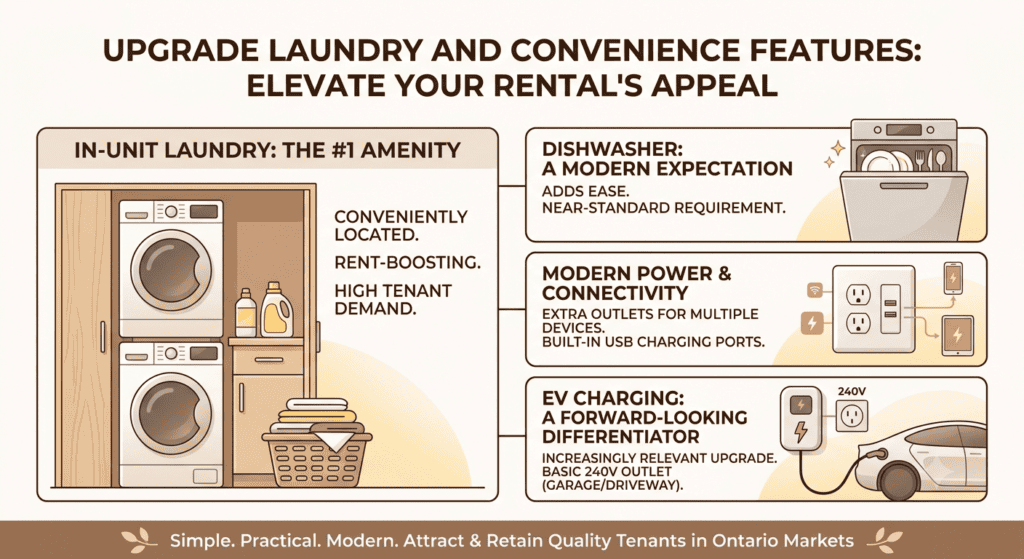
Convenience features increasingly separate a rental value property that rents quickly from one that lingers on the market.
In-unit washer and dryer is one of the single strongest rent-boosting features you can add. Tenants consistently rank in-unit laundry as a top priority, and units without it are competing at a real disadvantage in most Ontario markets.
A dishwasher has rental value shifted from a luxury feature to a near-standard rental value expectation, especially among renters relocating from newer apartment buildings.
Additional electrical outlets solve a common frustration in older homes, where a single outlet per wall no longer accommodates modern device usage.
USB charging ports built into outlets are a small, inexpensive rental value touch that reads as thoughtful and modern to prospective tenants.
EV charging, where practical, is an increasingly relevant upgrade as electric vehicle adoption grows across Ontario. Even a basic 240V outlet in a garage or driveway can be a meaningful differentiator for tenants who own or plan to buy an EV.
Don’t Ignore Essential Repairs
It’s tempting to focus entirely on visible, exciting upgrades, but essential repairs quietly determine whether your property retains value or slowly loses it.
Plumbing issues, even minor ones like slow drains or dripping faucets, should be addressed proactively. Left unresolved, they lead to far more expensive water damage and tenant complaints.
Electrical systems in older homes, particularly anything with knob-and-tube wiring or an undersized panel, should be inspected and updated. This is both a safety issue and something that can affect your insurance coverage.
Roof maintenance protects everything below it. A neglected roof leads to interior water damage that can undo the value of every cosmetic upgrade you’ve made.
HVAC servicing on a regular schedule prevents mid-tenancy breakdowns, which are inconvenient for tenants and often require emergency repair pricing.
Foundation issues, even small cracks, should be monitored and addressed early. Foundation problems are the type of deferred maintenance that compounds in cost the longer they’re ignored.
Why repairs often provide better ROI than cosmetic upgrades alone: A beautifully painted, professionally staged unit with a leaking roof or failing furnace isn’t actually a strong rental – it’s a liability waiting to surface. Repairs protect the underlying rental value asset, prevent emergency costs that are almost always higher than planned maintenance, and reduce the risk of a tenant breaking a lease over a habitability issue. Cosmetic upgrades rental value attract tenants; structural and mechanical soundness keeps them, and keeps your property compliant with Ontario’s maintenance standards.
Home Upgrades That Usually Don’t Pay Off
Not every renovation makes financial sense on a rental valueproperty, even if it would be lovely to have personally.
Luxury kitchens with high-end custom cabinetry and premium natural stone rarely return their cost in a rental context. Tenants notice quality, but they’re not paying a premium equivalent to what you spent.
High-end appliances, particularly commercial-grade or designer brands, add cost and repair complexity without a proportional increase in achievable rent.
Swimming pools are consistently ranked among the lowest-ROI additions in Canadian real estate, often recovering only a fraction of their installation cost, and they add liability, insurance, and maintenance burden that rarely make sense for a rental property.
Expensive custom finishes, like imported tile or bespoke millwork, appeal to a narrow slice of the market and are difficult to recoup through rent alone.
Over-personalized designs, such as bold accent walls or unusual layouts, can actively work against you by narrowing your pool of interested tenants.
The general rule: don’t renovate a rental property to a standard that exceeds what’s typical for your neighbourhood and price point. Overcapitalizing rarely pays off in rental income, even if it might in an owner-occupied resale.
How to Prioritize Renovations Based on Budget
Not every landlord has the same capital available, and that’s fine. Here’s how to sequence upgrades based on what you can realistically spend right now.
Small Budget ($500–$3,000)
- Fresh paint in neutral colours
- Updated lighting fixtures
- New cabinet and door hardware
- Basic landscaping and lawn care
- Faucet and fixture swaps in kitchen and bathroom
This tier delivers the fastest, most visible transformation for the least money and is a smart starting point for any landlord working with a limited renovation budget.
Medium Budget ($3,000–$10,000)
- New flooring (LVP or laminate)
- A bathroom refresh (vanity, fixtures, re-grouting)
- Kitchen improvements (countertops, backsplash, cabinet refacing)
- Mid-range appliance upgrades
This tier is where most of the meaningful, tenant-facing transformation happens, and it’s typically the sweet spot for landlords looking to reposition a unit for a higher rent without a full gut renovation.
Large Budget ($10,000+)
- Window replacements
- A complete kitchen remodel
- Comprehensive energy-efficient upgrades (insulation, HVAC, heat pump)
- Major exterior improvements (siding, roofing, driveway)
This tier is best reserved for properties with aging infrastructure or landlords planning to hold the property long-term, where the payback period extends beyond a single tenancy but the long-term value and reduced maintenance costs justify the investment.
Mistakes Landlords Make When Renovating Rental Properties
Even well-intentioned landlords fall into predictable traps when planning renovations.
Overspending for the neighbourhood. A rental priced far above what comparable units in the area command, because of an overly ambitious renovation, will sit vacant regardless of how nice it looks. Match your investment level to your local market.
Ignoring tenant preferences. Landlords sometimes renovate based on personal taste rather than what actually attracts and retains tenants – like functional storage, durable flooring, and in-unit laundry.
Choosing style over durability. A gorgeous but delicate finish that can’t withstand normal wear and tear will cost you more in repairs than it earned you in appeal.
DIY work that affects quality. Cosmetic DIY projects like painting can be a smart way to save money. Structural, electrical, or plumbing DIY work, done without proper permits or expertise, can create safety hazards, insurance complications, and costly rework down the line.
Forgetting maintenance costs. Every upgrade you add has an ongoing maintenance implication. Smart features, appliances, and finishes all require occasional service – factor that into your renovation budget, not just the upfront installation cost.
Renovating on the wrong timeline. Many landlords make the mistake of scheduling major work while a unit is occupied, which disrupts the tenant relationship, invites complaints, and often costs more due to rushed or partial work. Whenever possible, plan larger renovations for the gap between tenancies. This minimizes disruption, allows contractors full access to the space, and means your improved unit is ready to show – and rent at a higher price – right from the first listing.
Timing Your Renovations Around Tenant Turnover
One detail that separates experienced landlords from first-timers is timing. Rushing a kitchen renovation while a tenant is still living in the unit rarely goes smoothly, and it can strain a relationship you’d otherwise want to preserve for lease renewal.
The ideal window for most renovation work is the gap between move-out and move-in. This is when you have full access to every room, no tenant belongings to work around, and no daily disruption complaints to manage. It’s also the point where a renovated unit does the most good – a freshly upgraded space photographs better for new listings, shows better to prospective tenants, and can support a higher asking rent from day one of the new lease.
If a larger renovation isn’t feasible between every turnover, prioritize the smaller, faster upgrades – paint, hardware, lighting, and deep cleaning – during short turnaround windows, and save bigger projects like flooring replacement or a kitchen refresh for a longer vacancy period or a planned gap in your rental calendar. Being strategic about timing doesn’t just protect your renovation budget; it also protects your rental income by minimizing the number of days the unit sits empty and unrentable.
Final Thoughts
Increasing rental value isn’t about spending the most money. It’s about spending it in the right places. Focus on practical improvements with measurable ROI – fresh paint, durable flooring, an updated kitchen and bathroom, and reliable mechanical systems – rather than chasing luxury finishes that a tenant market simply won’t pay a premium for.
Balance durability, tenant comfort, and maintenance costs in every decision you make. The upgrades that consistently perform best are the ones that solve a real tenant need: more storage, lower utility bills, better security, and spaces that feel clean, current, and well cared for.
Done strategically, these home upgrades that increase rental value can boost your monthly income, shrink your vacancy periods, attract better-quality tenants, and strengthen your property’s value for years to come.
If you’d rather not manage renovation decisions, contractor coordination, and tenant turnover on your own, The HAH Developments can help. As a full-service property management company based in Niagara Falls, we work with landlords across the Niagara Region to identify the upgrades that will actually move the needle on rental income – and we handle everything from tenant placement to ongoing maintenance once the work is done. Reach out to The HAH Developments today to find out how a strategic renovation plan, paired with professional property management, can maximize the return on your rental investment.
Frequently Asked Questions
What home upgrades increase rental value the most?
Fresh interior paint, updated flooring, kitchen and bathroom refreshes, and in-unit laundry consistently deliver the strongest return relative to cost. These upgrades are visible, functional, and align closely with what tenants actively look for during a rental search.
How much should a landlord budget for rental property upgrades?
It depends on the property’s condition and your goals, but a meaningful mid-range refresh (paint, flooring, kitchen and bathroom updates) typically falls between $5,000 and $15,000 for an average unit. Smaller budgets can still make an impact by focusing on paint, lighting, and hardware.
Are energy-efficient upgrades worth it for rental properties?
Yes. Beyond potential rebate programs like Ontario’s Home Renovation Savings Program, energy-efficient windows, insulation, and smart thermostats reduce utility costs, appeal to cost-conscious tenants, and can reduce long-term maintenance issues tied to drafts and moisture.
Should landlords renovate between every tenant?
Not necessarily a full renovation, but a basic refresh – a deep clean, touch-up paint, and a check of appliances and fixtures – between tenants is standard practice and helps maintain the property’s rentability and condition over time.
What renovations should landlords avoid?
Swimming pools, luxury or custom finishes, high-end designer appliances, and highly personalized design choices generally don’t return their cost in a rental context and can even narrow your pool of prospective tenants.
Does curb appeal really affect rental income?
Yes. Curb appeal is often a prospective tenant’s first impression of the property, and it directly influences whether they book a showing at all. Simple, low-cost upgrades like landscaping, exterior paint, and a new front door can meaningfully improve interest and perceived value.