

If you own a rental property in Canada, you’ve probably felt something change over the past year. Units that used to rent in days are now sitting for weeks. Applicants aren’t lining up the way they used to. And the rent you could confidently ask for last spring might get you a lot of silence today.
You’re not imagining it. The Canadian rental market 2026 looks nothing like the market of 2022 or 2023. After years of brutal competition for apartments, tight vacancy, and rents that climbed every quarter, the country is settling into something closer to balance – in some cities, closer to a full renter’s market.
This shift isn’t happening evenly. Vancouver’s vacancy rate jumped past 3.7%, the highest it’s been since 1988. Toronto and Calgary have cooled in their own ways. Meanwhile, smaller regions like Niagara are watching a wave of new construction hit right as demand softens. If you manage even one rental unit, the rules that worked two years ago may already be working against you.
This guide breaks down exactly what’s driving the shift, what it means city by city, and – most importantly – what landlords, property managers, and investors need to do differently to stay ahead in 2026 and beyond. Understanding the latest Canada rental market trends isn’t optional anymore – it’s the foundation of every pricing and investment decision you’ll make this year.
Why Canada’s Rental Market Is Shifting in 2026
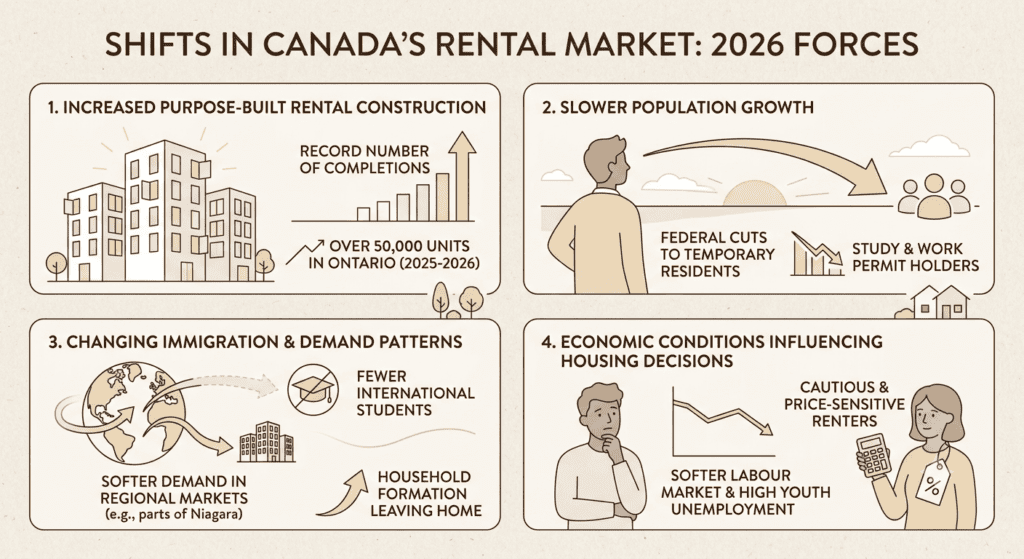
For most of the last decade, Canadian landlords had the upper hand. Vacancy rates sat near historic lows, asking rents climbed year after year, and a listed unit could attract a dozen applicants within hours. That environment is fading, and four forces are behind it.
Increased Purpose-Built Rental Construction
Developers spent the last several years responding to the tightest rental market in a generation, and that construction is now landing. CMHC’s mid-year update shows rental apartment completions in early 2026 tracking above the same period in 2025, with a near-record number of purpose-built rental units under construction across the country. In Ontario alone, completions are expected to total more than 50,000 rental units across 2025 and 2026 combined, staying near record highs into 2027 before the construction pipeline starts to thin.
That’s a lot of new supply landing in a short window – and it’s arriving in cities that spent years without enough of it.
Slower Population Growth
Population growth has been the single biggest driver of rental demand in Canada for years. That engine has slowed considerably. The federal government’s immigration levels plan cut temporary resident admissions sharply heading into 2026, and study permit holders, work permit holders, and international students – the group most likely to rent – make up a large share of that reduction. Fewer people arriving means fewer people searching for a place to live.
Changing Immigration and Demand Patterns
It’s not just about how many people are arriving – it’s about who. With international student and temporary foreign worker numbers down, some regional rental markets that leaned heavily on that population, including parts of Niagara, are seeing softer demand tied directly to those shifts. Broader rental demand Canada trends still point upward over the medium term, though. At the same time, CMHC notes that household formation will continue through 2026, led by younger Canadian-born renters taking advantage of easing costs to move out on their own for the first time.
Economic Conditions Influencing Housing Decisions
Add in a softer labour market and elevated youth unemployment, and you get renters who are more cautious, more price-sensitive, and less willing to jump at the first available unit. For landlords, this means the days of “list it and it’s gone by Friday” are behind us in most major markets.
Rental Supply Is Growing-but Not Everywhere
The headline story of the Canadian rental market 2026 is more supply. But supply growth isn’t evenly distributed, and treating it as a national story misses what’s actually happening on the ground.
Rise in New Apartment Completions
Ontario’s rental completions are on pace to stay near historic highs through 2026 and into 2027 before the pipeline begins narrowing in 2028. Much of this construction was greenlit during 2021–2023, when vacancy was near zero and rents were climbing fast. Developers are now delivering those units directly into a cooling market – which is part of why so many new buildings are offering incentives just to get leased up.
Regional Differences Across Provinces
Alberta continues to see strong rental construction paired with strong population growth from interprovincial migration, which has kept Calgary’s vacancy rate relatively stable even with a wave of new supply. British Columbia, by contrast, saw a dramatic vacancy jump as reduced international arrivals collided with record new supply. Quebec’s outlook points to more rental housing and higher vacancy rates heading into 2026 as well, according to CMHC’s regional forecasts.
Why Some Cities Remain Highly Competitive
Not every market is loosening. Cities and CMAs with less new construction, strong local job markets, or continued in-migration from other provinces are holding tighter conditions. This is exactly why a landlord in one city can be handing out move-in bonuses while a landlord two hours away still has a waitlist.
Supply vs. Affordability
Here’s the part that surprises a lot of people: more supply hasn’t fixed affordability for everyone. The broader picture of rental housing Canada-wide shows that CMHC’s own data confirms vacancy relief has been concentrated almost entirely in newer, higher-priced units – the segment built after 2020. Older, more affordable stock and family-sized units continue to see tighter conditions, and CMHC has found that only a small share of units affordable to lower-income households are sitting vacant. In other words, the renter’s market you’re reading about mostly applies to newer, pricier buildings – not the market as a whole.
Vacancy Rates Are Increasing in Major Cities
Vacancy is the number everyone in this industry watches, and 2026 has delivered some of the biggest moves in decades.
What Higher Vacancy Rates Mean
A rising vacancy rate means more available units chasing fewer renters. Tracking vacancy rates Canada-wide is now essential homework for any landlord setting a price. For tenants, higher vacancy translates into more choice and stronger negotiating power. For landlords, it means longer time-to-lease, more pressure on pricing, and a much bigger incentive to compete on quality rather than just being “available.”
Cities Experiencing Softer Rental Markets
Vancouver’s story is the most dramatic. Metro Vancouver’s purpose-built rental vacancy rate reached 3.7% as of October 2025 – more than double the 1.6% recorded the year before, and the highest level the city has seen since 1988. Average Vancouver apartment rents fell roughly 9% year-over-year by early 2026. Hamilton’s vacancy rate hit 3.6% in 2025, its highest since the pandemic, and CMHC projects it will keep climbing into 2026 before stabilizing.
Closer to home for many landlords in the Niagara Region, the St. Catharines–Niagara CMA vacancy rate held at 3.9% in 2025 – a more-than-decade high. Niagara Falls sub-markets saw even higher vacancy, driven partly by the expiry of temporary foreign worker permits and softer tourism-sector employment.
Areas That Remain Landlord-Favored
Calgary’s vacancy rate has stayed comparatively stable at around 3.3%, supported by strong interprovincial migration and higher local incomes, giving it one of the better rent-to-income ratios among Canada’s largest cities. Markets with strong local job growth and limited new construction remain far tighter than the national headlines suggest.
Impact on Rental Pricing
CMHC’s analysis found something worth remembering: Calgary and Edmonton need noticeably higher vacancy rates before rents stabilize, while Vancouver and Toronto rents respond to even small vacancy increases. That means the “right” vacancy target for a balanced market isn’t one number – it’s different city by city, sometimes even neighbourhood by neighbourhood.
This is a critical point for landlords comparing notes across regions. A 3.5% vacancy rate might signal a genuinely soft market in Vancouver, while the same number in Calgary or Edmonton could still reflect fairly normal, healthy conditions. Montreal, Ottawa, and Halifax sit somewhere in between, with CMHC describing these markets as having less volatility and more gradual transitions between tight and soft conditions. Before reacting to a headline vacancy number, it’s worth checking what “balanced” actually looks like in your specific market.
Asking Rents vs. Actual Rents-Understanding the Difference
This is one of the most misunderstood parts of the current market, and it’s where a lot of landlords get their pricing wrong.
Why Advertised Rents Are Falling
Asking rent is the price advertised on a vacant unit – and it’s the number most sensitive to short-term supply and demand. Nationally, average asking rent declined roughly 4.7% year-over-year as of spring 2026, marking close to two straight years of month-over-month declines according to Rentals.ca data. That’s a real shift after asking rents had climbed more than 20% from their 2021 lows.
Existing Tenants May Still See Rent Increases
Here’s the catch: asking rents falling doesn’t mean every tenant’s rent is falling. CMHC’s Q1 2026 data shows affordability for existing tenants actually worsened in most major markets compared to a year earlier, even as advertised rents for new units dropped. Toronto and Edmonton were exceptions, where slower rent growth combined with strong wage growth to improve affordability. The gap between what a new tenant pays to move in and what a long-term tenant already pays continues to widen in many cities.
Provincial Rent Regulations
In Ontario, the annual rent increase guideline caps how much most landlords can raise rent for existing tenants without Landlord and Tenant Board approval. For 2026, that guideline is 2.1% – the lowest in four years, down from 2.5% in each of the previous three years. It applies to units first occupied on or before November 15, 2018; units first occupied after that date are exempt from the guideline entirely, though landlords must still give 90 days’ written notice using the proper Form N1 and can only raise rent once every 12 months.
For a $2,000-a-month unit, the 2026 guideline caps the legal increase at about $42. Landlords who need to recover costs beyond that – for major capital work or steep utility increases – can apply to the Landlord and Tenant Board for an Above-Guideline Increase, though approval isn’t guaranteed and the process can take months.
What Landlords Should Know Before Pricing Units
Pricing to last year’s asking rents, or to what a similar unit rented for at the 2022–2024 peak, is one of the fastest ways to sit vacant right now. A unit priced even modestly above current market conditions can sit for weeks in many cities, and the carrying cost of that vacancy often outweighs any gain from holding firm on price.
Tenant Expectations Have Changed
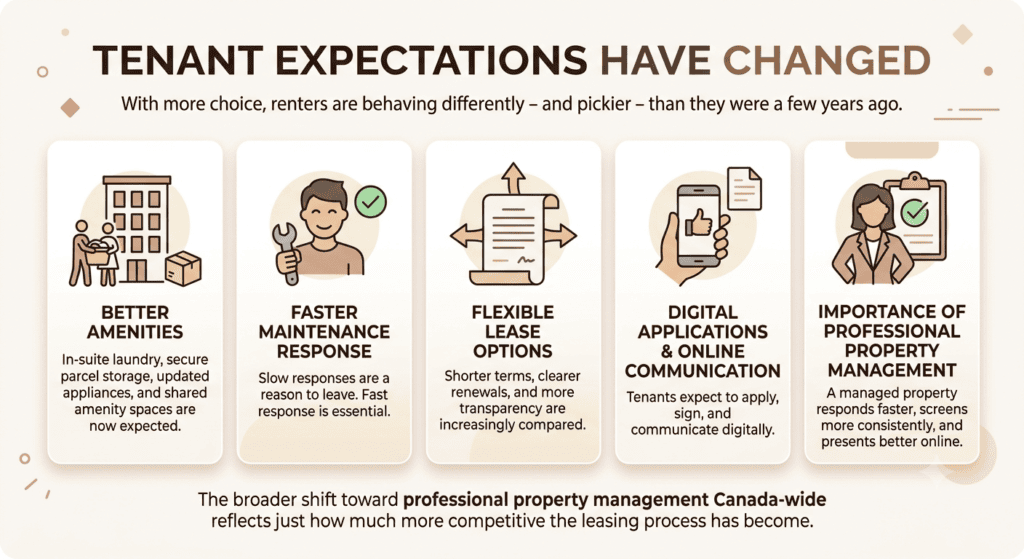
With more choice on the table, renters are behaving differently – and pickier – than they were a few years ago.
Better Amenities
In-suite laundry, secure parcel storage, updated appliances, and shared amenity spaces have gone from nice-to-have to expected in many newer buildings, and tenants comparing options will factor them into their decision even in older stock.
Faster Maintenance Response
A slow response to a maintenance request used to be an annoyance tenants tolerated because they had nowhere else to go. In a market with more options, it’s a reason to leave at renewal – or not to sign in the first place if word gets around.
Flexible Lease Options
Shorter lease terms, clearer renewal terms, and more transparency around what happens at the end of a lease are increasingly part of what tenants compare between listings.
Digital Applications and Online Communication
Renters, especially younger ones, expect to apply, sign, and communicate digitally from the first inquiry through move-in. A landlord still relying on phone tag and PDF applications is adding friction at exactly the moment competing units are one tap away.
Importance of Professional Property Management
This is where professional property management earns its keep. A managed property responds faster, screens more consistently, and presents better online – all of which matter more when tenants have real alternatives. The broader shift toward professional property management Canada-wide reflects just how much more competitive the leasing process has become.
How Landlords Can Stay Competitive in 2026
Winning in this market isn’t about panic-cutting rent. It’s about tightening every part of the operation.
Competitive Rental Pricing
Price to current market data, not to what a similar unit fetched two years ago. Landlords who’ve adjusted their pricing to reflect 2026 conditions are filling units in days; those still anchored to 2022–2024 numbers are competing against brand-new buildings offering free rent and gift cards just to get leased up.
Professional Tenant Screening
With more applicants shopping multiple listings at once – and rental application fraud on the rise – thorough, consistent tenant screening Canada landlords can rely on matters more, not less, in a softer market. Skipping steps to fill a unit faster is exactly how landlords end up with a costly problem tenant.
Preventive Maintenance
Catching small issues before they become expensive repairs protects both your property value and your tenant relationships. It also reduces the emergency work orders that eat into a landlord’s time and budget.
Property Upgrades With Strong ROI
Not every renovation pays for itself. Focus on upgrades that directly affect what tenants are comparing – in-suite laundry, updated kitchens and bathrooms, better lighting, and secure entry – rather than cosmetic changes that don’t move the needle on rentability.
Better Marketing and Photography
In a market with more listings competing for the same pool of renters, professional photos, a clear floor plan, and an honest, detailed listing description make the difference between a unit that gets clicked on and one that gets scrolled past.
Faster Response Times
Speed to respond to an inquiry is now a competitive advantage. Renters comparing several listings will often go with whoever answers first and makes the process easiest.
Technology Is Reshaping Property Management
Property management in 2026 looks meaningfully different from even three years ago, and the operators leaning into these tools are pulling ahead.
Online Rent Payments
Digital rent collection has become the standard rather than the exception. Automated reminders, multiple payment options, and instant posting to owner ledgers cut down on late payments and eliminate a huge amount of manual reconciliation work.
Digital Lease Signing
E-signatures and digital lease workflows speed up move-ins and reduce the back-and-forth that used to stretch a leasing process out over days.
Virtual Property Tours
3D tours and video walkthroughs let out-of-town or busy applicants shortlist units before ever setting foot inside – a meaningful edge in a market where speed to lease matters.
Maintenance Tracking
Digital work order systems route requests to the right vendor, track completion times, and create a paper trail that protects landlords in the event of a dispute.
AI-Powered Tenant Communication
Industry research shows AI adoption among property management professionals surged from roughly 20% to 58% in a single year. AI tools are now handling inquiry responses, drafting renewal and maintenance communications, and flagging fraudulent applications – freeing property managers to focus on the relationships that actually need a human touch.
The leasing funnel is where this shift is most visible. A prospective tenant who inquires at 9 p.m. on a Tuesday used to wait until the next business day for a reply – by which point they’d often already toured a competing unit. AI leasing assistants now handle those first-touch inquiries in real time across text, email, and web chat, qualifying leads and booking showings without a person needing to be online at that exact moment. The best-run operations still bring a human into the process before a lease is signed, but the speed advantage in those first few hours can be the difference between filling a unit quickly and watching it sit.
Data-Driven Rental Pricing
Rather than guessing at what the market will bear, more landlords and property managers are using real-time comparable data to set and adjust pricing – a critical advantage when asking rents are moving month to month.
Opportunities for Real Estate Investors
A softer market isn’t bad news for every investor – it’s a different kind of opportunity for the ones who read it correctly.
Growing Demand for Professionally Managed Rentals
As competition for tenants increases, the gap between amateur-managed and professionally managed properties widens. Professionally managed units tend to lease faster, retain tenants longer, and hold their value better through a softening cycle – which is exactly why demand for property management services Canada-wide is climbing even as the broader rental market cools.
Long-Term Value of Quality Properties
CMHC’s own forecasts point to rental construction slowing through the back half of 2026 as developers respond to higher vacancy and softer rent growth, with starts declining further into 2027 and 2028. That means the current supply surge is temporary. Investors who buy or hold well-located, well-managed properties now are positioned for tighter conditions again as that pipeline thins out.
Emerging Investment Markets
Regions like Niagara illustrate this well. St. Catharines issued more than 1,025 new dwelling unit building permits in 2025 alone – nearly double its nine-year average – backed by $25.7 million in federal Housing Accelerator Fund investment, while Niagara Falls exceeded 116% of its 2024 provincial housing target. Major projects like the 362-unit Parkline Apartments in downtown Niagara Falls signal real institutional confidence in the region’s long-term rental demand, even as short-term vacancy sits at a decade high. Add in the upcoming GO Train expansion to St. Catharines strengthening the region’s commuter appeal, and the structural case for Niagara as a rental property investment Canada destination remains strong.
Importance of Local Market Research
National headlines about a “renter’s market” can be misleading at the local level. The same week Vancouver posts near-record vacancy, a mid-sized Ontario city might still have tight conditions for family-sized units. Investors need city- and even neighbourhood-level data before making a move, not national averages.
Diversifying Rental Portfolios
Spreading investment across property types – long-term rentals, short-term and Airbnb management, and mixed-use holdings – helps insulate a portfolio from a downturn concentrated in one segment, such as the new-condo oversupply currently affecting parts of Toronto and Vancouver.
Common Mistakes Landlords Should Avoid in 2026
Some of the biggest losses landlords are seeing right now are self-inflicted. Here’s what to watch for.
Overpricing Rental Units
Holding out for last year’s rent in this year’s market is the single most common – and most expensive – mistake right now. Every extra week of vacancy costs more than a modest price adjustment ever would.
Ignoring Local Market Data
National trends don’t tell you what your specific unit, in your specific neighbourhood, should rent for today. Landlords pricing off outdated comparables or gut feel are consistently losing ground to those checking current data before every listing.
Delayed Maintenance
In a market where tenants have options, a slow maintenance response is one of the fastest ways to lose a renewal – or end up with a negative review that costs you future applicants.
Weak Tenant Screening
A softer market brings more applicants shopping multiple listings, and unfortunately more fraudulent applications too. Cutting corners on screening to fill a vacancy fast is a short-term fix that can create a much longer-term problem.
Poor Communication
Slow replies, unclear lease terms, and inconsistent updates erode trust fast – and trust is what keeps a good tenant renewing instead of shopping around.
Not Adapting to Changing Renter Expectations
Landlords still marketing and managing the way they did in 2021 are competing against buildings and portfolios that have already modernized. Standing still is, functionally, falling behind.
What the Future Holds for Canada’s Rental Market
Any honest rental market outlook Canada-wide has to hold two ideas at once: near-term relief for renters in many cities, and a supply pipeline that won’t stay this full forever.
Continued Supply Growth
Rental completions are expected to stay elevated through 2026 and into 2027 in many regions before construction starts pull back through 2028, as developers respond to softer rents and higher vacancy.
More Balanced Market Conditions
CMHC expects vacancy rates to stay elevated through 2026, with rental affordability improving gradually as incomes grow and the gap between turnover and non-turnover rents narrows.
Ongoing Affordability Challenges
Even with more supply, affordable and family-sized units remain in short supply in most major markets. The relief renters are feeling right now is concentrated in the newer, pricier segment – not across the board.
Predictions for the Next Few Years
Most forecasts point to the current supply wave easing by 2028 as construction starts decline, setting up the possibility of tighter conditions returning in several markets once this pipeline is absorbed. Regions like Niagara, where vacancy is expected to stay elevated before stabilizing later in the forecast period, illustrate that timeline well.
Why Professional Management Will Become Increasingly Valuable
As the market keeps shifting – softening in some cities, staying tight in others, and moving through cycles no landlord can fully predict – the value of experienced, data-driven property management keeps climbing. It’s the difference between reacting to the market and staying ahead of it.
Conclusion
The Canadian rental market 2026 is more complicated than a single headline can capture. Vacancy rates are up in cities like Vancouver, Hamilton, and even Niagara. Asking rents are falling nationally, even as many existing tenants face higher costs. New supply is reshaping competition, but mostly in the newer, higher-priced segment – not across the board. And through all of it, renter expectations keep climbing.
For landlords and investors, the biggest shift isn’t the vacancy rate itself – it’s what the vacancy rate demands of you. Pricing has to be current. Screening has to be consistent. Maintenance has to be fast. And marketing has to compete with buildings that are actively courting your tenants with incentives.
Staying informed and proactive isn’t optional anymore – it’s the baseline for protecting your rental income in a market that’s genuinely different from the one you may have started investing in. Professional property management helps close that gap, turning market shifts you’d otherwise be reacting to into changes you’re already prepared for.
Looking to maximize your rental property’s performance in today’s evolving market? Contact The HAH Developments for expert property management solutions tailored to the Canadian rental market.
Frequently Asked Questions
Is the Canadian rental market cooling down in 2026?
Yes, in most major cities. National asking rents have fallen for close to two years straight, and vacancy rates have risen sharply in markets like Vancouver, Hamilton, and Niagara. That said, conditions vary widely by city and by unit type – family-sized and affordable units remain tight in most markets.
Why are asking rents falling while some tenants pay more?
Asking rent reflects what’s advertised for vacant units and reacts quickly to supply and demand. Existing tenants’ rent increases are governed separately by provincial rules, like Ontario’s 2.1% guideline for 2026, so the two numbers can move in opposite directions at the same time.
What is Ontario’s rent increase guideline for 2026?
2.1% for most units first occupied on or before November 15, 2018. Units first occupied after that date are exempt from the guideline, though landlords must still give 90 days’ written notice.
Should landlords lower rents to match falling asking prices?
Not necessarily lower – but definitely re-check pricing against current comparables before listing. Holding out for outdated pricing typically costs more in vacancy time than a modest, market-aligned adjustment would.
Is now a good time to invest in Canadian rental property?
For investors focused on the long term, yes – with the right research. Construction starts are expected to slow through 2026–2028, which points toward tighter conditions returning once the current supply wave is absorbed. Local, city-level data matters far more than national averages when deciding where and when to buy.
How is technology changing property management in 2026?
AI-powered tenant communication and screening, online rent payments, digital lease signing, and data-driven pricing have all moved from niche tools to standard practice, helping landlords respond faster and compete more effectively for fewer available renters.