

The rental conversation in Canada has changed. For years, the story was simple: too few units, too many applicants, and landlords who could set almost any price and still fill a vacancy within days. That story is no longer accurate in most of the country. National vacancy has climbed to roughly 3.1 percent, a level not seen in years, as new supply comes online and population growth slows. In the Niagara Region specifically, CMHC’s 2026 outlook points to an elevated vacancy rate that is expected to stay high before stabilizing, driven partly by a wave of new purpose-built rental construction in Niagara Falls and St. Catharines.
That shift matters enormously for anyone who owns or manages a rental property. Renters now have real choices, and they are using that leverage. A recent Rentals.ca survey of more than 1,100 renters found that affordability is still the number one obstacle in the housing search, but it also revealed something landlords cannot ignore: tenants are comparing units on far more than just price. In-suite laundry, air conditioning, outdoor space, and even how quickly a landlord responds to a maintenance request are now deciding factors in whether someone signs a lease or renews one.
Canadian renters in 2026 are not asking for luxury. They are asking for value, reliability, and respect. Understanding exactly what that means in practice is how landlords reduce vacancies, keep good tenants longer, and protect the long-term value of their properties. This guide walks through what today’s renters actually prioritize, backed by current market data, and what property owners can do about it.
Affordable Rent Still Comes First
Affordability remains, by a wide margin, the top concern for Canadian renters. In the most recent Rentals.ca Renter Preference Survey, roughly seven in ten respondents named high rent prices as the biggest obstacle in their housing search, well ahead of unsuitable listings or low supply. Four in ten renters said they were planning to move specifically to find something more affordable, making cost the single biggest driver of relocation.
What’s interesting is that this isn’t simply about chasing the lowest number on a listing. Renters are increasingly comparing total cost of living in a unit, not just the sticker price of rent. A property that quotes a slightly higher rent but includes heat, water, or high-speed internet can look like the better deal once a tenant does the math. Hidden costs are a major source of frustration, and transparent, itemized pricing builds trust before a lease is even signed.
For landlords, this creates a specific opportunity. In a market where the Ontario rent increase guideline for 2026 sits at just 2.1 percent, the lowest cap in four years, tenants already expect predictable, modest increases rather than dramatic jumps. Landlords who price fairly at turnover, rather than trying to recoup losses in one large increase, tend to fill units faster and keep tenants longer. Overpricing a unit relative to current market conditions, especially with so much new purpose-built supply entering cities like Niagara Falls, can mean weeks of lost income that far outweigh a modest rent premium.
Actionable tip: Before listing a unit, check current comparable rents in your specific neighbourhood rather than relying on last year’s numbers. A unit priced even slightly above the local market can sit vacant for weeks, and that lost income usually exceeds what a small price correction would have cost.
Why “Value” Beats “Cheapest”
It’s worth separating two ideas landlords sometimes treat as the same thing: the lowest rent on the block, and the best value on the block. A slightly higher-priced unit that includes reliable internet, a well-maintained appliance package, and responsive management often out-competes a cheaper unit with none of those things, because renters are increasingly calculating cost per month of hassle-free living, not just cost per square foot. Being transparent about exactly what’s included, and why the price reflects that, tends to convert applicants faster than simply undercutting a competitor’s listing.
Fast Maintenance and Responsive Property Management
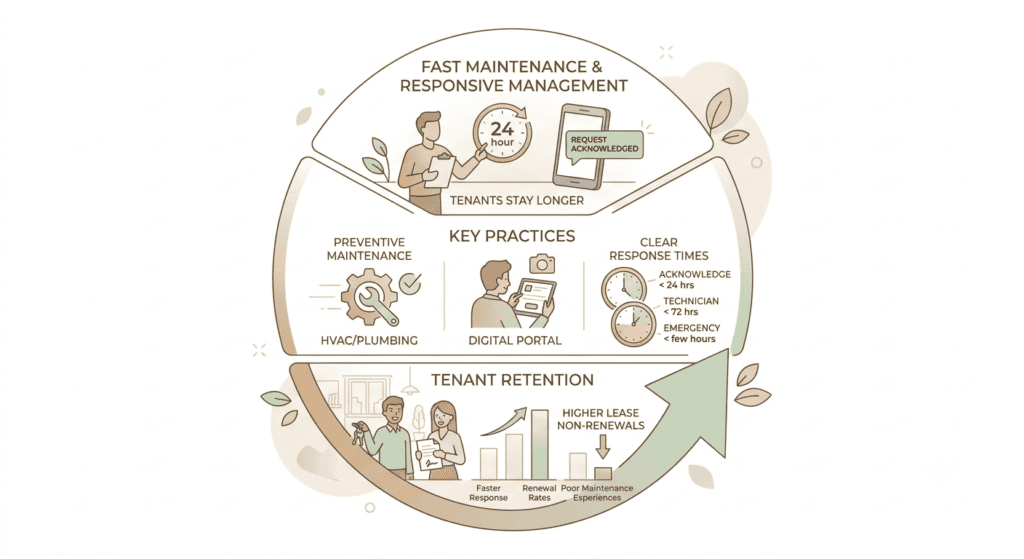
If affordability gets a renter in the door, maintenance response time is often what determines whether they stay. Industry data on lease non-renewals is striking: a large share of tenants who choose not to renew point directly to poor maintenance experiences, particularly slow response times and a lack of communication, rather than the repair itself.
The numbers back this up in very concrete terms. Tenants who receive a response to a maintenance request within 24 hours renew their lease at a noticeably higher rate than tenants who wait three days or more for even an acknowledgment. It isn’t always about how fast the repair gets finished. A quick message saying a technician is booked for Wednesday morning does more for tenant confidence than silence followed by a same-day fix.
A few practices consistently improve how tenants experience maintenance:
- Preventive maintenance schedules for HVAC systems, plumbing, and appliances catch small problems before they become emergency calls.
- Digital maintenance requests through a tenant portal or app let renters submit photos and track status without playing phone tag with an office.
- Clear response-time commitments, such as acknowledging non-emergency requests within 24 hours and dispatching a technician within 72, set expectations tenants can rely on.
- Emergency protocols for issues like no heat or major leaks should aim for a response within a couple of hours, with resolution targeted inside a day.
Communication is really the thread that ties all of this together. Tenants don’t expect every repair to be instant. They expect to be kept informed, and landlords who build that habit tend to see it reflected directly in renewal rates.
Safe, Clean, and Well-Maintained Properties
First impressions carry a lot of weight, and they start well before a tenant unlocks their unit. A building’s entrance, hallways, and common areas send an immediate signal about how seriously a property is managed. Secure entrances, working locks, and adequate lighting are baseline expectations, not upgrades, especially for renters who prioritize personal safety when choosing where to live.
Professional cleaning of shared spaces, stairwells, laundry rooms, and lobbies should happen on a set schedule rather than reactively. The same goes for exterior upkeep: landscaping, snow removal, and general grounds maintenance are often the first thing a prospective tenant notices when they pull up for a showing, and the last thing a current tenant complains about when it slips.
There’s also a practical health dimension here. Statistics Canada’s housing survey data shows renters report pest issues like bed bugs, mice, or cockroaches nearly twice as often as homeowners with a mortgage, and mould or mildew problems at roughly double the rate as well. Addressing these issues quickly and proactively, rather than waiting for repeated complaints, protects both the property and the landlord’s reputation.
A well-kept building doesn’t just attract new tenants faster. It also reduces turnover among tenants already living there, because people are far less likely to leave a place that feels genuinely cared for.
Modern Amenities That Improve Daily Living
Amenities have moved from “nice to have” to genuine deal-breakers, and the data on this is unusually specific. In the most recent national renter survey, two-thirds of respondents said they would pay more for a unit with in-suite laundry, making it the single most sought-after feature in the entire market. That’s followed closely by central air conditioning, which about 45 percent of renters said they’d pay a premium for, and private outdoor space like a balcony or patio, which mattered to roughly 40 percent.
Parking remains a consistent priority as well. A separate national amenities study found that nearly 80 percent of respondents preferred indoor parking, and over half said they’d pay more for a dedicated, assigned spot rather than open lot access. That preference tends to hold steady across age groups, alongside another near-universal expectation: reliable, building-wide internet and cellular connectivity.
Here’s a quick snapshot of what renters are prioritizing and willing to pay more for:
| Amenity | Renters willing to pay more |
| In-suite laundry | About two-thirds |
| Central air conditioning | About 45% |
| Private outdoor space (balcony/patio) | About 40% |
| Assigned/dedicated parking | Over half |
Smart home features, like keyless entry, smart thermostats, or leak sensors, are gaining traction too, particularly among younger renters, though they matter less than the fundamentals above. The lesson for landlords is straightforward: before investing in flashy upgrades, make sure the basics, laundry, climate control, outdoor access, and parking, are covered. Those are what actually move a renter’s decision.
Prioritizing Amenity Upgrades on a Budget
Not every landlord can renovate an entire unit at once. If budget is limited, in-suite laundry hookups typically deliver the strongest return on tenant satisfaction, followed by a portable or window air conditioning solution where central air isn’t feasible, and finally small outdoor upgrades like a patio set or planter box for units with balcony access.
Flexible Leasing Options
Rigid, one-size-fits-all leasing is losing ground to more flexible arrangements. Renters increasingly want options: shorter initial terms for those who aren’t ready to commit to a full year, straightforward renewal processes that don’t require re-negotiating from scratch, and application processes that don’t feel like a barrier in themselves.
Pet policies deserve particular attention here. A 2022 study by the Canadian Animal Health Institute found that over 80 percent of Canadian households own at least one pet, yet pet-friendly units remain genuinely scarce in many markets. In Calgary, for example, the local Humane Society reports that fewer than 10 percent of low-cost rentals allow pets at all. That gap is a real opportunity for landlords willing to accept well-screened tenants with pets, often through a reasonable pet deposit and a clear pet policy addendum rather than an outright ban. Landlords who open the door to pet owners, even selectively, immediately widen their pool of qualified applicants in a market where most competitors say no by default.
A simplified application process also matters more than landlords sometimes assume. A confusing, paper-heavy, or slow application can push a strong applicant toward a competing listing that makes the process easier, even if the unit itself is comparable.
Lease length flexibility is another area where a small adjustment can capture applicants a rigid policy would otherwise lose. Not every renter is ready for, or wants, a standard 12-month commitment. Some are relocating for a contract job, testing out a new neighbourhood before committing longer-term, or coming out of a living situation that ended abruptly. Offering a shorter initial term, even at a modest premium, or a clearly outlined path to a longer lease after the first renewal, can bring in qualified applicants that a strictly 12-month-only policy would screen out by default.
Digital Convenience Throughout the Rental Journey
The entire rental journey has gone digital, and renters expect it to stay that way. Online applications, digital lease signing, and online rent payments are now baseline expectations rather than premium features, particularly for renters under 35 who have never known a rental process that didn’t start on a phone or laptop.
Tenant portals have become a genuine differentiator. A portal where renters can submit maintenance requests with photos, check payment history, and message property management directly cuts down on phone calls and creates a paper trail that protects both parties.
Perhaps the most notable shift is the rise of AI in the rental search itself. According to Rentals.ca’s spring 2026 survey, close to a third of renters have used AI tools such as ChatGPT or Google Gemini to help compare listings, understand lease terms, research neighbourhoods, or draft communications with a landlord. That usage is highest among renters aged 25 to 34 and first-time renters, groups that are only going to grow as a share of the overall rental market. Listings with clear, complete, and accurate information tend to perform better in this environment, since AI tools pull directly from what’s published and renters increasingly cross-check details before ever booking a showing.
Getting Listings Ready for an AI-Assisted Search
If a growing share of applicants are running a listing through an AI tool before they ever call about it, the listing itself needs to hold up to that kind of scrutiny. That means consistent square footage across every platform, an accurate and current list of included utilities, and photos that were taken recently rather than recycled from a previous tenant’s move-in. Inconsistencies between a listing and reality don’t just frustrate a human applicant who notices them on a showing; they can also get flagged when a renter cross-checks details using an AI assistant, which erodes trust before a landlord ever gets the chance to make a first impression in person.
Energy Efficiency That Lowers Monthly Costs
Utility costs are a real and growing part of a renter’s monthly budget, and energy-efficient units are starting to command a genuine premium in tenants’ minds. Research on Canadian multi-family housing shows that when tenants pay their own utilities, a more efficient building can save them meaningfully on monthly bills, sometimes in the range of $100 to $150 a month depending on the unit and climate.
Simple upgrades make a measurable difference:
- Energy-efficient appliances reduce electricity draw on some of the biggest household consumers, refrigerators, washers, and dryers.
- LED lighting throughout common areas and units cuts both the landlord’s operating costs and the tenant’s portion of any shared utility charges.
- Improved insulation and weatherstripping lower heating and cooling costs significantly, especially in older Niagara-area housing stock.
- Programmable or smart thermostats let tenants manage their own usage more precisely, which tends to reduce complaints about high bills.
There’s also a policy dimension worth watching. Several provinces are moving toward requiring landlords to disclose a unit’s typical utility costs upfront, part of a broader push for a national renters’ bill of rights. Landlords who get ahead of this by tracking and sharing average utility costs for their units, rather than waiting for it to become mandatory, build credibility with prospective tenants who are increasingly budget-conscious.
Sustainability messaging resonates with a meaningful slice of the rental market too, particularly younger renters who factor a building’s environmental footprint into their decision alongside straightforward cost savings. Even small, visible steps, a note in the listing about updated windows, a heat pump installation, or an Energy Star appliance package, can signal to a cost-conscious applicant that the unit was chosen deliberately rather than left unmaintained since it was first built. Over a multi-year tenancy, those details add up to real savings for the tenant and a genuine competitive edge for the landlord, even in a market where rent growth itself is expected to stay modest.
Great Location Still Matters
No amount of in-unit upgrades fully compensates for a poor location, and renters continue to weigh this heavily. Proximity to public transit remains one of the most consistently cited priorities across every age group, followed closely by walkable access to grocery stores, schools, parks, and healthcare services.
Interestingly, Statistics Canada’s housing satisfaction research found that renters actually report higher satisfaction with their proximity to amenities than homeowners do, a reminder that renters often choose location deliberately, sometimes trading unit size or age for a stronger neighbourhood fit. Walkability, in particular, continues to command a premium in tenant demand, especially among renters without a vehicle or those looking to cut commuting costs.
For a region like Niagara, this means properties within easy reach of downtown cores, GO Transit connections, or established neighbourhood amenities in St. Catharines and Niagara Falls tend to hold value and fill faster than comparable units in more isolated pockets, even when the unit itself is similar in size and finish.
Location Trade-Offs in a Softening Market
With CMHC forecasting continued vacancy pressure across the Niagara Region through 2026, location has become an even bigger differentiator between units that lease quickly and units that linger. Renters who once had to accept a longer commute or a less walkable neighbourhood simply because nothing else was available now have the flexibility to hold out for a better fit. Landlords with properties in less central locations can offset this by leaning harder into other priorities from this guide, faster maintenance response, included utilities, or flexible lease terms, since location is one factor a landlord genuinely cannot change about an existing property.
Honest Communication and Transparency
Trust is built long before a tenant moves in, starting with the accuracy of the listing itself. Photos that reflect the actual unit, honest square footage, and clear disclosure of what is and isn’t included in rent all set the tone for the entire tenancy. Renters who feel misled by a listing rarely give a landlord the benefit of the doubt later, even over minor issues.
Clear lease terms matter just as much. Ambiguous clauses around pet policies, guest limits, or maintenance responsibilities create friction down the road that a few extra minutes of clarity at signing could have prevented. Fair, consistently enforced policies, applied the same way to every tenant in a building, also go a long way toward preventing disputes at the Landlord and Tenant Board.
Professional communication before and after move-in reinforces all of this. A landlord who responds promptly to questions during the application process and stays reachable afterward is signalling something important: that the relationship doesn’t end once the lease is signed.
That signal matters more than it might seem on the surface. A tenant who has to chase down answers, about a repair, a policy question, or a lease clause, starts to view the relationship adversarially, even if nothing has actually gone wrong yet. By contrast, a landlord who proactively shares information, upcoming maintenance visits, seasonal reminders, or even a simple check-in a few weeks after move-in, builds a reserve of goodwill that makes the inevitable hiccup of a rental relationship far easier to resolve without it turning into a dispute or, worse, a decision not to renew.
Long-Term Value Instead of Short-Term Discounts
In a softer rental market, it can be tempting to compete purely on price, offering a month of free rent or a steep discount just to fill a vacancy quickly. But the data on tenant retention suggests this isn’t where lasting value comes from. Renters consistently show they prefer quality, consistent management over a short-term incentive that evaporates after the first renewal.
This shows up clearly in the economics of turnover. Industry estimates put the true cost of a single tenant turnover, factoring in lost rent during vacancy, cleaning, repairs, marketing, and leasing fees, at roughly $3,000 to $4,000 per unit. A one-time discount that fills a unit a few days faster rarely offsets the far larger cost of that same tenant leaving after just one year because the day-to-day experience didn’t match expectations.
Landlords who instead invest in the fundamentals covered throughout this guide, responsive maintenance, fair pricing, clear communication, tend to see it pay off in tangible ways: higher renewal rates, more referrals from satisfied tenants, and fewer disruptive vacancies. Trust, once established, is what actually keeps a portfolio stable through market swings.
How Professional Property Management Meets These Expectations
Meeting all of these expectations consistently, across every unit and every tenant interaction, is genuinely difficult for an individual landlord to manage alone, especially one juggling a full-time job or multiple properties. This is exactly where professional property management earns its value.
A well-run management company brings systems that individual landlords often lack the time or infrastructure to build themselves:
- Consistent maintenance schedules that catch problems before they become expensive emergencies or tenant complaints.
- Structured tenant communication, including defined response-time commitments and digital channels tenants actually want to use.
- Streamlined operations for applications, lease signing, rent collection, and renewals that reduce friction on both sides.
- Data-driven pricing that reflects current local market conditions rather than guesswork, which directly affects how quickly a unit fills.
- Lower vacancy rates and higher tenant satisfaction, the natural result of getting the fundamentals right consistently rather than occasionally.
This is the role that companies like The HAH Developments play for property owners across the Niagara Region. Rather than a landlord trying to personally manage maintenance calls, screen applicants, track a rent increase guideline, and stay current on Residential Tenancies Act requirements all at once, a dedicated property management team handles the operational load while keeping tenants genuinely satisfied. For owners of long-term rentals, short-term Airbnb properties, or a mixed portfolio, that combination of professional oversight and tenant-focused service is what turns a stressful side business into a dependable source of income.
The gap between a self-managed unit and a professionally managed one tends to widen, not narrow, as market conditions soften. When vacancy was near zero and demand outstripped supply everywhere, almost any landlord could fill a unit regardless of how it was run. That’s no longer the case. With new purpose-built rental buildings opening across Niagara Falls and St. Catharines, and renters newly empowered to compare, negotiate, and walk away from a listing that doesn’t measure up, the properties that stay full are increasingly the ones backed by consistent systems rather than good luck. That’s precisely the shift The HAH Developments is built to help owners navigate.
Conclusion
Canadian renters in 2026 expect more than just a place to live. They want fair, transparent pricing, maintenance that actually responds when something breaks, amenities that make daily life easier, and communication that treats them like a valued tenant rather than a line item on a rent roll. None of this requires luxury finishes or extravagant spending. It requires consistency, honesty, and a genuine commitment to the tenant experience.
Landlords who adapt to these expectations, rather than relying on the tighter markets of years past, are the ones who will attract stronger applicants, reduce costly turnover, and protect the long-term value of their investment. In a market where renters finally have real choices, the properties that treat tenants well are the ones that win.
If you’re a property owner in the Niagara Region looking to reduce vacancies, improve tenant satisfaction, and take the day-to-day stress out of managing a rental, The HAH Developments can help. From long-term rental management to Airbnb co-hosting and professional property maintenance, our team is built to deliver exactly the kind of experience today’s renters are looking for. Contact The HAH Developments today to find out how professional property management can protect and grow your rental investment in 2026 and beyond.
Frequently Asked Questions
What do Canadian renters want most in 2026?
Affordability remains the top priority, but it’s closely followed by fast maintenance response, in-suite laundry, air conditioning, flexible leasing terms, and honest, transparent communication from landlords.
Why is in-suite laundry such a high priority for renters?
Recent survey data shows roughly two-thirds of Canadian renters would pay more for a unit with in-suite laundry, making it the single most requested amenity in the current market, ahead of parking or air conditioning.
How much can a landlord raise rent in Ontario in 2026?
The 2026 rent increase guideline in Ontario is 2.1 percent for most rent-controlled units, the lowest cap in four years, though units first occupied after November 15, 2018 are generally exempt from this cap.
Does allowing pets actually help fill a rental unit faster?
Often, yes. With most Canadian households owning a pet but relatively few landlords accepting them, a clear and reasonable pet policy can meaningfully widen the pool of qualified applicants for a listing.
Is professional property management worth it in a softer rental market?
In many cases it becomes more valuable, not less, since consistent maintenance, fair pricing, and responsive communication are exactly what differentiate a property in a market where renters have more choices than in previous years.
How does energy efficiency affect a rental property’s competitiveness?
Energy-efficient appliances, insulation, and lighting can lower a tenant’s monthly utility costs meaningfully, which increasingly factors into a renter’s overall value calculation alongside the advertised rent.