

Every day a rental unit sits empty, it costs money. Not just in lost rent, but in mortgage payments that don’t pause, utility bills that keep coming, and property taxes that don’t care whether anyone is living inside. For landlords across Ontario, that math has gotten more painful lately. New supply is flooding the market, tenants have more options than they’ve had in years, and the properties that used to rent themselves are suddenly sitting for weeks – sometimes months.
It’s tempting to blame the market. And sometimes the market really is the problem. But when you look closely at why rental properties stay vacant, the market is rarely the whole story – vacancy is, more often than not, preventable. It’s the result of a handful of decisions – pricing, presentation, communication, policy – that landlords make (or fail to make) long before a “For Rent” sign ever goes up.
This guide walks through the twelve most common landlord mistakes that lead to rental properties staying vacant longer than they should, backed by current Canadian rental data, and what you can do differently to fill units faster and keep them filled.
Why Rental Properties Stay Vacant: The Market Has Shifted
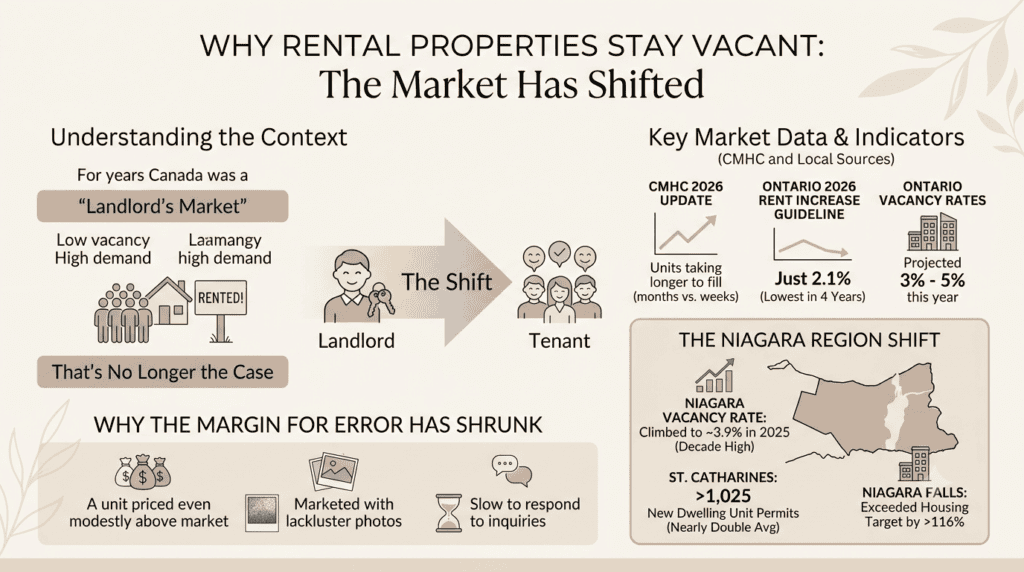
Before getting into the mistakes themselves, it helps to understand why this topic matters so much right now. For years, Canadian landlords operated in a landlord’s market. Vacancy was low, demand outpaced supply, and almost any listing found a tenant within days.
That’s no longer the case in large parts of the country. CMHC’s 2026 Mid-Year Rental Market Update found that rental operators are reporting units taking longer to fill – in some cases, months rather than weeks – as new purpose-built supply and investor-owned condo units give renters more choice and more negotiating power. Ontario’s residential rent increase guideline for 2026 sits at just 2.1%, the lowest in four years, and CMHC’s Housing Market Outlook projects Ontario-wide vacancy rates ranging between 3% and 5% this year.
The Niagara Region, where The HAH Developments operates, is feeling this shift directly. Local market data shows Niagara’s vacancy rate climbing to roughly 3.9% in 2025 – a decade high – while St. Catharines alone issued more than 1,025 new dwelling unit building permits in a single year, nearly double its historical average. Niagara Falls exceeded its provincial housing target by more than 116%. More rental apartment projects are expected to break ground in Niagara Falls through 2026, and CMHC expects the vacancy rate to stay elevated before it stabilizes.
None of this means your property has to sit empty. It means the margin for error has shrunk. A unit priced even modestly above market, or marketed with lackluster photos, or slow to respond to inquiries, will lose out to a competitor down the street that got the fundamentals right. Let’s look at where landlords most often go wrong.
1. Pricing the Property Above Market Value
Overpricing is, by a wide margin, the single biggest driver of extended vacancy. It sounds obvious, yet it’s the mistake nearly every struggling landlord makes at least once.
Here’s why it hurts so much: rental listing platforms are built around price filters. If your unit is priced $100 or $150 above the going rate for comparable properties, it doesn’t just look slightly less appealing – it often disappears from search results entirely for renters who’ve set a maximum budget. Fewer people ever see the listing, which means fewer inquiries, fewer showings, and a much longer road to a signed lease.
In today’s Niagara market, this mistake is especially costly. Landlords still pricing units based on 2022 rents are effectively competing against brand-new buildings offering move-in incentives and free rent periods. A unit priced accurately for current conditions can fill within days; one priced even slightly high can sit for weeks while the carrying costs quietly pile up.
How to price correctly:
- Run a comparable market analysis (CMA) using at least five to eight similar listings currently available in your immediate area – not units that rented six months ago.
- Check both asking rents (what’s currently advertised) and turnover rents (what similar units actually leased for recently), since these can differ meaningfully in a softening market.
- Resist the urge to “test the market high.” In a tenant’s market, that strategy almost always backfires – you lose weeks of rent trying to chase a number the market has already moved past.
- Consider pricing slightly below the top of your comparable range. A property that rents in the first week at a fair rate often outperforms, financially, one that sits vacant for a month chasing an extra $75.
Getting the number right on day one is the single highest-leverage decision you’ll make in the entire leasing process.
It also helps to think in terms of total return rather than headline rent. A property priced $50 above market that takes an extra three weeks to fill has already lost more income than it would have gained over an entire year at the higher rate. Landlords focused on how to reduce rental vacancy tend to treat the first two weeks of a listing as the most important window – if a well-marketed unit generates almost no inquiries in that time, price is almost always the reason, not bad luck.
2. Poor Listing Photos and Weak Marketing
Renters make snap judgments. On most listing platforms, a prospective tenant decides whether to click into your listing – or scroll straight past it – within seconds of seeing the thumbnail photo.
This is not a minor detail. Industry data on property marketing consistently shows that professional photography dramatically outperforms smartphone snapshots: well-lit, properly composed images generate significantly more online views and inquiries than amateur photos, and listings with strong visual presentation are shown to reduce time on market substantially compared to weak ones. In a market where renters are scrolling through dozens of near-identical listings, the photos are often the entire first impression.
What strong rental marketing looks like:
- Professional photography. Bright, wide-angle, well-composed shots of every room, taken during daylight hours whenever possible. Clutter-free, staged spaces photograph dramatically better than lived-in ones.
- A compelling description. Skip generic phrases like “cozy” and “must see.” Lead with specifics: square footage, standout features, proximity to transit or schools, and what makes this unit different from the ten others a renter has already scrolled past today.
- Multiple platforms. Don’t rely on a single site. List across major rental platforms, local Facebook groups, and your own website or brand channels to maximize visibility.
- Video or virtual tours where possible. Renters increasingly expect to preview a space before booking an in-person viewing, especially those relocating from out of town.
Weak marketing doesn’t just slow down leasing – it actively signals to renters that the property (and the landlord) may be poorly managed, even when that’s not true. Strong rental property marketing is one of the few areas where a modest upfront investment consistently pays for itself in reduced vacancy days.
3. Delayed Responses to Prospective Tenants
Speed matters more than most landlords realize. A renter browsing listings on a Tuesday evening is often messaging five or six different landlords or agents at once. The first one to respond – and to offer a convenient viewing time – usually wins the tenant, regardless of which unit was objectively “better.”
When a landlord takes two or three days to reply to an inquiry, the prospective tenant has almost always already found something else. In a market with more rental supply and more renter choice, slow communication is one of the fastest ways to lose a qualified applicant.
Best practices for fast response:
- Aim to respond to every inquiry within one to two hours during waking hours, and same-day at the absolute latest.
- Set up instant notifications for listing platform messages so inquiries don’t sit unread in an inbox.
- Offer flexible viewing windows, including evenings and weekends, rather than only weekday business hours.
- Use a simple pre-screening message (move-in date, household size, pets) to qualify leads quickly without dragging out back-and-forth emails.
- Consider same-day or next-day showings whenever possible – momentum matters, and delays give renters time to reconsider or find alternatives.
If you can’t commit to fast, consistent communication yourself, this is one of the clearest signals that professional property management may be worth the investment. For landlords wondering how to rent a property faster without changing anything about the unit itself, tightening response time is often the fastest and cheapest fix available.
4. The Property Isn’t Move-In Ready
Renters are shopping for a home, not a renovation project. A unit that needs touch-up paint, has a leaky faucet, smells faintly of the previous tenant’s pet, or still has boxes and old furniture sitting in a corner will consistently underperform a clean, ready-to-occupy space – even if the underlying property is identical.
Small issues that create outsized hesitation:
- Scuffed walls, chipped trim, or outdated paint colours
- Dirty grout, carpets, or appliances
- Poor lighting (dim bulbs, missing fixtures)
- Overgrown landscaping or a cluttered entryway
- Deferred maintenance items – a running toilet, a sticking door, a broken cabinet handle
None of these are expensive to fix. A weekend of deep cleaning, a fresh coat of neutral paint, and a landscaping tidy-up can meaningfully change how a unit performs online and in person. Renters read a well-maintained space as a signal that the landlord is responsive and easy to work with – which, in turn, makes them more willing to sign quickly.
5. Limited or Incomplete Property Information
Every unanswered question in your listing is a reason for a renter to move on to the next one. If your description doesn’t specify parking availability, utility inclusions, pet policy, or square footage, prospective tenants either have to message you to ask (adding friction and delay) or simply assume the worst and skip the listing entirely.
Information every listing should include:
- Exact square footage and layout, ideally with a floor plan
- Parking type and availability (included, extra cost, street only)
- Utilities included versus tenant-paid
- Pet policy, stated clearly rather than left ambiguous
- Nearby schools, transit stops, and grocery access
- In-suite features: laundry, storage, balcony, dishwasher
A complete listing does double duty: it attracts more serious inquiries and filters out mismatched ones, saving you time on showings that were never going to convert.
6. Ignoring Today’s Tenant Expectations
What renters consider “standard” has shifted noticeably in the last few years, and landlords who haven’t updated their offering accordingly are losing ground to newer buildings and better-equipped units.
High-speed internet is a good example of how quickly expectations move. Recent renter surveys show that the large majority of tenants now rank reliable high-speed internet as a near-essential feature, placing it just behind air conditioning and in-unit laundry in importance – well ahead of amenities like parking or pet-friendliness that used to dominate the leasing conversation. A growing share of renters even expect internet to be pre-installed and working the day they move in, treating connectivity as a fourth utility alongside water, electricity, and gas.
Features today’s renters increasingly expect:
- Reliable high-speed internet, ideally pre-installed
- In-unit or in-building laundry
- Smart home basics: keyless entry, smart thermostats, video doorbells
- Flexible lease lengths, including shorter-term or month-to-month options
- Energy-efficient appliances that keep utility costs predictable
You don’t need to renovate a unit from top to bottom. But identifying which one or two upgrades would meaningfully close the gap with newer competing buildings is often a better use of capital than a general cosmetic refresh. Among tenant attraction strategies available to landlords right now, closing the connectivity gap tends to offer the best return relative to cost.
7. Restrictive Rental Policies
Overly rigid policies can quietly shrink your pool of qualified applicants without you realizing it. A blanket no-pets rule, for instance, eliminates a large share of renters outright – many of whom would otherwise be excellent long-term tenants.
Similarly, unrealistic income requirements (demanding four or five times the rent in verified income, for example) or inflexible twelve-month-only lease terms can filter out renters who are financially solid but don’t fit a narrow template.
Where to find the balance:
- Consider a conditional or case-by-case pet policy rather than a hard no – pet deposits and pet-specific clauses can manage risk without losing the tenant entirely.
- Set income requirements that reflect realistic affordability standards rather than arbitrary multiples.
- Offer at least some flexibility on lease length, especially in a market where relocation, remote work, and shorter-term housing needs are increasingly common.
- Review your application criteria periodically against what’s actually working – policies copied from a template years ago may no longer reflect your market.
The goal isn’t to eliminate screening standards. It’s to make sure your policies are protecting you from genuine risk, not accidentally screening out good tenants along with the bad ones.
8. Seasonal Rental Market Timing
Rental demand isn’t constant throughout the year. In most Canadian markets, spring and late summer (tied to school years, lease renewals, and warmer-weather moving preferences) see the highest tenant activity, while the period around the winter holidays tends to be noticeably slower.
Landlords who list a unit in mid-December and expect the same response rate as a June listing are often setting themselves up for a longer vacancy – not because anything is wrong with the property, but because there are simply fewer active renters searching.
How to work with seasonal timing:
- Where possible, plan lease turnovers to align with peak search periods.
- If a vacancy is unavoidable during a slow season, adjust expectations (and marketing effort) accordingly rather than assuming something is wrong with the listing.
- Use slower months productively – for maintenance, upgrades, or deep cleaning – so the unit is in peak condition when demand picks back up.
- Watch local absorption trends; in markets with rising new supply, like much of Niagara right now, timing matters even more than usual.
It’s also worth remembering that seasonal slowdowns compound with other mistakes on this list. A unit that’s slightly overpriced might still find a tenant quickly during a high-demand month simply because there are more renters actively searching. That same unit, listed in late December at the same price, may sit empty for weeks – not because anything changed about the property, but because the pool of active renters shrank. Understanding your local seasonal rhythm helps you set realistic expectations and adjust pricing or incentives accordingly during naturally slower stretches.
9. Skipping Preventative Maintenance
Deferred maintenance doesn’t just create move-in friction – it drives vacancy in a second, less obvious way: it pushes existing tenants to leave sooner than they otherwise would, restarting the entire leasing cycle more often than necessary.
A leaking faucet that takes three weeks to fix, a furnace that struggles every winter, or a unit that never quite gets aesthetically refreshed between tenants all chip away at tenant satisfaction. Over time, this shows up as shorter average tenancies, more frequent turnovers, and more cumulative vacant days per year – even if no single vacancy period looks unusual on its own.
A simple preventative approach:
- Schedule seasonal inspections (HVAC, plumbing, exterior) rather than waiting for something to break.
- Address tenant-reported issues within 24 to 48 hours whenever possible.
- Budget proactively for aging appliances and systems instead of waiting for emergency replacements.
- Treat the turnover period between tenants as an opportunity for a refresh, not just a quick clean.
Regular upkeep protects occupancy in the same way regular pricing checks protect your rent roll – quietly, but consistently.
Consider a simple example: a tenant reports a slow-draining bathroom sink in October. If that request sits unaddressed through November, it’s a small annoyance. By January, when the drain backs up fully during a cold snap, it’s an emergency repair, a frustrated tenant, and quite possibly a non-renewal decision six months down the line. The dollar cost of fixing the original issue in October was minor. The downstream cost – in tenant goodwill, potential turnover, and a future vacancy period – is much larger and much harder to see coming.
10. Poor Tenant Retention
It’s almost always cheaper to keep a good tenant than to find a new one. Between marketing costs, screening time, potential vacancy days, and the wear and tear of a full move-out and move-in cycle, tenant turnover carries real costs that many landlords underestimate.
Yet retention often gets far less attention than acquisition. Landlords who put significant effort into marketing a vacant unit sometimes go quiet the moment a lease is signed – and then wonder, a year later, why the tenant chose not to renew.
What drives tenants to stay:
- Clear, responsive communication throughout the tenancy, not just during the leasing process
- Fast turnaround on maintenance requests
- Proactive lease renewal conversations, offered before the tenant starts shopping around
- Small gestures – a reasonable approach to minor requests, flexibility during hardship, simple courtesy – that build goodwill over time
- A rental experience that feels professional and predictable, rather than reactive and inconsistent
A tenant who renews year after year effectively removes an entire vacancy cycle from your calendar. That’s worth protecting.
11. Not Understanding Local Market Trends
Pricing and marketing decisions made in a vacuum – without an accurate read on what’s actually happening in your specific submarket – are a common source of prolonged vacancy.
Local conditions can shift faster than landlords expect. In Niagara specifically, a wave of new construction is actively reshaping the competitive landscape: multiple new rental apartment projects are underway or planned for Niagara Falls and the broader region through 2026 and beyond, adding supply that didn’t exist just a year or two ago. A pricing or marketing strategy that worked perfectly in 2023 may already be outdated.
Staying current means tracking:
- Local vacancy rate trends, not just national or provincial averages
- New construction and upcoming rental supply in your immediate area
- What competing units are actually renting for right now, not what they were listed at
- Demographic shifts affecting demand – student populations, employment centres, migration patterns
Landlords managing a single property often don’t have the time or the data access to monitor this continuously. This is precisely where local, on-the-ground property management expertise pays for itself – a rental pricing strategy that isn’t revisited regularly tends to drift out of step with the market faster than most owners expect.
12. Managing Everything Alone
The final – and often most significant – reason properties stay vacant longer than necessary is simply that self-managing landlords are stretched too thin to execute everything above consistently.
Pricing research, professional photography, multi-platform marketing, same-day responses, tenant screening, maintenance coordination, and retention strategy are each manageable individually. Doing all of them well, every time, on top of a full-time job or multiple properties, is a different challenge entirely. Something usually slips – and it’s often the very thing (a slow response, a slightly-too-high rent, a listing that never got refreshed photos) that’s quietly extending vacancy.
Where self-management most often breaks down:
- Tenant screening takes longer, or gets skipped, when a landlord is juggling other responsibilities
- Marketing quality drops without dedicated time for photography and listing optimization
- Maintenance requests pile up rather than getting same-day attention
- Rent collection and lease administration become reactive instead of systematic
This is the gap professional property management is built to close.
How Professional Property Management Helps Reduce Vacancy
The HAH Developments works with property owners across Niagara Falls and the surrounding region to address every mistake outlined above, systematically and consistently, so vacancy stops being a recurring drain on rental income.
That includes:
- Accurate, data-backed rental pricing based on current local comparables, not outdated assumptions
- Professional marketing and listing optimization across the platforms where today’s renters are actually searching
- High-quality photography that gives every listing a strong first impression
- Thorough tenant screening that protects owners without unnecessarily narrowing the applicant pool
- Fast, consistent communication with prospective and current tenants alike
- Proactive property maintenance that keeps units move-in ready and existing tenants satisfied
- Full lease management, from documentation to renewals
- Tenant retention strategies designed to reduce turnover and protect long-term occupancy
For owners of long-term rentals, short-term and Airbnb properties, or investment portfolios across Niagara Falls, this kind of full-service management turns vacancy from an unpredictable cost into something actively managed and minimized. As property management Canada-wide continues to professionalize in response to a more competitive rental landscape, owners who partner with an experienced local team are consistently the ones who stay ahead of it.
Quick Vacancy Prevention Checklist
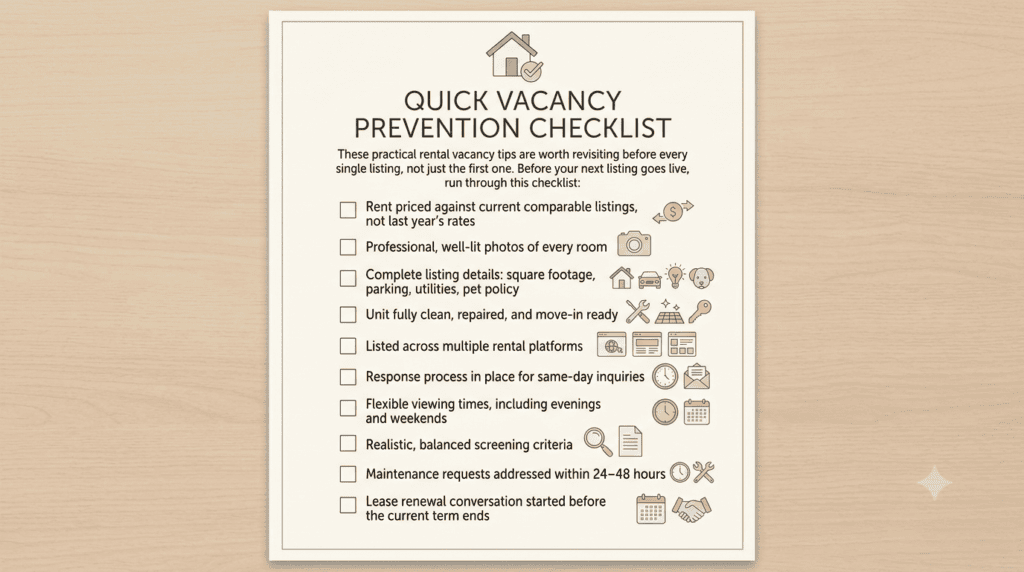
These practical rental vacancy tips are worth revisiting before every single listing, not just the first one. Before your next listing goes live, run through this checklist:
- [ ] Rent priced against current comparable listings, not last year’s rates
- [ ] Professional, well-lit photos of every room
- [ ] Complete listing details: square footage, parking, utilities, pet policy
- [ ] Unit fully clean, repaired, and move-in ready
- [ ] Listed across multiple rental platforms
- [ ] Response process in place for same-day inquiries
- [ ] Flexible viewing times, including evenings and weekends
- [ ] Realistic, balanced screening criteria
- [ ] Maintenance requests addressed within 24–48 hours
- [ ] Lease renewal conversation started before the current term ends
Conclusion
When you step back and ask why rental properties stay vacant for extended periods, the answer is rarely caused by a single issue. More often, it’s the compounding effect of a slightly-too-high rent, a handful of mediocre photos, a slow reply, and a policy or two that quietly turned away good applicants. Individually, each mistake might only cost a few extra days on the market. Together, they can stretch a vacancy from one week into two months.
The good news is that every mistake on this list is fixable – and most of them cost far less to correct than another month of lost rent. Accurate pricing, strong presentation, fast communication, and genuine attention to tenant retention are within reach for any landlord willing to treat vacancy prevention as an ongoing process rather than a one-time listing task.
For property owners who’d rather hand that process to experts who track Niagara’s rental market every single day, The HAH Developments offers full-service property management built specifically to reduce vacancy, protect rental income, and take the guesswork out of renting property in today’s market. If your property has been sitting empty longer than it should, reach out to The HAH Developments for a consultation – and let’s get it filled, faster.
Frequently Asked Questions
Why is my rental property not getting any inquiries?
The most common causes are overpricing relative to current comparable listings, weak or outdated photos, and an incomplete listing description. Start by comparing your rent and photos against similar active listings in your immediate area – if yours look noticeably weaker, that’s usually the first thing to fix.
How long should a rental property typically stay vacant?
This varies by market and season, but in a balanced Ontario rental market, a well-priced, well-marketed unit should generally attract serious interest within one to two weeks. Longer than that is usually a signal that something – pricing, presentation, or policy – needs adjusting.
Does professional photography really make a measurable difference?
Yes. Listings with high-quality, professionally shot photos consistently generate significantly more online views and inquiries than those with amateur smartphone photos, and tend to spend meaningfully less time on the market as a result.
Should I lower my rent if the property isn’t renting?
Often, yes – but first confirm the issue is actually pricing and not marketing or presentation. If comparable units are renting quickly at a lower price point, adjusting yours is usually faster and cheaper than continuing to advertise at an above-market rate.
Is it worth hiring a property management company just to reduce vacancy?
For many landlords, yes. Professional property management brings consistent pricing research, marketing, fast tenant communication, and maintenance coordination – the exact combination of factors that most often determines how quickly a unit rents.
What’s the biggest mistake landlords make when trying to reduce vacancy?
Overpricing the unit relative to current market conditions. It’s the single factor most likely to keep a listing invisible to renters who are filtering by budget, and it’s often the easiest one to correct.