

If you own a rental property in Niagara Falls, St. Catharines, or anywhere in the Niagara Region, you’ve probably asked yourself this question at 11 p.m. while replying to a tenant’s text about a leaking faucet: is it actually cheaper to manage this myself?
It’s a fair question. Management fees feel like money leaving your pocket every single month, while your own time feels “free.” But that math only looks simple until you actually run the numbers.
In this guide, we’re going to walk through the real, current cost of both options – not the marketing version, the honest one. We’ll look at what property management actually costs in Ontario right now, what self-managing really costs once you count everything (not just the parts that show up on a bank statement), and how 2026’s shifting Niagara rental market changes the calculation. By the end, you’ll have a clear framework for deciding which path actually protects your bottom line.
Consider a fairly typical scenario: a landlord buys a duplex in Niagara Falls, places a tenant, and enjoys a few quiet months of steady rent. Then a furnace fails in February, a downstairs tenant starts complaining about noise from upstairs, and a rent increase notice gets sent out a week too late to count for that cycle. None of these problems are dramatic on their own. Together, they turn what felt like passive income into a part-time job with unpredictable hours – and that shift is exactly why so many owners eventually revisit the property management vs self-managing rentals decision, often after they’ve already absorbed a costly lesson.
What “Saving Money” Really Means When You Compare Property Management vs Self-Managing Rentals
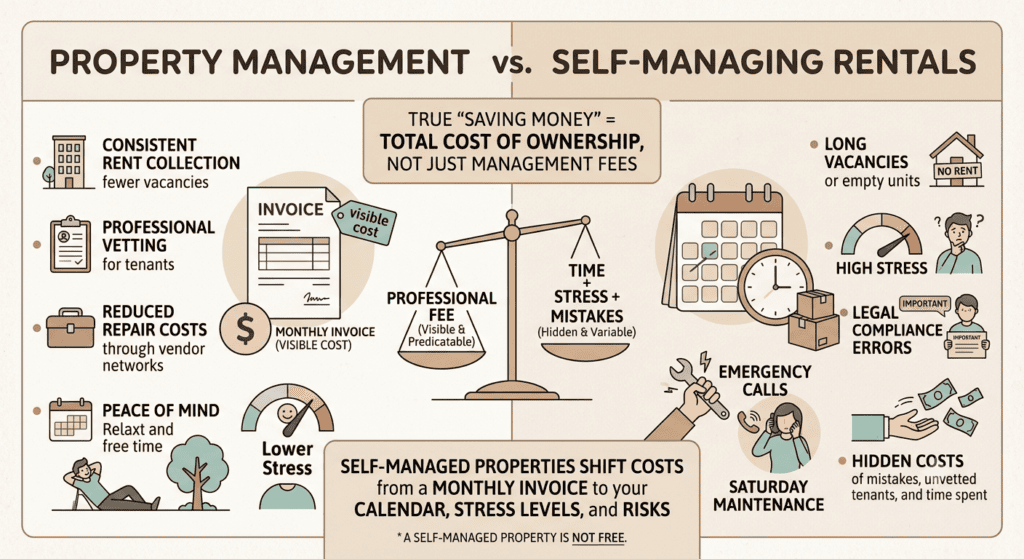
Most landlords frame this decision as a single line item: a management fee versus no management fee. That’s the wrong comparison.
The real comparison, when you weigh property management vs self-managing rentals, is total cost of ownership – every dollar and every hour that goes into keeping a property occupied, compliant, and well maintained, no matter who’s doing the work. A self-managed property isn’t a free property. It just moves the cost from a monthly invoice to a less visible place: your calendar, your stress levels, and the mistakes that happen when a non-expert handles a specialized job.
So before we get into numbers, here’s the honest framing: you’re not choosing between “cost” and “no cost.” You’re choosing between a cost you can see and a cost you usually can’t, until it shows up as a longer vacancy, a legal notice you served incorrectly, or a Saturday you spent on hold with a plumber instead of with your family.
The Real Cost of Self-Managing a Rental Property
The Management Fee You’re Not Paying (But Still Paying, in Time)
Self-managing landlords like to point out that they’re not handing 8–12% of their rent to a property manager every month. That’s true. But that percentage doesn’t disappear – it gets replaced by your own labour, and your labour has a price whether or not you’re the one setting it.
Industry research consistently puts the time cost of self-managing a single rental at somewhere between 8 and 15 hours a month during a stable period, covering tenant communication, rent collection, minor maintenance coordination, bookkeeping, and periodic inspections. During a tenant turnover, that number climbs sharply – often by another 15 to 25 hours for relisting, showings, screening, and move-in paperwork. A landlord who values their time at even a modest hourly rate can easily find that a single month’s workload is worth more than what a professional manager would have charged for the same period.
How Many Hours Does Self-Managing Actually Take?
It depends on the property, the tenant, and the season – but the pattern across multiple landlord surveys is remarkably consistent. Estimates range from as low as 4 hours a month during a quiet stretch with a stable, long-term tenant, up to 20 hours a month or more when things go sideways: an emergency repair, a late-paying tenant, or a full turnover cycle.
Here’s a rough breakdown of where that time typically goes for a single rental in a normal month:
- 3–5 hours resolving tenant questions, complaints, or requests
- 2–5 hours coordinating maintenance and following up with contractors
- 1–3 hours on rent collection, banking, and bookkeeping
- 1–2 hours on paperwork, lease documentation, and recordkeeping
- 2–4 hours quarterly on property inspections
Multiply that by the number of doors you own, and it becomes obvious why so many landlords with three or more properties describe self-management as “a second job that doesn’t pay overtime.”
The Hidden Costs Landlords Forget to Count
This is where the property management vs self-managing rentals comparison usually gets skewed, because these costs rarely appear on a spreadsheet until after they’ve already happened.
Vacancy Costs
An empty unit is the single most expensive mistake a landlord can make, and it’s usually invisible until you calculate it directly. If your rental brings in $1,800 a month and it sits empty for even three extra weeks because your listing wasn’t optimized, your showings were scheduled around your day job, or you were slow to respond to inquiries, you’ve lost more money than a full year of typical management fees. Professional managers tend to fill vacancies faster because marketing, showings, and applicant screening are their full-time job, not something squeezed in around yours.
Legal Mistakes and LTB Risk
Ontario’s Residential Tenancies Act is detailed, technical, and unforgiving of procedural errors. A rent increase notice served on the wrong form, delivered without the required 90 days’ notice, or issued before the 12-month waiting period has passed can be thrown out entirely – meaning you lose the increase and have to start the clock over. An improperly served eviction notice can add months to an already lengthy Landlord and Tenant Board process. These aren’t rare edge cases; they’re the most common reasons landlord applications get delayed or dismissed at the LTB.
Maintenance Markups and Emergency Repairs
DIY landlords typically don’t have an established network of trusted, vetted trades. That means paying retail emergency rates for a weekend furnace repair instead of a pre-negotiated rate, and it means more trial and error finding contractors who show up on time and do the job right the first time. Established property managers usually have standing relationships with electricians, plumbers, and general contractors, which tends to mean faster response times and better pricing than a first-time landlord can negotiate alone.
Tenant Screening Errors
A bad tenant is, dollar for dollar, one of the most expensive mistakes in this business. Skipping a thorough credit check, rental history verification, or income confirmation to fill a vacancy quickly can lead to missed rent, property damage, or a costly and emotionally draining eviction process. Standardized, consistent screening – the kind a professional manager applies to every applicant – is one of the clearest ways to avoid this entirely.
Software, Insurance, and Administrative Overhead
Even a self-managed rental isn’t run on goodwill alone. Most landlords who take the job seriously end up paying for at least some of the following: property management software or a basic accounting subscription to track rent and expenses, landlord-specific insurance riders, background-check and credit-report services for screening applicants, and occasionally a paralegal consultation when a tenancy issue gets complicated enough that a Google search stops being sufficient. None of these costs are enormous individually, but together they chip away at the “I’m not paying anything” narrative that makes self-management look cheaper than it is. A professional manager typically already has these tools and relationships built into their operation, which is part of what the management fee is paying for.
What Property Management Actually Costs in Ontario in 2026
Standard Management Fees
Across Ontario, full-service property management fees for long-term residential rentals typically run between 6% and 12% of collected rent, with most single-unit residential properties in the GTA and surrounding regions landing around 8–10%. In Niagara and other mid-sized markets, rates tend to sit toward the lower-to-middle end of that range. On a $1,800-a-month rental, that works out to roughly $144–$216 a month, or about $1,700–$2,600 a year for core management services.
Leasing and Tenant Placement Fees
Most management agreements charge a separate leasing or tenant placement fee whenever a unit turns over – commonly half a month’s rent to a full month’s rent. This fee typically covers marketing, showings, applicant screening, and lease preparation, and it’s charged only when a new tenant is placed, not every month.
Short-Term Rental / Airbnb Management Fees
For Airbnb and short-term rental properties, fee structures work differently because they’re based on gross booking revenue rather than monthly rent. Co-hosting arrangements, where a manager handles guest communication and bookings but the owner stays involved, typically run 10–20% of revenue. Full-service short-term rental management – covering guest communication, cleaning coordination, dynamic pricing, and maintenance – commonly runs 20–30% of gross bookings, reflecting the significantly higher day-to-day workload of hosting compared to a long-term tenancy.
What’s Usually NOT Included
Before comparing quotes, it’s worth knowing what typically sits outside the base management fee: leasing fees on turnover, lease renewal fees, eviction or LTB representation costs, major repair coordination beyond a certain dollar threshold, and property inspections beyond the standard schedule. A management quote that looks cheaper on paper can end up more expensive once these add-ons are factored in – always ask for the full service schedule before comparing two providers on fee percentage alone.
Side-by-Side: Self-Managing vs Hiring a Property Manager
| Factor | Self-Managing | Professional Property Management |
| Monthly cost | $0 in fees, but 8–15+ hours of your time | Roughly 6–12% of collected rent |
| Vacancy risk | Higher – marketing and showings compete with your schedule | Lower – dedicated marketing and faster showings |
| Legal risk | Higher – RTA compliance errors are common among first-time landlords | Lower – forms and notices handled by people who do this daily |
| Maintenance costs | Often retail rates, limited contractor network | Typically negotiated rates through established trade relationships |
| Tenant screening | Inconsistent unless you build a formal process | Standardized, consistent criteria applied to every applicant |
| Time commitment | 8–15+ hours a month per property, more during turnovers | Minimal – periodic reporting and approvals only |
| Best suited for | Owners with one property, flexible schedules, and local proximity | Owners with multiple properties, full-time jobs, or out-of-town ownership |
Sample Math on a Niagara Rental
Let’s put real numbers against a typical Niagara long-term rental renting at $1,700 a month.
Self-managing: No management fee. But at even a conservative $35/hour value on your time and 10 hours a month of hands-on work, that’s $350 a month, or $4,200 a year – before counting a single vacancy day, a maintenance emergency, or a legal misstep. Add one turnover involving 20 hours of relisting, screening, and showings, and you’ve added another $700 in time cost for that year alone.
Professional management: At 9% of rent, that’s roughly $153 a month, or $1,836 a year, plus a leasing fee (typically half a month’s rent, or about $850) when the unit turns over. Total: approximately $2,686 in a turnover year – noticeably less than the self-managed time cost above, before even factoring in reduced vacancy days and fewer compliance risks.
The gap narrows or widens depending on your hourly value, how hands-on you enjoy being, and how smoothly your tenancy runs. But for most landlords working a full-time job elsewhere, the math tends to favour professional management once time is honestly priced in.
Niagara Region Rental Market Conditions in 2026
Vacancy Rates and What They Mean for Landlords
The St. Catharines–Niagara rental market has shifted noticeably over the past two years. According to CMHC’s most recent rental market data, the region’s average vacancy rate held at 3.9% – a more-than-decade high – with Niagara Falls posting the sharpest increases due to a decline in temporary foreign worker permits and softer tourism-sector employment. The average two-bedroom purpose-built rent in the region rose to $1,527, up 5.5% year over year, even as vacancies climbed.
What does that mean practically? In a tighter market, almost any listing rents itself. In a market with rising vacancy, pricing accuracy, listing quality, and response speed genuinely start to matter – and that’s exactly where the gap between self-managed and professionally managed properties widens. A landlord who prices a unit even slightly above market or is slow to respond to inquiries can watch a vacancy stretch from a couple of weeks into a couple of months.
Rent Increase Guideline and Its Impact on Returns
Ontario’s 2026 rent increase guideline is set at 2.1% – the lowest cap in four years, and the first time in several years it has landed below the legal maximum of 2.5%. That guideline applies to most units first occupied on or before November 15, 2018, and requires 90 days’ written notice on the official LTB Form N1, with increases allowed only once every 12 months. With returns already compressed by a lower guideline, avoidable losses – a botched notice, an extra month of vacancy, an unnecessary repair markup – eat into your margin more than they would have in a hotter market. That makes cost efficiency, in whichever direction you choose, more important than ever this year.
When Self-Managing Makes Sense
Self-management isn’t automatically the wrong choice. It tends to work well when:
- You own a single property, or at most two, and live close enough to respond quickly
- You have genuine flexibility in your schedule – not just willingness, but actual available hours
- You’ve taken the time to learn the Residential Tenancies Act and current LTB procedures
- You enjoy the hands-on work and don’t mind being reachable for tenant calls
- Your tenant has a stable, long-term history with minimal turnover
If all of those are true, the time cost of self-managing may genuinely be lower than a management fee, and the experience can be manageable rather than draining.
When Professional Property Management Wins
Hiring a manager tends to be the financially smarter move when:
- You own three or more properties, or a portfolio that’s growing
- You work full-time elsewhere and can’t take calls during business hours
- You live outside the region and can’t respond to emergencies in person
- You want genuinely passive income rather than a second job
- You’re not fully confident navigating Ontario’s landlord-tenant law without costly mistakes
- Your properties include short-term rentals, which require far more day-to-day involvement than a standard lease
Portfolio scale changes the calculation more than almost any other factor. A landlord with one property and time flexibility can often self-manage successfully. A landlord with five or more properties, or a demanding career, is usually working against their own goals by continuing to self-manage.
2026 Trends Shaping the Property Management Decision
A few shifts happening right now make this decision more consequential than it might have been a couple of years ago.
Rising vacancy is changing the marketing game. With Niagara’s vacancy rate sitting at a more-than-decade high, new purpose-built buildings in Ontario are increasingly offering one to two months of free rent to attract tenants. A self-managed listing competing against that kind of incentive needs sharper pricing, better photos, and faster response times than it did in a landlord’s market – exactly the skills a professional manager brings as a matter of routine.
Compliance keeps getting more technical. Recent changes around bad-faith eviction notices, including significant compensation penalties for landlords who serve an N12 without a genuine intention to move in or sell, mean the cost of a procedural misstep keeps climbing. This isn’t the kind of risk most self-managing landlords are tracking closely, and it’s precisely the kind of detail a property manager who handles these forms daily is built to catch.
Technology is narrowing the gap on the low end, but not closing it. Landlord software now automates rent collection, notice generation, and basic screening, which has made self-managing more manageable than it was five years ago. What software still can’t do is show up in person for a trade appointment, negotiate contractor pricing through an established relationship, or represent your interests at an LTB hearing – the parts of the job that create the most value in the property management vs self-managing rentals comparison.
Short-term rental oversight is intensifying. Airbnb and other platforms continue to adjust host fee structures and compliance requirements, and municipalities across Ontario are paying closer attention to short-term rental licensing. For STR owners specifically, the operational complexity has grown to the point where full-service management has become less of a luxury and more of a practical necessity for anyone not treating hosting as a full-time role.
7 Actionable Steps to Decide What’s Right for You
- Track your actual hours for one month. Write down every minute you spend on tenant communication, maintenance calls, paperwork, and marketing. Most landlords underestimate this until they measure it.
- Assign a real dollar value to your time. Use your actual hourly rate, or what you’d earn doing something else with that time – not zero.
- Get a written quote from a local property manager. Compare the full fee schedule, not just the headline percentage, against your own time cost.
- Calculate your last vacancy period honestly. How many days did the unit sit empty, and what did that cost in lost rent?
- Review your compliance history. Have you ever served a notice incorrectly, missed a deadline, or been unsure about an RTA requirement? That’s a risk cost, even if nothing’s gone wrong yet.
- Factor in growth plans. If you’re planning to add properties, build a system now that scales – whether that’s professional management or a much stronger DIY process.
- Revisit the decision annually. Market conditions, your schedule, and your portfolio size all change. What made sense last year may not make sense this year.
Frequently Asked Questions
Is property management worth the cost for a single rental property? It depends on your schedule and comfort with landlord-tenant law. If you have the time, live nearby, and understand the Residential Tenancies Act well, self-managing one property can be cost-effective. If you work full-time or want a truly passive investment, a manager’s fee is often offset by fewer vacancy days and fewer compliance mistakes.
What is the average property management fee in Ontario in 2026? Most Ontario property managers charge between 6% and 12% of collected monthly rent for long-term residential properties, with a separate leasing fee – typically half a month’s to a full month’s rent – charged when a new tenant is placed.
How much time does self-managing a rental actually take? Research consistently shows 8–15 hours a month per property during stable periods, with an additional 15–25 hours during a tenant turnover. That workload multiplies with each additional property you own.
Can a property manager help with Ontario’s Landlord and Tenant Board process? Most full-service property managers handle notice preparation, documentation, and procedural compliance to reduce the risk of errors that delay or void an LTB application. Some also represent owners at hearings, though this varies by company and should be confirmed before signing.
Do property management fees apply to short-term rentals like Airbnb? Yes, but the structure is different. Short-term rental management is typically priced as a percentage of gross booking revenue rather than monthly rent, commonly 10–20% for co-hosting support and 20–30% for full-service management including cleaning and guest communication.
How do I know if my portfolio has grown too large to self-manage? A common signal is spending more than 10 hours a month on landlord tasks, feeling consistent stress around tenant or maintenance issues, or owning properties outside the area where you can respond in person. Landlords who hit two or more of these signs often find professional management pays for itself.
Will hiring a property manager reduce my vacancy time? In most cases, yes. Professional managers typically run active marketing across multiple channels, respond to inquiries faster, and have a larger pool of pre-qualified applicants than an individual landlord juggling a full-time job. Since even a few extra weeks of vacancy can cost more than a year of management fees, faster leasing is often where a manager delivers the clearest return.
Can I switch from self-managing to professional management partway through a tenancy? Yes. A property manager can take over an existing tenancy at any point – reviewing the current lease, updating records, and becoming the tenant’s point of contact going forward. Many landlords make this switch specifically after a stressful turnover, a legal misstep, or simply realizing the time commitment no longer fits their schedule.
The Long-Term Financial Angle Most Landlords Miss
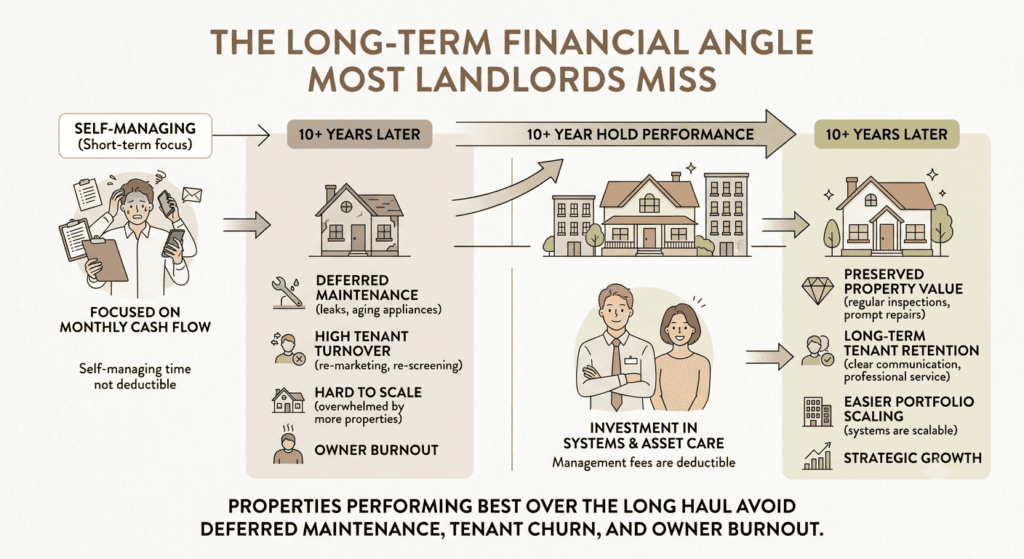
Most of this article has focused on monthly cash flow, because that’s the comparison landlords usually make first. But the property management vs self-managing rentals decision also affects your investment over a longer horizon, in ways that don’t show up until years later.
Property management fees are a deductible business expense. In most cases, the cost of professional management can be claimed against your rental income at tax time, which softens the real-world impact of the fee compared to its sticker price. Time spent self-managing, by contrast, isn’t deductible – it’s simply hours you don’t get back.
Well-maintained properties hold their value better. A property manager who runs regular inspections and responds quickly to maintenance issues tends to catch small problems – a slow leak, a failing seal, an aging appliance – before they become expensive ones. Landlords who self-manage while also working full-time often defer non-urgent maintenance simply because there isn’t time to deal with it, and deferred maintenance compounds in cost the longer it sits.
Consistent management supports long-term tenant retention. Turnover is expensive no matter who handles it, but tenants tend to stay longer with landlords who communicate clearly, respond promptly, and handle issues professionally. A revolving door of tenants doesn’t just cost you in vacancy days; it costs you in the cumulative hours spent re-marketing, re-screening, and re-negotiating a lease every year or two.
Scaling a portfolio is easier with systems already in place. If you’re planning to add a second, third, or tenth property, self-managed processes that work for one unit rarely scale cleanly to five. Landlords who bring in professional management earlier in their portfolio’s growth typically find the transition to a larger portfolio far smoother than those who try to retrofit systems after they’re already overwhelmed.
None of this means self-managing is a bad long-term strategy for every owner – plenty of hands-on landlords build successful portfolios that way. It does mean the decision deserves more than a glance at the monthly fee percentage. The properties that perform best over a 10-year hold are usually the ones where maintenance wasn’t deferred, tenants weren’t churned unnecessarily, and the owner didn’t burn out somewhere around year three.
Final Verdict: Property Management vs Self-Managing Rentals
There’s no universal right answer here – but there is a right answer for your specific situation, and it comes down to being honest about what your time is actually worth and how much risk you’re comfortable carrying. If you have one property, real spare time, and a solid grasp of Ontario’s rental laws, self-managing can work. For everyone else – especially owners with multiple properties, full-time careers, out-of-town ownership, or short-term rentals – professional management usually delivers more value than its fee costs, once vacancy reduction, legal protection, and your own time are properly counted.
At The HAH Developments, we work with property owners across Niagara Falls and the wider Niagara Region to take the guesswork – and the 11 p.m. maintenance texts – off your plate. Whether you’re managing a long-term rental, exploring Airbnb hosting, or trying to decide if it’s finally time to hand off the day-to-day work, our team can walk you through exactly what professional management would look like for your specific property. Contact The HAH Developments today for a free rental assessment and see the real numbers for your situation.