

If you own a rental property in Niagara Falls or anywhere in the Niagara Region, you already know the feeling. A 2 a.m. text about a broken furnace. A tenant who stopped paying rent three weeks ago and won’t answer your calls. A stack of paperwork you’re pretty sure you filled out wrong. Owning property was supposed to build wealth, not steal your weekends.
Here’s the good news: stress-free property management isn’t a fantasy reserved for owners with deep pockets and a team of lawyers on retainer. It’s a system. And once you understand how that system works – the right processes, the right technology, and the right people – you can turn a demanding rental property into a genuinely passive source of income.
This guide walks you through exactly what stress-free property management looks like in 2026, why the Niagara market makes this both harder and more important than ever, and the practical steps you can take starting today, whether you self-manage or work with a professional team like The HAH Developments.
What Does Stress-Free Property Management Actually Mean?
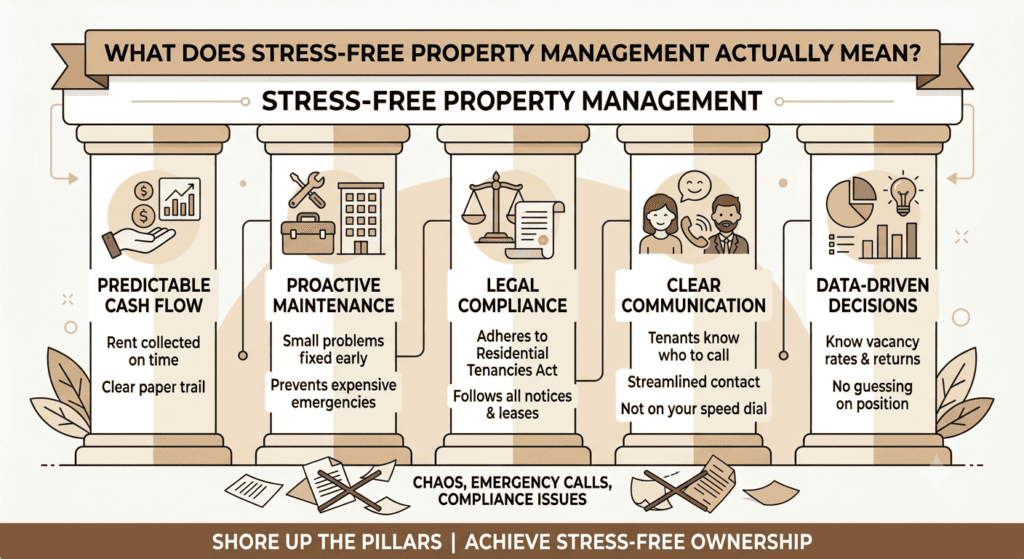
Stress-free property management doesn’t mean nothing ever goes wrong. Pipes still burst. Tenants still move out. Markets still shift. What it means is that when something does go wrong, you have a system in place to handle it quickly, professionally, and without it consuming your evenings and weekends.
At its core, stress-free property management rests on five things working together:
- Predictable cash flow – rent gets collected on time, every time, with a clear paper trail.
- Proactive maintenance – small problems get fixed before they become expensive emergencies.
- Legal compliance – every notice, lease, and increase follows the Residential Tenancies Act to the letter.
- Clear communication – tenants know who to call, and you’re not the first point of contact for every leaky faucet.
- Data-driven decisions – you know your vacancy rate, your rent position, and your return, instead of guessing.
When even one of these pillars is miss ing, the whole structure gets shaky. Miss rent collection and you’re chasing tenants. Skip maintenance and you’re paying for a $12,000 repair that should have cost $200. Get a notice wrong and you’re stuck at the Landlord and Tenant Board for months. The goal of this guide is to help you shore up every one of these pillars, so property ownership finally feels like the investment it was supposed to be.
The Stress Points Every Niagara Landlord Recognizes
Before diving into solutions, it helps to name the problems clearly. Most owners we talk to describe the same handful of frustrations:
- Never knowing whether rent will actually land on the first of the month.
- Getting maintenance calls at the worst possible times, for issues that could have been prevented.
- Feeling unsure whether a notice, lease clause, or rent increase is actually legal.
- Watching a unit sit empty for weeks because pricing or marketing wasn’t quite right.
- Spending evenings on spreadsheets instead of with family, just to keep basic records straight.
If any of that sounds familiar, you’re not managing your property badly – you’re managing it without a system. The rest of this guide builds that system, piece by piece.
The State of the Niagara Rental Market in 2026
Before you can manage a property well, you need to understand the market you’re managing it in – and the Niagara Region’s rental landscape has shifted noticeably over the past year.
Vacancy Rates Are Rising, and That Changes Your Strategy
According to CMHC’s most recent rental market survey, the average vacancy rate across the St. Catharines–Niagara area sits at roughly 3.9%, a more-than-decade high for the region. Niagara Falls specifically has seen an even sharper increase, driven by a decline in temporary foreign worker permits, softer tourism-sector employment, and a wave of new purpose-built rental supply coming online, including a 362-unit development in downtown Niagara Falls.
What does that mean for you as a landlord? Simply put, tenants have more options than they did two or three years ago. A unit priced even slightly above market can sit vacant for weeks, and every week of vacancy costs far more than a modest, well-timed price adjustment would. Owners who are still pricing units based on 2022 or 2023 comparables are the ones struggling most right now. The landlords winning in this market are the ones pricing accurately, marketing aggressively, and turning vacant units around fast – which is exactly where a professional property manager earns their fee.
The 2026 Rent Increase Guideline
Ontario’s rent increase guideline for 2026 is set at 2.1%, the lowest cap in four years, reflecting cooling inflation as measured by the Ontario Consumer Price Index. For a unit renting at $1,800 a month, that works out to a maximum legal increase of roughly $37.80 without applying for an Above Guideline Increase through the Landlord and Tenant Board.
A few details matter here. The guideline only applies to units first occupied for residential use before November 15, 2018 – newer buildings and additions are exempt and can be priced at market rate. Landlords must also give at least 90 days’ written notice using the official N1 form, and at least 12 months must pass between increases on the same unit. Get any of these details wrong, and a tenant can challenge the increase at the LTB, potentially forcing you to reverse it and refund the difference. This is exactly the kind of detail-heavy compliance work that trips up self-managing landlords, and it’s a core reason experienced Ontario landlord regulations knowledge is worth paying for.
The 7 Pillars of Stress-Free Property Management
With the market context in mind, let’s get into the operational side – the actual systems that separate stressed-out landlords from ones who barely think about their properties day to day.
Pillar 1: Rigorous Tenant Screening
Nearly every major landlord headache – late rent, property damage, eviction proceedings – traces back to one root cause: the wrong tenant moved in. A thorough screening process should include a credit check, employment and income verification (aim for gross income at least three times the monthly rent), landlord references from the past two tenancies, and, where legally permitted, a background check.
Resist the temptation to rent to the first applicant just to stop the vacancy clock. A property that sits empty for an extra two weeks while you screen properly is far cheaper than a tenant who stops paying in month four. Rental fraud is also on the rise: recent industry research found that a majority of property managers reported encountering fraudulent applications in the past year, from doctored pay stubs to fake reference letters, which makes a documented, consistent screening process more important than ever.
Pillar 2: Preventive Maintenance, Not Reactive Repairs
This is the single biggest lever for reducing both stress and cost. Most landlords don’t lose money on maintenance issues – they lose money on maintenance they ignored. A furnace that gets serviced annually rarely fails in January. A roof that gets inspected each spring rarely leaks into a tenant’s living room.
Build a simple preventive maintenance calendar:
- Seasonal: HVAC servicing before summer and winter, eavestrough cleaning in fall, exterior inspection in spring.
- Annual: smoke and carbon monoxide detector testing, water heater inspection, roof and foundation check.
- Ongoing: a 24–48 hour response standard for tenant-reported issues, since small leaks and minor pest sightings only get more expensive the longer they’re left alone.
Increasingly, this is where technology helps most. IoT sensors that monitor for water leaks, unusual temperature swings, or HVAC strain can flag a failing system weeks before it actually breaks, and predictive maintenance programs have been shown to meaningfully cut both downtime and repair costs compared with a purely reactive approach.
It also helps to think about maintenance in three buckets rather than one long to-do list. Life-safety items – smoke alarms, carbon monoxide detectors, handrails, exterior lighting – get checked first, every time, because they carry both tenant-safety and liability implications. Big-ticket systems – furnace, roof, water heater, foundation – get a documented annual inspection, since these are the repairs that turn a healthy year of cash flow into a loss if they’re missed. Everyday wear items – caulking, weatherstripping, appliance seals – get bundled into a spring and fall walkthrough rather than handled one at a time as they’re noticed. A property that follows this rhythm consistently will, almost without exception, cost less to run over five years than one that only gets attention when something breaks.
Keep a simple maintenance log for every property, even if it’s just a shared spreadsheet: date, issue, vendor, cost, and follow-up needed. This single habit does two things. It gives you a clear record if a tenant ever disputes the condition of a unit, and it lets you spot patterns – a water heater that’s needed three service calls in two years is telling you something a one-off repair invoice never will.
Pillar 3: Airtight Legal Compliance
Ontario’s Residential Tenancies Act governs nearly every part of the landlord-tenant relationship – notices, rent increases, entry rights, and the eviction process. Getting this wrong is one of the fastest ways to turn a minor issue into a costly, months-long LTB hearing.
A few compliance basics every Niagara landlord should have locked down:
- Use current, LTB-approved lease and notice forms – outdated templates are a common and entirely avoidable mistake.
- Provide 24 hours’ written notice before entering a unit for non-emergency reasons.
- Return the last month’s rent deposit interest annually, as required under the RTA.
- Keep a documented paper trail for every notice, communication, and rent payment, since LTB disputes are won or lost on documentation.
Pillar 4: Reliable Rent Collection and Financial Reporting
Chasing rent is one of the most emotionally draining parts of self-managing a property. Automated rent collection – through a tenant portal with e-transfer, pre-authorized debit, or credit card options – removes the awkwardness of being your tenant’s monthly reminder and creates a clean, timestamped record if a dispute ever reaches the LTB.
Pair this with monthly financial reporting: income, expenses, maintenance costs, and net yield, all in one place. Owners who track this consistently catch problems – a unit underperforming its comparables, a maintenance category quietly eating into margin – months before owners who only check their bank balance.
Pillar 5: Communication That Doesn’t Depend on You
A huge amount of landlord stress comes from being the single point of contact for everything. A tenant with a plumbing emergency at 11 p.m. shouldn’t be calling your personal cellphone; they should have a clear escalation path – an emergency line, a maintenance portal, a property manager – that gets the issue handled without your direct involvement.
This matters for guest and tenant satisfaction too. A striking number of landlords now say they’d accept somewhat lower returns in exchange for a better tenant or guest experience, recognizing that responsive communication drives retention, reduces turnover costs, and protects the property’s reputation.
Pillar 6: Smart Use of Technology
2026 has brought a genuine shift in how property management technology works, moving from disconnected point solutions toward integrated platforms that handle the full tenant lifecycle – leasing, screening, maintenance, payments, and communication – in one place. AI-assisted leasing tools can now respond to prospective tenant inquiries within minutes instead of days, which matters enormously in a market where a slow reply means a lost showing to a faster-moving competitor.
You don’t need enterprise software to benefit from this. Even a basic property management platform that centralizes applications, payments, maintenance tickets, and lease documents will save hours a week and dramatically reduce the odds of a compliance slip-up.
It’s also worth noting how tenant expectations around technology have shifted. A recent industry survey found that a large majority of small landlords now expect to use AI tools when researching or evaluating a property manager, and most tenants are comfortable with AI supporting day-to-day operations like maintenance ticket routing or lease renewal reminders, provided a real person is still reachable when something goes wrong. The lesson isn’t that technology should replace the human side of property management – it’s that it should remove the repetitive, low-value tasks so the human side gets more attention, not less. A tenant whose maintenance request gets acknowledged automatically within minutes, then handled by a real technician within 48 hours, has a far better experience than one who leaves a voicemail and waits three days to hear back.
Pillar 7: A Real Vacancy and Turnover Plan
Every day a unit sits empty is a day of pure lost income. Stress-free landlords treat turnover as a process, not a scramble: a standard move-out inspection checklist, a pre-lined-up cleaning and maintenance crew, professional photos ready before the old tenant is even out, and marketing that goes live the same day the unit becomes available. In a market where Niagara Falls vacancy has climbed and new supply is competing hard for tenants, a fast, polished turnover is often the difference between a two-week vacancy and a two-month one.
Financial Best Practices That Keep Ownership Stress-Free
Good property management isn’t only about tenants and maintenance – it’s also about running the numbers like a small business, because that’s exactly what a rental property is.
Build a Capital Reserve, Not Just an Operating Buffer
Most owners budget for the small stuff – a plumber’s callout, a coat of paint between tenants – but forget to set aside money for the big-ticket replacements that are inevitable over time: a roof, a furnace, a set of appliances. A common rule of thumb is to reserve 1–3% of a property’s value annually toward major capital repairs, separate from your day-to-day maintenance budget. Owners who skip this step often end up financing a $15,000 roof replacement at the worst possible moment, instead of pulling from a reserve that’s already there.
Track Every Deductible Expense
Mortgage interest, property management fees, insurance, repairs, utilities you cover, and even mileage driven for property-related errands are typically deductible against rental income in Canada. Landlords who keep loose, incomplete records routinely leave money on the table at tax time simply because they can’t substantiate expenses they actually incurred. A dedicated bank account for each property, paired with monthly reconciliation, makes this almost effortless instead of a scramble every April.
Review Your Rent Position Annually, Not Just at Renewal
Even in a market with rising vacancy, most owners are still leaving money on the table by defaulting to the guideline increase every year without checking whether their unit is actually priced correctly against current comparables. A property manager focused on genuine performance will pull current listings for similar units nearby each year and recommend a number based on real data, not habit – sometimes that means holding rent flat to protect a good tenant, and sometimes it means adjusting further than the guideline allows through a properly filed Above Guideline Increase when major capital work justifies it.
(Note: This article provides general guidance only and is not tax or legal advice. Speak with a licensed accountant or paralegal for advice specific to your situation.)
Short-Term Rentals Add a Whole Extra Layer
If your property is an Airbnb or vacation rental rather than a long-term lease, Niagara Falls stress-free property management looks a little different – and, frankly, a little more demanding.
The City of Niagara Falls requires every short-term rental to hold a Vacation Rental Unit (VRU) license, with a $500 initial fee and a $250 annual renewal. Short-term rentals are only permitted in designated tourist and commercial zones; most residential neighbourhoods are off-limits entirely, and operating without a license can carry fines reaching into the tens of thousands of dollars. Hosts must also collect and remit a Municipal Accommodation Tax on every booking, keep booking records for several years, and pass fire, health, and electrical inspections before they can legally operate.
The city is also running a 14-month Owner Occupied Short-Term Rental pilot program, capped at 100 licenses, that allows residents to rent a portion of their principal residence – a meaningfully different set of rules from a standalone VRU. If you’re considering entering the Airbnb space, or you’re already running one and aren’t sure your paperwork is current, this is an area where local expertise pays for itself many times over: rules change often enough that a license that was compliant last year may not be this year.
DIY Property Management vs. Hiring a Professional: What’s the Real Cost?
Every owner asks this question eventually. Self-managing feels like the cheaper option on paper – no monthly management fee eating into your rent roll. But the honest math looks different once you account for your time, your risk exposure, and your opportunity cost.
Self-management makes sense when:
- You own one property, ideally close to where you live.
- You have flexible time and don’t mind being reachable for emergencies.
- You’re comfortable navigating LTB forms, notices, and hearings if needed.
Professional management makes sense when:
- You own multiple properties, or the property isn’t local to you.
- Your time is worth more than the hours you’d spend on maintenance calls and paperwork.
- You want rental income optimization from someone actively tracking market comparables, not a number you set once and forget.
- You’d rather not personally handle an LTB hearing, a difficult eviction, or a 2 a.m. emergency.
A professional manager typically charges a percentage of monthly rent, but that fee usually pays for itself through faster turnovers, fewer costly maintenance surprises, stronger rent positioning, and – perhaps most valuable of all – getting your evenings and weekends back.
Run the numbers for your own situation before deciding either way. Add up the hours you spend each month on showings, screening, maintenance coordination, and paperwork, then multiply by what your time is actually worth. Compare that against a typical management fee, and factor in the cost of the mistakes professional managers are specifically trained to avoid – an improperly served notice, a missed inspection, a vacancy that drags on an extra month because the listing wasn’t optimized. For owners with more than one property, or a property that isn’t a short drive from home, the math almost always favours bringing in professional help.
How The HAH Developments Delivers Stress-Free Property Management
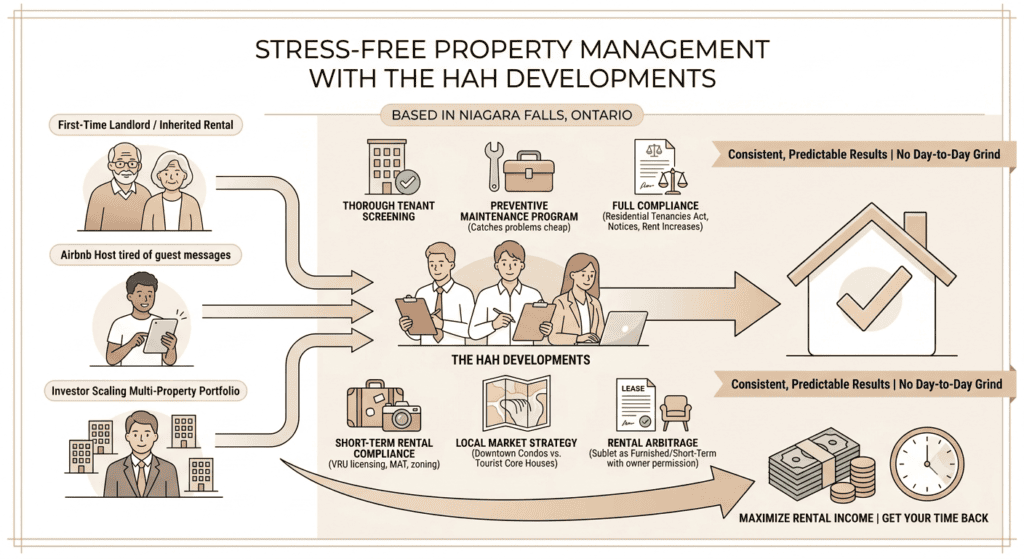
This is exactly the gap The HAH Developments was built to close. Based in Niagara Falls, Ontario, our team manages the full spectrum of rental property – long-term tenancies, Airbnb hosting and co-hosting, rental arbitrage, and full-service property care – so owners get consistent, predictable results without the day-to-day grind.
That looks like thorough tenant screening before anyone gets the keys. A preventive maintenance program that catches problems while they’re still cheap to fix. Full compliance with the Residential Tenancies Act, including every notice and rent increase handled correctly and on time. Transparent monthly reporting so you always know exactly how your property is performing. And for short-term rental owners, full VRU licensing, MAT remittance, and zoning compliance handled on your behalf, so you’re never at risk of an avoidable fine.
Whether you’re a first-time landlord who inherited a rental and isn’t sure where to start, an Airbnb host tired of juggling guest messages at all hours, or an investor scaling a multi-property portfolio, the goal is the same: maximize your rental income while giving you your time back.
We also work with investors exploring rental arbitrage – leasing a property with the landlord’s permission to sublet it as a furnished or short-term rental – and with owners weighing long-term versus short-term strategies for a specific property. Every market is different, and Niagara Falls’ mix of steady tourism demand, a growing student population near Niagara College, and rising purpose-built supply means the right strategy for a downtown condo can look very different from the right strategy for a house near the tourist core. Part of stress-free ownership is having someone who actually knows the difference make that call with you, instead of guessing.
The Bottom Line
Stress-free property management isn’t about eliminating every problem your rental property will ever throw at you. It’s about building the systems – screening, maintenance, compliance, communication, and technology – so that when problems do come up, they get handled quickly and don’t consume your life. In a Niagara market that’s shifting fast, with vacancy rates climbing, new supply coming online, and short-term rental rules getting stricter by the year, having those systems in place matters more than it did even twelve months ago.
If building and running all of that yourself sounds like more time and risk than you signed up for, that’s exactly where The HAH Developments comes in. From long-term tenant placement to full Airbnb co-hosting and everything in between, our Niagara Falls team handles the details so your property works for you – not the other way around. Reach out to The HAH Developments today for a free portfolio consultation and find out what stress-free property management could look like for your investment.
Frequently Asked Questions
What does stress-free property management actually cost in Niagara Falls?
Professional property management typically runs 8–12% of monthly rent for long-term rentals, and a similar or slightly higher percentage for short-term rental co-hosting given the added workload of guest turnover. Most owners find the fee pays for itself through reduced vacancy, fewer costly repairs, and stronger rent positioning.
How much can I legally raise rent in Ontario in 2026?
The 2026 rent increase guideline is 2.1% for most rent-controlled units, provided you give 90 days’ written notice on the correct N1 form and at least 12 months have passed since the last increase. Units first occupied after November 15, 2018 are exempt and can be increased at market rate.
Do I need a license to run an Airbnb in Niagara Falls?
Yes. Any short-term rental (28 consecutive days or less) requires a Vacation Rental Unit license from the City of Niagara Falls, which costs $500 initially with a $250 annual renewal, and the property must sit within an approved tourist or commercial zone.
How do I reduce vacancy time between tenants?
Price the unit accurately against current comparables rather than last year’s rents, have professional photos and a cleaning crew ready before the old tenant moves out, and list the unit the same day it becomes available. In a market with rising vacancy, speed and accurate pricing matter more than ever.
Is preventive maintenance really worth the upfront cost?
Almost always, yes. A serviced furnace or an inspected roof costs a fraction of what an emergency replacement or water damage repair would cost, and predictive maintenance programs have been shown to meaningfully cut both downtime and total repair costs over time.
What’s the biggest mistake self-managing landlords make?
Skipping proper documentation. Whether it’s a rent increase notice, a maintenance request, or a lease renewal, undocumented communication is the single most common reason landlords lose disputes at the Landlord and Tenant Board.
How is the Niagara rental market different from Toronto or Hamilton?
Niagara’s vacancy rate has climbed faster than many nearby markets due to a mix of new purpose-built supply, softer tourism-sector employment, and fewer temporary foreign worker permits. That means Niagara landlords need to compete harder on pricing and presentation than they did just a couple of years ago, even though overall rents remain more affordable than the GTA.
Should I self-manage my first rental property or hire help right away?
If the property is close to home and you have the time and temperament to handle late-night calls and LTB paperwork, self-managing a single unit can work well as a learning experience. Once you add a second property, take on a long-distance rental, or simply decide your time is better spent elsewhere, that’s usually the point where professional management starts paying for itself.