

If you own a rental property, you’ve probably typed some version of this question into Google late at night: “Is a property manager actually worth what they charge?” It’s a fair question, and it deserves a straight answer instead of a vague “it depends.”
Here’s the short version: most Canadian landlords pay somewhere between 6% and 12% of their monthly rent for professional management, with the national average sitting closer to 8-10%. But that single number hides a lot – what’s bundled into the fee, what shows up as a surprise charge in month three, and whether you’re managing a long-term rental or an Airbnb changes the math completely.
This guide breaks down exactly what property owners across Canada are paying in 2026, city by city and service by service, so you can look at any quote and know whether it’s fair.
What Is the Average Property Management Cost in Canada in 2026?
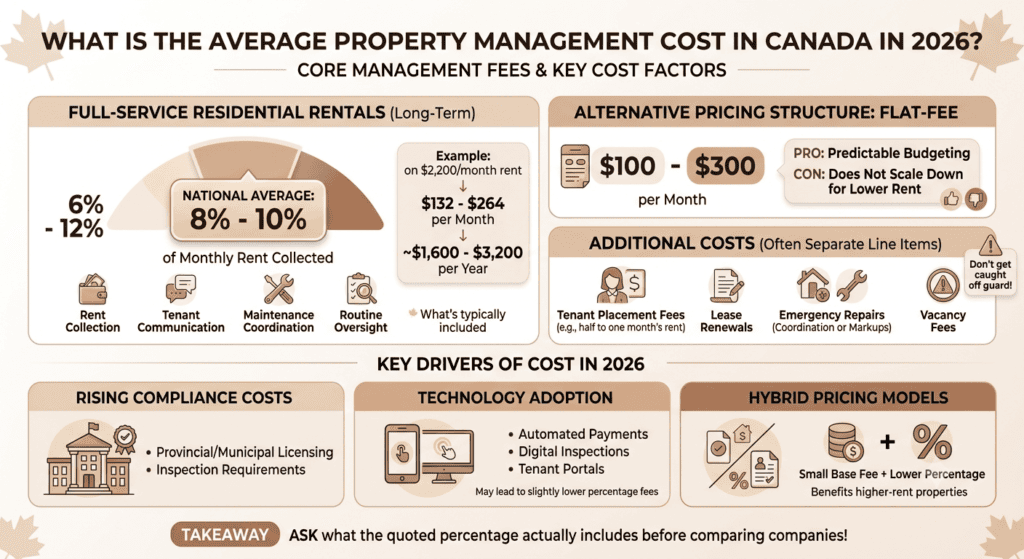
Let’s start with the number everyone actually wants: the average property management cost in Canada right now.
For a standard long-term residential rental, full-service property managers typically charge between 6% and 12% of the monthly rent collected, with most companies landing in the 8-10% range nationally. On a $2,200/month rental, that works out to roughly $132 to $264 a month, or about $1,600 to $3,200 a year in core management fees alone.
That percentage covers the basics: rent collection, tenant communication, maintenance coordination, and routine oversight. It usually doesn’t cover tenant placement, lease renewals, or emergency repairs – those tend to show up as separate line items, which is exactly where a lot of landlords get caught off guard.
Flat-fee pricing is the other common structure, typically running $100 to $300 per month depending on the property type and city. Flat fees make budgeting predictable, but they don’t scale down if your rent is modest, and they don’t reward the manager for pushing rents higher, either.
A few things are pushing this range in 2026:
- Rising compliance costs. Provinces and municipalities keep adding licensing and inspection requirements, and management companies pass some of that cost along.
- Technology adoption. Companies using automated rent collection, digital inspections, and tenant portals are starting to offer slightly lower percentage fees because their overhead is lower.
- Hybrid pricing. A growing number of firms are blending a small flat base fee (often around $100) with a lower percentage rate, which tends to benefit owners with higher-rent properties.
The takeaway: when someone quotes you a single percentage, ask what that percentage actually includes before comparing it to another company’s number.
A Quick Snapshot: What $2,200/Month Rent Actually Costs to Manage
Numbers are easier to picture with a real example. Say you own a two-bedroom unit renting for $2,200 a month.
- At a 6% fee, you’d pay roughly $132 a month, or $1,584 a year.
- At a 10% fee – the most common rate in cities like Toronto – you’d pay $220 a month, or $2,640 a year.
- At a 12% fee, closer to what you’d see in Vancouver, you’d pay $264 a month, or $3,168 a year.
Add a single tenant placement fee of one month’s rent (a fairly standard rate when a lease turns over), and the first-year total climbs by another $2,200. This is why comparing property management quotes purely on the percentage number, without factoring in leasing and renewal fees, rarely gives you an accurate picture of what you’ll actually spend over twelve months.
How Property Management Fees Are Structured
Not every management company prices its services the same way. Understanding the three common models makes it much easier to compare quotes apples-to-apples.
Percentage-of-Rent Model
This is the most common structure in Canada, and it’s easy to see why. The manager’s income rises and falls with your rent, which keeps their incentives roughly aligned with yours – they don’t get paid more by leaving your unit vacant. Rates generally run 6-12% of monthly rent collected, though this is for the base management service only. Leasing, inspections, and renewal fees are typically extra.
The downside is that on a high-rent property, a percentage fee can end up costing more in dollar terms than a comparable flat-fee arrangement, even though the service delivered is identical.
Flat-Fee Model
A flat monthly fee, usually somewhere between $100 and $300 depending on the market and property size, gives owners a predictable number to plug into their budget every month. It tends to work best on single-family homes with stable, consistent rents.
The tradeoff is that a flat fee doesn’t motivate a manager to push for rent increases the way a percentage model does, since their pay stays the same either way. It can also feel expensive relative to rent on lower-value properties, so flat-fee property management tends to suit higher-rent, low-maintenance units best.
Hybrid Model
Hybrid pricing is becoming more common in 2026, particularly in mid-sized markets. A typical hybrid structure might combine a modest flat base fee – say $100 – with a lower percentage on top, often around 4%. This model tries to capture the predictability of flat fees while keeping some incentive alignment from the percentage side.
Whichever model you’re quoted, the real comparison isn’t the headline number. It’s the total annual cost once every add-on is factored in. A 10% flat rate with no extras is often cheaper over a year than an “8% fee” that comes stacked with leasing charges, inspection fees, and maintenance markups.
Property Management Costs by Province and City
Location matters more than most first-time landlords expect. Local licensing requirements, market competitiveness, and average rents all push fees up or down.
Ontario: Toronto, the GTA, and Niagara Region
Ontario tends to sit at the higher end of the national range, and property management fees Ontario-wide generally track close to that upper band. In Toronto and the broader GTA, 8-12% of gross rent is standard, with 10% being the most common rate for single-unit residential management. Hamilton, London, and Windsor generally run a bit lower, while Ottawa and the 905 belt track closer to Toronto’s rates.
In the Niagara region – including Niagara Falls, where The HAH Developments is based – Niagara Falls property management pricing reflects a mix of long-term rental management and a strong short-term and vacation rental market driven by tourism. That mix matters, because short-term rental management in Niagara Falls is priced very differently from a standard long-term lease, which we’ll get into shortly.
British Columbia: Vancouver
Vancouver has some of the highest property management fees in the country, generally 8-12% of monthly rent. Stricter licensing requirements and a high cost of living both contribute to the premium here compared to most other Canadian cities.
Alberta: Calgary
Calgary fees typically run 7-12% for the percentage model, or $150 to $250 a month for flat-fee arrangements. On a $1,860 two-bedroom rental, that translates to roughly $149-$223 a month for core management.
Quebec: Montreal
Montreal’s rental market moves quickly, and percentage-based fees tend to be more common here than flat fees, since they let managers respond to rent fluctuations more easily than a fixed monthly rate would.
Atlantic Canada: Halifax
Halifax has been an early adopter of hybrid pricing, with some firms blending a roughly $100 base fee with a 4% variable rate. This reflects a smaller, less saturated market where predictable pricing helps companies compete for new clients.
Why City-Level Pricing Varies So Much
It’s tempting to assume the cheapest city automatically means the cheapest management, but the reality is more nuanced. A few forces drive these regional gaps:
- Regulatory complexity. Cities with stricter licensing, inspection, or rental-registry requirements (Vancouver and Toronto being good examples) tend to have higher fees, since compliance work takes real staff time.
- Market competitiveness. Markets with more property managers per capita, like Toronto, don’t always have lower fees – higher overhead and rent levels tend to offset the added competition.
- Rent levels. Percentage-based fees scale with rent, so a city with higher average rents will naturally generate higher dollar-figure management costs even at an identical percentage rate.
- Property type mix. Regions with a strong short-term rental market, like Niagara Falls, often have management companies quoting very different rates depending on whether you’re asking about a long-term lease or a vacation rental.
The practical lesson: always ask for local, property-specific pricing rather than assuming a national average applies directly to your situation.
What’s Included in the Base Management Fee (and What’s Not)
This is where most landlord frustration actually comes from – not the size of the fee, but the gap between what they assumed was included and what actually was.
Standard Inclusions
Most base management fees, regardless of the model, typically cover:
- Rent collection and deposit handling
- Tenant communication and day-to-day questions
- Coordinating routine maintenance requests
- Basic financial reporting
- Routine property inspections, usually annual or semi-annual (spring and fall)
Common Add-On Fees
Almost everything outside the core list above tends to be billed separately:
- Leasing or tenant screening charges for finding and vetting a new tenant
- Lease renewal fees when an existing tenant signs on for another term
- Move-in and move-out inspection reports, beyond the routine seasonal visits
- Maintenance markups, where the manager adds a percentage on top of contractor invoices
- Emergency repair coordination, sometimes billed at an hourly or flat call-out rate
Before signing any management agreement, ask for the full fee schedule – not just the headline percentage. A company advertising a low base rate can easily make up the difference through high leasing fees or expensive à la carte charges, so the only real way to compare two quotes is to estimate your total annual cost under each one.
Long-Term Rental vs Short-Term Rental (Airbnb) Management Costs
This is one of the biggest cost differences landlords overlook, and it’s a big deal if you’re deciding between a traditional lease and a vacation rental strategy.
Long-Term Rental Management Fees
As covered above, long-term residential management generally runs 6-12% of monthly rent, plus occasional leasing and renewal charges. It’s the lower-cost, lower-touch option, since the manager isn’t handling guest turnover, cleaning between stays, or dynamic pricing.
Airbnb and Vacation Rental Co-Hosting Fees
Short-term rental management fees run significantly higher than long-term equivalents, because the scope of work is much bigger. A property manager isn’t just collecting rent once a month – they’re handling guest messaging, check-ins, cleaning coordination, dynamic pricing, and guest issues around the clock.
Full-service Airbnb and vacation rental management typically runs 20-30% of gross booking revenue. Lighter-touch co-hosting arrangements, where the manager handles guest communication and check-ins but the owner still deals with some of the logistics, tend to run 10-20% of revenue. Solo, independent co-hosts sometimes charge less than a full property management company, often in the 10-15% range, though usually without bundling in extras like cleaning coordination or maintenance oversight. Airbnb co-hosting fees can also climb toward 20% once cleaning scheduling and guest-issue resolution are added to the scope of work.
The gap between a full-service manager and a lighter co-hosting arrangement isn’t just about service level – it also reflects who carries the liability and who holds the listing. A full property manager typically operates the listing within their own business systems, while a co-host works as a helper inside the owner’s personal account.
Understanding Airbnb’s Own Platform Fees
It’s worth separating your property manager’s fee from what Airbnb itself charges, because both come out of your revenue. Airbnb has been shifting hosts in Canada from a split-fee model (roughly 3% from the host, 14-16.5% from the guest) to a single host-only fee of about 15.5%, deducted entirely from the host’s payout. This shift became mandatory for hosts using professional management software in late 2025, and Airbnb has since set final deadlines for the rest of its hosts through the second half of 2026.
What this means practically: if you’re budgeting for a short-term rental in 2026, plan for Airbnb’s own platform fee on top of whatever percentage your property manager or co-host charges. The two are separate costs, and both come off your gross booking revenue.
Extra Costs Property Owners Should Budget For
Beyond the management fee itself, a handful of recurring and one-time costs tend to catch first-time landlords off guard.
Leasing and Tenant Screening Charges
When a property manager finds and screens a new tenant, this is billed separately from the monthly management fee almost universally. Expect somewhere between half a month’s rent and a full month’s rent per placement, depending on the market and how competitive the rental pool is.
Vacancy and Advertising Costs
Listing photography, online advertising, and showings during a vacancy are sometimes included in the leasing fee and sometimes billed on top of it. Always confirm which side of that line your contract falls on.
Maintenance and Repair Markups
Many management companies add 10-20% on top of contractor invoices for coordinating repairs. This isn’t necessarily a red flag – someone has to manage the trades – but it should be disclosed clearly in your contract, not buried in the fine print.
Licensing Fees for Short-Term Rentals
If you’re running a short-term rental in a city like Niagara Falls, licensing is its own line item entirely, separate from any management fee. Niagara Falls requires a Vacation Rental Unit (VRU) licence, with an initial fee and an annual renewal, plus a municipal accommodation tax collected on top of each guest’s stay. Short-term rentals are also restricted to designated commercial and tourist zones, so a property in the wrong zoning district simply isn’t eligible, regardless of how much you’re willing to spend on licensing.
Neighbouring Niagara-on-the-Lake runs its own separate licensing system with its own fee schedule, and municipalities across the wider Niagara region are all at different stages of formalizing their short-term rental rules. If short-term rental income is part of your plan, this is exactly the kind of local detail worth confirming with a property manager who already operates in that specific municipality.
Is Property Management Worth the Cost?
This is the question underneath all the numbers above, and the honest answer is: it depends on what your time and stress are worth, and how hands-off you actually want to be.
Here’s a simple way to think about rental property ROI once management fees enter the picture. If professional management costs you $2,000 a year but reduces your vacancy rate by even a few weeks, catches a maintenance issue before it becomes a $5,000 repair, or keeps you out of a costly Landlord and Tenant Board dispute, the fee often pays for itself many times over.
Self-managing can absolutely work, especially for a single property close to home and an owner with time to spare. But the math shifts quickly once you own multiple units, live far from the property, or hold a short-term rental that needs guest communication seven days a week. At that point, the “savings” from self-managing often get eaten up by missed bookings, slower repairs, and the value of your own time.
The properties where professional management pays off most clearly tend to share a few traits:
- The owner lives far from the property or owns multiple units
- The property is a short-term or vacation rental requiring constant guest turnover
- The owner values predictable, hands-off income over hands-on control
- Local regulations (like short-term rental licensing) require ongoing compliance work
It also helps to run the comparison the other way: what does self-managing actually cost, even when there’s no invoice attached to it? Screening tenants properly takes hours of background and reference checks. Coordinating a single emergency repair, like a burst pipe on a Sunday night, can eat an entire evening. A vacancy that drags on an extra three weeks because a listing wasn’t marketed well can quietly cost more than a full year of management fees. None of that shows up as a line item on a spreadsheet, but it’s a real cost all the same – usually paid in stress and lost time rather than dollars.
Are Property Management Fees Tax Deductible in Canada?
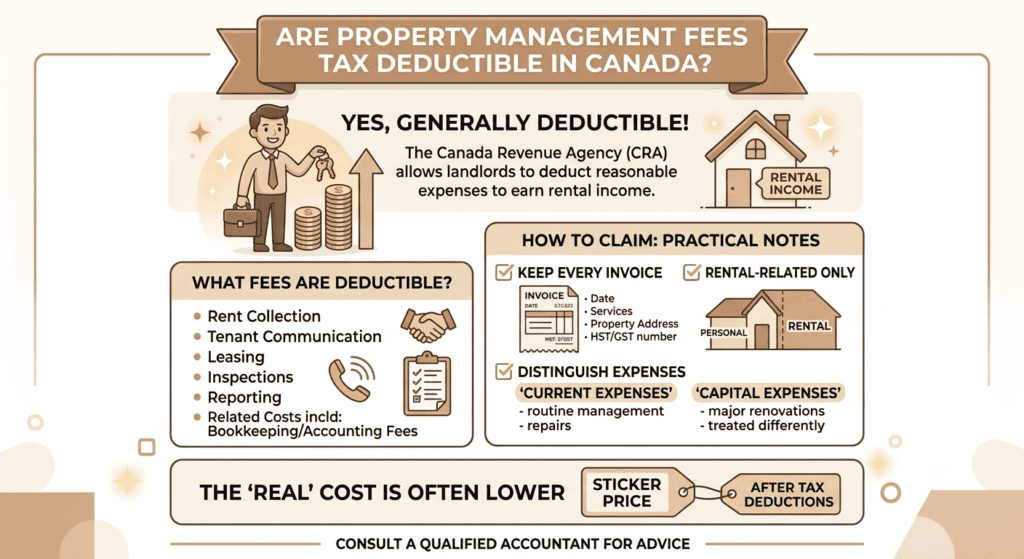
Good news for anyone weighing the cost: the Canada Revenue Agency generally allows landlords to deduct reasonable expenses incurred to earn rental income, and professional property management fees fall squarely into that category.
In most cases, fees paid to a property management company – covering rent collection, tenant communication, leasing, inspections, and reporting – are treated as current expenses and are fully deductible against your rental income for the year. The same generally applies to related costs like bookkeeping or accounting fees tied to managing the property.
A few practical notes if you plan to claim this deduction:
- Keep every invoice, and make sure each one lists the date, services provided, property address, and the management company’s HST/GST number.
- Only claim the amount tied to earning rental income – if a property is partly personal-use, only the rental-related portion applies.
- Distinguish current expenses (routine management, repairs, and maintenance) from capital expenses (major renovations or improvements), since capital costs are treated differently for tax purposes.
This deduction is one of the reasons the “real” cost of hiring a property manager is often lower than the sticker price suggests, once tax season factors into the picture. As always, a qualified accountant familiar with rental income is worth consulting for anything beyond the basics.
How to Choose the Right Property Management Company for Your Budget
Once you understand the pricing landscape, the next step is comparing actual companies – and price should never be the only factor.
Questions to Ask Before Signing
- What exactly is included in the base management fee, in writing?
- How is the leasing or new-tenant charge calculated, and when is it billed?
- Is there a markup on maintenance and repair invoices, and if so, how much?
- How are routine inspections scheduled, and what do they cover?
- What’s the process – and the cost – if I want to end the contract early?
- Do you have direct experience with properties like mine, in this specific city or neighbourhood?
Red Flags to Watch For
- A quote that only mentions the base percentage, with no fee schedule for extras
- Vague answers about maintenance markups or who chooses the contractors
- No sample monthly report or financial statement available to review
- Pressure to sign quickly without time to compare other quotes
- Little to no experience with your specific property type – short-term rentals and long-term leases require genuinely different skill sets
A company that’s upfront about every fee, even the unflattering ones, is usually more trustworthy than one whose pricing page only shows a single low percentage. When you’re comparing any property management company Canada-wide, ask for a written fee schedule before you ask about the percentage rate.
Tips to Reduce Property Management Costs Without Sacrificing Quality
Cost-conscious landlords have real options that don’t involve cutting corners on service:
- Negotiate on volume. If you own multiple units, ask about a reduced rate across your whole portfolio.
- Bundle services. Some companies offer a lower combined rate when management and maintenance are handled by the same team, rather than separate vendors.
- Compare total annual cost, not headline rate. A slightly higher percentage with no hidden add-ons can beat a “cheap” quote once every extra fee is added up.
- Ask about technology-driven pricing. Companies using automated rent collection and digital inspections often pass some of those efficiency savings on to owners.
- Match the pricing model to your property. A flat fee usually makes more sense for a stable, higher-rent single-family home; a percentage model tends to fit better on lower-rent units or portfolios where rents may grow over time.
Trends Shaping Property Management Pricing in 2026
A few shifts are worth watching if you’re budgeting for the next year or two, since they’re already nudging pricing in noticeable directions.
Airbnb’s fee restructuring is changing short-term rental math. With Airbnb moving all hosts toward a single host-only fee of roughly 15.5% through 2026, owners running vacation rentals need to plan for a bigger platform cost sitting alongside their property manager’s percentage. Some hosts are responding by raising nightly rates slightly to offset the change, while others are leaning more heavily on direct booking channels to reduce their platform dependency.
Municipalities are tightening short-term rental rules. Niagara Falls, Niagara-on-the-Lake, and neighbouring municipalities have all been actively updating licensing fees, zoning restrictions, and accommodation tax structures. For owners in the region, this means the true cost of running a short-term rental increasingly includes licensing and compliance work, not just a management percentage. A property manager with direct experience in your specific municipality’s bylaws can save real money here by avoiding fines or missed renewal deadlines.
Technology is starting to compress fees slightly. Companies using automated rent collection platforms, digital inspection tools, and tenant portals are reporting lower administrative overhead, and some are passing part of that savings on to owners through slightly reduced percentage rates or bundled pricing. This trend is still early, but it’s worth asking any company you’re considering whether their systems are digital-first or still largely manual.
Hybrid pricing is gaining ground outside major metros. Smaller and mid-sized markets, where a purely percentage-based model can feel unpredictable for owners, are seeing more companies offer blended base-fee-plus-percentage structures. This tends to benefit owners who want more budget certainty without giving up the incentive alignment of a percentage-based fee entirely.
Compliance requirements are adding administrative cost. As rental markets across Canada face more reporting requirements, rental registries, and tenant protection rules, management companies are spending more staff time on documentation and compliance. This is a quiet but real contributor to the gradual upward pressure on fees seen in several major markets over the past couple of years.
None of these trends mean costs are simply rising across the board. In several cases, technology and hybrid pricing are working in the opposite direction, giving cost-conscious owners more options than they had a few years ago. The key is asking any prospective management company how they’re adapting, rather than assuming last year’s pricing structure still applies.
Final Thoughts
Property management costs in Canada aren’t one fixed number – they shift based on your city, your property type, and whether you’re renting long-term or hosting short-term guests. What matters most isn’t finding the lowest percentage on a website, but understanding the full picture: what’s included, what’s billed separately, and what kind of value you’re actually getting for the fee.
If you own a property in Niagara Falls or the wider Niagara region – whether it’s a long-term rental, a short-term vacation rental, or an investment property you’re not sure what to do with yet – The HAH Developments can walk you through exactly what management would look like for your specific property, with no vague percentages and no hidden line items. Reach out to our team today for a clear, honest breakdown of what professional management would actually cost you, and what it would save.
Frequently Asked Questions
What is the average property management fee in Canada?
Most Canadian landlords pay between 6% and 12% of monthly rent for full-service management, with the national average sitting close to 8-10%. Flat-fee arrangements typically run $100 to $300 a month.
Is property management more expensive for Airbnb than long-term rentals?
Yes, significantly. Long-term rental management generally costs 6-12% of monthly rent, while short-term rental and Airbnb management typically runs 10-30% of gross booking revenue, depending on the level of service.
Are property management fees negotiable?
Often, yes – especially for owners with multiple properties or long-term contracts. It never hurts to ask whether a company offers portfolio discounts or bundled pricing.
Do property managers charge extra for finding a new tenant?
Almost always. Tenant placement or leasing fees are typically charged separately from the monthly management fee, often ranging from half a month’s rent to a full month’s rent per new tenant.
Can I deduct property management fees on my Canadian tax return?
Generally, yes. The CRA treats professional property management fees as a current expense that can be deducted against rental income, provided you keep proper invoices and documentation.
Is it worth hiring a property manager for just one rental unit?
It depends on your location, time, and how hands-off you want to be. For owners who live far from the property, hold a short-term rental, or simply don’t have time for tenant calls and maintenance coordination, even a single unit can justify professional management.