

If you’ve started researching how to hand off your short-term rental to a professional, you’ve probably noticed something confusing right away: everyone uses the terms “Airbnb management” and “vacation rental management” like they mean the same thing. Some companies even use both phrases on the same page.
They’re not the same thing. And picking the wrong one can quietly cost you thousands of dollars a year, or leave your property locked into a single platform when the smarter move is to spread your risk across several.
This guide breaks down exactly what separates vacation rental management from Airbnb management, what each one actually costs in 2026, how the two approaches perform differently in a market like Niagara Falls, and how to figure out which one fits your property, your goals, and how hands-on you actually want to be.
Whether you’re a first-time landlord weighing your first short-term rental, an established Airbnb host wondering if you’ve outgrown a co-host arrangement, or a real estate investor building a small portfolio across the Niagara Region, the terminology matters because it changes what you’re actually paying for. Getting this decision right early can save you from switching providers, and re-signing new listings from scratch, a year or two down the road.
What Is Airbnb Management?
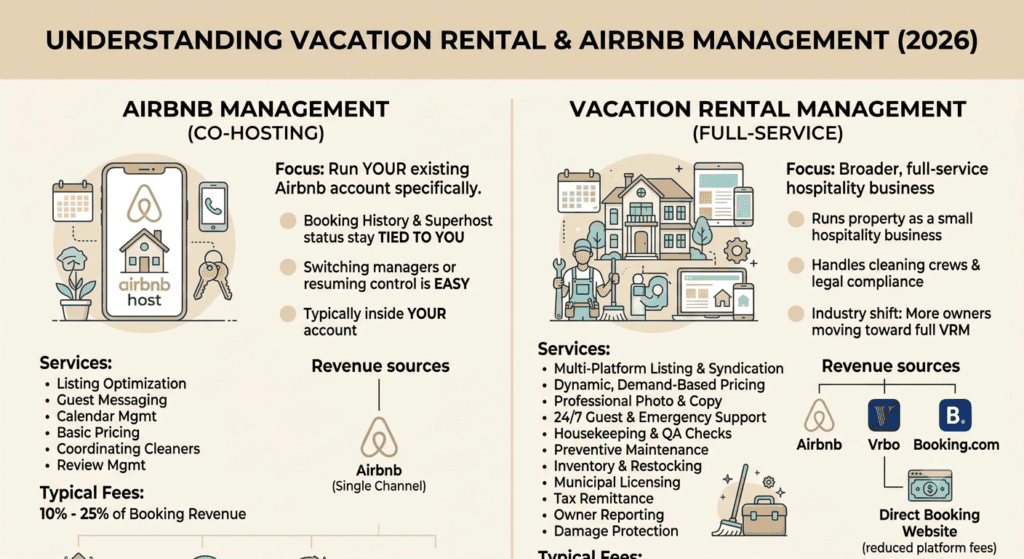
Airbnb management is exactly what it sounds like: a service built around running your listing on the Airbnb platform specifically. Most Airbnb managers, sometimes called co-hosts, work inside your existing Airbnb account rather than creating a separate operation around your property.
That distinction matters more than it sounds. When a co-host operates inside your account, your booking history, your reviews, and your Superhost status all stay tied to you. If you ever want to switch managers or take the reins back yourself, you’re not starting from zero.
What an Airbnb Manager Actually Does
A typical Airbnb management arrangement covers:
- Listing optimization (photos, descriptions, amenities)
- Guest messaging and inquiry responses
- Calendar and booking management
- Basic pricing adjustments
- Coordinating cleaners between check-ins and check-outs
- Review management and guest follow-up
Some Airbnb managers stop there and leave maintenance, restocking, and deeper pricing strategy to the owner. Others bundle in more, which is exactly why the line between “Airbnb management” and “vacation rental management” gets blurry in practice.
Typical Airbnb Management Fees in 2026
Airbnb co-hosts typically charge somewhere between 10% and 25% of booking revenue, depending on how hands-on they are. A co-host who only handles messaging and pricing tends to sit at the lower end of that range, while one who also coordinates cleaning and guest support charges closer to 20-25%. On a property earning $50,000 a year, that’s the difference between roughly $5,000 and $12,500 in annual fees for a service that, in most cases, is still limited to one booking channel.
What Is Vacation Rental Management?
Vacation rental management is the broader, full-service version of the same idea. Instead of managing one listing on one platform, a vacation rental management company runs your property as a small hospitality business, distributing it across Airbnb, Vrbo, Booking.com, and often a direct booking website, while handling everything from cleaning crews to legal compliance in the background.
This is where the industry has genuinely shifted over the past couple of years. Self-managing a listing now feels closer to running a small business than renting out a spare room, thanks to tighter municipal rules, pickier guests, and constant platform policy changes. That shift is a big part of why more owners are moving toward full vacation rental management instead of trying to co-host their way through it.
Multi-Platform Distribution: Airbnb, Vrbo, Booking.com and Direct
The single biggest structural difference between the two models is distribution. An Airbnb manager, by definition, keeps your booking eggs in one basket. A vacation rental manager spreads your calendar across several channels so a slow week on one platform can be filled by demand on another.
This matters more than most owners realize once fee stacking enters the picture. Airbnb currently charges hosts a host-side service fee of roughly 15% of the booking subtotal for professional, PMS-connected listings, a change from the older split-fee model where hosts paid about 3% and guests paid a separate 14-16.5% fee at checkout. When your property is only listed on Airbnb, that fee applies to every single booking. A vacation rental manager who also books you directly, or through Vrbo’s different fee structure, can meaningfully reduce how much of your revenue goes to platform fees rather than into your pocket.
What Full-Service Vacation Rental Management Includes
A genuine full-service vacation rental management company typically covers:
- Multi-platform listing creation and syndication
- Dynamic, demand-based pricing across all channels
- Professional photography and listing copywriting
- 24/7 guest communication and emergency support
- Housekeeping and turnover management with quality checks
- Preventive maintenance scheduling
- Inventory and supply restocking
- Municipal licensing, tax remittance, and regulatory compliance
- Owner reporting and revenue statements
- Damage protection and insurance coordination
That’s a materially different scope of work than a typical Airbnb co-host arrangement, and the pricing reflects it.
Typical Vacation Rental Management Fees in 2026
Full-service vacation rental management companies generally charge between 20% and 35% of gross booking revenue, with the industry average sitting around 25%. On a property grossing $50,000 a year, that works out to roughly $12,500 in annual fees, or a little over $1,000 a month, though cleaning fees are usually passed through to guests rather than absorbed into that percentage.
Newer, tech-driven management models are starting to challenge that pricing. A handful of AI-assisted operators now offer flat fees closer to 4% of bookings for a similar scope of service, though owners considering these newer options should confirm exactly what’s included, since “full operations” can mean very different things from one provider to the next. The headline percentage rarely tells the whole story. It’s worth asking any manager, traditional or tech-driven, whether cleaning markups, maintenance margins, or supply costs get layered on top of the quoted rate.
Vacation Rental Management vs Airbnb Management: 7 Key Differences
Here’s where the two models diverge in ways that directly affect your income, your workload, and how protected you are if something goes wrong.
1. Platform Scope
Airbnb management lives inside one platform. Vacation rental management typically spans three or more booking channels plus a direct website, which reduces your dependence on any single company’s algorithm, policy changes, or fee structure.
2. Level of Service
Airbnb managers often focus on the guest-facing side: messaging, bookings, and basic pricing. Full-service vacation rental managers extend into the physical side of the business too, cleaning crews, maintenance vendors, supply restocking, so the owner is genuinely hands-off rather than just off the messaging app.
3. Pricing Strategy & Revenue Management
Individual hosts and light-touch co-hosts tend to set a nightly rate and adjust it a handful of times a year around holidays. Professional vacation rental managers run dynamic pricing tools that adjust rates daily based on local demand, competitor pricing, and booking pace. Better pricing and broader distribution together are why professionally managed properties tend to outperform self-managed or lightly co-hosted listings on annual revenue.
4. Guest Experience & Brand Consistency
This is subtle but real. An individually hosted Airbnb depends entirely on one person’s standards, cleanliness, response time, house rules. A managed vacation rental applies the same checklist and service standard to every property in its portfolio, which is exactly why group travelers and repeat guests increasingly favor professionally managed listings over one-off Airbnb rentals.
5. Compliance & Legal Responsibility
Short-term rental rules are getting stricter almost everywhere, and Ontario is no exception. A vacation rental management company typically takes on licensing renewals, tax remittance, and inspection readiness as part of the service. A basic Airbnb co-hosting arrangement often leaves that responsibility with the owner, which becomes a real liability in municipalities with aggressive enforcement.
6. Cost Structure
Airbnb management generally costs less (10-25%) because the scope is narrower. Vacation rental management costs more (20-35%) because it covers more ground, cleaning, maintenance, multi-channel distribution, and compliance. Neither is automatically the better deal; it depends on what you’d otherwise be doing yourself, and what your time is worth.
7. Scalability for Multiple Properties
If you own one property and want to stay involved, a co-host can work fine. If you’re building a portfolio, two, five, ten properties, full-service vacation rental management scales in a way that stitching together individual co-hosts doesn’t. Centralized reporting, consistent branding, and one point of contact become far more valuable as your portfolio grows.
Niagara Falls Short-Term Rental Rules Every Owner Should Know in 2026
Ontario still has no province-wide short-term rental law as of 2026. Licensing, zoning, and taxation are all set municipality by municipality, which means the rules that apply to a property in Niagara Falls can look completely different from those a few kilometres away in Niagara-on-the-Lake or St. Catharines.
VRU and OOSTR Licensing Requirements
Niagara Falls currently recognizes two categories of short-term rental license: a Vacation Rental Unit (VRU) for investment properties and an Owner-Occupied Short-Term Rental (OOSTR) for hosts renting out space in their primary residence. The OOSTR pilot is capped at 100 licenses citywide and is scheduled to conclude at the end of September 2026, after which city council will decide whether to continue it.
Both license types require guest stays of 28 consecutive days or less to qualify as short-term; anything longer falls under the Residential Tenancies Act instead. VRU properties must sit within a designated Tourist, General, or Commercial zone, since Niagara Falls does not permit short-term rentals in standard residential neighbourhoods. This is actually a notable advantage for Niagara Falls investors: it remains one of the few cities in the region where an investment property, not just a principal residence, can legally operate as a short-term rental.
Zoning, Fees, and Municipal Accommodation Tax
The VRU license carries an initial fee of $500, with a $250 annual renewal. Hosts can rent out a maximum of three bedrooms per property, and occupancy is capped based on the Ontario Building Code and fire safety standards, generally no more than two adults per bedroom.
On the tax side, Niagara Falls moved away from its earlier flat per-night Municipal Accommodation Tax and now applies a rate closer to 4% of the total room rate, on top of the standard 13% HST. Airbnb typically collects and remits both automatically for listings booked through the platform, but license holders remain responsible for accurate reporting, and VRU and OOSTR operators must remit on a quarterly basis regardless of how the tax was collected.
Hosts also need to carry a minimum of $2 million in liability insurance, maintain working smoke alarms and carbon monoxide detectors, keep detailed booking logs for at least three years, and display their license number on every listing and advertisement.
Penalties for Non-Compliance
Enforcement in Niagara Falls is not symbolic. Operating an unlicensed VRU can carry fines reaching tens of thousands of dollars for a first offense, and repeated bylaw violations, including guest-caused disturbances, can lead to license suspension or permanent revocation, sometimes with a waiting period of several months before an owner can reapply. Since the bylaw holds operators responsible for guest conduct, even a single unruly weekend booking can put an entire license at risk if house rules aren’t enforced.
This is precisely where the compliance gap between a light-touch Airbnb co-host and a full vacation rental management company tends to show up. A manager who tracks renewal dates, remits taxes on schedule, and screens guests against house rules is protecting your license, not just your calendar.
It’s also worth remembering that Niagara Falls’ rules are not the region’s rules. Niagara-on-the-Lake enforces its own occupancy and license-term structure, and St. Catharines runs a demerit-point system alongside a principal-residence requirement for many host types. An owner with properties in more than one Niagara municipality is effectively managing two or three different rulebooks at once, which is one more reason portfolio owners tend to gravitate toward a management company with regional expertise rather than trying to track every bylaw update themselves.
Which Model Is Right for You?
There’s no universally correct answer here. It genuinely depends on how many properties you own, how much time you want to spend on this, and how much control you want to keep.
Choose Airbnb Management If…
- You own a single property and want to stay reasonably involved in day-to-day decisions
- You’re comfortable handling cleaning and maintenance yourself, or already have reliable vendors in place
- Airbnb is your only realistic booking channel for this property, whether due to location or guest demand
- You want lower fees and are willing to trade some convenience and platform exposure for cost savings
- You’re testing the waters with your first short-term rental before committing to a bigger operational lift
Choose Full-Service Vacation Rental Management If…
- You want a genuinely passive, hands-off ownership experience rather than a second job
- You own an investment property and want it treated as a hospitality business rather than a side project
- You want exposure to multiple booking platforms rather than relying on one company’s algorithm and fee structure
- You want licensing, tax remittance, and inspection readiness handled for you in a market with rules as specific as Niagara Falls’
- You’re planning to scale to multiple properties over time and want systems that grow with you
- You live outside the region and can’t realistically respond to a maintenance issue or guest emergency in person
A Hybrid Approach: Best of Both Worlds
Some owners land in the middle: they keep ownership of their Airbnb account and guest relationships while outsourcing the operational load, cleaning coordination, dynamic pricing, maintenance, and compliance, to a management partner. This hybrid model has become more common as owners get more cautious about handing over full control of their booking accounts and payout history to a third party, while still wanting the workload taken off their plate.
Current Trends Shaping Vacation Rental Management in 2026
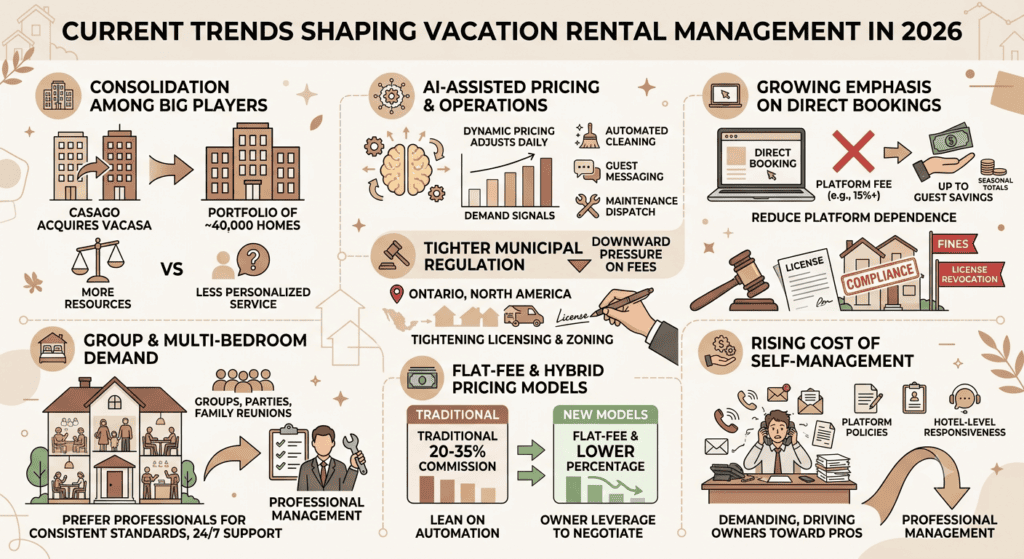
A few shifts are worth knowing about if you’re weighing your options this year.
Consolidation among the big players. The vacation rental management space has seen significant consolidation, most notably Casago’s acquisition of Vacasa, creating a combined portfolio of roughly 40,000 homes. Bigger platforms bring more resources but can also mean less personalized service, which is worth factoring in if local, hands-on care matters to you.
AI-assisted pricing and operations. Dynamic pricing tools that adjust rates daily based on demand signals have become standard rather than a premium add-on. Several newer entrants are also automating cleaning coordination, guest messaging, and maintenance dispatch, which is starting to put downward pressure on traditional management fees.
Growing emphasis on direct bookings. With Airbnb’s host-side fee sitting around 15% for professional listings, more managers are building direct booking websites to reduce platform dependence. A guest who books directly instead of through Airbnb can save a meaningful percentage of the booking value, and that adds up quickly across a full season of returning guests.
Tighter municipal regulation. Niagara Falls is far from alone. Municipalities across Ontario, and across North America generally, are tightening licensing, zoning, and enforcement around short-term rentals. Owners who treat compliance as an afterthought are increasingly the ones facing fines or license revocation.
Group and multi-bedroom demand favoring professional management. Larger groups booking bachelor parties, family reunions, and multi-family trips increasingly prefer professionally managed properties over individually hosted Airbnb listings, largely because of consistent cleaning standards and 24/7 support when something goes wrong mid-stay.
Flat-fee and hybrid pricing models gaining ground. The traditional 20-35% commission structure is facing real competition from flat-fee and lower-percentage alternatives that lean on automation to cut overhead. This doesn’t mean cheaper is always better, but it does mean owners now have more leverage to negotiate than they did even a year or two ago, especially on properties with strong, predictable occupancy.
Rising cost of self-management. Between platform policy changes, stricter municipal licensing, and guests who expect hotel-level responsiveness, running a short-term rental solo has quietly become far more demanding than it was when Airbnb first took off. This is arguably the single biggest driver pushing owners, especially first-time landlords and passive income seekers, toward professional management of some kind, whether that’s a co-host or a full-service company.
Real-World Cost Comparison: A Niagara Falls Example
Numbers make this a lot less abstract, so here’s how the two models play out on a mid-size Niagara Falls investment property earning $70,000 in gross annual bookings.
Scenario A: Airbnb co-host at 18%. The co-host earns $12,600 a year, working strictly inside your Airbnb account. You’re still responsible for finding and scheduling a cleaner, budgeting for maintenance, tracking your VRU license renewal, and remitting your own Municipal Accommodation Tax and HST. If a pipe bursts at 11 p.m., the co-host may or may not be the one fielding that call, depending on what was agreed upfront.
Scenario B: Full-service vacation rental manager at 28%. The manager earns $19,600 a year. In exchange, your property is distributed across Airbnb, Vrbo, and Booking.com instead of one channel, cleaning and turnovers are scheduled and quality-checked without your involvement, maintenance issues get triaged by the manager’s vendor network, and your VRU renewal, tax remittance, and booking-log recordkeeping happen without you thinking about it.
The $7,000 gap between the two isn’t automatically wasted money. If broader distribution and dynamic pricing lift your gross bookings by even 10-15%, which is a realistic range for professionally managed properties compared to single-channel listings, the full-service model can end up costing you less on a net basis while requiring almost none of your time. The only way to know for sure is to ask any manager you’re evaluating for their actual average revenue lift across comparable properties, not just their fee percentage.
Questions to Ask Before Hiring a Vacation Rental Manager
Whichever model you lean toward, a short list of questions upfront can save you from a bad contract later.
- Which platforms will my property actually be listed on? “Multi-channel” sometimes means Airbnb plus one other site with almost no bookings coming through it. Ask for real booking data by channel, not just a list of logos.
- Who owns the Airbnb account and the guest review history? If the manager’s account is used instead of yours, your reviews and Superhost status may not transfer if you ever switch providers.
- Is cleaning billed at cost or marked up? Cleaning markups are one of the most common places management fees quietly grow beyond the headline percentage.
- Who is responsible for license renewals and tax remittance? In a municipality like Niagara Falls, missing a VRU renewal or a quarterly MAT remittance can mean fines or suspension, so get this in writing.
- What happens during a maintenance emergency at 2 a.m.? Ask specifically who guests call, how fast a response is guaranteed, and whether that’s included in the base fee or billed separately.
- Can I see real occupancy and revenue numbers for a comparable property? Any legitimate manager should be able to show verified performance data rather than industry-wide averages.
How The HAH Developments Simplifies Vacation Rental Management in Niagara
Choosing between Airbnb management and full vacation rental management shouldn’t feel like a gamble, and in a market with rules as specific as Niagara Falls’, it shouldn’t be handled by guesswork either.
The HAH Developments manages short-term and long-term rental properties throughout the Niagara Region, and we built our service around the gap this article just walked through. We handle multi-platform distribution across Airbnb, Vrbo, and Booking.com, dynamic pricing, professional cleaning and property care, and the licensing and tax compliance work that Niagara Falls, Niagara-on-the-Lake, and St. Catharines each enforce a little differently.
If you’re an Airbnb host wondering whether you’ve outgrown a co-host arrangement, or a property owner exploring rental arbitrage or investment property management for the first time, our team can walk you through what full-service vacation rental management would actually look like for your specific property and your specific numbers.
Frequently Asked Questions
Is vacation rental management more expensive than Airbnb management? Generally, yes. Vacation rental management typically costs 20-35% of gross revenue because it covers cleaning, maintenance, multi-platform distribution, and compliance, while basic Airbnb co-hosting runs 10-25% for a narrower scope focused mainly on guest messaging and booking management.
Can I switch from Airbnb management to full vacation rental management later? Yes, and many owners do exactly this once their property is established and they’re ready to hand off more of the operational workload. Just confirm who retains ownership of your Airbnb account, review history, and guest data during the transition, since this affects how smoothly your booking history carries over.
Do I need a license to operate a short-term rental in Niagara Falls? Yes. All short-term rentals in Niagara Falls require either a Vacation Rental Unit (VRU) or Owner-Occupied Short-Term Rental (OOSTR) license, with an initial fee of $500 and a $250 annual renewal, and the property must sit within an approved tourist, general, or commercial zone.
What’s the difference between a co-host and a full-service property manager? A co-host typically works inside your existing Airbnb account, handling messaging, pricing, and bookings on that single platform. A full-service property manager runs your property as a standalone hospitality operation, listing it across multiple platforms and taking on cleaning, maintenance, and compliance in addition to guest communication.
Will professional vacation rental management actually increase my income? It can, though results vary by property and market. Professional managers commonly improve rental performance through better pricing, wider distribution across booking channels, and stronger guest reviews, which can offset a meaningful portion of the management fee itself. The right way to evaluate this is comparing net income after fees, not the headline percentage alone, and asking any prospective manager for real occupancy and revenue data from comparable properties they already manage.
Can I list my property on Airbnb, Vrbo, and Booking.com at the same time without a manager? Technically yes, but keeping availability calendars, pricing, and guest messages in sync across three separate platforms manually is time-consuming and prone to double bookings. This is exactly the kind of operational load that full-service vacation rental management is built to absorb through synced channel management software.
What happens if I don’t comply with Niagara Falls’ short-term rental bylaw? Non-compliance can result in fines reaching into the tens of thousands of dollars for a first offense, plus license suspension or permanent revocation for repeated violations, including guest-caused disturbances. A licensed operator is also held responsible for guest conduct, so unclear house rules can put your entire license at risk.
Conclusion
Airbnb management and vacation rental management solve different problems. One keeps you inside a single platform with a lighter service load and a lower fee. The other treats your property as a full hospitality business across multiple channels, with more support and a higher price tag to match. Neither is wrong, but picking based on the label alone instead of the actual scope of service is how owners end up overpaying for too little, or underpaying for a job that’s bigger than they realized.
If you own property in Niagara Falls, Niagara-on-the-Lake, or anywhere across the Niagara Region and you’re weighing this decision for yourself, The HAH Developments can walk you through exactly what your property could earn under each model, and handle the licensing and compliance work either way, so the choice comes down to what genuinely fits your goals rather than which company happened to answer the phone first.
Ready to find out what your property could really be earning? Contact The HAH Developments today for a free rental income assessment and see how stress-free vacation rental management can be.