

Owning a rental property sounds simple on paper. You buy a place, find a tenant, collect rent, and watch the income roll in every month.
Real ownership rarely works that way.
Between vacant units, late-night maintenance calls, tenants who stop paying, and rent prices that quietly fall behind the market, most property owners lose more income than they realize. It doesn’t happen all at once. It happens in small leaks – a unit that sits empty for three extra weeks, a repair that gets put off and turns into a bigger bill, a lease renewal that never happened because nobody followed up.
This is where professional property management changes the math. It isn’t just about having someone else answer the phone when a tap breaks. It’s about running your rental like a business, with pricing strategy, tenant screening, maintenance systems, and reporting that protect and grow your income instead of quietly draining it.
In this guide, we’ll break down exactly how professional property management increases rental income, what the numbers say in 2026, and how owners in Niagara Falls and across Ontario can apply these strategies to their own properties – whether you’re renting long-term, hosting on Airbnb, or exploring rental arbitrage. By the end, you’ll have a clear, practical picture of where your rental income is currently leaking, and exactly what a professional approach would do differently.
The Real Cost of Self-Managing a Rental Property
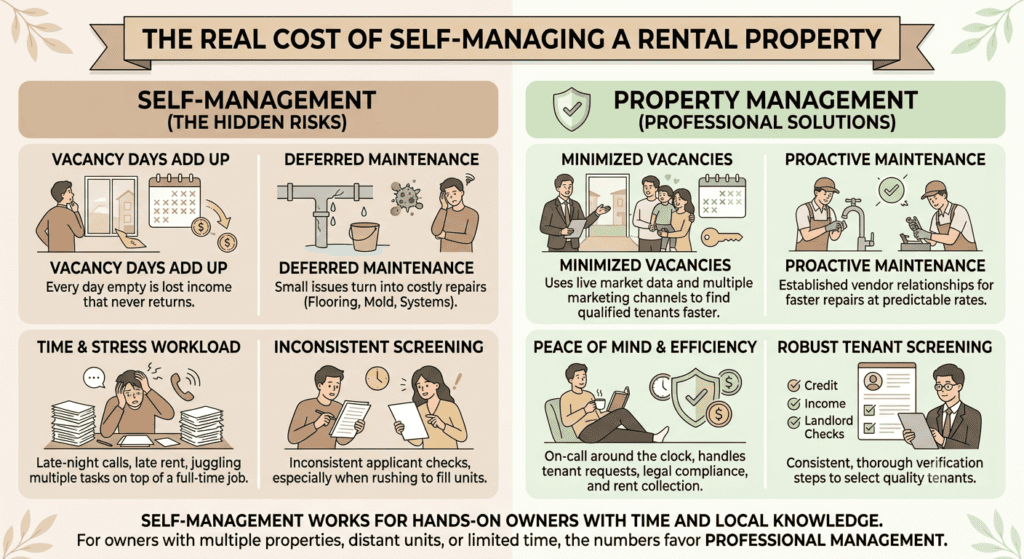
Before we get into solutions, it’s worth understanding what self-management actually costs. Most landlords underestimate this number badly, because the losses are spread out and easy to miss.
Vacancy Days Add Up Faster Than You Think
Every day a unit sits empty is a day of lost income that can never be recovered. Nationally, property owners lose an average of close to $3,900 for every vacant rental unit, and vacancy rates in many markets have been climbing rather than shrinking. In some U.S. markets, the rental vacancy rate reached above 7% in early 2026, and closer to home, Niagara Region landlords have been dealing with a wave of new rental supply that makes overpriced or poorly marketed units sit far longer than they used to.
A self-managed landlord without access to real-time market data often reacts to a vacancy after it happens, rather than preventing it. A property manager, by contrast, is already watching absorption rates, comparable listings, and seasonal demand shifts before a tenant even gives notice.
Deferred Maintenance Turns Small Problems into Big Bills
The second hidden cost is maintenance that gets pushed back “for now.” A running toilet, a slow leak, or an aging furnace filter feels minor in the moment. Left alone, these small issues compound into flooring damage, mold remediation, or full system replacements – all of which cost far more than early intervention would have.
Maintenance reserves typically eat up 10% to 15% of rental income even under normal conditions. Deferred maintenance pushes that number much higher, and it also increases tenant turnover, since renters don’t stay long in units that feel neglected.
The Hidden Cost of Doing It All Yourself
There’s a third cost that rarely shows up in any spreadsheet: time and stress. Fielding maintenance calls at 11 p.m., chasing down late rent, drafting lease renewals, and keeping up with changing Ontario landlord-tenant rules is a part-time job on top of whatever else an owner does for a living.
That workload leads to shortcuts. A landlord who’s exhausted from a difficult tenant is more likely to accept the next applicant without a full screening. An owner juggling three properties alone is more likely to let a maintenance request sit for a week instead of a day. None of these decisions look like a financial loss in the moment, but each one chips away at the property’s long-term performance.
Self-management isn’t free – it’s just paid for in time, stress, and the income that quietly slips away while an owner is stretched too thin to catch it.
Property Management vs. Self-Management: A Side-by-Side Look
It helps to see the difference laid out directly. Here’s how the two approaches typically compare across the factors that affect income the most:
- Pricing strategy: Self-managed owners often price based on gut feeling or what a neighbor charges. Professional managers price using live comparable data, adjusted for seasonality and demand.
- Vacancy turnaround: A self-managed listing often relies on a single platform and word of mouth. A managed listing is marketed across multiple channels with professional photos and a pre-qualified applicant pipeline.
- Tenant screening: Self-managed screening is frequently inconsistent, especially under time pressure. Professional screening follows the same verification steps every time, regardless of how urgently the unit needs to be filled.
- Maintenance response: Self-managed maintenance often waits for a convenient moment. Professional management usually has vendor relationships already in place, so repairs happen faster and at more predictable rates.
- Recordkeeping: Self-managed owners often piece together records at tax time. Professional management provides ongoing statements that make both budgeting and tax filing far simpler.
None of this means self-management is a bad choice for every owner. It works well for hands-on landlords with one property, plenty of time, and strong local market knowledge. But for owners with multiple properties, a property outside their local area, or simply a desire to stop being on call around the clock, the numbers usually favor professional management.
How Professional Property Management Increases Rental Income
Once you understand where income leaks out, it becomes clear how a structured management approach plugs those gaps. Here’s what that looks like in practice.
Data-Driven Rent Pricing Instead of Guesswork
Roughly 60% of small landlords price their units below market rate, often because they’re worried about vacancy or simply haven’t checked what comparable properties are actually renting for. That single habit can quietly cost thousands of dollars a year.
Professional managers price differently. They pull comparable listings, track seasonal demand, and monitor how quickly similar units are renting before setting – or adjusting – a price. In a market like Niagara Falls, where new purpose-built rental supply is expected to keep arriving through 2026 and 2027, pricing accuracy matters even more. A unit priced even slightly above the market can sit unrented for weeks, while an accurately priced comparable unit fills within days.
Consider a simple example. A two-bedroom unit priced $150 above market might feel justified because of a recent renovation, but if it sits vacant for five extra weeks while the owner waits for the “right” tenant, that premium has already cost more than a full year of the higher rent would have earned back. A property manager watching real-time absorption data catches this mismatch immediately and adjusts before the vacancy drags on.
Faster Tenant Placement Reduces Vacancy Loss
Speed matters as much as price. A property manager typically has an existing marketing process – professional photos, syndicated listings, pre-qualified applicant pipelines – that gets a vacant unit in front of serious renters faster than a single online listing ever could.
This matters because every week of vacancy isn’t just lost rent. It also delays cash flow that could be reinvested into the property or used to cover the mortgage, insurance, and property taxes that keep accruing whether or not the unit is occupied.
Stronger Tenant Screening Improves Retention and Reduces Turnover Costs
A rushed tenant approval is one of the most expensive mistakes an owner can make. It can lead to missed rent, property damage, or an expensive early turnover just months into a lease.
Professional screening – credit checks, income verification, rental history, and reference calls – filters for tenants who are more likely to pay on time and stay longer. Longer tenancies mean fewer turnover costs (cleaning, repainting, re-marketing, lost rent between leases), which has a direct and compounding effect on annual income.
Proactive Maintenance Protects Long-Term Property Value
Instead of waiting for tenants to report problems, professional managers schedule regular inspections and preventive maintenance. This catches small issues before they become expensive ones, keeps tenants satisfied enough to renew their lease, and protects the resale value of the property itself.
Careful expense management, not just higher rent, is often what actually improves net income. A property that avoids one major emergency repair a year can outperform a property that charges slightly higher rent but suffers from constant breakdowns and turnover.
Better Reporting Means Faster, Smarter Decisions
None of the strategies above work well without visibility. A property manager’s monthly or quarterly reporting gives owners a clear picture of income, expenses, occupancy trends, and upcoming lease renewals – the kind of information that makes it possible to plan ahead instead of reacting after the fact.
This matters at renewal time especially. An owner who knows six weeks in advance that a lease is ending can start marketing before the unit even goes vacant. An owner who finds out the week a tenant moves out is starting from zero, and every day of that head start is lost income.
Short-Term Rental and Airbnb Management: A Different Path to Higher Income
For owners considering Airbnb hosting or already running a short-term rental, the income levers look a little different – but professional management still plays a central role.
Dynamic Pricing Tools Maximize Nightly Rates
Static, flat nightly rates are one of the biggest reasons short-term rental owners leave money on the table. Industry data from short-term rental pricing platforms shows that properties using dynamic pricing – rates that adjust automatically based on demand, local events, seasonality, and competitor pricing – generate meaningfully more revenue than those on fixed rates, with some studies pointing to gains in the range of 20% to 40% annually.
A property manager who actively monitors these tools day to day, rather than setting rules once and forgetting them, captures demand spikes (a concert weekend, a holiday, a sudden surge in tourism) that a manual pricing approach would simply miss.
Professional Co-Hosting Improves Guest Experience and Reviews
Guest experience directly affects search ranking on platforms like Airbnb, which in turn affects how often a listing gets booked and at what price. Fast response times, spotless turnovers, and consistent communication all feed into the review scores that determine visibility.
Professional co-hosting takes this off the owner’s plate entirely – coordinating cleaning crews, managing guest messages around the clock, and handling issues during a stay before they escalate into a bad review or a refund request.
Managing Multiple Channels Without Losing Occupancy
Listing a property across Airbnb, Vrbo, and Booking.com can multiply exposure, but only if the calendar stays perfectly synced. A missed double-booking or an outdated calendar creates guest complaints and lost trust. Professional short-term rental management uses channel management software to keep pricing and availability consistent everywhere at once, which protects both occupancy and reputation.
Seasonal Rental Strategy for a Tourism-Driven Market
Niagara Falls presents a specific opportunity that flat, year-round pricing simply can’t capture: it’s one of the most visited destinations in Canada, with demand that shifts sharply by season, by weekend, and around major events.
A short-term rental priced the same way in February as it is during peak summer tourist season, or during a major fireworks weekend, is leaving a significant amount of revenue on the table. Professional management builds a seasonal strategy around these patterns – raising rates ahead of predictable high-demand periods, softening rates just enough during shoulder seasons to keep occupancy up, and watching for one-off demand spikes tied to festivals, conferences, or holiday travel.
This kind of seasonal awareness is one of the clearest examples of how professional property management increases rental income beyond what a fixed monthly or nightly rate could ever achieve. It’s not about charging more across the board – it’s about charging the right amount at the right time, night by night.
The Niagara Falls Rental Market in 2026: What Property Owners Need to Know
Local context matters just as much as national trends, and the Niagara Region is shifting in ways that owners need to understand before setting a pricing or leasing strategy.
Local Rent Trends and Vacancy Data
As of March 2026, the average three-bedroom rental in Niagara Falls, Ontario was priced around $2,244 per month, and rents across the wider Niagara Region have continued climbing on a year-over-year basis even as some individual listing platforms show short-term monthly fluctuations. Meanwhile, regional vacancy has stayed relatively tight, under roughly 2% across parts of the Niagara Region, which has kept rents firm even as new construction ramps up.
At the same time, the picture is not uniform. Basement apartments have seen strong demand growth, student housing near Brock University and Niagara College has climbed as enrollment expands, and detached homes are attracting remote workers looking for more space. Each of these segments needs a slightly different pricing and marketing approach – something a locally experienced property manager tracks far more closely than an owner managing a single unit part-time.
New Supply and What It Means for Pricing Strategy
Niagara Falls has exceeded its provincial housing targets, and multiple new rental apartment projects are expected to break ground in 2026, following significant federal housing investment across the wider Niagara Region. That means more competition for tenants, particularly for units priced at outdated, pre-2023 rates.
Owners who price to older market conditions risk competing directly against brand-new buildings offering incentives like a free month’s rent. Professional property management adjusts pricing to reflect this shifting supply in real time, rather than relying on last year’s numbers.
Rental Arbitrage and Long-Term Rental Management: Choosing the Right Strategy
Not every property – or every owner – benefits from the same rental model. Understanding the difference helps you choose the strategy that will actually maximize income for your specific situation.
When Long-Term Rental Management Makes Sense
Long-term rentals offer predictable, stable income with less day-to-day involvement. They tend to suit owners who want consistent cash flow, fewer operational touchpoints, and lower exposure to short-term booking fluctuations or short-term rental regulations. Properties in strong school districts, near universities, or in family-friendly neighborhoods often perform particularly well under this model.
When Rental Arbitrage or Short-Term Rental Fits Better
Rental arbitrage – where an operator leases a property long-term and then re-rents it short-term for a profit margin – and traditional Airbnb hosting tend to perform best in high-tourism areas. Niagara Falls, as one of the most visited destinations in Canada, is a strong candidate for this model, particularly for owners near the tourist core or major attractions.
The tradeoff is more active management: pricing has to be monitored constantly, turnovers happen far more often, and guest communication never really stops. This is exactly the kind of workload a professional short-term rental manager is built to absorb, so owners get the higher upside of short-term income without taking on the operational burden themselves.
Technology and AI Are Reshaping Property Management
The tools available to property managers have changed significantly in the last two years, and this shift is directly improving how much income owners keep.
Automated Rent Collection and Reporting
Online rent collection, automatic late-fee tracking, and digital reporting dashboards mean owners get paid faster and see exactly where their money is going. Good reporting also shortens the gap between “something changed” and “the owner responded,” which allows for quicker decisions about repairs, rent adjustments, or reserve planning.
AI-Powered Maintenance Coordination
Property managers are adopting AI-driven tools at a fast pace – adoption jumped from roughly 21% to 34% of property managers in a single recent year. These tools are being used to triage maintenance requests, predict which repairs are likely to become urgent, and coordinate vendors more efficiently. For owners, this translates into fewer surprise expenses and a maintenance process that catches problems earlier.
Insurance, Compliance, and Risk: The Less Visible Ways Income Gets Protected
Rental income isn’t only about what comes in – it’s also about what doesn’t get lost to preventable risk. This is one of the most overlooked parts of the equation, and it’s an area where professional management earns its fee even when nothing appears to be going wrong.
Ontario’s landlord-tenant rules change periodically, and non-compliance – an improperly served notice, an incorrect rent increase, a missed inspection requirement – can lead to disputes, delays at the Landlord and Tenant Board, or lost months of rent while a case works its way through the system. A property manager who handles these situations regularly is far less likely to make a costly procedural mistake than an owner managing their first rental.
Insurance is another blind spot. Short-term rentals often need different coverage than long-term leases, and a policy gap only becomes obvious after a claim is denied. Professional managers typically flag these mismatches early, before an owner discovers the hard way that a standard homeowner’s policy doesn’t cover Airbnb guests.
None of this shows up as a line item labeled “income protected.” It shows up as the absence of an expensive problem – which, over the life of an investment property, can be worth just as much as any rent increase.
Best Practices for Owners Working With a Property Manager
If you’re evaluating or already working with a property manager, these habits help you get the most value out of the relationship:
- Ask for a written pricing strategy. A good manager should be able to explain exactly how they set and adjust your rent, not just tell you a number.
- Review your reports monthly, not just at tax time. Regular reporting reveals trends – rising maintenance costs, slowing inquiries – while there’s still time to act.
- Set clear expectations on communication. Know how quickly you’ll be updated on vacancies, maintenance issues, or tenant concerns.
- Ask about vacancy and turnover history. A manager’s average days-to-lease and tenant retention rate tell you more than any sales pitch.
- Understand the fee structure completely. Property management typically runs 8% to 12% of monthly rent for long-term units, and higher for full-service short-term rental management – know exactly what’s included before signing.
- Revisit your strategy annually. Rental markets shift. What worked two years ago may not be optimal today, especially in fast-changing markets like Niagara Falls.
- Get everything in writing. A clear management agreement that spells out responsibilities, reporting frequency, and fee structure prevents misunderstandings down the road and gives both sides something to point back to.
Common Mistakes That Quietly Reduce Rental Income
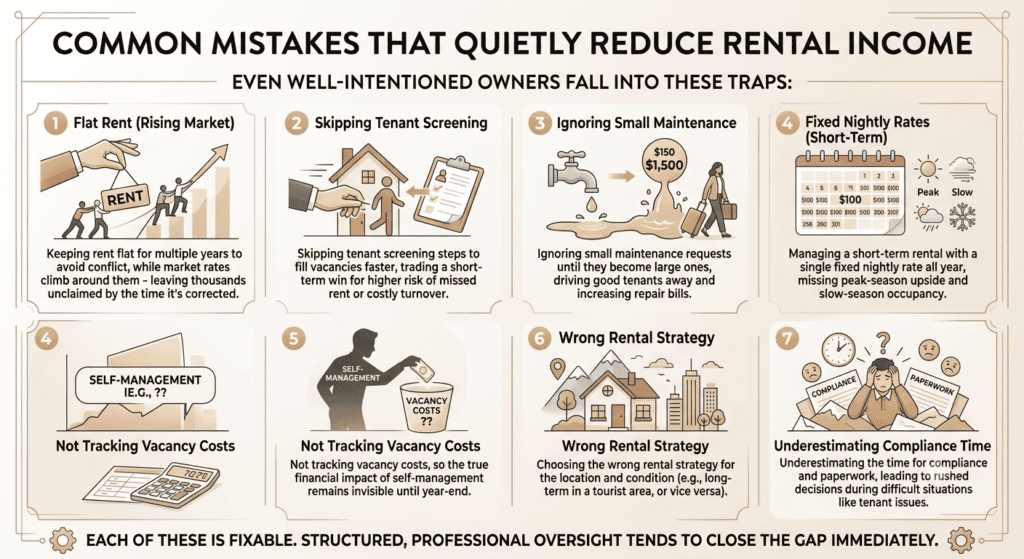
Even well-intentioned owners fall into these traps:
- Keeping rent flat for multiple years to avoid conflict with tenants, even as market rates climb around them – a habit that can leave thousands of dollars a year unclaimed by the time it’s finally corrected.
- Skipping tenant screening steps to fill a vacancy faster, which trades a short-term win for a much higher risk of missed rent or costly turnover later.
- Ignoring small maintenance requests until they become large ones, turning a $150 repair into a $1,500 one and pushing good tenants toward the door in the process.
- Managing a short-term rental with a single fixed nightly rate all year, which leaves both peak-season upside and slow-season occupancy on the table.
- Not tracking vacancy costs, so the true financial impact of self-management stays invisible until it’s added up at the end of the year.
- Choosing the wrong rental strategy for the property’s location and condition – for example, running a long-term lease on a property that’s perfectly positioned for tourism income, or vice versa.
- Underestimating how much time compliance and paperwork actually take, which often leads to rushed decisions during exactly the moments – a difficult tenant, a legal notice – that call for the most care.
Each of these is fixable, and each is a place where structured, professional oversight tends to close the gap almost immediately.
Conclusion
Rental income isn’t usually won or lost through one big decision. It’s built – or quietly eroded – through a dozen smaller ones: how quickly a vacancy gets filled, how accurately a unit is priced, how well a tenant is screened, how fast a leak gets fixed. Professional property management brings structure to all of it, replacing guesswork with a repeatable process built on real market data.
For owners in Niagara Falls navigating a market with new supply, shifting tenant expectations, and a strong short-term rental opportunity right on the doorstep of one of Canada’s biggest tourist destinations, that structure matters more than ever.
The owners who come out ahead over the next few years won’t necessarily be the ones who bought the best property. They’ll be the ones who priced it accurately, filled it quickly, protected it with proper maintenance, and adjusted their strategy as the market moved – all things that happen far more consistently under professional management than they do part-time, in the evenings, between everything else an owner has going on.
Ready to see what your property could actually be earning? The HAH Developments works with property owners across Niagara Falls and the wider Niagara Region to manage everything from long-term rentals to full-service Airbnb hosting and rental arbitrage. Contact The HAH Developments today for a free rental income assessment and find out exactly where your property stands – and how much more it could be earning under professional management.
Frequently Asked Questions
How much can professional property management actually increase rental income? It depends on the starting point, but owners who move from self-management to professional management commonly see gains from reduced vacancy alone, plus additional upside from accurate pricing, stronger tenant retention, and, for short-term rentals, dynamic pricing tools that can lift revenue well beyond flat-rate pricing.
Is professional property management worth the fee for a single rental property? Even with one property, professional management can pay for itself through faster leasing, fewer costly tenant mistakes, and better maintenance decisions – particularly for owners who don’t have the time or local market knowledge to manage pricing and tenant issues actively.
What’s the difference between long-term rental management and short-term rental management? Long-term rental management focuses on tenant placement, lease compliance, and stable monthly income with a fixed lease. Short-term rental management involves nightly pricing, guest turnover, cleaning coordination, and multi-platform listing management – a much more active, hands-on process.
Does professional property management help with rental arbitrage? Yes. Rental arbitrage depends heavily on accurate pricing and consistent occupancy to stay profitable, both of which are core strengths of professional short-term rental management.
How is the Niagara Falls rental market performing in 2026? Rents in the wider Niagara Region have continued trending upward with tight vacancy in several segments, even as new rental supply is expected to arrive through 2026 and 2027. This makes accurate, up-to-date pricing more important than it’s been in recent years.
Can a property manager help reduce maintenance costs, not just increase rent? Yes. Preventive maintenance and faster response to small issues typically cost far less than emergency repairs, which means professional management protects net income from both directions – higher revenue and lower unplanned expenses.
Should a first-time landlord hire a property manager right away, or wait? Many first-time landlords benefit most from professional management early on, since it prevents the costly early mistakes – mispricing, weak screening, missed compliance steps – that are hardest to recover from financially.
How often should rent be reviewed to stay competitive? Long-term rents are typically best reviewed annually against current comparables, while short-term rental pricing should be reviewed continuously, since nightly demand can shift week to week based on events, seasonality, and competitor availability.