

Renting out your first property feels a lot like standing at the edge of a pool, guessing at the temperature before you jump in. You’ve done the math on mortgage payments, maybe read a blog post or two, and you’re fairly sure this is a good investment. But the moment you start thinking about tenant applications, lease clauses, and what happens if the furnace dies in January, the confidence can wobble fast.
You’re not alone in that. Every landlord who now manages a portfolio of ten, twenty, or a hundred units started exactly where you are: with one property, one set of keys, and a long list of questions nobody fully answered for them.
This first-time landlord guide is built to close that gap. It walks through everything you need to know to manage a rental property with confidence in 2026 – from Ontario’s newest legal changes to tenant screening, rent collection, maintenance, insurance, and the moment when it might make sense to hand the keys to someone else.
Why the First-Time Landlord Learning Curve Feels So Steep Right Now
Rental housing in Ontario isn’t the sleepy, predictable market it was a decade ago. Rules are shifting quickly, tenant expectations are higher, and in some regions, demand is outpacing supply by a wide margin.
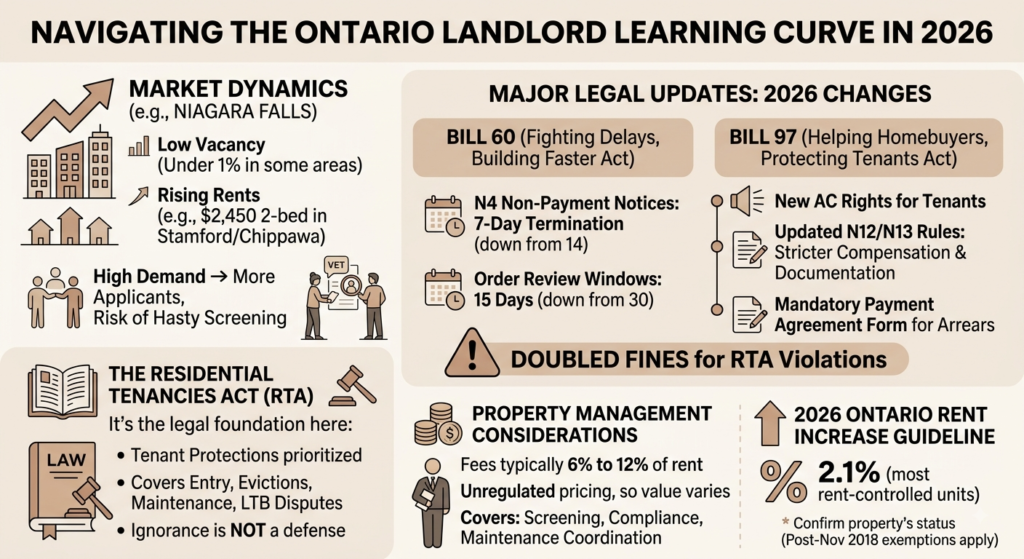
Take Niagara Falls as an example, since it’s a market many first-time investors are drawn to. Vacancy rates in neighborhoods like Stamford and Chippawa have fallen below 1%, and two-bedroom units in the area are now averaging roughly $2,450 a month, driven partly by a jump in local service-sector employment and renters priced out of nearby St. Catharines. That’s a landlord’s market on paper, but low vacancy also means more applicants per listing, more pressure to decide quickly, and more room to make a costly screening mistake if you rush.
At the same time, the legal framework governing landlords has changed substantially in 2026. Two pieces of legislation – Bill 60 (the Fighting Delays, Building Faster Act) and Bill 97 (the Helping Homebuyers, Protecting Tenants Act) – have reshaped notice periods, eviction timelines, and tenant rights around things like air conditioning. If you’re managing your first rental property without knowing these changes, you’re operating with an outdated playbook.
None of this is meant to scare you off. It’s meant to explain why “just wing it” isn’t a realistic strategy anymore – and why a structured approach matters more than ever for a first-time landlord.
There’s also a broader trend worth noting: property management fees across Ontario now typically fall between 6% and 12% of collected rent, and that spread exists partly because the industry isn’t regulated at the consumer-pricing level, so the value you get for that fee varies enormously between providers. Understanding what a fair fee actually buys you – screening, compliance, maintenance coordination – is part of being a well-informed first-time landlord, whether you end up self-managing or not.
What Every First-Time Landlord Needs to Know Before Listing a Property
Before you post a single photo or set a rent price, it helps to understand the legal foundation you’re operating within. Ontario landlords are governed primarily by the Residential Tenancies Act, 2006 (RTA), which sets out the rights and responsibilities of both parties in a tenancy.
Understanding the Residential Tenancies Act
The RTA covers almost every part of the landlord-tenant relationship: how much notice you need to give before entering a unit, what counts as a valid reason to end a tenancy, how maintenance obligations are split, and how disputes get resolved through the Landlord and Tenant Board (LTB). If you take away one thing from this section, let it be this: the RTA assumes tenants have significant protections, and ignorance of the rules is not a defense if something goes to a hearing.
Bill 60 and Bill 97 – What Changed for Landlords in 2026
Several amendments took effect on July 1, 2026, with more arriving on September 21, 2026. The changes that matter most for a first-time landlord include:
- Faster non-payment notices. Landlords can now serve an N4 notice with a 7-day termination date for unpaid rent, down from the previous 14-day window.
- Shorter review windows. A request to review an LTB order must now be filed within 15 days, down from 30.
- Faster document service for above-guideline increases. AGI-related documents now have a 7-day service requirement.
- A mandatory Payment Agreement Form for landlords negotiating repayment plans with tenants in arrears.
- New tenant rights around air conditioning, plus updated rules for N12 (landlord’s own use) and N13 (renovation) evictions, including stricter compensation and documentation requirements.
- Doubled fines for landlords found in violation of RTA provisions, a clear signal that enforcement is tightening, not loosening.
If you’re managing a property yourself, block time to read the LTB’s operational updates directly, since some provisions phase in later in the year and forms will keep changing through 2026.
The 2026 Ontario Rent Increase Guideline
For most rent-controlled units, the province set the 2026 guideline at 2.1%, down slightly from 2.5% in 2025. This is the maximum increase you can apply without LTB approval for an above-guideline increase, and it applies to increases taking effect between January 1 and December 31, 2026. If your unit is exempt from rent control (generally, buildings first occupied after November 15, 2018), different rules apply, so confirm your property’s status before setting any increase.
Preparing Your Rental Property for the Market
A well-prepared listing does more than attract eyeballs. It attracts the right applicants and reduces the number of questions, delays, and no-shows you’ll deal with during showings.
Setting the Right Rent Price
Pricing a unit is part art, part data. Pull comparable listings in your immediate neighborhood rather than the whole city – rent in the Niagara region alone can swing by more than 90% between a Niagara Falls bachelor unit and a comparable space in Niagara-on-the-Lake. Overpricing leads to weeks of vacancy; underpricing leaves money on the table and can make screening harder, since a suspiciously cheap unit attracts a flood of applicants you don’t have time to vet properly.
It helps to think of pricing as a range rather than a single number. Set a realistic floor (the lowest you’d accept without losing money) and a stretch target (what you’d get if a bidding-style situation develops in a low-vacancy pocket like Stamford or Chippawa). Revisit comparable listings every few weeks while your unit is active, since rents in tight markets can move faster than a static “market research” spreadsheet suggests. If a listing sits for more than two to three weeks with steady showings but no applications, that’s usually a pricing signal, not a marketing problem.
Getting the Property Rental-Ready
Before you list, walk through the unit as if you were the tenant. Check that smoke and carbon monoxide detectors work, that locks are secure, that there’s no visible mold or pest activity, and that appliances are in good repair. A property that shows well photographs well, and better photos consistently shorten the time a listing sits vacant.
Small, inexpensive fixes tend to have outsized returns here. A fresh coat of neutral paint, updated light fixtures, and thoroughly cleaned grout can shift a unit from “acceptable” to “the one I want” in a prospective tenant’s mind, often for a few hundred dollars total. Take photos in daylight with the blinds open, and resist the urge to photograph a cluttered or half-staged room – professional-looking photos consistently pull more qualified applicants than a phone snapshot taken in a rush.
Deciding Between Long-Term and Short-Term Rentals
This is a decision worth pausing on, particularly if your property is in a tourism-heavy area like Niagara Falls. Long-term rentals offer predictable income and lower turnover, while short-term or Airbnb-style rentals can generate higher revenue per night but come with more operational demands – cleaning turnovers, guest communication, and local licensing rules that vary by municipality. Some owners split the difference with a mid-term rental model. There’s no universally “correct” answer here; it depends on your income goals, how hands-on you want to be, and whether you plan to manage the property yourself or bring in help.
How to Screen Tenants Like a Pro
If there’s one skill that separates a stress-free landlord from a burned-out one, it’s tenant screening. Bad tenant selection is consistently cited as the single most expensive mistake landlords make, sometimes costing tens of thousands of dollars in unpaid rent, damage, and legal fees that thorough screening would have caught.
Building a Legally Compliant Rental Application
Start with a written application that collects consistent information from every applicant: employment details, income verification, rental history, and references. Under Canadian privacy law, you need the applicant’s written consent before running a credit check or background check, and you should only collect information that’s directly relevant to the rental decision. Asking for a Social Insurance Number as a standard requirement, for instance, is considered a risky and unnecessary practice.
Consistency matters as much as thoroughness. If you ask one applicant for proof of income, apply the same standard to every comparable applicant – treating people differently opens the door to human rights complaints, since Ontario’s Human Rights Code prohibits discrimination based on things like source of income, family status, and pardoned criminal records.
Red Flags to Watch For
Most applicants are honest, but a handful of patterns should slow you down:
- Pressure to skip steps (“Can we just skip the credit check if I pay extra deposit?”)
- Unprompted offers of several months’ rent upfront or above-asking rent without negotiation
- Urgency that doesn’t match the situation (“I need to move in this weekend, can you approve me now?”)
- Inconsistent details about previous addresses or employment dates
- Reluctance to provide a previous landlord’s contact information – not just the current one
Verifying References and Income
Always call at least one previous landlord directly, not just the current one, since a current landlord may be motivated to give a glowing reference just to move a problem tenant along. Confirm the person you’re speaking with is actually a landlord and not a friend posing as one. For income, pay stubs, a letter of employment, or Notices of Assessment are more reliable than a verbal claim, and cross-referencing two sources gives you a fuller picture than relying on any single document.
A simple rule of thumb used by many experienced landlords: gross monthly income should be roughly three times the monthly rent. That’s not a legal requirement, and it shouldn’t be applied so rigidly that it screens out otherwise qualified applicants with non-traditional income (self-employed applicants, for example, might show income through Notices of Assessment rather than pay stubs). Use it as one data point among several, not a single pass-or-fail gate.
It’s worth saying plainly: rushing this stage because a unit has been vacant for three weeks is one of the most common and most expensive first-time landlord mistakes. A rigorous screening process that takes an extra week almost always costs less than a bad tenancy that takes months to unwind through the LTB.
Writing a Lease That Protects Both Sides
Using the Ontario Standard Lease
Ontario requires most residential landlords to use the Ontario Standard Lease template for tenancies that fall under the RTA. Using a homemade lease or an out-of-province template can create enforceability problems down the road, so start with the official form and build from there.
Key Clauses First-Time Landlords Often Miss
A few details get overlooked more often than they should:
- Rent due date and accepted payment methods, spelled out clearly rather than assumed.
- Utility responsibilities – who pays for what, and how shared metering (if any) is handled.
- Additional terms in Schedule A, where you can add reasonable, RTA-compliant clauses about things like smoking, parking, or number of occupants.
- Move-in condition documentation, ideally a signed checklist with photos, so there’s no dispute about pre-existing damage at move-out.
- Occupancy limits and guest policies, so expectations about who’s actually living in the unit are clear from day one rather than negotiated after the fact.
- Maintenance and repair responsibilities, spelling out which minor repairs (like replacing a lightbulb or a furnace filter) fall to the tenant versus the landlord, since the RTA sets a baseline but doesn’t cover every scenario.
Walk through the lease with the tenant in person or over a call before signing, rather than simply emailing it over. A five-minute conversation about what each clause means prevents a surprising number of disputes later, and it sets a collaborative tone for the tenancy rather than a purely transactional one.
Managing Rent Collection and Finances
Setting Up Reliable Rent Collection
Manual e-transfers work for a single unit, but they get messy fast if you’re tracking late fees, partial payments, or multiple properties. Automated rent collection platforms are increasingly common among Canadian landlords precisely because they create a clean paper trail – something that matters enormously if a dispute ever lands in front of the LTB.
Budgeting for Vacancies and Repairs
A common first-time landlord mistake is budgeting as if the unit will always be occupied and nothing will ever break. A more realistic approach sets aside a percentage of monthly rent – many experienced landlords use 1% of the property’s value per year – toward repairs and capital expenses, plus a vacancy buffer of at least one month’s rent per year.
Tax Deductions Every Landlord Should Track
Property management fees, mortgage interest, insurance premiums, repairs, and even a portion of your own vehicle mileage for property-related trips are generally deductible against rental income on your T776 form, provided the expenses are reasonable and documented. Keep every invoice and receipt in one place – the CRA’s scrutiny on rental income has been increasing, and most first-time landlords are not documentation-ready when it matters.
Property taxes, utilities you cover on the tenant’s behalf, condo or association fees, and advertising costs to fill a vacancy are also generally deductible. What’s not deductible is the value of your own labour if you’re doing repairs yourself, nor the principal portion of your mortgage payment – only the interest counts. A simple spreadsheet, or better, dedicated landlord accounting software, saves hours of reconstruction work every spring and reduces the odds of an uncomfortable conversation with the CRA down the line.
Handling Maintenance and Repairs
Preventive Maintenance Schedule
Reactive maintenance – waiting until something breaks – is the most expensive way to manage a property. A seasonal checklist keeps small issues from becoming five-figure repairs.
Spring
Inspect the roof and gutters after winter, test the air conditioning before tenants need it, and check exterior drainage for signs of pooling water.
Summer
Service the HVAC system, inspect window and door seals, and check for pest activity while it’s easiest to spot.
Fall
Clean gutters again before leaves and ice build up, inspect the furnace ahead of the heating season, and check weatherstripping on doors and windows.
Winter
Monitor for ice damming, keep an eye on pipes in unheated areas to prevent freezing, and confirm smoke and carbon monoxide detectors have fresh batteries.
Emergency Repairs and Response Times
Ontario landlords are required to maintain rental units in a good state of repair, and delays on urgent issues – no heat, no water, electrical hazards – can escalate quickly into an LTB complaint. Having a short list of trusted, pre-vetted contractors before you need them (plumber, electrician, HVAC technician) saves you from scrambling during an actual emergency.
Protecting Your Investment With the Right Insurance
Landlord Insurance vs. Tenant Insurance
These are not the same product, and mixing them up leaves gaps. Landlord insurance is a commercial-style policy that covers the building structure, loss of rental income if the unit becomes uninhabitable, and your liability as the property owner. It typically runs between $800 and $2,500 a year in Ontario, depending on location, building age, and tenant profile. Tenant (renters) insurance, by contrast, covers the tenant’s own belongings and personal liability, and typically costs the tenant $20 to $35 a month – it does not protect you or your building at all.
What Coverage You Actually Need
At minimum, confirm your policy includes property damage coverage, liability protection, and loss-of-rental-income coverage. Many first-time landlords assume a standard homeowner’s policy carries over once they start renting the unit out – it doesn’t, and insurers can deny a claim entirely if they discover the property was rented without the correct policy in place. It’s also worth requiring tenants to carry their own renters insurance as a lease condition, which reduces disputes over who’s responsible for a tenant’s damaged belongings after a covered loss.
Your premium is shaped by more than just the building itself. Location, the age and condition of the property, the number of units, and even the tenant profile you’re renting to all factor into the quote. If you’re unsure whether a bundled home-and-rental policy or a dedicated landlord policy makes more sense for your situation, a licensed insurance broker can flag coverage gaps that are easy to miss on your own – particularly around equipment breakdown (HVAC, appliances) and loss-of-income coverage, which many first-time landlords skip to save a small amount on the premium and later regret.
Navigating Difficult Situations
Late Rent and the New 7-Day N4 Process
If rent goes unpaid, Ontario’s N4 notice is the formal starting point for the eviction process. As of the 2026 changes, the termination date on an N4 can be set just 7 days out for monthly tenancies, a significant shift from the previous 14-day standard. It’s still worth attempting a conversation and a documented payment plan before filing – many disputes resolve without ever reaching a hearing, and the LTB now requires a standardized Payment Agreement Form for these arrangements.
When to Involve the Landlord and Tenant Board
Not every disagreement needs to go to the LTB, but some do: persistent non-payment, property damage beyond normal wear and tear, or a tenant who won’t leave after a valid termination notice. Keep a paper trail of every communication from day one, because LTB hearings are decided on documentation, not on who tells the more convincing story in the room.
Filing an application is only the start of the process, not the end of it – LTB wait times for a hearing can still run into weeks or months depending on the region and application type, even with the 2026 timeline changes. That’s part of why prevention (solid screening, a clear lease, and early, documented conversations when a payment is missed) matters so much more than knowing the eviction process itself. The best outcome is almost always the one where you never have to file at all.
DIY Management vs. Hiring a Property Manager
Signs You’ve Outgrown Self-Management
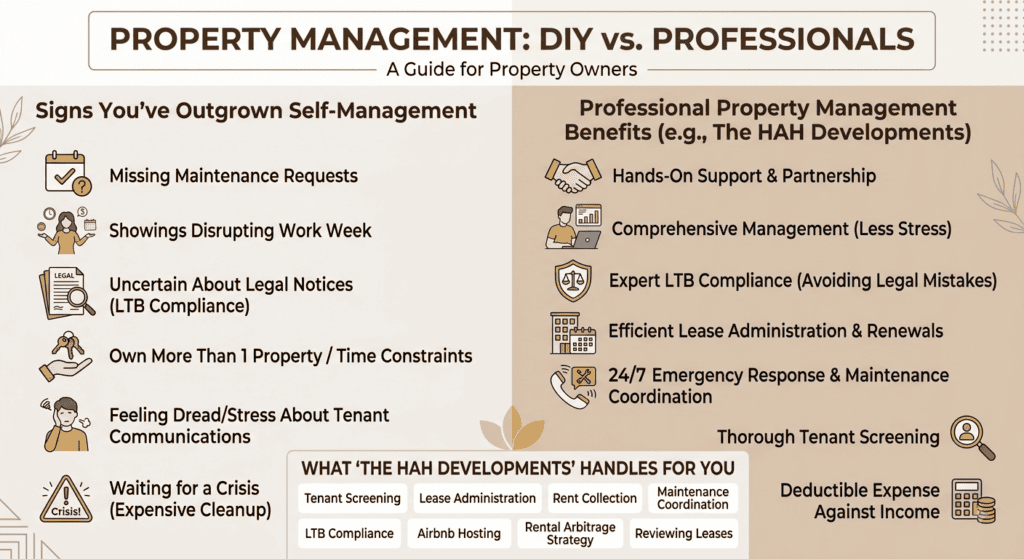
Self-managing a single unit is very doable for a hands-on first-time landlord. The signs it’s time to bring in help usually show up gradually: you’re missing maintenance requests, showings are eating into your work week, you’re unsure whether a new legal notice applies to your situation, or you simply own more than one property and the math no longer adds up on your time.
There’s also a quieter signal worth paying attention to: dread. If checking your phone before a tenant’s name pops up on the screen has started to feel stressful rather than routine, that’s usually a sign the property is costing you more in mental energy than the rent is worth managing solo. Landlords who wait until a crisis (a bad tenant, a missed legal deadline, a costly repair gone sideways) to bring in help tend to pay more for management than those who make the switch proactively, simply because a manager stepping into a mid-crisis file has more cleanup work to do.
Professional property management in Ontario typically runs 6% to 12% of collected rent, or a flat monthly fee, and it’s a fully deductible expense against your rental income – which softens the real cost significantly once you account for your marginal tax rate. When comparing quotes, ask exactly what’s included versus billed separately: lease renewals, LTB representation, and after-hours emergency response are common areas where “affordable” quotes turn out to have costly gaps.
What The HAH Developments Handles For You
This is exactly the gap The HAH Developments was built to close for property owners across Niagara Falls and the surrounding region. Whether you’re managing a long-term rental, testing the waters with Airbnb hosting, or exploring rental arbitrage as an income strategy, our team handles tenant screening, lease administration, rent collection, maintenance coordination, and LTB compliance so you’re not learning Ontario’s rental laws the hard way. First-time landlords in particular benefit from having an experienced partner absorb the parts of the process – screening, legal notices, emergency repairs – where mistakes are the most expensive.
We also work with owners who already self-manage but want a second set of eyes on a specific piece, like reviewing a lease before it’s signed or handling a single difficult tenant situation, rather than handing over the whole property. Property management isn’t all-or-nothing, and a good partner should be able to flex to where you actually need the support.
Final Thoughts
Becoming a first-time landlord is a genuine milestone, and it’s normal for the responsibility to feel bigger than you expected once the keys are actually in your hand. The good news is that almost every challenge covered here – legal compliance, screening, maintenance, insurance – has a proven, repeatable process behind it. You don’t have to reinvent it; you just have to follow it consistently.
If you’d rather skip the learning curve altogether, The HAH Developments manages rental properties across Niagara Falls and the wider region, from long-term leasing to short-term rental and Airbnb co-hosting. Reach out to our team for a free consultation, and let’s talk about what stress-free property ownership could look like for you.
Frequently Asked Questions
Do I need to use the Ontario Standard Lease for every rental unit?
Most private residential tenancies covered by the RTA are required to use the Ontario Standard Lease. A small number of exemptions exist, such as certain care homes and co-operative housing, so confirm your property type before drafting a lease.
How much can I legally increase rent in 2026?
For most rent-controlled units, the provincial guideline caps increases at 2.1% for 2026 without LTB approval. Units first occupied after November 15, 2018 are generally exempt from this cap, but you should verify your building’s status before applying any increase.
What’s the fastest way to evict a tenant for unpaid rent?
As of the 2026 RTA amendments, landlords can serve an N4 notice with a termination date as short as 7 days for non-payment, though the tenant retains the right to pay the arrears and void the notice before that date passes.
Is landlord insurance mandatory in Ontario?
It’s not legally mandatory in the same way auto insurance is, but most mortgage lenders require proof of adequate landlord coverage, and operating without it leaves you personally exposed to the full cost of fire, liability claims, or lost rental income.
Should a first-time landlord manage the property themselves or hire help right away?
There’s no single right answer – it depends on how much time you have, how many properties you own, and your comfort level with Ontario’s legal requirements. Many first-time landlords start solo and bring in professional management once the time cost outweighs the fee.
What’s the biggest mistake first-time landlords make?
Rushing tenant screening to fill a vacancy faster. The cost of a few extra weeks of vacancy is almost always smaller than the cost of placing the wrong tenant.