

If you live anywhere in the Niagara Region, you already know your property has to survive a lot. Humid summers that push grass and gardens into overdrive. Wet, unpredictable falls. Winters where the temperature can swing from a light drizzle to a sudden snow squall in the same week. Then spring arrives and you’re left cleaning up the mess winter left behind.
It’s tempting to think of property care as seasonal property upkeep – mow the lawn, trim a few hedges, and call it done until next year. But that mindset is exactly why so many homeowners and business owners in Niagara Falls, St. Catharines, Welland, and beyond end up facing expensive surprises: a driveway that heaves from freeze-thaw damage, a lawn that never recovers from a rough winter, or a slip-and-fall claim because nobody cleared the ice in time.
Year-round property maintenance is the alternative. It’s the practice of caring for your property continuously, season after season, instead of reacting only when something looks bad or breaks down. In this guide, we’ll walk through exactly why that approach matters so much in a climate like ours, what it actually involves month to month, and how it protects both your wallet and your peace of mind. Whether you own a single-family home or manage a commercial property, by the end of this article you’ll have a clear picture of how to build a maintenance plan that works in every season – not just the pretty ones.
This matters more in 2026 than it used to. Material costs, labour rates, and emergency repair bills have all climbed in recent years, which means the gap between what preventive care costs and what a reactive repair costs keeps widening. At the same time, more property owners are recognizing that a well-kept exterior isn’t just a nice-to-have – it’s one of the few home improvements that pays for itself while you’re still living there, not just when you eventually sell. That shift in thinking is exactly why year-round maintenance plans have become the standard approach for property owners who want to protect their investment instead of constantly patching problems after the fact.
What Is Year-Round Property Maintenance?
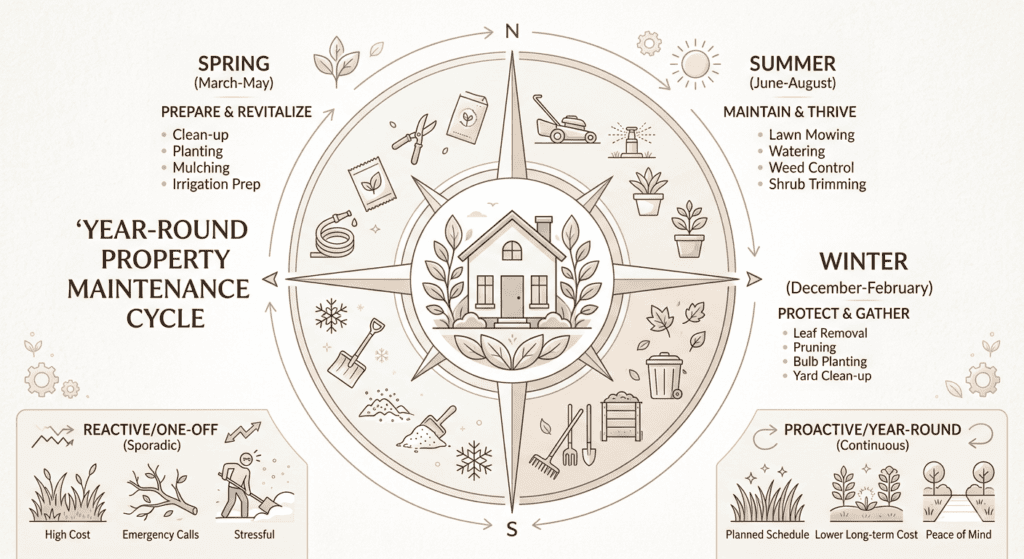
Year-round property maintenance means treating your property’s upkeep as a continuous cycle rather than a once-a-year event. It typically covers lawn care, landscaping, exterior cleaning, garbage and junk removal, and snow and ice management – all coordinated on a calendar that follows the seasons instead of ignoring them.
Think of it less like “yard work” and more like a maintenance schedule for a car. You don’t wait for the engine to fail before changing the oil. You service it on a schedule because small, consistent attention prevents big, expensive problems. A property works the same way. Grass, gardens, drainage, walkways, and exterior surfaces all respond better to steady care than to sporadic bursts of effort.
How It Differs From Seasonal or One-Off Maintenance
Seasonal maintenance usually means calling someone in spring to clean up the yard, then again in fall to rake leaves, with nothing in between. One-off maintenance is even more reactive – you call a company because a tree fell, a pipe froze, or your driveway is buried under a foot of snow and you have nowhere to park.
Year-round maintenance replaces that reactive pattern with a proactive one. Instead of scrambling every few months, you have an ongoing relationship with a provider who already knows your property, understands its recurring problem spots, and shows up on a predictable schedule – whether that’s weekly mowing in July or same-day snow clearing in January.
Why Niagara’s Climate Makes Continuity Non-Negotiable
Niagara’s weather is more demanding on properties than people often realize. The region typically sees dozens of snowfall days each winter, with St. Catharines averaging roughly 56 days a year with at least a centimetre of snow on the ground, and February historically bringing the heaviest snow totals of the season. Winter temperatures hover close to freezing, which means the ground goes through repeated freeze-thaw cycles – a process that’s brutal on driveways, walkways, and foundations because water expands as it freezes and gradually pries surfaces apart.
Summers bring the opposite challenge: long stretches of heat and humidity that push lawns and landscaping to their limits if they aren’t watered, mowed, and cared for consistently. And because Niagara sits between two Great Lakes, weather can shift quickly, with lake-effect snow squalls capable of dropping significant snowfall in a matter of hours.
Put simply, there’s no “off season” here. A property that only gets attention in spring and summer is left exposed for roughly half the year – right when freeze-thaw damage, ice hazards, and drainage issues are most likely to occur. That’s the core reason year-round property maintenance isn’t a luxury in this region. It’s basic protection for one of your biggest investments.
The Core Benefits of Year-Round Property Maintenance
1. Protecting and Increasing Property Value
This is often the single biggest financial argument for consistent upkeep, and the data backs it up in a way that might surprise you. According to the National Association of Realtors’ 2023 Remodeling Impact Report on outdoor features, routine lawn care – mowing, edging, and seasonal upkeep – recovers around 217% of its cost at resale, while general landscape maintenance like mulching and pruning returns roughly 104%. In other words, ongoing maintenance consistently outperforms one-time landscaping upgrades when it comes to actual return on investment.
Separately, research from Virginia Tech Extension found that high-quality landscaping can increase a home’s perceived value by 5.5% to 11.4%, and a related study from Michigan State University Extension put well-executed landscaping’s value boost as high as 12.7% compared to homes without it. Realtors overwhelmingly agree curb appeal matters: 97% say it’s important for attracting buyers, and 92% recommend sellers improve it before listing.
The takeaway is straightforward. Year-round property maintenance isn’t just about looking tidy – it’s one of the most cost-effective ways to protect and grow your property’s value, whether you plan to sell next year or stay for decades.
2. Preventing Costly Emergency Repairs
Small problems rarely stay small. A clogged gutter left unattended can lead to water pooling against your foundation. A hairline crack in a driveway, ignored through a Niagara winter, can turn into a full heave after a few freeze-thaw cycles. A gutter that overflows repeatedly can rot fascia boards and invite pests.
Routine inspections built into a year-round maintenance plan catch these issues while they’re still inexpensive to fix. Waiting until a problem is visible or urgent almost always means paying more – sometimes dramatically more – to repair it.
Think about how this plays out in practice. A property that gets a quick monthly walk-around might catch a downspout that’s come loose before the next heavy rain, costing nothing more than a few minutes to reattach it. A property that doesn’t get checked might not notice until water has already pooled against the foundation for weeks, leading to cracking, efflorescence, or even basement seepage – repairs that can run into the thousands of dollars. The pattern repeats across almost every part of a property: a small drainage issue caught early is a five-minute fix, while the same issue left alone through an entire wet season can undermine a walkway, erode a garden bed, or damage a driveway’s base. Consistency is what turns “catch it early” from a nice idea into something that actually happens.
3. Saving Money Through Preventive Care vs. Reactive Fixes
Financial experts generally recommend budgeting somewhere between 1% and 4% of your home’s value annually for maintenance and repairs. On a $500,000 property, that works out to roughly $5,000 to $20,000 a year – a number that can feel high until you compare it to the cost of a single emergency repair, like replacing storm-damaged siding or repairing water damage from a poorly maintained drainage system.
Preventive maintenance spreads that cost out predictably over the year instead of hitting you with one large, unplanned bill. It also tends to be cheaper in aggregate, since ongoing care (mowing, trimming, snow clearing) is far less labor-intensive than emergency remediation (major landscaping overhauls, structural repairs, or water damage restoration).
4. Keeping Your Property Looking Its Best Every Season, Not Just Spring
A property’s appearance isn’t a one-season concept. A home or business that looks sharp in June but is buried under unshoveled snow and dead leaves in December sends a very different message to neighbours, clients, or potential buyers. Year-round maintenance means your lawn, gardens, walkways, and entryways look cared for in every season – whether that’s crisp edging in summer, a clean, leaf-free yard in fall, or clear, safe walkways in winter.
For businesses in particular, this matters more than owners often realize. First impressions happen at the parking lot and front entrance, long before anyone walks through the door.
5. Improving Safety for Residents, Tenants, and Visitors
Safety is one of the most underrated benefits of consistent property care. Overgrown shrubs can block sightlines and hide tripping hazards. Wet leaves left on walkways become slippery in seconds. And in winter, ice buildup on driveways, steps, and sidewalks is one of the leading causes of slip-and-fall injuries – a serious liability concern for both homeowners and commercial property owners.
A property maintained year-round has fewer of these hazards because they’re addressed before they become dangerous, not after someone gets hurt.
6. Supporting Energy Efficiency
Well-placed, healthy trees and landscaping can meaningfully reduce a home’s energy costs by providing shade in summer and blocking wind in winter – mature shade trees alone have been shown to add real value while lowering cooling costs. On the maintenance side, keeping gutters clear and grading correct prevents moisture intrusion that can compromise insulation, while regular snow and ice management keeps walkways and entry points from becoming a source of cold air infiltration. It’s a smaller, less obvious benefit than looks or safety, but it adds up over a full year.
7. Saving Time and Reducing Stress for Owners and Managers
There’s a real, if less quantifiable, benefit to simply not having to think about it. Homeowners with full-time jobs and families often don’t have a free Saturday every week for mowing, weeding, and gutter cleaning – let alone time to shovel snow before a 7 a.m. commute. For commercial property managers juggling multiple sites, coordinating separate vendors for lawn care, cleaning, garbage removal, and snow clearing is its own part-time job.
A consistent, professionally managed maintenance plan removes that mental load. You’re not scrambling to find someone last-minute after a snowstorm or trying to squeeze yard work into an already packed weekend.
8. Staying Compliant With Municipal and Insurance Requirements
Many municipalities have bylaws requiring snow and ice to be cleared from sidewalks within a set time after a storm, and commercial properties in particular often carry insurance policies that expect documented, regular maintenance as a condition of coverage. Falling behind on either can create legal or financial exposure that a consistent maintenance schedule simply avoids.
A Season-by-Season Breakdown of Property Maintenance in Niagara
Spring – Lawn Wake-Up, Cleanup, and Landscaping Prep
Spring is about undoing winter’s damage and setting the tone for the rest of the year. This typically includes clearing debris left behind by snow and wind, dethatching and aerating the lawn so it can breathe, applying early fertilization, pruning shrubs and trees, and inspecting hardscaping (walkways, driveways, retaining walls) for any freeze-thaw damage that needs repair before it worsens.
This is also the season to check for anything winter left behind that isn’t obvious at first glance – salt damage along the edges of driveways and walkways, compacted soil where snow was piled, or garden beds that need fresh mulch after months of exposure. Getting ahead of these details in spring means your lawn and landscaping have the best possible start heading into the growing season, rather than trying to recover from a rough winter while also handling normal summer upkeep.
Summer – Mowing, Irrigation, Weed Control, and Outdoor Upkeep
This is the season most people associate with “lawn care,” and for good reason – regular mowing, weed control, and proper watering are essential during Niagara’s warm, humid stretch. It’s also a good time for landscaping refreshes, edging, mulching, and general tidying of garden beds, since plants are actively growing and respond well to attention.
Consistency is what separates a lawn that looks great all summer from one that looks good for a week after each visit and rough the rest of the time. Mowing on a set weekly schedule, rather than “whenever it gets long,” keeps grass at a healthy height that resists weeds and drought stress. The same logic applies to garden beds and hedges – regular light trimming keeps them looking sharp, while letting things go for a month and then doing one big trim tends to leave plants stressed and uneven.
Fall – Leaf Removal, Aeration, Winterizing Landscaping
Fall maintenance is where a lot of properties fall behind, but it’s arguably one of the most important seasons. Consistent leaf removal prevents mold and matting that can smother grass over winter. Aeration and overseeding in fall gives lawns a head start for spring. Trees and shrubs often need pruning before winter, and irrigation systems should be properly shut down and winterized to avoid frozen, cracked pipes.
It’s also the season to do a full property walk-around before the snow arrives: checking that gutters are clear, downspouts direct water away from the foundation, and any exterior cleaning (windows, siding, walkways) is done before the cold makes it far less pleasant to handle. Properties that get this fall “buttoning up” tend to sail through winter with far fewer surprises than properties that go into the season already behind.
Winter – Snow Removal, Ice Management, and Property Safety
Winter in Niagara means staying ahead of snow squalls and freeze-thaw cycles rather than reacting to them. That means prompt snow clearing from driveways, walkways, and parking areas; ice management to keep surfaces safe; and ongoing property checks, since a storm can move through the region quickly given its position between two Great Lakes. For commercial properties especially, same-day or overnight snow clearing is often essential to keep operations running and reduce liability.
Because Niagara’s winters tend toward frequent, moderate snowfalls rather than a handful of massive storms, the properties that fare best are usually the ones enrolled in proactive snow removal Niagara services rather than scrambling for a reactive one – someone who clears walkways and driveways as snow accumulates, instead of waiting for a call after the fact. This is especially important for businesses, where a blocked entrance or icy parking lot can mean lost customers and real liability exposure, sometimes within just a few hours of a snowfall starting.
Residential vs. Commercial Property Maintenance Needs
What Homeowners Should Prioritize
For most homeowners, the priority list starts with a great-looking property and protecting resale value, followed closely by safety – especially icy walkways and driveways in winter. Budget-conscious homeowners often get the most value by focusing on the items with the strongest lawn care ROI, such as consistent mowing, basic landscaping upkeep, and timely snow removal, rather than large one-time landscaping projects.
What Businesses and Property Managers Should Prioritize
Commercial properties carry different stakes. Liability is a much bigger factor – an icy parking lot or an unshoveled entrance can lead to injury claims, not just inconvenience. Tenant and customer satisfaction also depends heavily on how a property looks and functions; a well-kept exterior signals professionalism, while an unkempt one can quietly drive business away. For multi-tenant or multi-site properties, having one provider handle lawn care, cleaning, garbage removal, and snow clearing across every location dramatically simplifies Niagara Region property management for owners juggling several addresses.
Retail centers, in particular, tend to prioritize visual appeal and lighting since those directly affect foot traffic, while office and multifamily properties often place more weight on prompt response times, resident safety, and accessible walkways. Regardless of property type, commercial owners typically benefit from documented maintenance records as well, since these can support insurance claims and demonstrate due diligence if a liability issue ever arises.
Common Mistakes Property Owners Make With Maintenance
Skipping “off-season” upkeep. Many owners stop thinking about their property the moment summer ends, missing the fall prep work that protects it through winter.
Handling snow and ice removal themselves. DIY snow clearing is time-consuming, physically demanding, and can create liability if it’s done inconsistently or too late after a storm.
Ignoring gutters, drainage, and grading. These are easy to overlook because they’re not always visible, but poor drainage is one of the most common causes of foundation and basement problems.
Waiting until selling to invest in landscaping. As the ROI data above shows, last-minute landscaping before a listing gets a fraction of the return compared to a lawn and yard that have been consistently maintained for years. Buyers and their agents can often tell the difference between a lawn that’s been cared for over seasons and one that’s been rushed into shape for a few open houses – mature, healthy grass and established beds simply look different from a hasty patch job.
Treating maintenance as a single annual event. Some owners schedule one big spring cleanup and consider the property “done” for the year. Without follow-up mowing, trimming, and seasonal attention, the results of that cleanup fade within a few weeks, and the property ends up right back where it started by mid-summer.
Underestimating how quickly small jobs pile up. A missed mowing cycle, an unpruned hedge, and a few weeks of accumulated leaves don’t seem like much individually, but together they can turn a manageable weekend task into a much larger (and pricier) cleanup project.
Benefits of Hiring Professionals vs. DIY Year-Round Maintenance
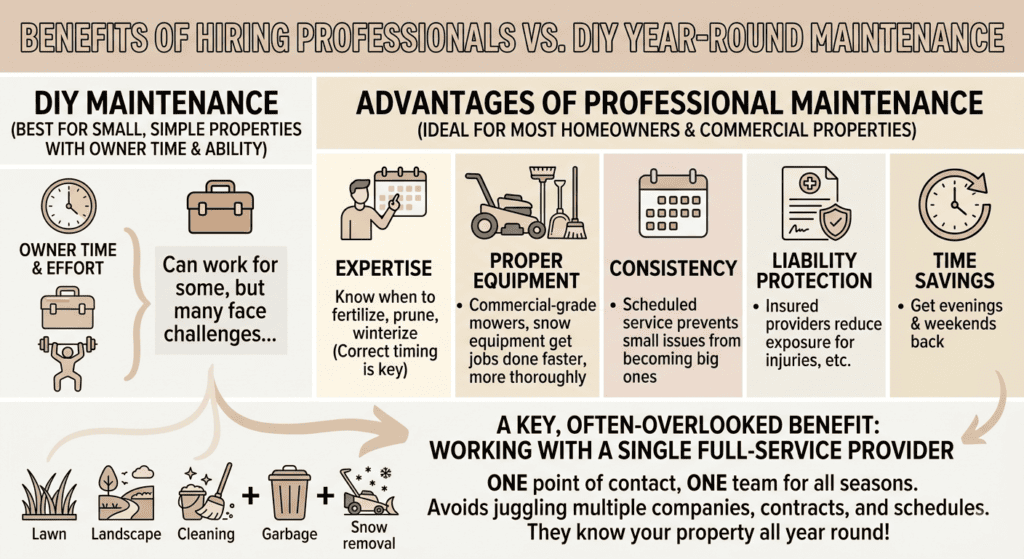
DIY maintenance can work for small, simple properties with an owner who has the time, tools, and physical ability to keep up with it. But for most homeowners and virtually all commercial properties, professional maintenance offers real advantages:
- Expertise: Professionals know how to time fertilization, pruning, and winterizing correctly – mistakes in timing can undo a season’s worth of work.
- Proper equipment: Commercial-grade mowers, snow-clearing equipment, and cleaning tools get the job done faster and more thoroughly than most homeowners’ equipment.
- Consistency: A scheduled provider shows up on a set cadence, rather than “whenever there’s time,” which is exactly what prevents small issues from becoming big ones.
- Liability protection: Insured providers reduce your exposure if something goes wrong, such as an injury during snow removal.
- Time savings: You get your evenings and weekends back.
There’s also a simpler, often-overlooked benefit: working with a single full-service provider – one that handles lawn care, landscaping, cleaning, garbage removal, and snow removal – means you’re not juggling four or five different companies, invoices, and schedules. One point of contact, one team that already knows your property, and one call to make when your needs change with the seasons.
This matters more than it might seem at first. Coordinating separate vendors means separate contracts, separate scheduling conflicts, and separate points of failure – if your lawn care company and your snow removal company aren’t the same team, nobody has full visibility into your property across the whole year. A single provider avoids that gap entirely, since the same team that mows your lawn in July is the one clearing your driveway in January, and they already know where your problem spots are.
How to Build a Year-Round Property Maintenance Plan
Step 1: Assess your property’s needs. Walk your property and note recurring problem areas – a section of lawn that struggles every summer, a walkway that ices over first, gutters that clog quickly.
Step 2: Set a seasonal calendar. Map out what needs to happen each season: spring cleanup and lawn wake-up, summer mowing and irrigation, fall leaf removal and winterizing, winter snow and ice management.
Step 3: Budget realistically. As a starting point, many financial guides suggest setting aside 1% to 4% of your property’s value annually for maintenance, adjusting based on the age and condition of the property.
Step 4: Partner with a local, full-service provider. Choose a company that understands your specific region’s climate and can handle every season under one plan, rather than piecing together multiple seasonal vendors.
Why Niagara Property Owners Choose NLLC for Year-Round Maintenance
At NLLC (Niagara Landscaping, Lawn Care & Cleaning), year-round property care isn’t an add-on service – it’s the whole business model. NLLC provides lawn care and landscaping, residential and commercial cleaning, garbage and junk removal, and snow removal, all under one roof, so property owners across Niagara Falls, St. Catharines, Welland, Fort Erie, Niagara-on-the-Lake, Thorold, Port Colborne, and the wider Niagara Region can rely on a single, trusted team through every season.
That full-service structure directly solves the biggest headache of DIY seasonal juggling: instead of coordinating a lawn care company in summer, a separate cleaning service, a garbage removal company, and a snow removal contractor in winter, NLLC’s team already knows your property and simply shifts focus as the seasons change.
If you’re ready to stop reacting to your property’s problems and start staying ahead of them, reach out to NLLC for a free, no-obligation quote tailored to your home or business.
Conclusion – Protect Your Property Every Season of the Year
Niagara’s climate doesn’t take a break, and neither should your property maintenance. From protecting your home’s value and preventing expensive emergency repairs to keeping your family, tenants, or customers safe from ice and hazards, the benefits of year-round property maintenance touch nearly every part of owning or managing a property in this region.
The good news is that you don’t have to manage it all yourself, or coordinate a handful of separate seasonal vendors. A single, local, full-service partner can carry your property through every season – spring cleanup, summer lawn care, fall winterizing, and winter snow removal – with one consistent team who already knows your property inside and out.
If you’re ready for a property that looks great and stays protected all year long, contact NLLC today for a free quote and see how a year-round maintenance plan can work for your home or business.
Frequently Asked Questions
How much should I budget for year-round property maintenance in Niagara? A commonly used guideline is 1% to 4% of your property’s value per year, though the right number depends on your property’s size, age, and the specific services you need (lawn care, snow removal, cleaning, etc.).
What’s included in a year-round maintenance plan? Most plans combine lawn care and landscaping, seasonal cleanup, exterior or interior cleaning, garbage and junk removal, and winter snow and ice management, scheduled continuously across the year rather than as isolated visits.
Can I combine lawn care, cleaning, and snow removal with one company? Yes – and it’s usually the simpler, more cost-effective option. A full-service provider like NLLC can manage all of these under a single plan, which means one point of contact and one consistent team across every season.
How often should professional property maintenance happen in Niagara? It varies by service and season: weekly mowing in summer, periodic cleanups in spring and fall, and on-demand or scheduled snow clearing throughout winter, since storms here can develop quickly.
Does landscaping maintenance really increase home value? Yes. Industry data shows routine lawn care can return over 200% of its cost at resale, and well-maintained landscaping overall can boost a home’s perceived value by 5% to nearly 13%, depending on the study and market.
Is snow removal necessary if I only get light snowfall? Yes – even light, recurring snow and ice can create slip hazards and freeze-thaw damage on driveways and walkways, and many municipalities require sidewalks to be cleared within a set time after snowfall regardless of amount.
What’s the difference between residential and commercial maintenance plans? Residential plans typically focus on appearance, safety, and property value. Commercial plans put more weight on liability management, tenant or customer experience, and coordinating maintenance across one or multiple sites.