
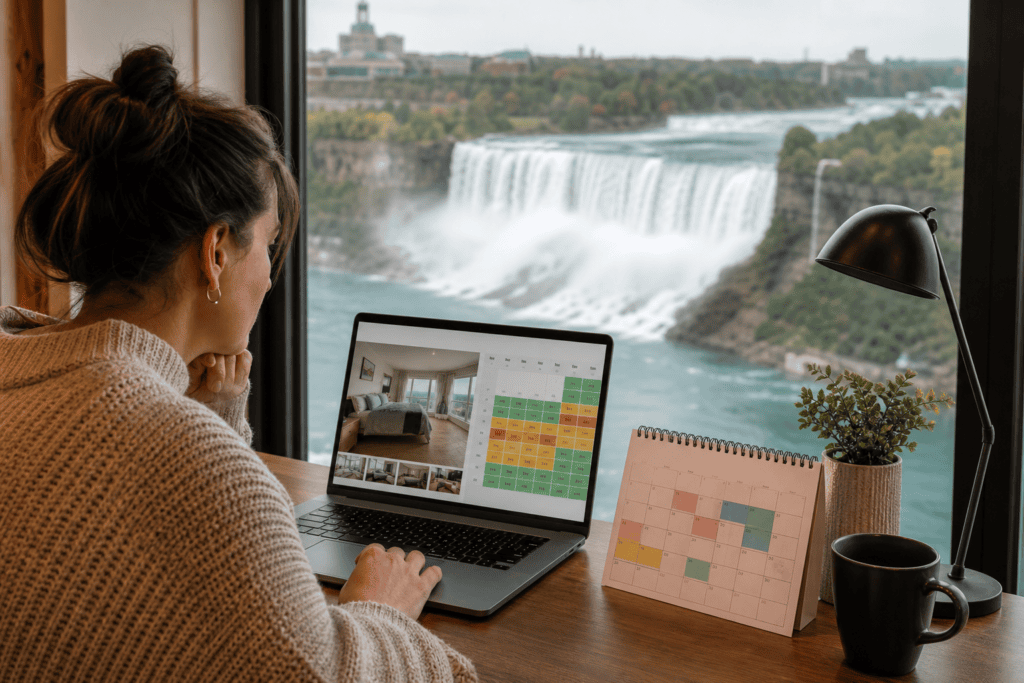
Dynamic pricing tools for Airbnb can cost more than a software subscription, or nothing beyond your time. The real choice is between manual rate setting, Airbnb’s built-in pricing tools, specialist software, and professional co-hosting. Each option trades off cost, control, automation, and the amount of operational work you still handle.
For a Niagara Falls rental, the best option is not necessarily the one with the lowest visible fee. It is the option that helps you respond to demand, manage minimum stays and open dates, and protect net profit after cleaning, maintenance, taxes, platform charges, and management costs.
What you are actually paying for
A pricing tool does more than suggest a nightly rate. Depending on the product, it may process information about demand, location, amenities, past bookings, local prices, listing performance, and market conditions. Airbnb explains that Smart Pricing uses factors about the listing and its area to adjust nightly prices based on demand. Airbnb’s explanation of Smart Pricing provides current platform-level detail.
You may also be paying for automation. Useful capabilities can include automatic rate updates, minimum and maximum prices, minimum-stay rules, last-minute discounts, gap-night settings, event adjustments, calendar synchronization, and manual overrides. A lower-cost option may still be expensive in owner time if you must check rates, research events, and update restrictions yourself.
There is also an operational cost when pricing changes work as intended. A lower rate may fill a short gap but create another turnover, while a higher rate may reduce booking volume and leave a date vacant. The right budget therefore includes the tool, your time, cleaning and maintenance consequences, taxes, platform charges, and total booking revenue.
Airbnb Smart Pricing, third-party software, manual pricing, or management

The four main approaches suit different owners. This comparison describes cost structures and tradeoffs without assuming a particular subscription price or management commission.
| Approach | Main cost | Control and automation | Best fit |
|---|---|---|---|
| Manual pricing | Owner time and research | Highest direct control, lowest automation | Small portfolios where the owner can review rates regularly |
| Airbnb Smart Pricing | Built-in platform option, subject to current Airbnb terms | Simple automated rate recommendations or adjustments within Airbnb | Newer hosts seeking an uncomplicated starting point |
| Third-party software | Potential subscription or service fee, plus setup time | More rules, data views, overrides, and possible multi-channel controls | Hosts who need detailed pricing logic or manage multiple listings |
| Professional co-hosting | Management fee or agreed service charge | Pricing bundled with human oversight and other operations | Owners who want less day-to-day involvement |
None of these approaches guarantees higher occupancy, revenue, or profit. The useful question is whether the added automation or service replaces enough work and improves enough decisions to justify its total cost.
Airbnb Smart Pricing: the low-complexity starting point
Airbnb provides built-in pricing tools that hosts can enable through their price settings. Its documentation identifies factors such as location, amenities, past bookings, and current prices in the area as inputs used by its pricing tools. Airbnb’s pricing tool guidance is the right place to confirm the current settings available on your account.
The main advantage is simplicity. There is no separate specialist dashboard to learn, and pricing information sits close to your Airbnb calendar and listing settings. This may be enough for an owner with one property, predictable availability, and time to review unusual dates.
The tradeoff is that a built-in option may not provide the same depth of rule-making, market views, or cross-platform workflow as specialist software. Before relying on it, check how it handles minimum and maximum prices, minimum stays, blocked dates, last-minute gaps, event periods, and manual overrides. Automated pricing should support your judgment, not replace calendar oversight.
Third-party Airbnb pricing software: more control, more decisions
Specialist tools are designed to automate more detailed pricing decisions. Their documented approaches can include market data, listing performance, demand signals, competitive conditions, and rule-based pricing. Some also provide controls for minimum stays, rate floors, booking windows, discounts, gap nights, and changes across connected channels.
The budget may include a recurring subscription, a service fee, setup time, or charges connected with the number of listings. Do not compare software by its fee alone. Confirm whether it connects correctly to your booking channels, synchronizes rate and availability changes, supports your preferred rules, and lets you override a recommendation quickly.
More controls also mean more decisions. A host can accidentally create restrictive minimum stays, discount dates that did not need a discount, or raise rates beyond what the property and guest experience support. Specialist software is most useful when the owner understands the rules and reviews performance rather than switching on every automation without supervision.
Manual pricing: no software fee, but a continuing time cost
Manual pricing can work when you have a small number of available dates and a reliable process. You can review comparable listings, booking pace, seasonality, upcoming events, lead time, open gaps, and your own operating costs before changing rates.
The weakness is inconsistency. Demand can change while you are busy with guest messages, cleaning coordination, maintenance, or another job. New hosts can avoid underpricing by comparing local rates and using dynamic pricing tools instead of relying only on intuition.
If you choose manual pricing, create a repeatable review schedule. Record why you changed a rate, monitor how quickly dates book, and review whether discounts are filling useful gaps or simply reducing the value of dates that would have sold at the original price.
Why Niagara Falls pricing needs local judgment
Niagara Falls demand is not uniform throughout the year. Holiday weekends, summer travel, school breaks, festivals, weather, and other local events can affect booking pace and the price guests may accept. A tool can identify patterns, but an owner still needs to check whether an unusual event, maintenance closure, or availability restriction makes the recommendation sensible.
Short-term rental pricing also sits inside a local operating framework. The City of Niagara Falls identifies licensing requirements for owner-occupied short-term rentals, and the city imposes a mandatory Municipal Accommodation Tax on short-term accommodation operating in the city. Review the current requirements for your property and build applicable obligations into your financial model rather than treating the displayed nightly rate as profit.
For a local view of how seasonality, event dates, rate changes, and calendar decisions fit together, review this explanation of demand spikes. The same principle applies whether you set prices manually, use Airbnb’s tool, or connect specialist software.
Airbnb pricing tool evaluation checklist
- Data: Check whether the tool considers local demand, comparable rates, booking pace, listing performance, seasonality, and events.
- Controls: Look for rate floors and ceilings, minimum stays, discounts, last-minute rules, gap-night settings, and event adjustments.
- Overrides: Confirm that you can change rates or block dates for repairs, owner use, unusual demand, or property-specific constraints.
- Synchronization: Confirm which platforms and calendars connect, how quickly changes publish, and what happens after a connection fails.
- Reporting: Look for rate history, booking pace, revenue summaries, and a way to compare results with your own costs.
- Exclusions: Pricing software usually does not clean the property, answer guests, repair damage, inspect the unit, or confirm licensing.
- Exit terms: Check trials, cancellation, data access, and whether removing the tool leaves your calendar and rates in the intended state.
Measure the result by net profit, not occupancy alone
Occupancy tells you how many nights were booked. It does not tell you whether those nights produced an acceptable return after cleaning, supplies, maintenance, platform charges, taxes, discounts, utilities, insurance, and management or software costs.
Track occupancy, average nightly rate, gross booking revenue, net profit, booking pace, and turnover frequency. A strategy that fills more nights at low rates may increase workload without improving the owner’s return, while a higher rate that leaves too many dates empty can also reduce total revenue.
HAH Developments describes short-term rental operations as including dynamic pricing, listing optimization, guest communication, cleaning coordination, maintenance, compliance, and owner oversight. Its broader dynamic pricing strategy context is useful because pricing decisions depend on the rest of the hosting system, not on a nightly rate in isolation.
When professional co-hosting may be the better budget decision
Professional co-hosting can make sense when the cost of your time, missed messages, delayed turnovers, maintenance coordination, or inconsistent rate reviews is greater than the cost of delegated management. The value is not just access to pricing software. It may include listing optimization, guest communication, cleaning coordination, maintenance, compliance support, and owner reporting.
Ask for a written quote that separates pricing management from other services. Confirm the fee basis, included tasks, exclusions, cleaning charges, repair approval limits, platform responsibilities, reporting frequency, cancellation terms, and who controls rate overrides. Owners who do not want to monitor rates manually can review how real-time pricing tools fit within a broader local management service, then request details specific to their property.
A simple decision framework for Airbnb hosts
| Choose this approach when | Start with |
|---|---|
| You have one listing, flexible availability, and time for regular reviews. | Manual pricing or Airbnb Smart Pricing with a written review routine. |
| You want a straightforward built-in option and do not need complex rules. | Airbnb Smart Pricing, subject to checking its current controls. |
| You manage multiple listings or need detailed rate, stay, and gap-night rules. | Third-party software, after confirming integrations and total fees. |
| You want pricing combined with guest, cleaning, maintenance, and compliance support. | Professional co-hosting or property management with a clear written scope. |
Frequently asked questions
Is Airbnb Smart Pricing free to use?
It is a built-in Airbnb pricing option rather than a separate specialist subscription. Confirm current terms and available settings in your Airbnb account, and remember that platform charges, taxes, cleaning, and operating costs still affect profit.
Are third-party Airbnb pricing tools worth paying for a single Niagara Falls listing?
They may be worthwhile if they save substantial review time or provide controls you genuinely need. Compare the subscription and setup effort with the time required to manage demand, events, minimum stays, and open dates yourself.
Can dynamic pricing tools adjust minimum stays as well as nightly rates?
Some tools provide minimum-stay and calendar rules, but capabilities differ. Confirm whether the specific product can set, publish, and override those rules through your connected booking channels.
Do pricing tools include Airbnb cleaning, guest communication, or maintenance?
Usually, pricing software handles pricing and related calendar rules, not physical property operations. Cleaning, guest support, inspections, repairs, and compliance must be handled by the owner, separate providers, or a management company.
Should an Airbnb host use pricing software or hire a co-host?
Choose software when you mainly need automated pricing controls and can manage operations. Consider a co-host when you also need guest communication, listing work, cleaning, maintenance, compliance support, and regular human oversight.
Choose the simplest option that protects the whole business
Dynamic pricing tools for Airbnb are useful when they improve decisions without hiding the costs around each booking. Start with the simplest approach that gives you adequate control, then compare actual net profit, booking pace, workload, and guest operations over time. For Niagara Falls properties, review local demand patterns alongside licensing and accommodation tax requirements.
If you want pricing, listing optimization, guest communication, cleaning coordination, maintenance, compliance support, and related short-term rental operations managed together, The Home Away From Home Developments Inc provides Airbnb hosting and property management services in Niagara Falls and the broader Niagara Region. Request a property-specific scope and written quote before deciding.