

Buying your first rental property feels like a milestone. You’ve done the math, saved the down payment, and maybe you’re already picturing that steady stream of rental income landing in your account every month. Then reality sets in. You need to price the unit, find a tenant, write a lease that actually protects you, and figure out what happens the first time a furnace dies at 11 p.m.
Becoming a first-time landlord is exciting, but it comes with a learning curve that catches almost everyone off guard. Most new property owners don’t lose money because they made one big mistake. They lose money in small, avoidable ways: a lease with a missing clause, a tenant they never properly screened, a rent set $150 too low because they guessed instead of checking the market.
This guide answers the questions every first-time landlord in Ontario asks before, during, and after their first rental. We’ll walk through pricing, screening, leases, maintenance, insurance, legal obligations, and the mistakes that cost new landlords the most time and money. Along the way, we’ll also explain when it makes sense to manage a property yourself and when handing the keys to a professional property management company is the smarter financial move.
Let’s get into it.
1. What Should I Do Before Listing My Rental Property?
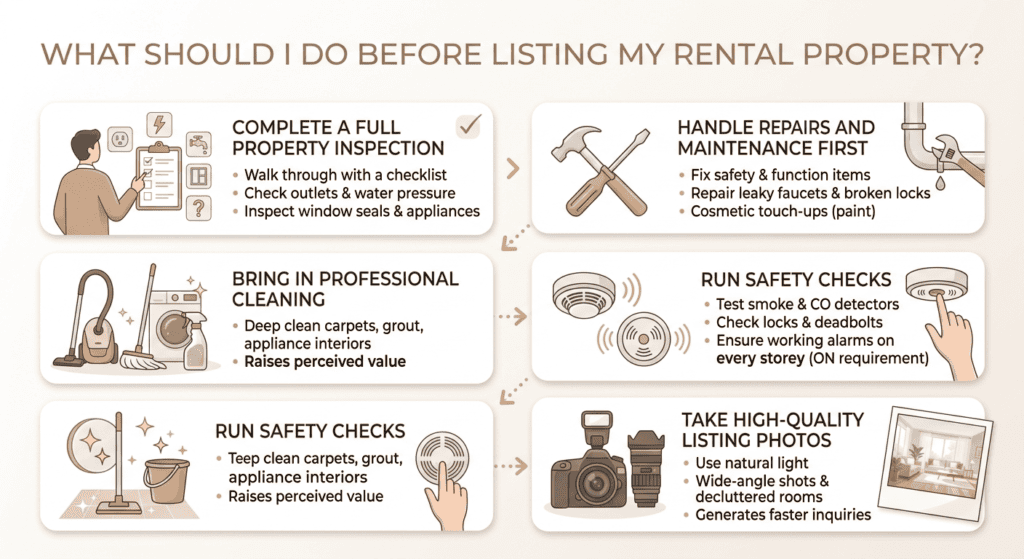
Before you post a single photo online, your property needs to earn top dollar and pass a tenant’s first impression test. Skipping this step is one of the fastest ways to end up with a longer vacancy or a lower-quality applicant pool.
Complete a full property inspection
Walk through every room with a checklist. Check outlets, water pressure, window seals, appliance function, and signs of moisture or pest activity. Small issues you catch now are cheap. The same issues discovered by a tenant three months into a lease often become disputes, or worse, maintenance emergencies that pull you away from work on short notice.
Handle repairs and maintenance first
Fix anything that affects safety or basic function before you list: leaky faucets, faulty smoke detectors, broken locks, damaged flooring. Cosmetic touch-ups like fresh paint or new caulking around tubs make a rental show significantly better in photos and in person.
Bring in professional cleaning
A property that’s merely “tidy” doesn’t compete well against one that’s been professionally deep cleaned. Carpets, grout, appliance interiors, and baseboards all show wear that regular cleaning misses. This is one of the cheapest ways to raise perceived value before a showing.
Run safety checks
Confirm smoke and carbon monoxide detectors are working and placed correctly, check that all locks and deadbolts function, and verify that any stairs or railings meet basic safety standards. In Ontario, working smoke alarms on every storey are a legal requirement, not a suggestion.
Take high-quality listing photos
Natural light, wide-angle shots, and decluttered rooms consistently outperform dim, cluttered photos in click-through rates. If you’re not confident with a camera, this is a small expense worth paying for. Listings with strong photography typically generate faster inquiries and higher-quality applicants.
It’s worth thinking about pre-listing prep as a single project rather than a checklist you tackle piecemeal over a few weekends. Landlords who bundle the inspection, repairs, cleaning, and photos into one focused week tend to list faster and with fewer surprises mid-process. Trying to fit it in “whenever there’s time” is how a two-day job turns into a six-week vacancy, and every week a unit sits empty is rent you never get back.
2. How Do I Determine the Right Rental Price?
Pricing is where most new landlords either leave money on the table or price themselves into a long vacancy. Neither mistake is cheap.
Research your local market
Start by looking at active listings for comparable units in your neighbourhood, not city-wide averages. Rental pricing can shift block by block depending on proximity to transit, schools, and amenities.
Study comparable rentals
Compare unit size, number of bedrooms and bathrooms, parking availability, in-unit laundry, and condition. A unit that looks similar on paper can rent for hundreds of dollars more or less depending on these details.
Watch vacancy rates in your area
<cite index=”12-1″>As of Q4 2025, the Niagara Region’s vacancy rate sat around 1.8%, well below the national average, which gives landlords more pricing leverage than in looser markets.</cite> That said, supply is shifting. New purpose-built rental developments are entering the Niagara pipeline, and CMHC has flagged that this added supply is expected to push vacancy rates higher and moderate rent growth over the next couple of years. Pricing based on last year’s numbers can leave your unit sitting empty longer than expected.
Factor in seasonal demand
Rental demand in most Ontario markets peaks in spring and early summer, when leases commonly turn over and moving activity is highest. Listing in December or January often means a smaller applicant pool and more negotiating pressure from tenants.
Avoid the two classic pricing mistakes
Overpricing leads to weeks of empty showings, which almost always costs more than the extra $50 or $100 a month you were hoping to capture. Underpricing, on the other hand, quietly costs you thousands over a full lease term. A quick way to sanity-check your number: if you’re not getting inquiries within the first week of listing, the price is probably the issue.
Two weeks of vacancy can easily cost more than a full year of pricing $75 to $100 under market. That math surprises a lot of new landlords, who often assume that pricing slightly high “just to see” carries no real downside. In practice, every extra week on the market pushes your break-even point further away and signals to prospective tenants that something about the unit or the price doesn’t add up, even when the reason is completely unrelated to the property itself.
Building supply is also part of the pricing conversation right now. CMHC’s 2026 housing outlook has flagged several new purpose-built rental projects entering the pipeline across the Niagara Region, including large developments in Niagara Falls. As that supply comes online over the next couple of years, it’s expected to ease vacancy pressure and slow rent growth in some pockets of the market. Landlords who check comparable listings every few months, rather than setting a price once and forgetting about it, stay ahead of these shifts instead of reacting to them after a unit has already sat vacant.
3. How Do I Find Good Tenants?
Good tenants rarely come from luck. They come from casting a wide net and running a tight process.
Choose the right advertising channels
List on major rental platforms, local Facebook groups, and Kijiji, and consider a yard sign if your property is in a walkable area. The wider your reach, the larger and more competitive your applicant pool.
Follow rental listing best practices
Write a clear, honest description. List the rent, included utilities, parking, pet policy, and move-in date up front. Vague listings generate more time-wasting inquiries and fewer serious applicants.
Pre-screen inquiries before booking showings
A short phone call or message exchange before you book a showing saves enormous time. Ask about move-in timeline, household size, pets, and income range. This filters out mismatched applicants before you’ve spent an evening doing showings.
Respond fast
In competitive rental markets, the first landlord to respond often gets first pick of applicants. Slow responses lose good tenants to other listings, sometimes within hours.
4. What Should I Look for During Tenant Screening?
This step is the single biggest predictor of how smooth your landlord experience will be. Skipping or rushing it is one of the most common and most expensive mistakes new landlords make.
Verify employment
Confirm the applicant’s employer and role directly, not just through a pay stub. A quick call to HR or a supervisor takes minutes and confirms the job is real and current.
Verify income
A common guideline is that gross monthly income should be roughly three times the monthly rent. This isn’t a hard rule, but it’s a useful starting benchmark, especially when comparing multiple applicants.
Run a credit check
Look for payment history, existing debt load, and any collections or judgments. A credit check won’t tell you everything about a person, but it flags patterns worth asking about.
Contact previous landlords
Ask direct questions: Did they pay rent on time? Did they give proper notice? Would you rent to them again? A hesitant or vague answer from a previous landlord is often more telling than what they actually say.
Watch for red flags
Be cautious of applicants who pressure you to skip screening, offer to pay several months in cash upfront with no explanation, or give landlord references that turn out to be friends or family. None of these automatically disqualify someone, but they’re worth a closer look.
Build a consistent process, not a case-by-case one
The biggest screening mistake isn’t skipping a single step for one applicant. It’s applying different standards to different applicants depending on how much you liked them in the showing. Beyond the legal risk of inconsistent screening, it also tends to produce worse outcomes, since the applicants who charm you in person aren’t always the ones who pay on time. Set your criteria before you start reviewing applications, apply them the same way to everyone, and keep a simple record of why each decision was made.
5. What Should Be Included in a Lease Agreement?
Your lease is the document that protects you when something goes wrong, so vague or missing terms almost always work against the landlord, not the tenant.
Core financial terms
Spell out the exact rent amount, due date, accepted payment methods, and what happens if a payment is late. Ambiguity here creates disputes later.
Utilities
Clearly state which utilities, if any, are included in rent and which the tenant is responsible for setting up in their own name.
Pet policy
Decide upfront whether pets are allowed, and if so, under what conditions. Note that in Ontario, “no pets” clauses in a lease are not enforceable once a tenant has moved in with a pet, so this is more about setting expectations than creating an ironclad rule.
Maintenance responsibilities
Outline who handles what, from lawn care to snow removal to minor in-unit repairs. This prevents the “I thought that was your job” conversation down the road.
Parking and property rules
Specify assigned parking spots if applicable, and note any building or property-specific rules around noise, guests, smoking, or common area use.
6. Who Pays for Repairs and Maintenance?
This is one of the most misunderstood parts of being a landlord, and getting it wrong can create both financial and legal exposure.
Landlord responsibilities
As the property owner, you’re responsible for maintaining the unit in a good state of repair and ensuring it complies with health, safety, and housing standards. This includes major systems like heating, plumbing, electrical, and structural elements, regardless of what the lease says.
Tenant responsibilities
Tenants are typically responsible for keeping the unit clean, using appliances and fixtures properly, and covering damage caused by their own negligence or misuse, separate from normal wear and tear.
Emergency repairs
Have a plan before you need one. A burst pipe or no-heat situation in winter needs a response within hours, not days. New landlords who don’t have a trusted contractor or plumber on call often scramble during an emergency, which costs more in both stress and repair fees.
Preventive maintenance
Seasonal furnace checks, gutter cleaning, and periodic inspections catch small problems before they become expensive ones. Landlords who budget for preventive maintenance consistently spend less over time than those who wait for something to break.
7. What Insurance Do I Need?
Homeowner’s insurance does not cover a rental property. This surprises a lot of first-time landlords, usually right when they need coverage most.
Landlord insurance
<cite index=”27-1″>Landlord insurance is a commercial-style policy built specifically for rental property owners, covering everything from physical damage to liability claims that a standard homeowner’s policy simply doesn’t include.</cite> In Ontario, annual premiums typically fall somewhere between roughly $800 and $2,500, depending on the property’s age, location, and coverage level, and landlord policies generally run about 15% to 25% more than a comparable homeowner’s policy.
Liability coverage
This protects you if a tenant or visitor is injured on the property and pursues a claim, covering legal costs and potential settlements.
Property damage coverage
This covers the structure itself against fire, storm damage, vandalism, and other covered perils, along with any landlord-owned appliances or fixtures.
Loss of rental income
If your unit becomes uninhabitable due to a covered event, this coverage replaces lost rent while repairs are underway, which can be the difference between a manageable setback and a serious financial hit.
Tenant insurance
Encourage, or require through the lease, that tenants carry their own renter’s insurance. Their policy covers their personal belongings and their own liability. Your landlord policy does not protect their possessions, a distinction many tenants don’t realize until it’s too late.
Making tenant insurance a lease requirement, rather than a suggestion, is a simple way to reduce your own exposure. If a tenant causes water damage to their own belongings or a neighbouring unit, their policy is the first line of defence before anyone looks to yours. It’s a low-cost requirement for the tenant, typically a few hundred dollars a year, and it meaningfully lowers the odds that a dispute over damaged belongings ends up landing on your desk.
8. How Do I Handle Late Rent Payments?
How you respond to the first late payment often sets the tone for the rest of the tenancy.
Set clear payment policies from day one
Your lease should state the due date, any grace period, and what happens if rent isn’t paid on time. Clarity here prevents “I didn’t know” arguments later.
Communicate early and directly
Reach out the day rent is late, not weeks later. A short, professional message asking about the payment often resolves the issue faster than silence followed by a formal notice.
Document everything
Keep records of every payment, every late notice, and every conversation about rent. If a situation eventually requires formal action, this paper trail matters enormously.
Follow provincial regulations exactly
Ontario has specific rules around late rent notices, including required forms and notice periods. Skipping a step or using the wrong form can invalidate the entire process and force you to start over.
Keep emotion out of it
Late rent is stressful, but reactive or emotional responses rarely help. Landlords who treat it as a process, not a personal conflict, tend to resolve issues faster and with less drama.
9. What Are My Legal Responsibilities as a Landlord?
Ontario’s rental laws are detailed, and ignorance of them is not a defence at the Landlord and Tenant Board.
Provide safe living conditions
You’re legally required to maintain the property in a habitable condition, including working heat, plumbing, and structural safety, throughout the tenancy.
Respect tenant privacy
You generally need to give proper written notice, usually 24 hours, before entering a unit for non-emergency reasons. Entering without notice, even with good intentions, can create legal problems.
Follow notice requirements
Any notice you give a tenant, whether for entry, rent increase, or ending a tenancy, has specific form and timing requirements. Using the wrong form or missing a deadline can invalidate the notice entirely.
Meet maintenance obligations
Beyond emergency repairs, you’re expected to keep the property in good repair throughout the tenancy, not just at move-in.
Understand provincial tenancy law
Ontario’s rental relationships are governed primarily by the Residential Tenancies Act, along with the rules and processes enforced by the Landlord and Tenant Board. Rent increases, for example, are capped annually. <cite index=”1-1″>For 2026, the maximum increase most landlords can apply without Board approval is 2.1%, and any increase requires proper notice using the correct form.</cite> Getting familiar with these rules before you need them saves enormous headaches later.
It’s also worth understanding that rent control rules don’t apply the same way to every unit. Buildings first occupied for residential use after November 15, 2018, are generally exempt from the annual guideline, meaning landlords of those units can set a new rent at any amount with proper notice. Vacancy decontrol is another concept worth knowing: once a tenant voluntarily moves out or a tenancy is legally ended, the landlord can reset the rent to whatever the market supports for the next tenant. Once that new tenant signs, the guideline applies to them going forward. Mixing up which rule applies to which unit is a common and costly error, especially for landlords managing more than one property with different histories.
10. How Much Time Does Managing a Rental Actually Take?
New landlords consistently underestimate the time commitment, especially in the first year.
Tenant communication
Questions, concerns, and routine check-ins add up. Even a “quiet” tenant will need occasional communication about repairs, notices, or lease details.
Maintenance coordination
Scheduling contractors, following up on repairs, and handling emergency calls takes real time, particularly if you don’t already have trusted trades on speed dial.
Accounting
Tracking rent payments, expenses, and receipts for tax purposes is an ongoing task, not a once-a-year scramble, if you want it done properly.
Vacancy marketing
Between listings, showings, and screening, filling a vacancy properly can take several hours a week until a new tenant is signed.
Inspections
Periodic walk-throughs help catch maintenance issues early and confirm the property is being cared for, but they need to be scheduled, coordinated, and properly documented.
Emergency calls
Plumbing failures, lockouts, and heating issues don’t wait for convenient timing. Landlords self-managing a property should expect the occasional late-night or weekend call.
11. Should I Manage the Property Myself or Hire a Property Management Company?
There’s no universally right answer here. It depends on your time, location, and comfort level with the legal and logistical side of renting.
DIY management
Managing the property yourself has a lower upfront cost since you’re not paying a management fee. It also means more direct involvement and control over every decision. The tradeoff is a significantly higher time commitment, along with full responsibility for screening, legal compliance, and emergency response.
Professional property management
A property management company typically handles:
- Tenant screening and placement
- Rent collection and accounting
- Maintenance coordination and vendor relationships
- Legal compliance, including notices and Board processes
- Reduced day-to-day stress for the owner
Who benefits most from professional management
Landlords who live far from their rental property, own multiple units, work demanding jobs, or simply don’t want to be on call for tenant issues tend to see the strongest return from professional management. The fee is often offset by fewer vacancy days, better tenant retention, and avoided legal missteps. First-time landlords in particular benefit from the guardrails a management company provides while they’re still learning the ropes.
There’s also a middle ground worth considering. Some owners manage the property themselves for routine matters but bring in a professional for specific pieces, like tenant placement or LTB representation, where the cost of a mistake is highest. If you’re new to renting out property, it’s worth honestly asking yourself how you’ll handle a 2 a.m. plumbing call, a tenant who stops paying rent, or a notice that needs to be served exactly right. If the answer makes you uneasy, that’s a strong signal professional support is worth the fee.
12. What Mistakes Do First-Time Landlords Make Most Often?
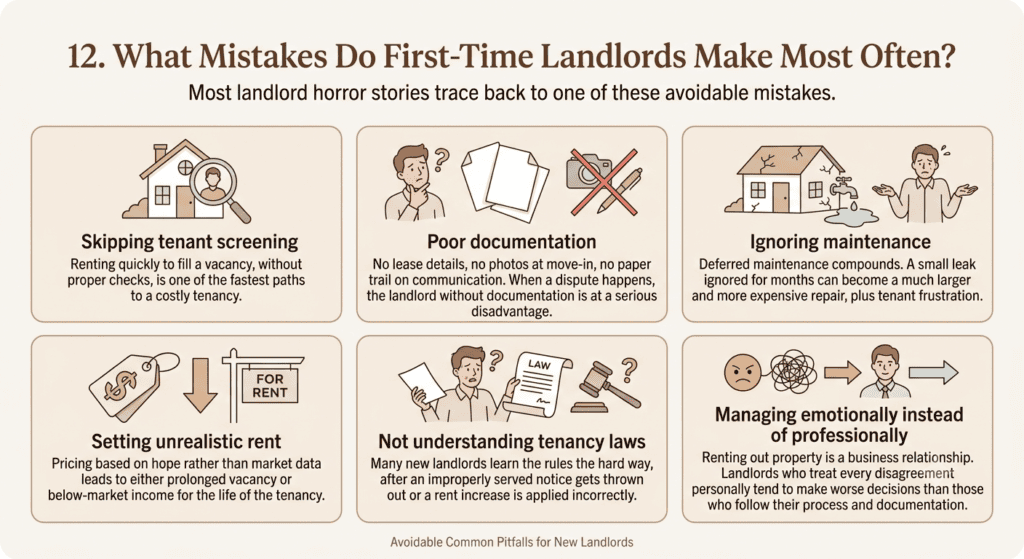
Most landlord horror stories trace back to one of these avoidable mistakes.
Skipping tenant screening
Renting quickly to fill a vacancy, without proper checks, is one of the fastest paths to a costly tenancy.
Poor documentation
No lease details, no photos at move-in, no paper trail on communication. When a dispute happens, the landlord without documentation is at a serious disadvantage.
Ignoring maintenance
Deferred maintenance compounds. A small leak ignored for months can become a much larger and more expensive repair, plus tenant frustration.
Setting unrealistic rent
Pricing based on hope rather than market data leads to either prolonged vacancy or below-market income for the life of the tenancy.
Not understanding tenancy laws
Many new landlords learn the rules the hard way, after an improperly served notice gets thrown out or a rent increase is applied incorrectly.
Managing emotionally instead of professionally
Renting out property is a business relationship. Landlords who treat every disagreement personally tend to make worse decisions than those who follow their process and documentation.
Conclusion
Every successful landlord started out with exactly the same questions you have right now. The difference between a smooth first year and a stressful one usually comes down to preparation: understanding your responsibilities, setting up proper systems before you need them, and knowing where to draw the line between what you can handle yourself and what deserves professional support.
Pricing correctly, screening thoroughly, documenting everything, and staying current on Ontario’s tenancy laws will protect both your investment and your peace of mind. But even with the best systems in place, managing tenants, maintenance, paperwork, and legal compliance is a genuine time commitment, one that catches many first-time landlords off guard once real life gets busy again.
None of this means you need to have every answer before you list your first unit. It means knowing where to look, which questions matter most at each stage, and when it’s worth bringing in help instead of learning an expensive lesson on your own.
If that sounds like more than you want to take on alone, you don’t have to. The team at The HAH Developments specializes in helping Niagara Region property owners maximize rental income while minimizing the day-to-day stress of self-management. From tenant screening to maintenance coordination to full legal compliance, we handle the details so you don’t have to learn them the hard way.
Ready to make property ownership work for you instead of the other way around? Contact The HAH Developments today to learn how our property management solutions can protect your investment and give you your time back.
Frequently Asked Questions
Can I increase rent whenever I want?
No. In Ontario, rent can only be increased once every 12 months for the same tenant, and the increase generally cannot exceed the annual guideline unless you’ve applied for an Above Guideline Increase through the Board. You also need to give proper written notice, typically at least 90 days in advance.
How often should I inspect my rental property?
Most landlords conduct a walk-through every three to six months, in addition to move-in and move-out inspections. Always provide proper written notice before entering, except in genuine emergencies.
Should utilities be included in rent?
It depends on your property and target tenant. Including utilities can simplify billing and make a listing more attractive, but it also removes the tenant’s incentive to conserve. Many landlords prefer to keep major utilities separate and billed directly to the tenant.
Is landlord insurance mandatory?
It’s not legally required in most cases, but it’s essential in practice. Your mortgage lender may require it as a condition of financing, and without it, you’re personally exposed to the full cost of property damage, liability claims, or lost rental income.
Can I evict a tenant immediately for unpaid rent?
No. Even for unpaid rent, you must follow the formal process: serve the correct notice, then apply to the Landlord and Tenant Board if the issue isn’t resolved. <cite index=”22-1″>As of April 2026, average scheduling for a straightforward non-payment application runs around three months, though this varies by region and case complexity.</cite> There is no legal shortcut to bypass this process, no matter how frustrating the delay feels.