
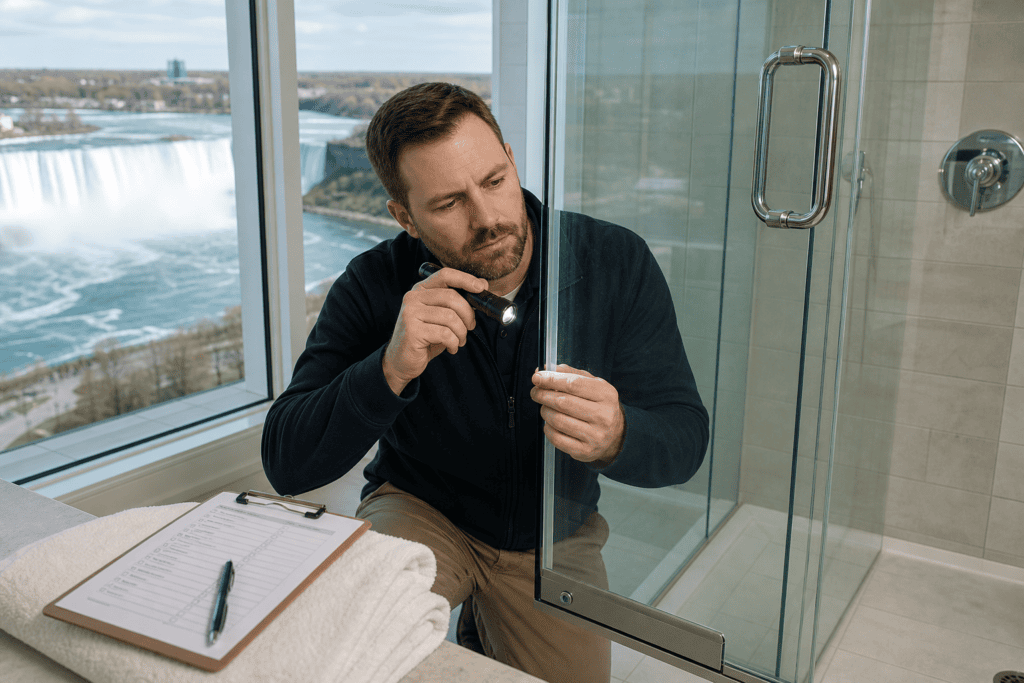
Rental-property glass needs more than occasional cleaning. Windows, doors, shower enclosures, mirrors, railings, and decorative panels should be observed as part of routine property care because a small change can affect appearance, moisture control, access, or the surrounding frame and hardware.
The safest approach is to inspect and document what you can see, avoid improvised repairs, and arrange qualified assessment when the defect is uncertain, changing, leaking, or connected to movement or damaged fittings. A checklist can identify an issue, but it cannot determine remotely whether a pane should be repaired, replaced, or monitored.
Quick summary

- Record chips, cracks, failed-looking seals, leaks, rattling, and loose fittings instead of dismissing them.
- Clean glass and nearby materials carefully without forcing tools into edges, seals, tracks, or hardware.
- Inspect the complete assembly, including the pane, frame, hinges, handles, tracks, and seals.
- Use turnover checks and dated photographs to compare condition over time.
- Request professional assessment when damage is changing, the defect is unclear, or access and rental operations may be affected.
Mistake 1: Treating a small chip, crack, or change as harmless
A small chip or short crack is an observation that deserves a record, not an automatic diagnosis. Its significance may depend on its position, whether it is spreading, whether it reaches an edge or corner, whether impact marks are visible, and whether the glass belongs to a door, shower enclosure, window, mirror, or another assembly.
Record the exact room and location, describe the visible shape, and photograph it from a consistent distance. If an earlier inspection photograph exists, compare the images without assuming that a visual difference proves a particular cause. The useful question is whether the condition appears unchanged, newly developed, or different enough to require assessment.
Pay attention to changes accompanied by moisture, drafts, movement, rattling, misalignment, or loose hardware. These observations may point beyond the glass itself. They do not establish the repair required, but they give a provider better information.
The National Park Service identifies regular inspection, cleaning, and recordkeeping as important stained-glass preservation practices. Its guidance is specific to stained glass, but the principle of retaining inspection records is useful for rental-property maintenance generally. The National Park Service stained-glass maintenance guidance explains why early identification and records matter.
What to record when damage first appears
- The property, room, fixture, and side of the assembly.
- Whether the issue is a chip, crack, cloudy area, moisture mark, scratch, loose fitting, or another change.
- Whether it reaches an edge, corner, frame, hinge, track, handle, or seal.
- Whether it appears different from an earlier photograph or report.
- Who noticed it and whether a guest, tenant, cleaner, or maintenance worker reported a related symptom.
Mistake 2: Cleaning glass without considering surrounding materials

Glass is only one part of most rental installations. A window may include a frame, seal, track, screen, latch, and adjacent wall finish. A shower enclosure may include hinges, channels, handles, and seals. Mirrors may have edges or backing that should not be treated like exposed glass.
Cleaning should remove ordinary surface dirt without creating a new maintenance problem. Avoid forcing cloths, scrapers, or other tools into edges and seals. Do not leave excess moisture around frames, tracks, hardware, or unprotected edges. If the glass type, finish, coating, or surrounding material is uncertain, follow available manufacturer instructions or ask a qualified provider before using a stronger product or abrasive method.
Cleaning can also hide a defect if it is performed without an inspection step. Before wiping a pane, look for chips, cracks, haze, moisture between layers, loose hardware, and impact marks. After cleaning, check whether the condition remains and record it rather than assuming the issue has disappeared.
Separate observations from repair conclusions
“There is moisture at the lower corner of the shower door” is a useful observation. “The seal needs replacement” is a repair conclusion that may require assessment. Similarly, “the window looks cloudy between layers” describes a symptom, while “the insulated unit has failed” is a diagnosis that should not be made from a general checklist.
This distinction helps owners communicate accurately with cleaners, tenants, managers, and repair providers. It also reduces the risk of choosing a product or method before the actual defect and construction are understood.
Mistake 3: Attempting a repair before identifying the defect
Cleaning, monitoring, repair, and replacement are different decisions. A generic adhesive, filler, sealant, pressure, or force may be unsuitable for the glass, coating, frame, or hardware involved. Applying it can affect appearance or make later assessment more difficult.
A checklist can help provide useful information, but it cannot identify every glass type or determine whether a defect is cosmetic, structural, seal-related, or connected to the surrounding construction. This matters especially when glass is in a moving door, near an edge or corner, associated with a leak, or showing change over time.
When to request assessment
Arrange qualified help when the glass or defect is unclear, a crack appears to be changing, a chip is near an edge or corner, moisture or a draft is present, or a door, panel, hinge, handle, track, or frame is moving unusually. These are reasons for assessment, not proof that replacement is required.
Before requesting help, take clear photographs, note the location, and describe what changed. Do not remove fittings or apply pressure simply to investigate. A provider can then determine whether the next step is further inspection, repair, replacement, or coordination with another maintenance trade.
Mistake 4: Inspecting the pane but not the surrounding system
A glass problem may actually involve the complete installation. A window can have a damaged frame, blocked track, deteriorated-looking seal, or latch that does not operate normally. A glass door may show movement at a hinge or handle. A shower enclosure may allow water near a channel or seal.
Look without disassembling anything. Observe frames, tracks, hinges, handles, latches, locks, and visible seals. Note movement, rattling, misalignment, water marks, dampness, drafts, or contact between moving parts. Record the symptom and location rather than naming a cause you cannot verify.
This broader view matters for property maintenance in Niagara because a glass repair appointment may need to be coordinated with cleaning, general maintenance, or another specialist. Reporting only “broken glass” may omit information needed to address a related leak, fitting, or frame concern.
Mistake 5: Leaving glass checks out of rental turnovers
Short-term rental turnovers create a natural opportunity to observe glass before the next guest arrives. The check need not become a technical examination. It should be a consistent visual review that identifies obvious changes, records guest reports, and sends unclear or worsening conditions to the appropriate maintenance contact.
A cleaner or turnover coordinator can note the room, fixture, visible symptom, and photograph. If a guest reported a crack, difficult door, leak, or unusual movement, preserve that information with the turnover record. A host should avoid promising a technical conclusion before the issue has been assessed.
Long-term rentals require a different operational emphasis. Tenants may report problems between scheduled reviews, so owners and managers should provide a clear way to record location and symptoms. Follow-up should state whether a provider attended, what was recommended, and whether another inspection is needed.
For broader short-term rental operating context, this overview of Airbnb hosting in Niagara Falls explains responsibilities that accompany hosting. Glass checks should fit within the wider communication, cleaning, and maintenance workflow.
A practical glass inspection checklist for rental properties
Use this checklist as an operational prompt, not as a legal, building-code, or safety standard. It helps owners, hosts, cleaners, tenants, and managers describe what they observe. If a condition is unclear, changing, or associated with movement or moisture, record the uncertainty and arrange appropriate assessment.
1. Identify the location
- Record the property, room, fixture, and exact position of the glass.
- Note whether it is a window, door, shower enclosure, mirror, railing, cabinet panel, or another installation.
- Record the glass type only if known from records, labels, or a provider. Do not guess.
2. Review the visible surface
- Look for chips, cracks, scratches, impact marks, cloudy areas, stains, or distortion.
- Note whether a defect extends toward an edge, corner, frame, hinge, channel, or seal.
- Compare with earlier photographs when available.
3. Observe surrounding components
- Check frames, glazing edges, tracks, channels, hinges, handles, latches, locks, and visible seals.
- Look for movement, rattling, misalignment, water marks, drafts, or contact between moving parts.
- Do not remove trim, pull fittings, press on a pane, or disassemble the assembly.
4. Check moisture and related symptoms
- Record condensation, moisture at an edge, unexpected water, or dampness near the frame.
- Note whether a shower door, window, or exterior door allows water or air through differently than before.
- Describe the symptom without assuming its source.
5. Photograph and write an escalation note
- Take one context photograph and one close view when appropriate.
- Include the date, person completing the check, and whether it was before or after cleaning.
- Write what changed, who reported it, whether it appears stable, and what access limits may affect the next step.
Turnover-specific checks
During a short-term rental turnover, focus on visible damage, cleanliness around edges, door operation, shower moisture, mirrors, and guest comments. Record an issue before cleaning if cleaning could obscure evidence. If a guest-facing area is affected, notify the responsible owner or manager so the condition can be assessed and the operational decision documented.
Long-term rental checks
For a long-term rental, preserve the tenant’s description as well as your own observations. Record when the issue was received, where it is located, whether it is changing, and what follow-up was arranged. Do not turn this checklist into an unsupported statement about legal obligations or habitability.
Repair, replacement, or continued monitoring: how to frame the decision
Owners often want to know whether glass can be repaired. The responsible answer depends on the glass, defect, surrounding installation, appearance requirements, access, and provider assessment. A visible chip does not automatically establish that replacement is needed, and a defect that looks minor should not automatically be left unrecorded.
When monitoring may be reasonable
If a qualified provider or responsible maintenance process identifies a condition as suitable for observation, keep dated records and compare the same area during future checks. Monitoring should not mean forgetting the issue. Set a follow-up point and note what change would trigger reassessment.
When assessment is more appropriate
Request assessment when the defect is uncertain, a crack or other change appears to spread, moisture or a draft is present, or the surrounding frame and hardware show movement. Assessment can clarify whether work concerns glass, a seal, hardware, a frame, or several components.
Operational tradeoffs
Repair may involve less disruption in some circumstances, but suitability depends on the defect and material. Replacement can affect access, scheduling, appearance, measurements, and the surrounding installation. Ask the provider to explain the recommendation and identify related work before approval.
For a rental, the decision also affects turnover timing, tenant or guest communication, cleaning, and future inspection records. The goal is a documented decision based on the actual condition, not the cheapest-looking response from a photograph.
Mistake 6: Keeping inadequate maintenance records
A useful record allows someone who was not present to understand what happened. “Window issue fixed” is usually too vague. A stronger entry identifies the property, room, fixture, symptom, date, photographs, reporter, action taken, provider recommendation, completion date, and follow-up.
A useful record includes:
- Location: property, room, fixture, and exact side or section.
- Observation: crack, chip, haze, leak, moisture, scratch, loose fitting, movement, or other symptom.
- Context: turnover, tenant report, guest message, cleaning observation, inspection, or maintenance visit.
- Evidence: dated wide and close photographs when appropriate.
- Action: cleaned, documented, monitored, assessed, repaired, replaced, or referred.
- Follow-up: recommendation, outstanding question, review date, and completion confirmation.
Records support continuity when cleaners, managers, tenants, or providers change. They also help distinguish recurring symptoms from new events. The National Park Service specifically recommends retaining stained-glass inspection records. Its recordkeeping advice is useful here, while its specialist interval guidance should remain limited to stained glass.
How often should rental glass be checked?
There is no single interval that can responsibly apply to every rental window, door, mirror, or shower enclosure. A schedule should reflect turnover patterns, maintenance history, exposure to moisture or impact, reported problems, and the type of glass and installation.
Short-term operators can incorporate a visual check into turnovers. Long-term owners can connect observations to planned maintenance reviews and tenant reports. Additional checks may be appropriate after an impact, leak, unusual movement, or other change.
The National Park Service discusses yearly custodian inspections and specialist assessment every three to five years for stained glass. Those intervals are specific to stained-glass preservation and should not be presented as a general rule for ordinary rental glass.
How owners and managers should coordinate glass repair
A clear handoff reduces repeated visits and prevents a provider from reconstructing the issue from a short message. Start with the exact location, what was observed, when it was noticed, whether it is changing, and whether moisture, movement, or a guest or tenant report is involved.
- Describe the symptom: State what is visible or reported without diagnosing the cause.
- Attach photographs: Include context and close views when appropriate.
- Note access: Explain whether the property is occupied, between stays, or subject to scheduling limits.
- Identify related observations: Mention moisture, drafts, rattling, difficult operation, loose fittings, or frame changes.
- Request assessment: Ask whether the recommendation is monitoring, repair, replacement, or related maintenance.
- Document the outcome: Save the recommendation, work completed, photographs, and follow-up date.
In Niagara Falls, The Home Away From Home Developments Inc. is a property management company offering glass repair alongside property maintenance and rental management services. Owners using a management partner should confirm the scope of coordination, documentation, access arrangements, and approval process rather than assuming every glass issue has the same response.
Glass maintenance priorities for short-term and long-term rentals
Short-term rentals
Short-term rental operations depend on frequent turnovers and clear communication. The priority is to notice visible changes before the next guest arrives, connect the observation to the correct room and fixture, and avoid allowing an uncertain condition to disappear into a general cleaning note.
Retain guest messages describing cracks, leaks, difficult doors, unusual sounds, or other symptoms. A host can acknowledge the report without making an unsupported diagnosis. The manager or owner can then decide whether to arrange assessment, schedule work, or document the condition for monitoring.
Long-term rentals
Long-term maintenance relies more heavily on tenant reporting and planned property reviews. Preserve the original description, record when it was received, and communicate the next step clearly. If a provider recommends further assessment or related work, add that recommendation to the property record.
Both rental types benefit from accurate observations and follow-up. Short-term rentals may offer more frequent visual opportunities, while long-term rentals may need stronger systems for receiving reports and tracking completion.
Questions to ask before arranging glass repair
- What type of glass, door, window, mirror, or fitting appears to be involved?
- What symptom was assessed, and does the photograph show the full surrounding assembly?
- Is the recommendation repair, replacement, monitoring, or further assessment?
- Could the frame, seal, track, hinge, handle, or nearby component be involved?
- What access, preparation, or downtime may be needed?
- What information should be added to the maintenance record?
- Are related cleaning, moisture-control, or general maintenance tasks required?
- What follow-up should occur after the work?
These questions do not guarantee a particular method, price, timeline, or outcome. They help owners understand the recommendation and keep records aligned with the actual condition.
Frequently asked questions
How often should rental-property glass be inspected?
The schedule depends on turnover patterns, glass type, maintenance history, exposure, and reported problems. Short-term operators can include visual checks in turnovers, while long-term owners can connect checks with planned reviews and tenant reports. The National Park Service’s yearly and three-to-five-year recommendations apply specifically to stained glass, not ordinary rental windows or doors.
Can a small chip in rental-property glass be ignored?
It should not be ignored without recording its location, appearance, photographs, and changes over time. A small chip does not automatically mean replacement is required, but its position and relationship to edges, corners, moisture, movement, or hardware may matter. Arrange assessment if it changes or remains unclear.
What should an owner document before calling for glass repair?
Record the property, room, fixture, exact location, visible symptom, date noticed, reporter, and related moisture, draft, rattling, movement, or operating problem. Add dated photographs showing the fixture and affected area when possible. Note access limitations and describe observations rather than naming a diagnosis.
When should a rental manager coordinate specialist glass help?
Coordinate assessment when the glass or defect is uncertain, damage appears to be spreading, moisture or a draft is present, or frames and hardware show unusual movement. Specialist input is also useful for stained glass and other specialty installations. Provide the records, arrange access, document the recommendation, and coordinate related maintenance.
Conclusion: Make glass maintenance observable and documented
The most avoidable mistakes are failing to record changes, cleaning without considering frames and fittings, attempting repairs before identifying the defect, and treating a pane as separate from its installation. Owners can reduce confusion by inspecting consistently, photographing visible issues, preserving guest and tenant reports, and distinguishing observations from professional recommendations.
Use turnover and maintenance checks to identify changes, not to make unsupported diagnoses. Continue monitoring only when the condition is clearly documented and appropriate for observation. When damage is changing, the cause is uncertain, moisture or movement is involved, or rental operations may be affected, arrange assessment and record the decision.
Niagara Falls owners seeking coordinated property maintenance or glass repair can contact The Home Away From Home Developments Inc. through its official website.