

A few years ago, “smart” property management meant a spreadsheet and a folder full of PDFs. Today, it means software that answers a tenant’s 11 p.m. maintenance message, flags a leaking water heater before it floods a unit, and tells you the exact rent to list at so your unit doesn’t sit empty for a month.
That shift didn’t happen quietly. Industry data shows AI adoption among property managers jumped from 21% in 2024 to 34% in 2025, and the number of property management companies using some form of AI tool has nearly tripled in the past year alone, climbing from roughly 20% to 58%. Nearly all of that growth is being driven by one simple thing: results. Companies that have built AI into their day-to-day operations report a 20–30% jump in efficiency, and firms with broad AI adoption are projecting portfolio growth nearly triple that of firms still doing everything by hand.
For landlords, Airbnb hosts, and real estate investors in Ontario, this isn’t a Silicon Valley story anymore. It’s showing up in the tools you already use – your leasing platform, your maintenance app, even the chatbot that answers questions on a listing at 2 a.m. AI in property management is no longer a “someday” technology. It’s becoming the baseline for how well-run rental businesses operate.
But here’s the part that gets lost in a lot of the hype: AI doesn’t replace good property management. It sharpens it. The properties getting the best results in 2026 are the ones pairing smart technology with experienced people who know their local market, their tenants, and their buildings. This guide walks through exactly how that combination works – and how you can start using it, whether you own one rental or a growing portfolio.
What Is AI in Property Management?
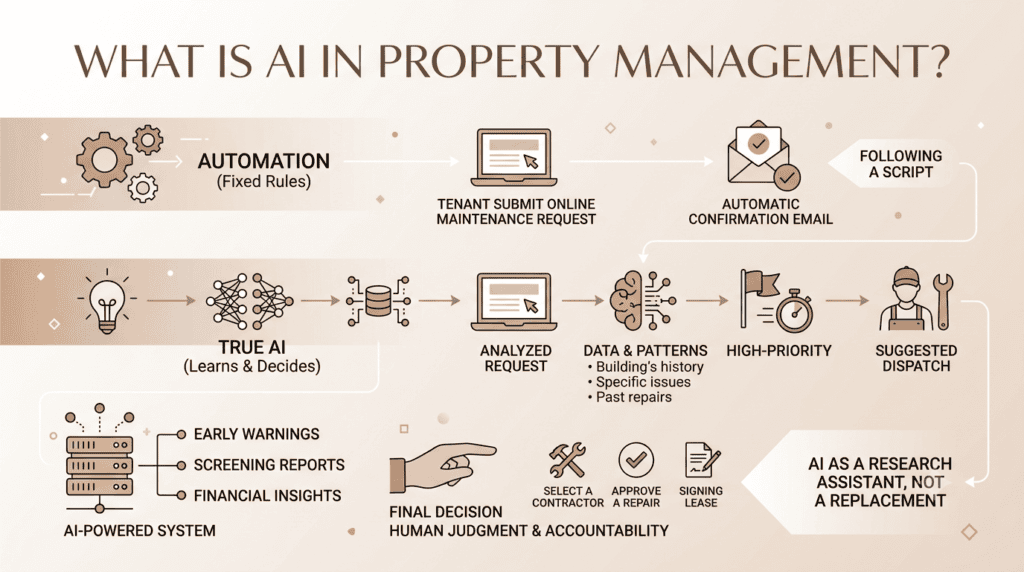
AI in property management refers to software that uses machine learning, data analysis, and pattern recognition to handle tasks that used to require a person sitting down and doing them manually – reviewing applications, pricing units, spotting maintenance problems, answering tenant questions, and pulling together financial reports.
It’s worth separating two terms that get used interchangeably but aren’t the same thing.
Automation follows fixed rules. If a tenant submits a maintenance request, automation can send an automatic confirmation email. That’s helpful, but it’s not thinking – it’s just following a script.
True AI looks at data, learns from patterns, and makes judgment calls. If that same maintenance request mentions “no hot water” and the system knows this unit’s water heater is nine years old and has had two prior repairs, AI can flag it as high-priority and suggest dispatching a plumber same-day, rather than waiting in a general queue.
Most property management technology today blends both. Automation handles the repetitive stuff. AI handles the pattern spotting and decision support.
Importantly, AI in property management doesn’t replace property managers – it supports them. An early-warning maintenance alert still needs a human to approve the repair and choose the contractor. A tenant screening report still needs a person to make the final leasing decision. AI shows up as a research assistant working around the clock, not as a replacement for judgment, relationships, or accountability.
AI-Powered Tenant Screening
Tenant screening is one of the clearest examples of where AI has moved from “nice to have” to standard practice. Automated screening tools can now reduce application fraud by as much as 75% while cutting decision times from days down to minutes, which matters a great deal in a competitive rental market where good applicants don’t wait around.
Faster Application Reviews
Instead of a property manager manually cross-referencing credit reports, employment letters, and references, AI tools pull and organize this information automatically. Property managers using these systems report saving significant hours per listing, freeing up time to actually talk to applicants and make thoughtful decisions rather than chasing paperwork.
Risk Analysis and Fraud Detection
Fake pay stubs, doctored bank statements, and identity fraud have become more sophisticated, and AI-driven screening tools are built to catch them. These systems cross-check documents, verify bank links, and flag inconsistencies a busy property manager might miss during a manual review – for example, an income document that doesn’t match the stated employer’s typical pay structure.
More Consistent Screening Processes
One of the most underrated benefits of AI tenant screening is consistency. When every applicant is evaluated against the same criteria in the same order, it removes the subjectivity that can creep into manual reviews – even unintentionally. That consistency isn’t just fairer; it’s also easier to document and defend if a decision is ever challenged.
Fair Housing and Privacy Compliance
This is the part landlords cannot skip. In Ontario, provincial human rights law prohibits discrimination in rental housing, and using AI does not change that responsibility – it actually raises the bar. Under Canada’s private-sector privacy law, tenants have a right to know when automated decision-making is being used in ways that significantly affect them. The safest approach is to treat AI as a tool that surfaces information, while a person remains the final decision-maker, with clear documentation showing that the same criteria were applied to every applicant. That paper trail is your best protection if a rejected applicant ever raises a complaint.
24/7 AI Chatbots and Virtual Leasing Assistants
Rental inquiries don’t arrive on a nine-to-five schedule. A prospective tenant scrolling listings after work at 9 p.m. wants an answer then, not the next morning. This is exactly the gap AI chatbots and virtual leasing assistants fill.
Instant Responses to Tenant Inquiries
Speed matters more than most landlords realize. Properties that respond to a rental inquiry within two hours convert to a booked showing at a much higher rate than those that wait six hours or longer, where interest drops off sharply. An AI chatbot can respond within seconds, any time of day, keeping interested renters engaged instead of moving on to the next listing.
Scheduling Property Tours
Instead of a back-and-forth email chain trying to find a time that works, virtual leasing assistants can check calendar availability and book a showing instantly. For property managers juggling multiple units, this alone can save hours every week.
Answering FAQs
Most rental questions are repetitive: Is parking included? Are pets allowed? What’s the deposit? An AI assistant trained on your listing details can answer these instantly and consistently, without a property manager having to type the same response for the twentieth time that week.
Improving Tenant Satisfaction Through Faster Communication
The benefit doesn’t stop at leasing. Current tenants get the same fast, consistent communication for everyday questions – when rent is due, how to submit a maintenance request, what the guest policy is. Faster answers mean fewer frustrated tenants and fewer calls escalating unnecessarily.
Predictive Maintenance Saves Money
If there’s one area where AI in property management delivers the most obvious return on investment, it’s maintenance.
AI Identifies Maintenance Issues Before Failures Occur
Predictive maintenance flips the old model on its head. Instead of waiting for a furnace to die in January or a water heater to flood a unit, AI-driven systems analyze equipment data – run times, temperature patterns, vibration signatures – to catch early warning signs of failure. Properties using this approach have reported detecting equipment problems two to four weeks before they would have caused a breakdown.
IoT Sensors and Data Analysis
This works through small sensors placed on HVAC systems, water heaters, and other critical equipment. Those sensors constantly feed data back to a system that’s trained to recognize what “normal” looks like – and flag anything that starts drifting away from it.
Reduced Emergency Repairs
The financial impact here is significant. Research shows this proactive approach can lower overall maintenance costs by roughly 25–40% while cutting unexpected downtime by as much as half. For a landlord, that means far fewer 2 a.m. emergency calls and far fewer surprise invoices from an after-hours contractor.
Longer Asset Lifespan
Catching small problems early doesn’t just prevent breakdowns – it extends how long your equipment lasts in the first place. A furnace that’s serviced at the first sign of strain rather than run into total failure will simply last longer, protecting one of the biggest capital investments in any rental property.
Smarter Rent Pricing with AI
Pricing a rental unit used to come down to gut feeling and a quick look at a few competing listings. AI has turned that into a much more precise science.
Market Trend Analysis
Modern pricing tools analyze dozens to hundreds of variables per unit – competitor pricing updated daily, seasonality, how close a lease is to expiring, and local demand signals – to recommend a rate that reflects what’s actually happening in the market right now, not what it was three months ago.
Demand Forecasting
Rental markets shift fast. In many Canadian cities, vacancy rates have been climbing through 2026 as new supply comes online, which means pricing too high – even slightly – can leave a unit sitting empty for weeks. AI pricing tools track these shifts in near real time, adjusting recommendations as demand rises and falls.
Vacancy Reduction
This precision pays off directly. Portfolios using data-driven pricing tools have cut average vacancy duration by several days per unit while still achieving slightly higher realized rents than manual pricing methods. On a single unit, a few days doesn’t sound like much – but multiplied across a portfolio, it adds up to real income.
Competitive Rental Pricing
The goal isn’t always to charge the maximum – it’s to find the number where a quality tenant signs quickly and stays long-term. AI helps landlords strike that balance instead of either overpricing and losing weeks of rent, or underpricing and leaving money on the table.
This matters even more in a market that’s shifting the way Ontario’s rental market is right now. After years of intense competition and steady rent growth, several major Canadian cities have seen vacancy rates climb and rent growth slow through 2026, with more landlords offering incentives to attract tenants. In that kind of environment, pricing based on last year’s numbers – or on what the unit down the hall rented for eight months ago – can leave a property sitting empty far longer than it should. AI pricing tools update constantly, which means a landlord isn’t guessing at what the market looks like today; the software is already tracking it.
Automated Lease and Document Management
Paperwork has always eaten up a disproportionate share of a property manager’s week. AI is closing that gap fast.
AI-Generated Lease Summaries
Instead of reading through a full lease line by line every time a question comes up, AI tools can generate plain-language summaries that highlight key terms – rent amount, renewal dates, pet clauses, maintenance responsibilities – so both property managers and tenants can find answers quickly.
Document Organization
Leases, inspection reports, insurance certificates, and correspondence used to live scattered across email threads and filing cabinets. AI-powered document systems organize and tag this material automatically, so nothing important gets buried when you need it during a dispute or an audit.
Contract Review Assistance
AI tools can scan lease agreements for missing clauses, inconsistent terms, or language that doesn’t match current provincial requirements, flagging it for review before a lease is signed rather than after a problem comes up.
Reduced Administrative Workload
None of this replaces a lawyer or a property manager’s judgment, but it does cut down significantly on the hours spent on repetitive document work – time that can be redirected toward tenant relationships and property performance instead.
AI for Financial Reporting and Expense Tracking
Owners and investors want to know one thing above all else: how is my property actually performing? AI has made that answer far easier to get to.
Automated Reporting
Instead of manually compiling income and expense data at the end of each month, AI-connected accounting tools pull transactions automatically and generate reports in real time, giving owners an up-to-date picture without waiting for a manual close.
Expense Categorization
AI systems learn to sort expenses – repairs, utilities, insurance, management fees – automatically and consistently, which cuts down on the kind of manual bookkeeping errors that can throw off a full year’s numbers.
Cash Flow Insights
Beyond simple reporting, AI tools can flag trends before they become problems – a maintenance category creeping upward month over month, or a unit consistently underperforming its comparables – giving owners a heads-up while there’s still time to act.
Portfolio Performance Dashboards
For owners managing multiple properties, dashboards pull everything into one view: occupancy, revenue, expenses, and maintenance costs side by side. That makes it far easier to see which properties are carrying the portfolio and which need attention.
Better Tenant Experience Through AI
It’s easy to think of AI in property management purely as a cost-saving tool for owners. But tenants benefit just as much, and happier tenants mean fewer vacancies and lower turnover costs.
Faster Maintenance Updates
Nobody likes submitting a repair request and hearing nothing for days. AI-powered systems can automatically update tenants on the status of their request – confirmed, contractor assigned, scheduled for Thursday – without anyone having to manually follow up.
Personalized Communication
AI tools can tailor communication based on a tenant’s history and preferences, whether that’s a reminder in their preferred language or a heads-up about something relevant to their specific unit.
Automated Reminders
Rent due dates, lease renewal deadlines, scheduled inspections – AI handles the reminders automatically, reducing missed payments and last-minute scrambles on both sides.
Improved Renewal Experience
When a lease is coming up for renewal, AI tools can flag the tenant’s payment history, maintenance record, and satisfaction signals, helping property managers decide who to prioritize retaining and what renewal terms make sense – turning renewals into a smoother, more informed conversation instead of a guessing game.
Benefits of AI for Property Managers
Pulling all of this together, the case for AI in property management comes down to a handful of measurable benefits.
- Increased productivity – AI can reduce errors in lease administration by up to 42% and save property managers roughly 10 hours a week that used to go toward manual, repetitive tasks.
- Lower operating costs – Companies using AI across their operations report average cost savings of around 25%, driven by fewer emergency repairs, tighter admin overhead, and smarter vendor management.
- Faster response times – From tenant inquiries to maintenance requests, AI closes the gap between “something happened” and “someone responded.”
- Improved decision-making – Real-time data on pricing, maintenance, and tenant risk gives property managers information they simply didn’t have access to a few years ago.
- Better portfolio management – Dashboards and predictive tools make it possible to manage more units well, rather than managing more units by simply working longer hours.
Challenges and Considerations
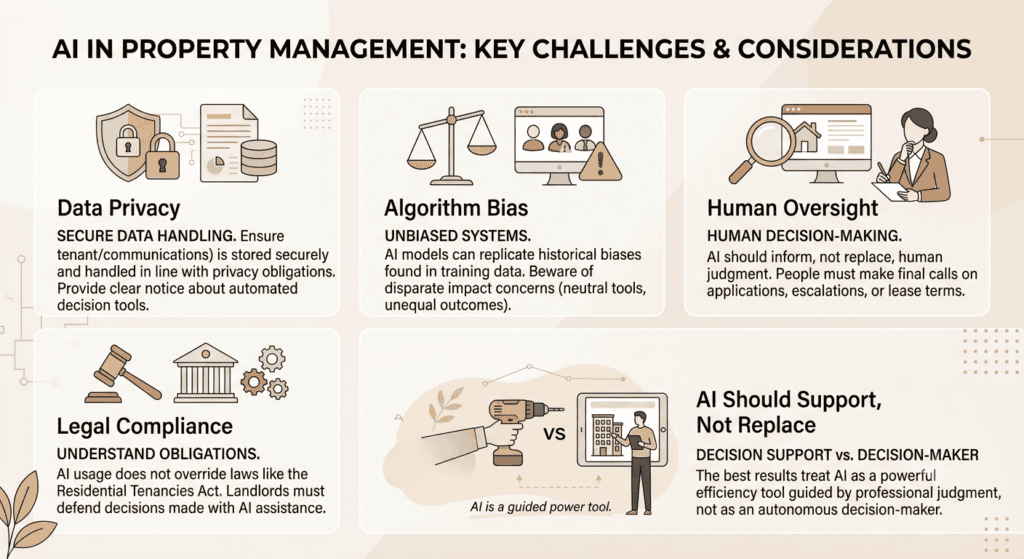
None of this comes without trade-offs, and any landlord considering AI tools should go in with eyes open.
Data Privacy
AI systems rely on large amounts of tenant and property data – income details, credit history, communication records. That data needs to be stored securely and handled in line with privacy obligations, including giving tenants clear notice when automated tools are being used to make decisions that affect them.
Algorithm Bias
AI is only as fair as the data it’s trained on. If a screening tool was trained on biased historical data, it can end up replicating that bias at scale, even without anyone intending it to. This is why disparate-impact concerns – meaning a tool that appears neutral but produces unequal outcomes – apply regardless of intent.
Human Oversight
AI should inform decisions, not make them unsupervised. A screening tool can surface risk factors, but a person should be the one making the final call on an application, a maintenance escalation, or a lease term.
Legal Compliance
Ontario landlords already operate under the Residential Tenancies Act and provincial human rights law. Layering AI on top doesn’t remove those obligations – it just means you need to understand how your tools work well enough to defend the decisions they help you make.
AI Should Support, Not Replace, Professional Judgment
The properties running into trouble with AI are usually the ones treating it as a decision-maker rather than a decision-support tool. The properties getting it right treat AI the way a good contractor treats a power tool – useful, efficient, but still guided by a skilled hand.
The Future of AI in Property Management
The pace of change here isn’t slowing down. A few trends worth watching heading further into 2026 and beyond:
- Predictive analytics will keep expanding beyond maintenance and pricing into areas like tenant retention forecasting and capital expenditure planning.
- Smart buildings with connected sensors will make entire properties, not just individual appliances, part of the early-warning maintenance picture.
- Voice assistants are starting to handle basic tenant requests and property manager tasks hands-free.
- Digital inspections using AI-assisted photo and video analysis are speeding up move-in and move-out documentation, reducing disputes over damage.
- AI-driven investment insights are helping investors evaluate potential acquisitions with automated valuation models that have become dramatically more accurate in recent years.
- Greater integration between AI tools and core property management software means fewer disconnected systems and more information in one place.
The broader numbers back up how quickly this space is moving. The global market for AI applications in real estate was valued at roughly $303 billion in 2025 and is projected to approach the $1 trillion mark within the next few years, reflecting how fast the technology is being absorbed across leasing, valuation, maintenance, and investment analysis. For landlords and investors, that pace of growth means the tools available today will likely look basic compared to what’s standard in just a couple of years – which is exactly why building good habits around data, documentation, and human oversight now will pay off as the technology keeps advancing.
Why Human Expertise Still Matters
For all the ground AI has covered, there are things it simply cannot do – and probably shouldn’t try to.
Handling Disputes
When a tenant and landlord disagree about a security deposit deduction or a noise complaint, that conversation needs empathy, context, and judgment. AI can organize the facts. It can’t read a room or de-escalate a tense situation.
Building Tenant Relationships
Good tenants renew because they trust their property manager, not because a chatbot answered quickly. Relationships are still built through consistency, follow-through, and the kind of care that a person – not a script – provides.
Strategic Planning
Deciding whether to renovate, hold, or sell a property involves weighing local market knowledge, an owner’s goals, and long-term trends that go well beyond what any dashboard can capture on its own.
Local Market Knowledge
AI models are trained on data, but experienced property managers know things data doesn’t always capture – which streets are quietly gentrifying, which buildings have reputations with contractors, which neighbourhoods are about to see new supply come online.
Combining AI With Experienced Property Managers Delivers the Best Results
The properties performing best right now aren’t the ones that went all-in on automation and removed people from the equation. They’re the ones using AI to handle the repetitive, data-heavy work – freeing up experienced property managers to focus on the judgment calls, relationships, and local expertise that technology still can’t replicate.
How to Start Using AI in Property Management
If you’re managing one rental or a handful of units, you don’t need an enterprise budget to start benefiting from AI. Here’s a practical starting point.
Start with one pain point, not everything at once. Trying to overhaul screening, pricing, maintenance, and communication all in the same month usually leads to half-finished setups and frustrated tenants. Pick whichever part of your operation costs you the most time or money right now – for many landlords, that’s either vacancy days or maintenance emergencies – and start there.
Look for AI features already built into your existing software. Many property management platforms now include AI tools for tenant communication, maintenance scheduling, and pricing at little to no extra cost. Before shopping for a new tool, check whether your current system already has one.
Keep a human in the loop for every decision that matters. Set up your workflows so AI surfaces information – a risk flag, a pricing recommendation, a maintenance alert – but a person makes the final call. This protects you legally and keeps the process defensible if it’s ever questioned.
Document how your AI tools make decisions. If you use AI for screening or pricing, keep records showing the criteria were applied consistently across every applicant or unit. That documentation is your best protection if a tenant or applicant raises a concern down the line.
Reassess after 60–90 days. Track a few simple numbers before and after: average days vacant, maintenance costs, and time spent on admin work. If the tool isn’t moving those numbers, it’s not worth keeping.
For landlords who would rather skip the trial-and-error entirely, working with a property management company that has already tested and integrated these tools is often the faster, lower-risk route.
Conclusion
AI in property management has moved well past the experimental stage. It’s screening applicants more consistently, catching maintenance problems before they become emergencies, pricing units more accurately, and answering tenant questions faster than any team could manage alone. For landlords and investors, the numbers make a strong case: lower costs, fewer vacancies, and stronger returns.
But the technology works best as a partner to good property management, not a replacement for it. The relationships, judgment calls, and local market knowledge that keep tenants happy and properties performing still come from experienced people – AI just gives them better tools to work with.
If you’re a property owner in Niagara Falls or across Ontario looking to combine smart technology with genuinely hands-on, experienced management, The HAH Developments can help. From Airbnb hosting and short-term rental management to long-term leasing and full-service property care, our team blends the latest tools with real local expertise to protect your investment and maximize your returns. Contact The HAH Developments today to see how a strategic, tech-enabled approach to property management can work for your property.
Frequently Asked Questions
Is AI replacing property managers? No. AI handles repetitive, data-heavy tasks like screening, pricing, and maintenance alerts, but decisions that involve judgment, relationships, or disputes still need an experienced person involved.
Is AI tenant screening legal in Ontario? Yes, as long as it’s used to support – not replace – human decision-making, applies the same criteria to every applicant, and complies with Ontario human rights law and Canadian privacy obligations around automated decision-making.
How much money can predictive maintenance actually save? Research on this proactive, sensor-driven approach points to cost reductions in the range of 25–40%, along with a significant drop in unplanned equipment downtime, though results vary by building and equipment type.
Do I need a large portfolio to benefit from AI in property management? No. Many AI-powered tools built for leasing, screening, and maintenance are priced and designed for individual landlords and small portfolios, not just large institutional operators.
Will AI pricing tools always recommend the highest possible rent? Not necessarily. Good AI pricing tools balance rent maximization against vacancy risk, often recommending a rate that fills the unit quickly with a quality tenant rather than the highest number the market might theoretically bear.
What’s the biggest risk of using AI in property management? The biggest risk is treating AI as a fully autonomous decision-maker instead of a support tool. Data privacy, algorithm bias, and legal compliance all require ongoing human oversight, no matter how good the technology gets.