

An empty unit doesn’t just sit quietly waiting for a new tenant. It bleeds money every single day it stays that way.
Most landlords know that vacancy means lost rent. Few stop to add up everything else it costs: the mortgage payment that still comes due, the utilities you keep running so pipes don’t freeze, the lawn that still needs cutting, the ad spend, the showings, the paperwork, and the weeks of “almost” tenants who never sign a lease.
If you’re a property owner in Niagara Falls, St. Catharines, or anywhere across the Niagara Region, the timing to get serious about this couldn’t matter more. Rental supply is growing faster than demand right now, and tenants have more choice than they’ve had in over a decade. That means the landlords who win are the ones who treat vacancy prevention as a system, not an afterthought.
This guide breaks down exactly how to reduce vacancy rates using twelve strategies that experienced landlords and property managers use every day. You’ll learn how to price smarter, market better, keep good tenants longer, and shrink the gap between one lease ending and the next one starting. By the end, you’ll have a practical checklist you can start using this week.
Why Rental Vacancy Rates Matter More Than Ever
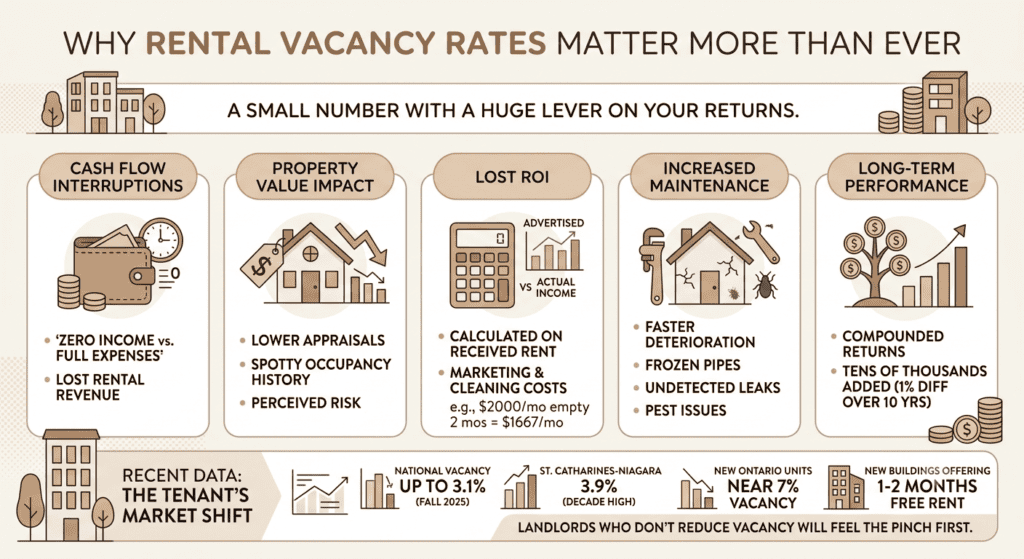
A vacancy rate sounds like a small, technical number. In practice, it’s one of the biggest levers on your property’s actual return.
Cash flow interruptions. Every vacant month is a month your property produces zero income while most of your expenses keep running exactly as before.
Property value impact. Buyers and appraisers look at occupancy history. A property with a spotty rental record often appraises lower than a comparable one with a stable tenant history, because future buyers price in the risk of turnover.
Lost ROI. Return on investment is calculated on actual income received, not advertised rent. A property advertised at $2,000 a month that sits empty for two months in a year is really earning $1,667 a month once you average it out – and that’s before you count the extra marketing and cleaning costs.
Increased maintenance costs. Vacant units deteriorate faster than occupied ones. Pipes freeze without regular heat cycling, pests move in undetected, and small issues like a slow leak go unnoticed until they become expensive repairs.
Long-term investment performance. Landlords who consistently keep vacancy low compound their returns year after year. A one percent difference in annual vacancy, held over a ten-year hold period, can add up to tens of thousands of dollars in additional rental income.
Recent data underscores why this matters right now. Ontario’s rental market has shifted meaningfully over the past year. According to the Canada Mortgage and Housing Corporation’s Fall 2025 Rental Market Report, the national purpose-built rental vacancy rate climbed to 3.1 percent, up from 2.2 percent the year before and above the national ten-year average, driven by record rental construction and softer demand. The St. Catharines–Niagara region held at a vacancy rate of 3.9 percent, a more-than-decade high, with Niagara Falls specifically posting some of the sharpest local increases due to softer tourism-driven employment and shifts in temporary foreign worker permits. Newly built rental units across Ontario were sitting at vacancy rates near 7 percent, and roughly three-quarters of new buildings were offering one to two months of free rent just to attract tenants.
In plain terms: this is a tenant’s market. Landlords who don’t actively work to reduce vacancy rates are the ones who will feel the pinch first.
1. Price Your Rental Based on Market Data-Not Emotion
Pricing is the single biggest lever you control, and it’s also the one landlords get wrong most often – usually because of attachment, not analysis.
Run a real Comparative Market Analysis (CMA). Look at at least five to eight active and recently rented comparable listings within a one- to two-kilometre radius. Match on bedroom count, square footage, parking, in-suite laundry, and condition, not just neighbourhood.
Avoid overpricing based on what you “need.” Your mortgage payment is not a market input. Tenants don’t care what you owe the bank; they care what similar units nearby actually cost.
Account for seasonal pricing. Rental demand in Niagara typically softens in November through February and picks up in spring and summer, partly driven by tourism-adjacent hiring and university terms nearby in St. Catharines. Pricing slightly more competitively in slow months can prevent a unit from sitting empty through an entire winter.
Monitor competing listings continuously, not just once before you list. If three similar units near yours drop their price or add a month of free rent, your listing is instantly less competitive even if nothing about your unit changed.
Know when to adjust. If you haven’t had a serious inquiry within 10 to 14 days of listing at a reasonable price, that’s your signal, not a reason to wait it out.
Pro Tip: Lowering rent by $50 a month costs you $600 a year if the unit is filled immediately. Thirty extra vacant days on a $2,000 unit costs you roughly $2,000 in lost rent, plus utilities and continued mortgage carrying costs. The math almost always favours pricing to fill quickly over holding out for a higher number.
2. Make Your Property Move-In Ready Before Listing
First impressions decide showings before a prospective tenant ever calls back.
- Professional cleaning, top to bottom, including inside appliances, baseboards, and grout – not a quick surface tidy.
- Fresh paint in neutral tones. It’s one of the cheapest upgrades with the highest visual impact per dollar spent.
- Minor repairs completed before listing: loose handles, dripping faucets, squeaky doors, and cracked outlet covers all signal neglect to a walk-through tenant even if they’re trivial to fix.
- Modern fixtures – updated light fixtures, cabinet hardware, and faucets can modernize a unit’s feel without a full renovation budget.
- Landscaping and curb appeal, especially for standalone homes and small multiplexes. The exterior is the first thing a prospective tenant sees, often before they even step inside.
A unit that’s genuinely move-in ready photographs better, shows better, and rents faster – which directly helps reduce vacancy rates before you even open the listing.
3. Create Listings That Stand Out Online
Your listing has seconds to earn a click, and only a little longer to earn a call.
- Professional photography. Listings with high-quality, well-lit photos consistently draw more inquiries than those shot on a phone with poor lighting.
- Virtual tours and video walkthroughs. These help pre-qualify serious tenants and cut down on wasted in-person showings for people who were never going to sign.
- SEO-friendly descriptions. Use natural language that includes what tenants actually search for – “2-bedroom apartment near Niagara Falls with in-suite laundry” performs better than vague marketing copy.
- Highlight nearby amenities: transit access, grocery stores, schools, parks, and – in Niagara specifically – proximity to tourism employment hubs and the QEW.
- Include floor plans. They help tenants visualize furniture placement and room flow, which reduces “maybe” responses and increases serious applications.
Listings with strong visuals and complete information consistently receive more qualified inquiries than bare-bones posts with a few dark photos and a two-line description.
4. Market Across Multiple Rental Platforms
Relying on a single listing site limits your pool of prospective tenants unnecessarily.
Post across:
- Zillow
- Realtor.ca
- Facebook Marketplace
- Local rental groups (Niagara-specific community groups often surface serious, local applicants quickly)
- Google Business Profile
- Your company website
- Social media advertising
- Email marketing to a list of past applicants or referral contacts
Different platforms attract different tenant demographics. A young professional scrolling Facebook Marketplace may never see a listing that only lives on a single classifieds site. Casting a wider net shortens the time between “vacant” and “leased.”
5. Respond to Tenant Inquiries Immediately
Speed is a competitive advantage that costs nothing but attention.
- Speed matters. Serious renters are usually contacting multiple listings at once. The first landlord to respond often books the first showing – and the first showing often gets the application.
- Automated responses confirming receipt of an inquiry, even outside business hours, keep prospective tenants engaged instead of moving on to the next listing.
- Schedule showings quickly, ideally within 24 to 48 hours of first contact.
- Manage leads systematically with a simple spreadsheet or CRM so no inquiry falls through the cracks during a busy week.
A delayed response of even a day or two can mean losing a qualified tenant to a competing property that called them back first.
6. Reduce Tenant Turnover Before It Happens
The cheapest vacancy is the one that never happens. Keeping good tenants in place is almost always more profitable than finding new ones.
- Excellent communication – responding to messages within a business day builds trust and reduces the small frustrations that push tenants toward moving.
- Fast maintenance response. Tenants who feel ignored on repair requests are far more likely to leave at lease end, regardless of rent price.
- Respectful, professional management that treats the property as their home, not just your asset.
- Annual inspections that catch small issues before they become expensive ones, done with proper notice and a collaborative tone.
- Tenant appreciation gestures – even something small, like a holiday card or a gift card, builds goodwill that pays off at renewal time.
- Renewal reminders sent 90 days before lease end, opening the conversation early instead of leaving it until the last minute.
Retention costs less than acquisition every time. A renewed lease means no vacancy gap, no new marketing spend, no new tenant screening, and no turnover cleaning or repairs.
7. Offer Lease Renewal Incentives
Sometimes a small investment prevents a large loss.
- Small rent discounts or rent freezes for tenants who renew early, especially given that Ontario’s 2026 rent increase guideline sits at 2.1 percent – the lowest cap in four years – meaning the financial upside of squeezing out the maximum legal increase is often smaller than the cost of finding a replacement tenant.
- Free carpet cleaning or a deep clean as a renewal thank-you.
- Appliance upgrades timed around renewal conversations.
- Flexible lease terms, such as offering a choice between a 12-month and 18-month renewal.
- Reserved parking or a small perk that costs you little but means something to the tenant.
These incentives are almost always cheaper than a vacancy period, turnover cleaning, new photography, and weeks of lost rent.
8. Minimize Turnover Time Between Tenants
When a tenant does give notice, the goal is zero gap between move-out and move-in. Build a simple, repeatable checklist:
- Notice received – confirm the exact move-out date in writing.
- Inspection scheduled – walk the unit within a few days of notice to scope needed work.
- Repairs booked – line up contractors before move-out day, not after.
- Cleaning arranged – professional cleaning booked immediately following move-out.
- Photography completed – new photos taken as soon as the unit is repair-ready and clean.
- Listing published before move-out – start marketing while the current tenant is still in their notice period, with respectful scheduling for showings.
- Keys ready for the new tenant on day one.
This operational sequencing is where many independently managed properties lose the most time – often two to four extra weeks per turnover simply because steps happen in sequence instead of in parallel. Overlapping these tasks is one of the fastest ways to reduce vacancy rates without spending a single extra dollar on marketing.
9. Offer Amenities Tenants Actually Want
Tenant expectations have shifted, and the properties that keep up rent faster and retain tenants longer.
- Pet-friendly policies – a huge differentiator, since pet owners often face limited options and stay longer once they find a welcoming landlord.
- Smart locks for keyless entry and easier turnover management.
- High-speed internet included or pre-wired, now considered close to a baseline expectation rather than a bonus.
- EV charging access, increasingly requested in newer builds and a strong differentiator for longer-term tenants with electric vehicles.
- In-suite laundry, consistently one of the top-requested features in listing searches.
- Energy-efficient appliances that also lower tenant utility costs, a meaningful selling point during a period of rising living costs.
- Storage space, even a small amount, which is frequently underestimated by owners but highly valued by renters juggling seasonal items and gear.
You don’t need every amenity on this list. Identifying which two or three matter most to your target tenant profile and delivering them well is usually more effective than a scattershot approach.
10. Screen Tenants Carefully-But Efficiently
Careful screening prevents future turnover problems, but a screening process that drags on for weeks can lose good applicants to faster-moving landlords.
- Credit checks to assess financial reliability.
- Employment verification to confirm stable income.
- References from current and previous landlords.
- Rental history review for past late payments or lease violations.
- Avoid unnecessary delays. Aim to complete screening within two to three business days of receiving a complete application.
The goal is thoroughness without friction. A strong applicant who feels stuck in a slow, unclear process may simply accept another offer while waiting on yours.
11. Track Your Vacancy Metrics
You can’t improve what you don’t measure. Track these key performance indicators consistently:
- Days on Market (DOM) – how long a unit sits vacant and listed before being leased.
- Lead-to-Showing Rate – the percentage of inquiries that convert into a booked showing.
- Showing-to-Application Rate – how many showings result in a submitted application.
- Application Approval Rate – how many applicants pass your screening criteria.
- Renewal Rate – the percentage of tenants who renew rather than move out.
- Annual Vacancy Rate – total vacant days across the year, divided by total available rental days.
Tracking these numbers over time reveals exactly where your process breaks down. If Days on Market is high but Lead-to-Showing is strong, your pricing or listing quality may be the issue. If showings are plentiful but applications are low, the unit itself or the terms may need adjusting. This kind of data-driven diagnosis is what separates landlords who guess from landlords who consistently reduce vacancy rates year over year.
12. Consider Professional Property Management
At a certain point, especially with more than one unit or a property outside your immediate area, professional management often pays for itself.
A professional team helps by:
- Pricing accurately, using live comparable data instead of guesswork.
- Marketing effectively across multiple channels with professional photography and copywriting.
- Managing maintenance through vetted contractor relationships that respond faster than a one-person operation typically can.
- Improving tenant retention through consistent, professional communication.
- Coordinating faster turnovers by running inspection, repair, cleaning, and marketing steps in parallel rather than in sequence.
- Handling leasing efficiently, from inquiry response through screening and lease signing.
This is exactly where The HAH Developments fits into the picture for Niagara Falls property owners. As a full-service property management company serving Niagara Falls, Ontario, we combine long-term rental management, short-term and Airbnb hosting, and hands-on maintenance coordination to keep occupancy high and vacancy periods short – without requiring owners to manage the day-to-day themselves.
Common Mistakes That Increase Vacancy Rates
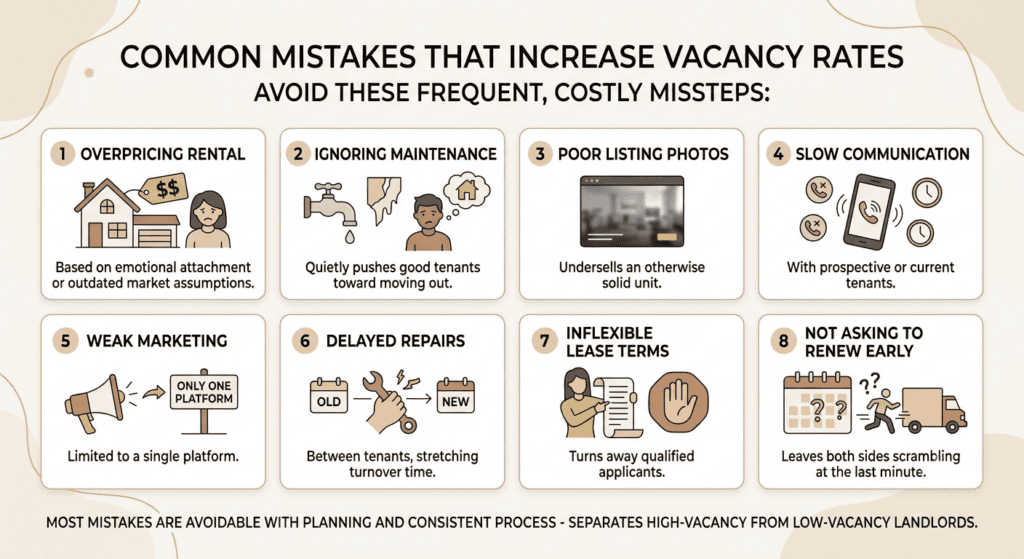
Avoid these frequent, costly missteps:
- Overpricing the rental based on emotional attachment or outdated market assumptions.
- Ignoring maintenance requests, which quietly pushes good tenants toward moving out at lease end.
- Poor listing photos that undersell an otherwise solid unit.
- Slow communication with prospective or current tenants.
- Weak marketing limited to a single platform.
- Delayed repairs between tenants that stretch turnover time unnecessarily.
- Inflexible lease terms that turn away otherwise qualified applicants.
- Not asking existing tenants to renew early enough to plan around, leaving both sides scrambling at the last minute.
Most of these mistakes are avoidable with a bit of planning and a consistent process – which is exactly what separates high-vacancy landlords from low-vacancy ones.
Quick Vacancy Reduction Checklist
Use this as a monthly self-audit:
- ✔ Review rental pricing monthly against live comparables
- ✔ Use professional photos for every listing
- ✔ Respond to inquiries within one hour where possible
- ✔ Keep the property move-in ready at all times
- ✔ Market on multiple platforms simultaneously
- ✔ Start renewal conversations 90 days early
- ✔ Schedule turnovers before move-out, not after
- ✔ Track vacancy metrics every month
Conclusion
Reducing vacancy rates isn’t about one clever trick – it’s about combining competitive, data-based pricing with proactive maintenance, wide-reaching marketing, excellent tenant service, and a tight, well-planned turnover process. Landlords who treat vacancy reduction as an ongoing discipline, not a one-time fix, consistently protect their cash flow and strengthen their long-term returns, even in a softer rental market like Niagara’s current conditions.
If managing all twelve of these moving parts sounds like more than you want to handle alone, that’s exactly the gap The HAH Developments was built to fill.
Ready to stop losing income to empty units? The HAH Developments helps Niagara Falls property owners maximize occupancy through professional pricing, marketing, tenant retention, and maintenance coordination – for long-term rentals, short-term rentals, and Airbnb hosting alike. Contact The HAH Developments today for a free property assessment and see exactly how much income your property could be capturing.
H2: Frequently Asked Questions
What is a good rental vacancy rate?
Most housing economists consider a vacancy rate between 3 and 5 percent healthy – low enough to reflect strong demand, but high enough to allow normal tenant turnover without extreme rent spikes. In the St. Catharines–Niagara region, the current rate sits close to 3.9 percent, which means competition for good tenants has increased compared to recent years.
How long should a rental property stay vacant?
Ideally, no more than a few days to two weeks between tenants. Anything beyond 30 days usually signals a pricing, marketing, or process issue that’s worth investigating directly.
Should I lower rent to reduce vacancy?
Often, yes – modest reductions frequently cost far less than the accumulated loss from extended vacancy. Run the math for your specific unit rather than assuming a higher asking rent is automatically more profitable.
How can I attract better tenants?
Combine a well-priced, well-presented listing with clear screening criteria and fast, professional communication throughout the process. Quality tenants often have options, so a smooth experience matters as much as the unit itself.
What causes high vacancy rates?
A mix of overpricing, weak marketing, poor tenant retention, slow turnovers, and – at a market level – rising rental supply outpacing demand, which is currently the case across much of Ontario.
Is hiring a property manager worth it?
For many owners, yes, particularly those with multiple properties, properties outside their local area, or limited time to manage pricing, marketing, and maintenance consistently. The cost of professional management is often offset by shorter vacancy periods and stronger tenant retention alone.