

Most expensive repairs don’t happen overnight. A roof doesn’t collapse out of nowhere, and a furnace doesn’t quit without warning signs weeks or months in advance. What actually happens is quieter and far more common: a small leak gets ignored, a filter never gets changed, a gutter stays clogged through two seasons, and then, all at once, a landlord is staring down a five-figure repair bill and a very unhappy tenant.
If you own a rental property in Niagara Falls, St. Catharines, Niagara-on-the-Lake, or anywhere else in the region, you already know that owning real estate is rarely about the big, dramatic disasters. It’s about the slow accumulation of small problems that nobody addressed in time. That’s exactly why preventive property maintenance has become the single most reliable strategy for protecting rental income, tenant satisfaction, and long-term property value.
This guide walks through what preventive property maintenance actually means, why waiting for something to break almost always costs more, and exactly how a proactive maintenance plan can save Ontario landlords thousands of dollars every year. You’ll also get a full seasonal maintenance checklist built specifically for Niagara Region weather patterns, along with the warning signs that tell you a property needs attention right now.
Whether you self-manage a single rental unit or oversee a growing portfolio of long-term and short-term rentals, the underlying math doesn’t change. Systems wear down whether you’re watching them or not. The only real decision a landlord makes is whether that wear gets caught early, on your terms and your budget, or discovered late, on an emergency contractor’s terms and their after-hours rate. Everything in this guide is built around helping you make that decision proactively, before a small issue becomes a five-figure one.
What Is Preventive Property Maintenance?
Preventive property maintenance is the practice of scheduling inspections, routine servicing, and small repairs on a set calendar, rather than waiting for something to fail. It’s the rental property equivalent of getting your car’s oil changed every few months instead of waiting for the engine to seize.
A preventive maintenance plan typically includes:
- Planned inspections – walking through the property on a set schedule to catch problems while they’re still small
- Routine servicing – annual furnace tune-ups, HVAC filter changes, gutter cleaning, and similar recurring tasks
- Seasonal maintenance – tasks tied to Ontario’s four distinct seasons, like winterizing pipes or checking the roof after a windy spring
- Minor repairs before they become emergencies – fixing a slow drip before it becomes a burst pipe, or resealing a window before winter drafts drive up heating costs
Preventive vs. Reactive Maintenance
Reactive maintenance is the opposite approach: you wait until something breaks, then you call a contractor and pay whatever the emergency rate happens to be that day. It feels cheaper in the moment because you’re not spending money on things that “still work,” but it almost always costs more over the life of a property.
Preventive maintenance flips that logic. You spend smaller, predictable amounts throughout the year specifically to avoid the large, unpredictable bills that come with system failures, water damage, and emergency contractor call-outs. For landlords managing rental property maintenance across multiple units, this shift from reactive to preventive is often the difference between a profitable portfolio and one that quietly bleeds money every year.
Why Waiting for Something to Break Costs More
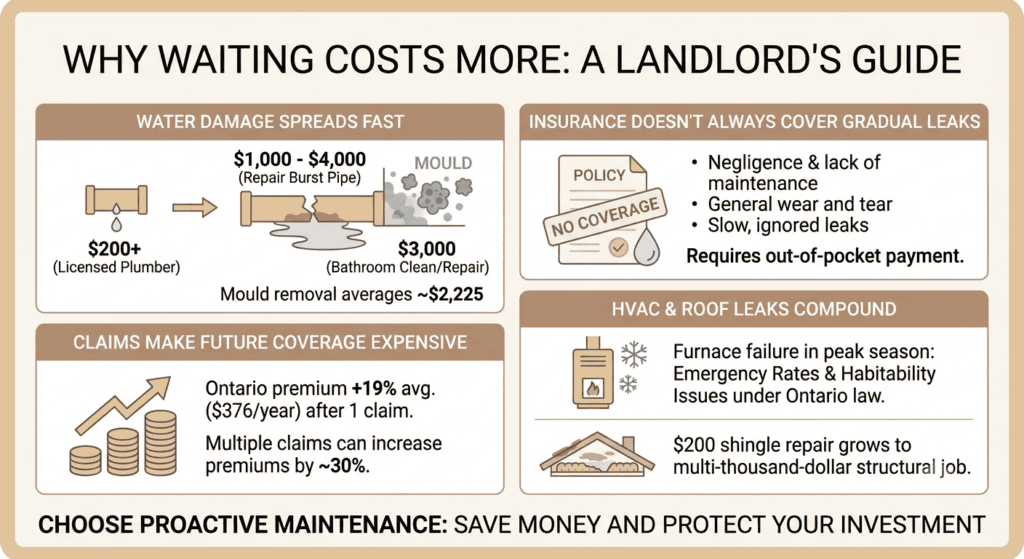
It’s worth being specific about what “waiting” actually costs, because the numbers are larger than most landlords expect.
Water damage spreads fast, and it’s expensive. A licensed plumber called out for a leaking pipe typically costs a few hundred dollars. Let that same leak run unnoticed for a few weeks and you’re looking at a very different bill. Repairing a burst pipe and the resulting damage generally runs between $1,000 and $4,000, and a soaked 120-square-foot bathroom can cost up to $3,000 to clean and repair. Mould removal alone averages around $2,225, and mould can start growing within just 24 to 48 hours of water exposure, depending on the surface and moisture level.
Insurance doesn’t always bail you out. This is the part many landlords miss. Water damage caused by gradual leaks, lack of maintenance, negligence, or general wear and tear is typically not covered by standard home insurance – coverage generally applies only to damage that’s sudden and accidental. In other words, if an inspector determines that a slow, ignored leak caused the damage, you could be paying the full repair cost out of pocket.
Claims also make future coverage more expensive. Even when a water damage claim is approved, it doesn’t end there. A single water damage claim can push up an Ontario homeowner’s insurance premium by an average of 19%, or roughly $376 a year, and landlords with multiple water-related claims can see premiums climb by nearly a third. Weather-related repair costs across Canada have also surged 485% since 2019, so the gap between a proactive repair bill and a reactive one keeps widening every year.
HVAC breakdowns hit hardest during peak seasons. A furnace that fails on the coldest night of a Niagara winter isn’t just an inconvenience – it’s a habitability issue under Ontario law, and it usually means paying emergency after-hours rates on top of the repair itself. Preventive maintenance, like annual tune-ups and filter changes, is one of the main things that separates a furnace lasting 15 to 20 years from one that fails closer to the 12-year mark.
Structural damage from roof leaks compounds quietly. A small roof leak rarely announces itself. It shows up as a faint water stain on a ceiling, gets ignored for a season, and by the time it’s obvious, it has often damaged insulation, drywall, and sometimes framing – turning a $200 shingle repair into a multi-thousand-dollar structural job.
8 Ways Preventive Maintenance Saves Thousands Every Year
1. Prevents Major Water Damage
Water is consistently the leading cause of home insurance claims in Canada, and most of it is preventable. Regular inspection of plumbing connections, caulking around tubs and sinks, and roof and gutter checks catch small leaks before they become five-figure restoration jobs. Overland flooding alone causes an average of $800 million in insured losses across Canada every year, and yet only about half of homeowners carry coverage for it – which makes prevention, not just insurance, the real first line of defence.
2. Extends the Life of Expensive Systems
Every major system in a rental property – furnace, air conditioner, water heater, roof, appliances – has a manufacturer-rated lifespan that assumes regular maintenance. Skip that maintenance and you shorten the lifespan considerably. A well-maintained Ontario furnace typically lasts 15 to 20 years, but neglect can shrink that to as little as 12 to 15 years, according to HVAC industry guidance. Given that a new furnace installation in Ontario now runs roughly $3,500 to $8,000 depending on efficiency rating, shaving even three or four years off that lifespan is an expensive mistake.
3. Reduces Emergency Repair Bills
Emergency plumbing and HVAC call-outs come with premiums that planned service simply doesn’t. After-hours emergency dispatch fees commonly run in the range of $180 to $280 on top of the repair itself, and contractors are far less available – and far less negotiable on price – during a January cold snap than during a routine spring inspection. Catching a problem early, while it’s still a $300 fix instead of an emergency, is one of the simplest ways preventive maintenance protects a landlord’s bottom line.
4. Keeps Tenants Happy and Reduces Vacancy
Tenants notice when a property is well cared for, and they notice even faster when it isn’t. A responsive landlord who fixes small issues quickly builds trust, and that trust translates directly into lease renewals. Every vacancy costs a landlord not just lost rent but also turnover cleaning, marketing, and screening time – all of which is far more expensive than a routine maintenance visit. Consistent upkeep is one of the most underrated tools for improving tenant retention and protecting rental income.
5. Protects Property Value
Deferred maintenance is one of the fastest ways to erode a property’s resale value. Curb appeal, interior condition, and the general sense that “this place has been looked after” all factor into what a future buyer or appraiser is willing to pay. A property with documented, consistent maintenance history also tends to move faster on the market, since buyers – including investors – are wary of properties with unknown or neglected mechanical systems.
6. Improves Energy Efficiency
Poorly maintained systems work harder than they need to, which shows up directly on utility bills. Regular HVAC servicing, clean filters, proper weather stripping, sealed windows, adequate insulation, and even switching to LED lighting all reduce the strain on a property’s systems. In a rental where the landlord covers utilities, or where high bills make a unit less attractive to prospective tenants, these efficiency gains matter for the bottom line, not just the environment.
7. Helps Avoid Insurance Claims
Every claim a landlord avoids is money saved twice over – once on the repair itself, and again on the premium increase that follows a claim. Preventing burst pipes, roof leaks, fire hazards, and mould growth through routine inspection keeps a property’s claims history clean, which matters increasingly in Ontario’s current insurance market. Canada’s property and casualty insurers posted a record $9.4 billion in insured weather-related losses in 2024, and the industry has responded with higher deductibles and stricter underwriting – a $2,500 minimum deductible for water damage claims is now standard on many policies. Keeping documented maintenance records also strengthens a landlord’s position if a claim ever does need to be filed.
8. Makes Budgeting More Predictable
Perhaps the most practical benefit of preventive maintenance is the one landlords feel every month: predictability. A planned annual maintenance budget – a few hundred dollars here, a service call there – is far easier to manage than an unplanned $6,000 furnace replacement in February. Setting aside roughly 1% to 2% of a property’s value each year for maintenance is a common industry guideline, and it turns unpredictable repair shocks into a manageable, recurring line item.
The Real Cost of Deferred Maintenance: A Simple Comparison
It helps to see the numbers side by side, because “preventive maintenance saves money” can sound like a vague talking point until you compare actual repair categories.
A furnace tune-up costs a landlord somewhere in the range of $100 to $200 a year. Skip it for long enough, and instead of a tune-up you’re paying for a full replacement – commonly $3,500 to $8,000 in Ontario in 2026 – often at the worst possible moment, since furnaces tend to fail during the coldest weeks of winter rather than on a convenient spring afternoon.
The same pattern holds for plumbing. A plumber called to check a slow drip or reseal a fitting might charge a few hundred dollars for a routine visit. Left alone, that same drip can turn into a burst pipe, and repairing a burst pipe along with the resulting water damage typically runs $1,000 to $4,000 – before you even factor in mould remediation, which averages around $2,225 on its own if moisture sits long enough.
Roofing follows the same logic. Catching a handful of damaged shingles during a spring inspection might cost $200 to $400 to fix. Ignore it through a rainy season and the water that gets in can damage insulation, drywall, and framing, turning a minor repair into a structural project costing many times more.
In every one of these categories, the pattern is identical: the preventive fix costs a fraction of what the reactive one does, and the gap tends to widen every year as construction and labour costs continue climbing across Ontario.
Building a Preventive Maintenance Budget for Your Rental Property
Landlords who treat maintenance as a planned line item, rather than a surprise expense, consistently come out ahead. Here’s a simple framework for building that budget.
Start with a percentage of property value. The 1% to 2% annual guideline mentioned earlier is a reasonable starting point for most single-family rentals in decent condition. A property valued at $500,000 would suggest a maintenance reserve of roughly $5,000 to $10,000 per year, covering everything from routine HVAC servicing to the occasional larger repair.
Adjust for the age of major systems. A property with a 3-year-old furnace and a recently replaced roof can lean toward the lower end of that range. A property with an 18-year-old furnace, original windows, and aging plumbing should budget closer to the higher end, since several big-ticket replacements may be approaching at once.
Separate routine maintenance from a capital reserve. Routine maintenance – filter changes, gutter cleaning, seasonal inspections – is a predictable, smaller monthly or quarterly cost. A separate capital reserve fund should be built up specifically for the larger, less frequent expenses: furnace replacement, roof replacement, or water heater replacement, each of which has a known lifespan you can plan around.
Review and adjust annually. A maintenance budget isn’t a one-time calculation. As a property ages, or as you complete major upgrades like a furnace or roof replacement, revisit the numbers and adjust accordingly.
DIY Maintenance vs. Hiring Professionals: What Landlords Should Handle Themselves
Not every preventive maintenance task requires a licensed contractor, but knowing where that line sits matters – both for safety and for your wallet.
Tasks landlords can reasonably handle themselves:
- Changing HVAC filters every one to three months
- Testing and replacing batteries in smoke and carbon monoxide detectors
- Cleaning gutters (or hiring a general handyman rather than a specialized contractor)
- Visual inspections of the roof, siding, and foundation from ground level
- Resealing minor caulking around tubs, sinks, and windows
- Basic landscaping and grading checks to keep water flowing away from the foundation
Tasks that call for a licensed professional:
- Furnace and HVAC servicing – in Ontario, gas furnace work legally requires a TSSA-licensed technician
- Electrical inspections or repairs, which require an ECRA/ESA-licensed electrician
- Roof repairs beyond minor shingle replacement
- Plumbing work involving supply lines, water heaters, or anything connected to a home’s main systems
- Structural inspections following any sign of foundation cracking or settling
Attempting electrical or gas work without proper licensing isn’t just risky – in Ontario, it can void insurance coverage entirely if something goes wrong, on top of violating building code. When in doubt, the cost of a licensed inspection is almost always smaller than the cost of a mistake.
Ontario’s four distinct seasons each put different stress on a property. Here’s what should be on every landlord’s calendar.
Spring
- Roof inspection for winter damage, missing shingles, or ice-related wear
- Gutter cleaning and downspout checks to direct water away from the foundation
- Exterior siding inspection for cracks or moisture intrusion
- Landscaping cleanup, including grading checks so water flows away from the building
- Foundation inspection for new cracks after the freeze-thaw cycle
Summer
- HVAC servicing and air conditioner tune-up before peak heat
- Deck and porch inspection for loose boards or rot
- Window sealing and caulking checks
- Pest prevention, including checking for entry points before insects and rodents become active
Fall
- Furnace inspection and professional tune-up before heating season
- Final gutter cleaning to clear fallen leaves
- Chimney inspection, if the property has a fireplace
- Weatherproofing doors and windows against incoming cold
Winter
- Pipe insulation, especially in unheated basements, garages, and exterior walls
- Snow removal planning, including a clear plan for who handles walkways and driveways
- Ice dam prevention through proper attic insulation and ventilation
- Smoke and carbon monoxide detector testing – a legal requirement, not just a best practice, under Ontario fire code
Signs Your Property Needs Preventive Maintenance Immediately
Some warning signs shouldn’t wait for the next scheduled inspection. If any of the following show up during a walkthrough or a tenant report, act right away:
- Water stains on ceilings or walls
- New or widening cracks in walls or foundation
- Unusually high utility bills compared to previous months
- Mould or a persistent musty smell
- Strange plumbing noises, like banging pipes or gurgling drains
- Visible roof damage, including missing or curling shingles
- An HVAC system that’s running constantly but not keeping up
- Loose handrails or unstable stairs
- Peeling paint, which can signal moisture problems underneath
- Signs of pest activity, including droppings or chewed materials
Any one of these can be the early signal of a much larger and more expensive problem. Catching them early is the entire point of a preventive maintenance program.
How Property Management Companies Help
Managing a preventive maintenance schedule alone, especially across multiple properties, is a significant time commitment – which is exactly why so many Niagara Region landlords turn to professional property management.
A property management company like The HAH Developments handles the parts of preventive maintenance that are easiest to let slip when you’re managing everything solo:
- Scheduling regular inspections so nothing gets missed between tenant turnovers
- Coordinating trusted, vetted contractors for plumbing, HVAC, roofing, and general repairs
- Maintaining detailed maintenance records, which matter both for insurance purposes and for demonstrating compliance with Ontario’s Residential Tenancies Act
- Responding quickly to tenant concerns, which keeps small issues from escalating into Landlord and Tenant Board disputes
- Preventing costly long-term damage through consistent, proactive oversight rather than reactive firefighting
- Reducing owner stress, particularly valuable for landlords who don’t live near their rental property or who own multiple units across different neighbourhoods
This is especially relevant for Ontario landlords, since the Residential Tenancies Act legally requires landlords to keep rental units in a good state of repair and to meet health, safety, and maintenance standards – regardless of what a lease says. If a landlord doesn’t fix a maintenance issue after being notified, a tenant can file a Tenant Application about Maintenance with the Landlord and Tenant Board, and the Board has the authority to order repairs, award compensation to the tenant, or even freeze rent increases until the problem is resolved. A consistent preventive maintenance program isn’t just about protecting your investment – it’s about staying compliant with provincial law.
Beyond compliance, professional property management adds a layer of documentation that many self-managed landlords skip entirely. Detailed maintenance logs – dates of inspection, work performed, contractor invoices – serve two purposes. First, they’re powerful evidence if a tenant ever disputes the condition of a unit at the Landlord and Tenant Board. Second, they matter to insurers: a documented history of regular maintenance can support a claim by demonstrating that damage was sudden and unforeseeable rather than the result of neglect, which is often the deciding factor in whether a water damage claim gets approved.
For landlords with short-term rentals, including Airbnb properties, preventive maintenance carries even more weight. Guests expect a flawless experience on every stay, and a maintenance issue that might annoy a long-term tenant for a day can turn into a negative review that affects bookings for months. Coordinating cleaning, inspections, and rapid-response repairs between every guest turnover is a full-time job on its own – one more reason many Niagara-area hosts choose professional co-hosting and property management support rather than handling it solo.
Common Maintenance Mistakes Landlords Make
Even well-intentioned landlords fall into a handful of predictable traps:
- Ignoring small repairs because they don’t seem urgent yet
- Skipping seasonal inspections when things “seem fine”
- Delaying roof maintenance until a leak is already visible indoors
- Forgetting annual HVAC servicing, which quietly shortens system lifespan
- Waiting for tenant complaints instead of inspecting proactively
- Choosing the cheapest repair instead of the right one, which often means paying twice
- Having no annual maintenance budget, which turns every repair into a financial surprise
Avoiding these mistakes is less about spending more money and more about spending it on a predictable schedule instead of in emergency mode.
Preventive Maintenance Checklist for Every Landlord
A quick reference checklist to keep on hand:
- [ ] Inspect plumbing for leaks and slow drips
- [ ] Service HVAC system annually
- [ ] Clean gutters at least twice a year
- [ ] Inspect roof for damage or wear
- [ ] Test smoke and carbon monoxide detectors
- [ ] Seal windows and doors before winter
- [ ] Check electrical systems and outlets
- [ ] Inspect major appliances for wear
- [ ] Schedule pest control inspections
- [ ] Walk through the property every season
Frequently Asked Questions
How often should a landlord inspect a rental property in Ontario? A seasonal walkthrough – four times a year – is a reasonable minimum for most single-family or small multi-unit rentals, with additional inspections during tenant turnover. Note that Ontario law requires 24 hours’ written notice before entering an occupied unit, except in genuine emergencies.
What is the difference between preventive and reactive maintenance? Preventive maintenance is scheduled and proactive – inspections, tune-ups, and small repairs done on a calendar. Reactive maintenance means waiting until something fails and then responding, which typically costs more due to emergency rates and secondary damage.
Does home insurance cover damage caused by poor maintenance? Generally, no. Most Ontario home insurance policies exclude damage that results from gradual leaks, neglect, or general wear and tear, and only cover water damage that’s sudden and accidental. This is one of the strongest financial arguments for preventive maintenance.
How much should a landlord budget for preventive maintenance each year? A common industry guideline is roughly 1% to 2% of the property’s value annually, though older properties or those with aging major systems may need to budget higher.
Is a property management company worth it just for maintenance coordination? For landlords who own multiple properties, live outside the area, or simply don’t have time to manage seasonal inspections and contractor relationships, yes – the cost is usually offset by avoided emergency repairs, better tenant retention, and reduced vacancy time.
What are landlords legally required to maintain under the Residential Tenancies Act? Landlords must keep the rental unit and building in a good state of repair and comply with health, safety, housing, and maintenance standards, including keeping all vital services – heat, water, and electricity – in working order.
Can a tenant withhold rent if a landlord ignores a maintenance request? No. Ontario tenants should not withhold rent on their own, even if a maintenance issue goes unresolved. Instead, they can file a Tenant Application about Maintenance (Form T6) with the Landlord and Tenant Board, which can order repairs, compensation, or even permit the tenant to pay rent to the Board directly until the issue is fixed.
How does preventive maintenance affect a property’s resale value? Documented, consistent maintenance history reassures buyers and appraisers that major systems haven’t been neglected, which typically supports a stronger resale price and a faster sale compared to a property with unknown or deferred maintenance issues.
Conclusion
Preventive property maintenance isn’t an expense – it’s a long-term investment in the safety, value, and profitability of a rental property. Regular inspections and timely repairs help Niagara Region landlords avoid emergency costs, extend the life of major systems like furnaces and roofs, keep tenants satisfied enough to renew their leases, and preserve the property’s long-term market value.
The math is straightforward: a $300 seasonal HVAC tune-up is always cheaper than a $6,000 emergency furnace replacement in the middle of February. A $150 caulking job is always cheaper than a $3,000 water damage claim – one that might not even be covered by insurance if it’s traced back to neglect. A proactive maintenance strategy consistently saves landlords thousands of dollars while creating a safer, more reliable rental property for everyone involved.
If managing seasonal inspections, contractor relationships, and Ontario’s maintenance-related legal requirements feels like more than you want to handle alone, The HAH Developments offers full-service property management built specifically for Niagara Falls, St. Catharines, and the surrounding region. From routine preventive maintenance and inspections to emergency response and long-term investment strategy, our team helps property owners protect their investment without the day-to-day stress. Contact The HAH Developments today to schedule a property assessment and find out how a proactive maintenance plan can protect your rental income.