
Owning a rental property sounds simple until the furnace dies in January, a tenant reports a leak behind the drywall, or a by-law officer shows up asking why your smoke alarms haven’t been tested. None of these problems appear out of nowhere. They almost always start small, get ignored, and then turn into five-figure repair bills and unhappy tenants.
That’s exactly why every serious landlord needs a rental property maintenance checklist they actually follow, not one that sits in a folder collecting dust. A good property maintenance checklist protects your investment, keeps you on the right side of Ontario’s Residential Tenancies Act, and – perhaps most importantly – keeps your tenants safe and renewing their leases year after year.
In this guide, we’ll walk through exactly what belongs in a rental property maintenance checklist for 2026, what Ontario law actually requires of you as a landlord, and how property owners in Niagara Falls and across Ontario can build a maintenance system that saves money instead of draining it.
Why a Property Maintenance Checklist Matters More Than Ever
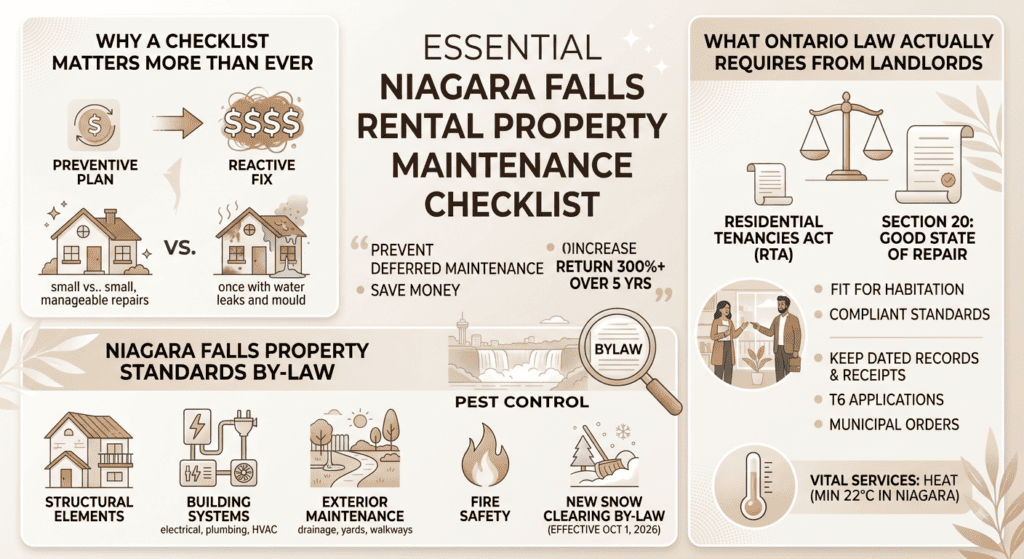
Here’s the uncomfortable truth about deferred maintenance: it never actually saves you money, it just delays and multiplies the cost. A $500 plumbing fix ignored for six months can turn into thousands of dollars in water damage, drywall replacement, and mould remediation. Industry research on rental portfolios has found that preventive maintenance investments can return more than 300% over a five-year period compared to a reactive, fix-it-when-it-breaks approach.
The pattern shows up everywhere. A furnace tune-up that costs a few hundred dollars, skipped for a few years, often ends in a full system replacement running into the thousands, plus higher energy bills the whole time the unit was running inefficiently. Emergency repairs typically cost three to four times more than the same job done on a planned, preventive basis.
There’s a tenant retention cost too. A tenant who has to ask twice for a repair before it gets addressed is far less likely to renew their lease, and replacing a tenant – factoring in vacancy, marketing, cleaning, and turnover repairs – often costs the equivalent of one to two months’ rent. A property maintenance checklist isn’t paperwork for its own sake. It’s the single cheapest insurance policy a landlord can buy.
What Ontario Law Actually Requires From Landlords
Before we get into the checklist itself, it helps to understand the legal floor you’re working with. Ontario landlords aren’t just following best practices when they maintain a property – they’re following the law, and the rules have gotten stricter recently.
The Residential Tenancies Act and “Good State of Repair”
Section 20 of the Residential Tenancies Act, 2006 is short, but it covers almost everything. It requires landlords to keep the rental unit and the entire residential complex in a good state of repair, fit for habitation, and compliant with health, safety, housing, and maintenance standards. This obligation applies regardless of what condition the tenant knew the unit was in when they moved in, and regardless of what the lease says.
If a landlord doesn’t meet this standard, a tenant can file a T6 application with the Landlord and Tenant Board, which can order repairs, a rent abatement, or other remedies. Tenants are not permitted to simply stop paying rent because of a maintenance issue, but that doesn’t mean the underlying repair obligation disappears – it just means the dispute goes through the LTB instead. Landlords and Tenant Board adjudicators have also become noticeably less forgiving about documentation, so keeping dated records, photos, and receipts of every repair and inspection is no longer optional if you want a defensible file.
There’s also a separate enforcement track worth knowing about: a municipal property standards officer can issue a work order directly under the local by-law, independent of anything a tenant files. That means a landlord can face both an LTB application and a municipal order over the same issue, so a bylaw complaint should always be treated as urgent.
Vital services are another area the RTA is strict about. Landlords must provide heat, and in many municipalities – including Niagara Falls – the minimum required indoor temperature during the heating season sits around 22°C in habitable rooms. Shutting off heat, water, electricity, or fuel to try to force a tenant out is illegal and can lead to significant penalties.
The Niagara Falls Property Standards By-law
If your rental is in Niagara Falls, provincial law is only half the picture. The city’s Property Standards By-law sets its own minimum requirements for how rental properties must be maintained, and it applies to the inside and outside of the building. It covers:
- Structural elements: roofs, foundations, exterior and interior walls, floors, ceilings, stairs, porches, balconies, and fire escapes
- Building systems: electrical, plumbing, and heating, ventilation, and air conditioning (HVAC)
- Exterior maintenance: drainage, yards, walkways, parking areas, retaining walls, signs, canopies, and awnings
- Pest control and fire safety compliance
Niagara Falls residents and tenants can report suspected violations directly to Municipal Bylaw Enforcement, and every complaint is investigated by a By-law Enforcement Officer. If you own multiple units in the city, it’s worth reviewing the full by-law text on the city’s website so nothing on your property falls outside the minimum standard without you realizing it. The city has also introduced a new Snow Clearing By-law taking effect October 1, 2026, requiring property owners to keep sidewalks clear of snow and ice – one more seasonal task to add to your list if you own property in the region.
New 2026 Fire Code Carbon Monoxide Rules
This is the single biggest regulatory change landlords in Ontario need to know about this year. As of January 1, 2026, updates to the Ontario Fire Code (Ontario Regulation 87/25) significantly expanded carbon monoxide alarm requirements. If your rental has a fuel-burning appliance – a gas or oil furnace, a gas water heater, a gas stove, a fireplace, or even an attached garage – you’re now required to install a working CO alarm on every storey of the home, including basements and floors without bedrooms, not just adjacent to sleeping areas as the old rule required.
Landlords are legally responsible for purchasing, installing, and maintaining these alarms, and must be able to provide maintenance records and operating instructions to tenants. Tenants are responsible for testing alarms monthly and reporting problems immediately, but the legal weight of compliance sits with the property owner. Alarms must be certified to Canadian standards (CSA 6.19 for CO, ULC S531 for smoke), and a poorly placed or non-functional alarm is treated as legally equivalent to having no alarm at all.
Smoke alarms remain just as strict: working alarms are required outside every sleeping area and on every storey of the home, with a 10-year replacement cycle. Disabling a smoke alarm in Ontario is a provincial offence that can carry fines up to $50,000 for individuals. If you haven’t audited your properties against the new CO alarm rules yet, this should be the very first item on your 2026 property maintenance checklist.
The Complete Property Maintenance Checklist Every Landlord Should Follow
With the legal groundwork covered, here’s the practical, month-by-month version of the property maintenance checklist you should be running on every unit you own.
Monthly Maintenance Tasks
- Test every smoke and carbon monoxide alarm and log the results
- Check for any active leaks under sinks, around toilets, and near water heaters
- Inspect visible plumbing fixtures for drips, corrosion, or slow drains
- Replace or clean HVAC filters (monthly during heavy-use seasons)
- Walk the exterior for obvious trip hazards, loose railings, or debris buildup
- Confirm exterior lighting and any common-area lighting is functioning
- Check in briefly with tenants about any maintenance concerns they haven’t yet reported
Quarterly Maintenance Tasks
- Test garage door safety sensors and auto-reverse function, if applicable
- Inspect caulking and weatherstripping around windows and doors
- Flush and inspect the water heater for sediment buildup
- Check fire extinguishers for charge level and expiry date
- Clean dryer vents and lint traps to reduce fire risk
- Inspect and lubricate door hinges, locks, and window tracks
- Review the property for pest activity, particularly around foundations and entry points
Annual Maintenance Tasks
- Book a full HVAC inspection and tune-up with a licensed technician before the heating and cooling seasons
- Have a Gas Safe or licensed technician inspect all gas-burning appliances
- Schedule a professional roof inspection, especially after winter
- Have an electrician review the panel, outlets, and wiring for a multi-unit or older property
- Inspect and clean gutters and downspouts thoroughly
- Review your landlord insurance policy and confirm coverage still matches the property’s condition and value
- Conduct a full walkthrough inspection of every unit with proper notice given to tenants
- Replace smoke alarm batteries even in hardwired units with battery backup, and check alarm ages against their 10-year lifespan
Seasonal Maintenance Checklist for Ontario Landlords
Ontario’s climate swings hard between seasons, and a property maintenance checklist that ignores that reality will always leave gaps. Here’s how to break the year down.
Spring
Spring is your recovery season after winter has had its way with the property. Inspect the roof and attic for ice-damage or leaks that may have gone unnoticed. Check the foundation and grading to make sure melting snow drained away from the building rather than pooling against it. Service the air conditioning system before the first real heatwave hits, and clear gutters of the winter’s accumulated debris. This is also the ideal time to schedule any exterior painting, deck repairs, or landscaping work tenants will actually notice and appreciate.
Summer
Summer maintenance is about protecting the exterior and staying ahead of pest season. Inspect siding, brick, and stucco for cracks that let moisture in. Check window and door seals for efficiency. Trim trees and shrubs away from the roofline and siding. Test irrigation systems if the property has them, and keep an eye out for wasp nests, ants, and other seasonal pest activity before it becomes an infestation.
Fall
Fall is your last real window before winter locks everything down. This is when the furnace and heating system need their full inspection and tune-up, not in December when every HVAC company in the region is booked solid. Clean gutters again once the leaves have mostly dropped. Seal any gaps or cracks in the building envelope to cut down on heat loss. Check weatherstripping on all exterior doors and windows. If your property has an attached garage, this is also the moment to confirm your carbon monoxide alarm coverage meets the 2026 Fire Code requirements before appliances are running at full capacity for the winter.
Winter
Winter maintenance in Ontario is mostly about keeping ahead of the cold rather than reacting to it. Monitor for ice dams on the roof, which can force water back under shingles and into the structure. Keep walkways and driveways cleared of snow and ice – a legal requirement in most municipalities and, in Niagara Falls, formalized under the new Snow Clearing By-law taking effect this fall. Check that pipes in unheated or exterior-facing areas are properly insulated to prevent freezing. Confirm the heating system is holding the legally required minimum indoor temperature, and respond immediately to any tenant report of inadequate heat – this is one of the fastest ways to end up in front of the Landlord and Tenant Board.
System-by-System Property Maintenance Checklist
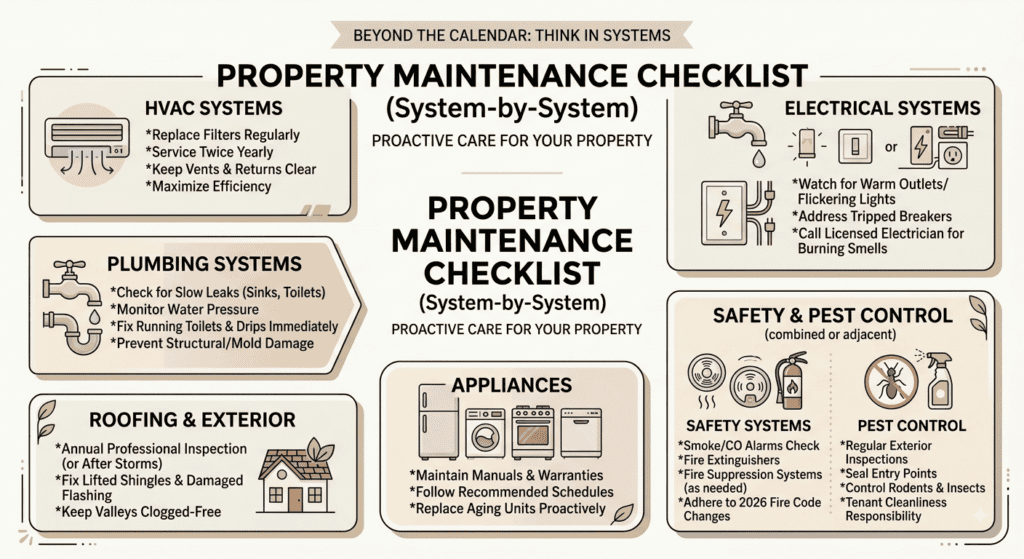
Beyond the calendar, it helps to think in terms of the individual systems that make up a property. Each one has its own failure points and its own maintenance rhythm.
HVAC Systems
Heating and cooling failures generate more tenant complaints and emergency calls than almost anything else on this list. Replace filters on a regular schedule, have the system professionally serviced twice a year, and keep vents and returns unobstructed. A well-maintained HVAC system also runs more efficiently, which keeps utility costs down for whoever is paying them.
Plumbing Systems
Water damage remains one of the most common and expensive insurance claims landlords face. Check under every sink and around every toilet for slow leaks, monitor water pressure, and address running toilets or dripping faucets immediately rather than waiting for a tenant to complain twice. A small leak behind a wall can go unnoticed for weeks while quietly causing thousands of dollars in structural and mould damage.
Electrical Systems
Older properties in particular need periodic electrical review. Watch for warm outlets, flickering lights, tripped breakers that reset repeatedly, or any burning smell – all signs that warrant an immediate call to a licensed electrician rather than a wait-and-see approach.
Roofing and Exterior
The roof is one of the most expensive components to replace and one of the easiest to inspect proactively. A professional inspection after major storms or at least once a year catches small issues – lifted shingles, damaged flashing, clogged valleys – while they’re still cheap to fix.
Appliances
Included appliances are a common source of tenant dissatisfaction when they fail unexpectedly. Keep manufacturer manuals and warranty information on file, follow recommended maintenance schedules, and replace aging units proactively rather than waiting for a breakdown during a heatwave or cold snap.
Safety Systems
This means smoke alarms, carbon monoxide alarms, fire extinguishers, and – in multi-unit buildings – any fire suppression or sprinkler systems. Given the new 2026 Fire Code changes, this category deserves its own line item on every inspection you run this year, not just an annual afterthought.
Pest Control
Landlords are responsible for taking reasonable steps to control rodents, insects, and other pests, while tenants are responsible for keeping their unit clean enough not to attract them in the first place. Regular exterior inspections, sealed entry points, and prompt response to any reported activity keep this from becoming a bigger problem.
Move-In and Move-Out Inspection Checklist
Every tenancy should begin and end with a documented, photographed walkthrough. At move-in, record the condition of walls, floors, appliances, fixtures, and any existing damage using a standardized form signed by both parties. This protects you from disputes later and gives the tenant a clear baseline of what “normal wear and tear” looks like for their unit.
At move-out, repeat the same inspection and compare against the move-in documentation. This is also your opportunity to catch maintenance issues that built up during the tenancy – worn caulking, an aging water heater, a furnace nearing the end of its service life – before a new tenant moves in and inherits the problem.
Special Considerations for Short-Term Rentals and Airbnb Hosts
If you’re operating a short-term or vacation rental in Niagara Falls, your maintenance checklist carries extra weight, because the city inspects licensed properties directly. Vacation Rental Units require a license from the city, and licensed hosts must maintain smoke alarms, carbon monoxide detectors, and clear emergency exits at all times, with properties subject to fire, building, and by-law inspections.
Short-term rentals also see far higher guest turnover than a traditional lease, which means appliances, furniture, and fixtures take more wear in a shorter period. A pre- and post-stay inspection routine, alongside the standard monthly and seasonal checklist, catches problems before they show up in a guest review rather than after.
A few things belong specifically on a short-term rental maintenance checklist that a long-term lease wouldn’t need: checking that every appliance and remote is fully functional before each new guest arrives, restocking safety items like fire extinguishers and first-aid kits, confirming Wi-Fi and smart-lock systems are working before check-in, and doing a fast but thorough visual sweep of the unit for damage between every single stay rather than waiting for a monthly cycle. Guest reviews are unforgiving of maintenance issues in a way that long-term tenants often aren’t, since a broken dishwasher or a slow Wi-Fi connection becomes a permanent, public part of your listing’s reputation rather than a private maintenance request.
For hosts managing multiple listings, this turnover-driven wear is exactly the kind of workload that a dedicated Airbnb co-hosting and property management partner is built to absorb.
How to Build a Maintenance Schedule and Budget That Works
A property maintenance checklist only works if it’s actually followed, which means it needs a schedule and a budget behind it. A commonly cited benchmark is to set aside 1% to 2% of your property’s value annually for preventive maintenance. On a $500,000 property, that works out to roughly $5,000 to $10,000 a year – and that investment typically saves three to four times as much in avoided emergency repairs and extended equipment life.
Practically, that means:
- Keeping a dedicated maintenance reserve fund separate from your operating income
- Using a shared calendar or property management software to track recurring inspection dates
- Logging every repair, inspection, and tenant communication with dates and photos
- Building relationships with a small number of trusted, licensed trades so you’re not scrambling during an emergency
- Reviewing your full maintenance log at least once a year to spot patterns, like a unit with recurring plumbing issues that may need a bigger fix
If you own more than one property, a simple spreadsheet quickly becomes unmanageable. Most landlords eventually move to some form of property management software that lets them assign recurring tasks, track work orders through to completion, store warranty and appliance information by unit, and generate a clean, dated history that holds up if a dispute ever reaches the Landlord and Tenant Board. Even a basic shared calendar with reminders is better than relying on memory, especially once you’re managing more than two or three units at once.
It also helps to separate your checklist into “must-do” compliance items – smoke and CO alarms, heating minimums, gas appliance inspections – from “should-do” preventive items like gutter cleaning or caulking. The compliance items are non-negotiable and carry legal and safety consequences if skipped. The preventive items are where the real long-term savings live, and they’re the ones that get pushed aside first when a landlord is busy, which is exactly why they need to be scheduled in advance rather than left to “whenever there’s time.”
Common Mistakes Landlords Make With Property Maintenance
Even experienced landlords fall into a few predictable traps. The most common is treating maintenance as reactive rather than scheduled – waiting for a tenant complaint instead of catching the issue during a routine inspection. Close behind that is inconsistent documentation, which leaves landlords exposed if a dispute ever reaches the Landlord and Tenant Board. Many owners also underestimate how quickly regulations change, as this year’s carbon monoxide alarm update shows, and end up out of compliance simply because they haven’t reviewed the rules since they last read the lease template. Finally, self-managing landlords with multiple properties often run out of bandwidth to keep every unit on the same rigorous schedule, which is usually the point where professional property management starts to make financial sense.
Another mistake worth naming on its own is hiring unlicensed or uninsured contractors to save money on gas, electrical, or structural work. Beyond the safety risk, this can void insurance coverage entirely if something goes wrong, and it can leave a landlord without the paper trail an inspector or adjudicator expects to see. Similarly, some landlords assume that because a tenant hasn’t complained, nothing is wrong – but plumbing leaks, electrical issues, and pest activity can all develop quietly behind walls or under floors long before they become visible or disruptive enough for a tenant to notice and report them. A scheduled inspection catches what a passive approach never will.
The Real Cost of Deferred Maintenance
It’s worth putting real numbers next to the abstract idea of “deferred maintenance.” A $200 plumbing inspection deferred for a few months can turn into a slow leak inside a wall that isn’t discovered until water stains appear on the ceiling below – at which point the repair has escalated from a couple hundred dollars to $5,000 or more once remediation, drywall, and potential mould treatment are factored in. A $1,200 annual HVAC maintenance contract skipped for five years can lead to tens of thousands in emergency repairs, higher energy bills the entire time, and an early, unplanned system replacement. Across the industry, deferred repairs are widely reported to cost three to four times more than the same job handled on a planned, preventive basis. None of this is hypothetical – it’s the predictable outcome of skipping the checklist.
When to Hire a Professional Property Management Company
There’s a point for almost every landlord where self-managing maintenance stops being the most profitable option. If you’re juggling multiple properties, living far from the rental, managing a short-term rental with constant guest turnover, or simply finding that repairs keep slipping through the cracks despite your best intentions, that’s usually the sign. A professional property management company brings an established network of licensed trades, a documented inspection schedule, and the kind of compliance awareness that keeps you ahead of changes like the 2026 Fire Code update – all of which protects both your tenants and your bottom line.
This is exactly where The HAH Developments fits in. Based in Niagara Falls, our team handles the full scope of property upkeep – from routine inspections and preventive maintenance scheduling to coordinating licensed trades and staying current on Ontario and municipal compliance requirements – for long-term rentals, short-term and Airbnb properties, and investment portfolios of any size.
Final Thoughts
A property maintenance checklist isn’t busywork – it’s the difference between a rental property that quietly builds equity and one that quietly bleeds money through emergency repairs, vacancy, and legal exposure. Ontario’s rules have only gotten stricter this year, and the landlords who stay ahead of changes like the new carbon monoxide alarm requirements are the ones who avoid both fines and far more expensive surprises.
If keeping up with monthly inspections, seasonal upkeep, and shifting compliance requirements feels like more than you want to manage alongside everything else running a rental property involves, The HAH Developments can take it off your plate entirely. From routine maintenance and licensed trade coordination to full-service property management for long-term rentals and short-term Airbnb properties across Niagara Falls, our team is built to keep your property protected, compliant, and profitable. Reach out to The HAH Developments today to find out how stress-free property ownership actually feels.
Frequently Asked Questions
How often should a landlord inspect a rental property in Ontario?
Most landlords benefit from a monthly walk-through of safety systems, quarterly checks on plumbing and exterior conditions, and at least one full annual inspection of every unit, with proper notice given to tenants under the Residential Tenancies Act.
What maintenance is a landlord legally required to handle in Ontario?
Under Section 20 of the Residential Tenancies Act, landlords must keep the unit and the building in a good state of repair, fit for habitation, and compliant with health, safety, and municipal property standards, regardless of what the lease says or what condition existed at move-in.
Do I need a carbon monoxide alarm on every floor of my rental?
Yes, if the property has a fuel-burning appliance, a fireplace, or an attached garage. As of January 1, 2026, the Ontario Fire Code requires a working CO alarm on every storey of the home, including floors without bedrooms, not just near sleeping areas.
Can a tenant withhold rent if maintenance isn’t done?
No. Ontario tenants cannot legally withhold rent over a maintenance dispute. The correct process is filing a T6 application with the Landlord and Tenant Board, which can order repairs or compensation.
How much should I budget annually for property maintenance?
A common benchmark is 1% to 2% of the property’s value per year. That budget typically prevents far larger emergency costs down the line.
What’s the difference between a landlord’s and a tenant’s maintenance responsibilities?
Landlords must maintain the structure, systems, and safety equipment in the unit and building. Tenants are responsible for keeping their unit reasonably clean and repairing any damage they or their guests cause, though normal wear and tear is not the tenant’s responsibility.