

Buying your first rental property feels like the finish line. In reality, it’s the starting gun. The mortgage is approved, the keys are in your hand, and now you’re the person tenants call at 11 p.m. when the furnace stops working.
This is the moment when almost every new landlord asks the same question: should I manage this property myself, or is professional property management for first-time investors actually worth the fee?
It’s a fair question, especially when every dollar of expense eats into your return. Many new landlords assume self-management is the “smart” financial choice because it skips the monthly fee. But that assumption often falls apart once real tenants, real repairs, and real legal deadlines enter the picture.
In this guide, you’ll learn exactly what a property manager does, what it actually costs in Ontario right now, when self-managing makes sense, and when it’s genuinely riskier than it’s worth. We’ll also walk through the questions to ask before you sign a management agreement, so you can make this decision with facts instead of guesswork.
The stakes are higher than they used to be, too. The rental landscape first-time investors are stepping into in 2026 looks different from the market their parents or older siblings bought into. Rules are more detailed, the tribunal system that resolves disputes is slower, and tenant expectations around communication and maintenance have risen. None of that means self-managing is impossible. It just means the margin for error is smaller, and the cost of getting something wrong is higher. That’s exactly why this decision deserves more than a gut feeling.
What Does a Property Manager Actually Do?
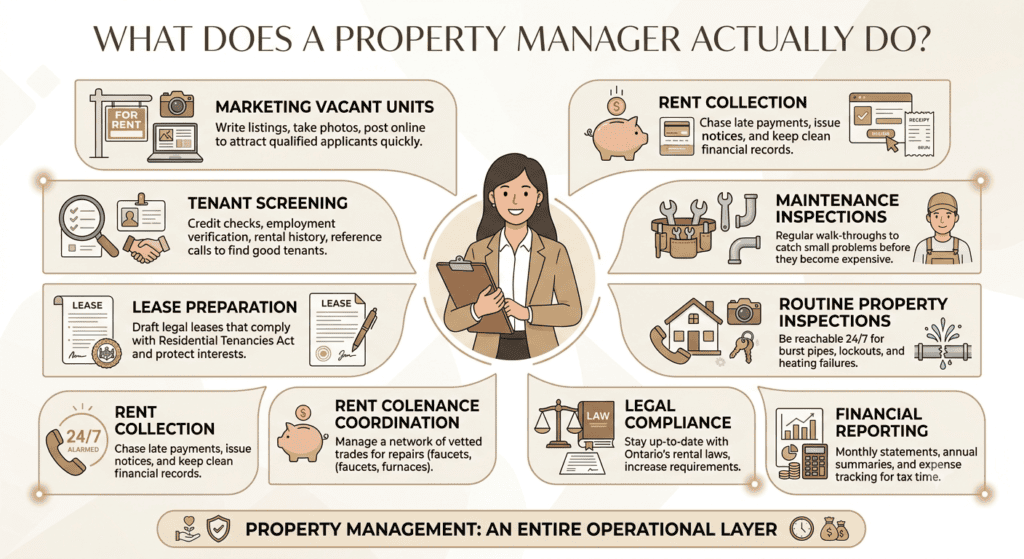
Before you can decide if property management for first-time investors makes financial sense, you need to know what you’re actually paying for. A good property manager isn’t just someone who collects rent and forwards it to you. The job covers nearly every operational layer of owning a rental.
Marketing vacant units. Professional managers write listings, take proper photos, and post across multiple rental platforms to attract qualified applicants quickly. In a slower rental market, presentation and pricing decide how long a unit sits empty. A listing with poor photos and a slightly-too-high asking rent can sit unrented for a month, which usually costs far more than the entire year’s management fee would have.
Tenant screening. This includes credit checks, employment verification, rental history, and reference calls. Screening is the single biggest factor in whether a tenancy runs smoothly or turns into a year-long headache. Experienced managers also know how to spot inconsistencies in an application, like a reference that turns out to be a friend rather than a former landlord, something a first-time investor might not think to verify.
Lease preparation. A property manager drafts a lease that complies with the Residential Tenancies Act and protects your interests, using the correct provincial forms rather than a template pulled off the internet. This matters more than it sounds. A lease built on an outdated or incorrect template can leave out clauses that would otherwise protect you if a dispute ends up at the Landlord and Tenant Board.
Rent collection. This includes chasing late payments, issuing proper notices, and keeping clean financial records for tax time. It also means knowing exactly when a late payment crosses the line from “give it a few more days” to “issue a formal notice,” a judgment call that carries legal weight.
Maintenance coordination. From leaky faucets to furnace failures, a manager has a network of vetted trades who respond quickly and charge fair rates. This network is built over years of working relationships, something a first-time landlord starting from zero simply doesn’t have on day one.
Routine property inspections. Regular walk-throughs catch small problems, like a slow leak or a pest issue, before they become expensive ones. Inspections also create a documented history of the property’s condition, which is valuable if a dispute over damage or a deposit ever arises.
Emergency response. Someone needs to be reachable 24/7 for burst pipes, lockouts, and heating failures. That’s a full-time commitment most investors underestimate, especially once they realize emergencies rarely happen during convenient hours.
Legal compliance. Ontario’s rental laws are detailed and change frequently. A manager keeps notices, increases, and entries compliant with current rules, including the correct forms, notice periods, and timing requirements the Residential Tenancies Act demands.
Financial reporting. Monthly statements, annual summaries, and expense tracking that make tax season simpler and give you a clear picture of your return. Good reporting also flags when a property’s expenses are creeping up faster than its income, a warning sign easy to miss when you’re managing everything yourself.
Seen together, this list explains why property management isn’t a luxury add-on. It’s an entire operating system for your rental, and every piece of it takes time, knowledge, or both to do well.
Why First-Time Investors Often Struggle With Self-Managing Rentals
Most new landlords don’t fail because they’re careless. They fail because the job is bigger and more technical than it looks from the outside. Here’s where the cracks usually show up first.
Lack of experience. Pricing a unit correctly, screening applicants properly, and knowing which lease clauses actually protect you all take practice. First-time investors are learning these skills in real time, often at their own expense.
Tenant disputes. Disagreements over repairs, noise, or lease terms are common, and resolving them incorrectly can escalate into a formal complaint at the Landlord and Tenant Board.
Late or missed rent. A single missed payment sets off a chain of decisions: when to issue a notice, how to document it, and whether to escalate. Get any step wrong and you weaken your legal position.
Maintenance emergencies. A burst pipe on a Sunday night doesn’t wait for business hours. Self-managing landlords without a contractor network often pay premium emergency rates or scramble to find anyone available.
Understanding provincial landlord-tenant law. Ontario’s Residential Tenancies Act governs everything from notice periods to rent increases, and the rules are not intuitive for someone reading them for the first time.
Finding reliable contractors. Good tradespeople are often booked out weeks in advance. Property managers maintain standing relationships that get repairs prioritized.
Time commitment. Self-management isn’t a few minutes a month. Between showings, screening, maintenance calls, and paperwork, it functions like a part-time job, one most first-time investors are trying to fit around a full-time career.
Here’s a practical example. A first-time investor in St. Catharines rents out a single condo without a lease-specific N1 rent increase notice and instead sends a text message asking for more rent. Under the Residential Tenancies Act, that increase isn’t valid, the tenant can dispute it, and the landlord has to restart the entire notice process, effectively losing months of the increase they were counting on for cash flow.
The Biggest Benefits of Hiring a Property Manager
Better Tenant Screening
Quality tenants are the foundation of a stress-free rental. A property manager runs credit checks, verifies income and employment, and calls previous landlords to catch red flags before a lease is signed. This reduces the risk of late payments, property damage, and costly turnover.
Lower Vacancy Rates
Professional managers know how to price a unit for current market conditions and market it across the right channels. In a market where a unit priced accurately for current conditions fills in days while a unit priced too high can sit for weeks, that pricing expertise directly protects your cash flow.
Time Savings
Handing off leasing, maintenance calls, inspections, and tenant communication gives you your evenings and weekends back. For investors juggling a full-time job, a family, or multiple properties, this is often the single biggest reason to outsource.
Legal Protection
Ontario’s rental rules change often, and a small mistake, like an incorrect notice or an improperly delivered rent increase, can void the entire action. A property manager who works within these rules daily is far less likely to make a costly procedural error.
Professional Maintenance Network
Established managers work with electricians, plumbers, and general contractors they trust, which usually means faster response times and better pricing than a first-time landlord could negotiate alone.
Reduced Stress
Perhaps the most underrated benefit: peace of mind. Not being the one who answers a 2 a.m. call about a flooded basement changes the entire experience of owning a rental property.
Professional management often delivers value through lower vacancy, stronger tenant retention, and fewer costly missteps, particularly for landlords who are new to the business.
The Niagara Rental Market in 2026: What First-Time Investors Should Know
Understanding the local market matters just as much as understanding the legal side of being a landlord. The rental conditions a first-time investor buys into directly affect whether self-managing is realistic or whether professional support becomes essential.
Niagara has historically run tighter than the provincial average. As of late 2025, CMHC data placed the regional vacancy rate around 1.8%, well below the national average of roughly 3.1%, meaning landlords in cities like St. Catharines, Niagara Falls, and Welland have generally been able to be selective about tenants.
That said, supply is shifting. St. Catharines issued more than 1,000 new dwelling unit building permits in 2025 alone, nearly double its typical nine-year trend, while Niagara Falls and Welland have both exceeded their provincial housing targets. New purpose-built rental supply arriving in 2026 and 2027 is expected to gradually ease that tightness, giving tenants more options and putting more pressure on landlords to price units accurately and keep them well-maintained to avoid extended vacancies.
Provincially, the story is similar. Ontario’s rent increase guideline for 2026 sits at 2.1%, the lowest cap in four years, which limits how quickly landlords can grow rental income on existing tenancies. Combined with softer asking rents in some markets and a rising vacancy trend across major Ontario cities, 2026 is shaping up to be a year where competent, hands-on management matters more than in a red-hot seller’s market where almost any unit rented itself.
For first-time investors, this shift cuts both ways. On one hand, entering a more balanced market means less pressure to make a rushed purchase. On the other, it means the days of a mediocre listing renting itself in 48 hours are fading in many pockets of the province. Pricing correctly, marketing well, and retaining good tenants now require real effort, exactly the kind of ongoing effort a property manager is built to provide.
How Much Does Property Management Cost in Ontario?
This is usually the deciding factor, so let’s break down the real numbers for 2026.
Across Ontario, residential property management typically runs 8% to 12% of gross monthly rent, with 10% being the most common rate for single-unit management in the GTA. In the Niagara Region, rates often land toward the lower end of that range, closer to what’s seen across smaller Southern Ontario markets, though this varies by property type and service level.
Here’s what that looks like on a typical Niagara rental: on a $2,000-per-month unit, an 8-10% management fee works out to roughly $160-$200 per month, or about $1,920 to $2,400 per year, for core management alone.
That figure covers day-to-day operations, but it’s rarely the whole bill. Watch for these additional charges:
- Leasing or tenant placement fee: charged each time a new tenant is secured, typically 50% to 100% of one month’s rent
- Lease renewal fee: $150 to $350 per renewal when an existing tenant signs a new term
- Maintenance coordination markup: a 10-15% surcharge added on top of contractor invoices for sourcing and overseeing repairs
- Move-in/move-out inspection fee: $100 to $250 per inspection
- Eviction management fee: $300 to $800 to handle an LTB filing, separate from the tribunal’s own filing fees
The takeaway here isn’t that these fees are excessive. It’s that a low headline percentage can hide a much higher effective cost once add-ons are stacked on top. Before signing anything, ask for a complete, written fee schedule rather than comparing companies on the management percentage alone. The right way to judge cost isn’t the sticker price of the monthly fee, it’s the total annual cost measured against the value the manager actually delivers in reduced vacancy, faster repairs, and legal protection.
Here’s a quick-reference table for a typical $2,000/month Niagara rental, using common Ontario fee ranges:
| Fee Type | Typical Range | Example Cost |
| Monthly management fee | 8-12% of rent | $160-$240/month |
| Leasing/tenant placement fee | 50-100% of one month’s rent | $1,000-$2,000 (one-time, per placement) |
| Lease renewal fee | $150-$350 | $150-$350 per renewal |
| Move-in/move-out inspection | $100-$250 | $100-$250 per inspection |
| Maintenance coordination markup | 10-15% of repair invoice | Varies by repair size |
Run these numbers against your own rent roll before deciding. A property with low turnover and few maintenance issues will see the core monthly fee dominate the annual total. A property with frequent tenant turnover will feel the leasing and inspection fees far more, which is worth factoring in if your unit tends to attract shorter-term renters, such as students near Brock University or Niagara College.
Is Hiring a Property Manager Actually Worth the Cost?
There’s no universal answer here, only trade-offs. Let’s compare both paths honestly.
DIY Management
Pros:
- Lower monthly expenses, since you skip the management fee entirely
- Full control over every tenant interaction and decision
- You learn the business hands-on, which can pay off if you plan to scale later
Cons:
- Time-consuming, often functioning like an unpaid second job
- Higher risk of costly mistakes, especially around notices and lease terms
- Greater legal responsibility falls entirely on you
- Stressful emergencies land on your phone, at any hour
Professional Property Management
Pros:
- A more passive investing experience, freeing up your time
- Better tenant experience, which supports longer tenancies
- Built-in compliance support that reduces legal exposure
- Faster issue resolution through established contractor networks
- Easier to scale to a second or third property without burning out
Cons:
- Ongoing management fees that reduce monthly cash flow
- Less direct, hands-on control over daily decisions
For a single, nearby property with a reliable tenant, self-managing a rental property can genuinely work, especially if you enjoy the hands-on involvement. But the calculation shifts quickly once distance, portfolio size, or your available time change the equation.
Consider a simple side-by-side. Say a first-time investor owns a $2,000/month condo in Niagara Falls. Self-managed, they save roughly $200/month in management fees, about $2,400 a year. But if that same investor loses three weeks of rent to a vacancy they didn’t catch in time to re-list, roughly $1,400, and spends a weekend a month on showings, screening calls, and maintenance coordination, the “savings” shrink fast once their own time is factored in. A property manager who fills that vacancy in days instead of weeks, and who never misses a maintenance call, can easily make up the difference in fees through the time and income they protect.
When Should First-Time Investors Definitely Hire a Property Manager?
Certain situations tip the scale firmly toward professional management, regardless of the fee:
- You live far from the rental. Responding to maintenance issues or showings from another city isn’t realistic.
- You own multiple properties. Juggling more than one rental while self-managing multiplies the time commitment fast.
- You have a demanding full-time job. Tenant emergencies don’t work around your schedule.
- You’re unfamiliar with rental laws. Ontario’s Residential Tenancies Act has strict, technical requirements, and one procedural mistake can cost months of delay if a dispute reaches the Landlord and Tenant Board.
- You want a genuinely passive investment. If the goal was cash flow without a second job, self-managing works against that goal.
- You’re investing from another city or province. Out-of-town investors face the biggest gap between expectation and reality when they try to self-manage remotely.
This point matters more in 2026 than it did a few years ago. Ontario’s Landlord and Tenant Board is still working through a significant backlog, and scheduling a hearing generally takes anywhere from four to twelve months depending on the application type. A property manager who understands how to file correctly the first time, and who knows how to avoid the adjournments that add months to a case, is worth far more in a slow-moving legal environment than in a fast one.
Professional management is often most valuable for investors with limited time, limited experience, or properties located away from where they live.
When Self-Managing May Be the Better Choice
Self-management isn’t automatically the wrong call. It can be the smarter one when:
- You own a single property close to where you live
- You already have property management or landlord experience
- You’re comfortable coordinating maintenance and handling minor repairs yourself
- Your schedule genuinely has room for tenant calls, showings, and paperwork
- You’re intentionally learning the business before scaling to more properties
If this describes your situation, self-management can save real money without exposing you to the risks that trip up less-prepared investors. The key is being honest with yourself about the time commitment. It’s easy to underestimate how disruptive a single difficult tenant, a major repair, or a rent dispute can be until it happens. Investors who thrive at self-management tend to treat it like a real business from day one: they keep organized records, respond to tenant requests promptly, and take the time to understand their legal obligations under the Residential Tenancies Act rather than learning the rules only after something goes wrong.
A reasonable middle ground also exists. Some first-time investors self-manage the day-to-day tenant relationship but outsource specific pieces, like leasing and tenant screening, or emergency maintenance dispatch, to a professional. This hybrid approach can capture some of the cost savings of self-management while still covering the areas where a mistake is most expensive.
Questions Every First-Time Investor Should Ask Before Hiring a Property Manager
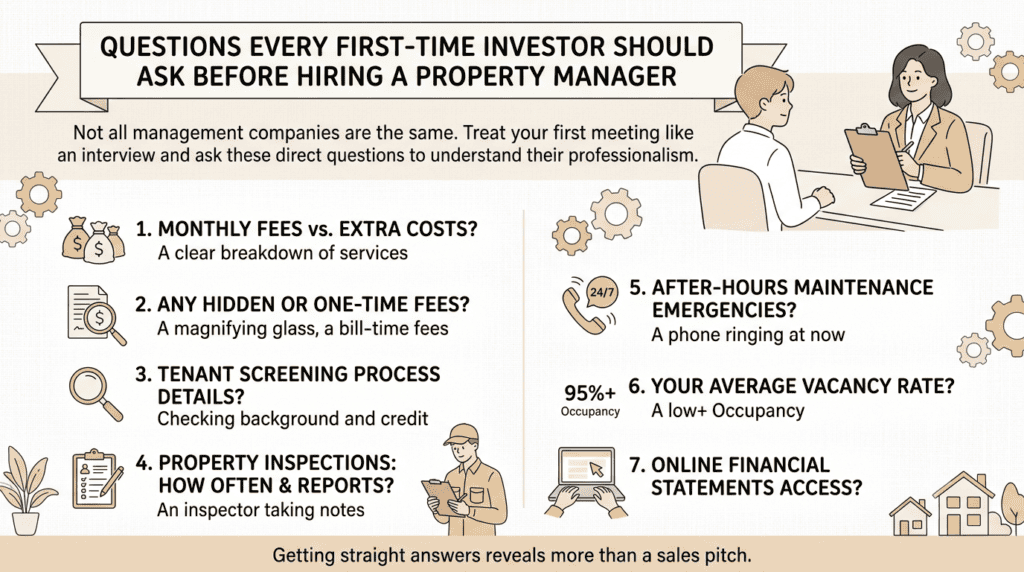
Not every property management company operates the same way, and the gap between a great one and a mediocre one shows up fastest in how they answer direct questions. Before signing anything, treat the initial conversation like an interview, because it is one. A strong property manager will answer these clearly and without hesitation:
- What services are included in the base monthly fee, and what costs extra?
- Are there any hidden or one-time fees I should know about upfront?
- What does your tenant screening process actually involve?
- How often are property inspections completed, and will I receive reports?
- How are maintenance emergencies handled outside business hours?
- What is your average vacancy rate across your current portfolio?
- Can I review monthly financial statements and reports online?
Getting straight answers to these questions tells you more about a company’s professionalism than any sales pitch will.
Mistakes First-Time Investors Make When Choosing Property Management
Even investors who decide to hire help sometimes choose the wrong partner. The most common missteps include:
- Choosing based on the lowest price alone. A cheap management fee often comes with weaker service, slower response times, or hidden charges that offset the savings. For example, a company advertising a 6% management fee might make up the difference through a higher leasing fee, an inspection fee on every visit, and a steep maintenance markup, quietly landing at a higher effective annual cost than a competitor charging 10% with no add-ons.
- Not reading the contract closely. Termination clauses, renewal terms, and fee schedules matter as much as the headline rate. Some contracts auto-renew annually and require 60-90 days’ notice to exit, a detail easy to miss when you’re focused only on the monthly fee.
- Ignoring communication standards. If a company is slow to respond during the sales process, that pattern rarely improves once you’re a client.
- Skipping reviews and references. Talking to current or past clients reveals far more than a company’s own marketing materials.
- Overlooking local market expertise. A manager unfamiliar with Niagara-specific pricing, seasonal demand, and regional bylaws will struggle to price and market your unit competitively.
- Failing to clarify who handles LTB matters. Given how long Ontario’s tribunal timelines currently run, ask upfront whether your manager files and represents you at Landlord and Tenant Board hearings, or whether that’s an extra cost passed on to a paralegal.
Final Verdict: Is It Worth It for First-Time Investors?
There’s no single right answer, only the right answer for your situation. It depends on your goals, your available time, and how much hands-on experience you already have.
If your priority is building a long-term, low-stress rental portfolio, professional property management can deliver strong value despite the fees, particularly through lower vacancy, stronger legal compliance, and dramatically less personal stress.
If you’re looking to gain hands-on experience with a single, nearby rental, self-management may be a reasonable starting point, one you can transition away from as your portfolio and your time constraints grow.
Either way, the goal is the same: protect your investment, keep good tenants in place, and build income that doesn’t cost you your evenings and weekends.
If you’re a first-time investor in Niagara Falls, St. Catharines, or the surrounding region and you’d rather focus on growing your portfolio than chasing late rent and coordinating repairs, The HAH Developments offers full-service property management built specifically for landlords who want passive, stress-free rental income. From tenant screening to maintenance coordination to legal compliance, our team handles the day-to-day so you don’t have to. Reach out today for a free rental property consultation and see what professional management could mean for your bottom line.
Whichever direction you choose, the most important thing is making the decision deliberately rather than defaulting into self-management just to save the fee, or hiring the first company you find just to offload the stress. Take the time to run your own numbers, ask the right questions, and pick the path that actually fits the investor you are today, not the one you hope to become in five years.
Frequently Asked Questions
Is property management worth it for one rental property?
It depends on proximity and your available time. If the property is nearby and you’re comfortable handling tenant calls and minor repairs, self-management can work. If you live far away or have limited time, a property manager often pays for itself through lower vacancy and fewer costly mistakes.
How much do property managers charge in Canada?
Most residential property managers charge between 6% and 12% of monthly rent, with the national average sitting close to 8-10%. In Ontario specifically, rates commonly range from 8% to 12%, plus separate fees for leasing, renewals, and inspections.
Can a property manager increase rental income?
Yes, often through accurate market pricing, reduced vacancy periods, and stronger tenant retention. A well-priced, well-marketed unit typically earns more over a year than one priced too high that sits vacant for weeks.
What are the disadvantages of hiring a property manager?
The main drawbacks are the ongoing management fee and slightly less day-to-day control over decisions, since your manager handles tenant communication and routine choices on your behalf.
Should first-time landlords manage their own property?
Only if they have the time, live close to the property, and are willing to learn provincial landlord-tenant law in detail. For anyone short on time or new to the legal side of renting, professional help significantly reduces risk.
What services are included in property management?
Typically marketing, tenant screening, lease preparation, rent collection, maintenance coordination, inspections, emergency response, legal compliance, and financial reporting. Exact inclusions vary by company, so always request a full service list.
How do property managers find quality tenants?
Through professional marketing across multiple platforms, combined with a structured screening process that includes credit checks, income verification, and reference calls to previous landlords.
How do I choose the right property management company?
Compare full fee schedules (not just the headline percentage), read client reviews, ask about local market experience, and confirm response times for maintenance emergencies before signing anything.