

If you own a property anywhere near the Falls, wine country, or the QEW corridor, you’ve probably noticed the same thing everyone else has: short-term rentals here are booming, and they’re also getting a lot harder to run correctly. Between licensing rules that change by municipality, a tourist season that swings hard between packed and empty, and guests who now expect hotel-level service from a private home, doing this well takes more than listing a spare property on Airbnb and hoping for the best.
That’s exactly why short-term rental management in Niagara has turned into its own specialized industry. Owners who once handled everything themselves – pricing, cleaning, guest messages, licensing paperwork – are increasingly handing those jobs to people who do it full-time. This guide walks you through what’s actually involved in short-term rental management in Niagara today: the rules you need to follow, the numbers you should expect, and the decisions that separate a property that barely breaks even from one that pays for itself many times over.
What Is Short-Term Rental Management in Niagara, Anyway?
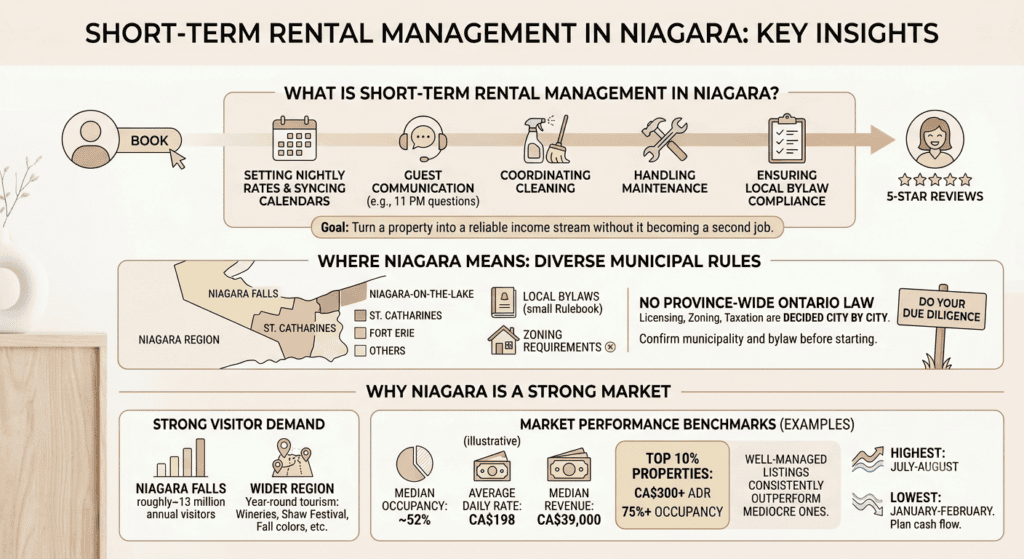
Short-term rental management in Niagara covers everything that happens between a guest clicking “book” and leaving a five-star review. That includes setting the nightly rate, keeping your calendar synced across platforms, answering guest questions at 11 p.m., coordinating cleaners between checkout and check-in, handling maintenance issues, and making sure your property stays compliant with local licensing rules.
For some owners, this means hiring a full-service property management company. For others, it means using software to handle pricing and messaging while they still manage cleaning and maintenance themselves. Either way, the goal is the same: turn a property into a reliable income stream without it becoming a second job.
Where “Niagara” Really Means: Falls, NOTL, St. Catharines, and Beyond
One thing that trips up new hosts fast: “Niagara” isn’t one market with one set of rules. The Niagara Region is made up of a dozen separate municipalities, and each one – Niagara Falls, Niagara-on-the-Lake, St. Catharines, Fort Erie, and others – writes and enforces its own short-term rental bylaw. A rule that applies to your cousin’s condo in Niagara Falls might not apply at all to a cottage twenty minutes away in Niagara-on-the-Lake.
This matters because Ontario has never passed a province-wide short-term rental law. Licensing, zoning, and taxation are decided city by city, so due diligence looks different depending on exactly where your property sits. Before you do anything else, confirm which municipality governs your address and pull up that specific bylaw.
Why Niagara Is One of Canada’s Strongest Short-Term Rental Markets Right Now
Despite the regulatory patchwork, Niagara remains one of the more attractive short-term rental markets in Ontario, and the tourism numbers explain why.
Tourism Numbers That Matter to Hosts
Niagara Falls alone draws roughly 12 to 13 million visitors a year, and the wider region pulls in tourists chasing wineries, the Shaw Festival, and the falls themselves nearly twelve months a year. That steady flow of visitors is the entire reason short-term rentals work here better than in most Ontario cities – demand doesn’t disappear the moment summer ends, it just shifts toward wine tourism, holiday travel, and off-season getaways.
Current Occupancy, ADR, and Revenue Benchmarks
Numbers vary depending on which data source and time period you look at, but recent market data paints a consistent picture. Median short-term rental occupancy in Niagara Falls sat around 52% over the past year, with an average daily rate near CA$198 and median annual revenue close to CA$39,000 per listing. Top-performing properties – the top 10% by quality and pricing – pulled in nightly rates above CA$300 and hit occupancy north of 75%.
That gap between median and top-tier performance is the whole story. A well-managed listing with sharp photos, accurate pricing, and fast guest response consistently outperforms a mediocre one sitting two blocks away, even when both properties are nearly identical. This is exactly where professional short-term rental management in Niagara earns its keep – the difference between average and excellent execution is worth thousands of dollars a year on the same four walls.
Seasonality is real here too. July and August are the strongest months for bookings and revenue, while January and February are consistently the slowest. Smart owners plan their cash flow around this instead of getting caught off guard every winter.
How Niagara Compares to Other Ontario Short-Term Rental Markets
It helps to see Niagara next to the rest of the province. Toronto’s Municipal Accommodation Tax briefly climbed to 8.5% to help fund World Cup preparations before dropping back to 6% on August 1, 2026, and the city now requires platforms to verify registration numbers through a municipal API before a listing can even go live. Cottage country markets like Muskoka and Prince Edward County often charge similar or higher licensing fees than Niagara but layer on stricter minimum-stay rules aimed at curbing weekend party rentals.
Niagara Falls stands out because it’s one of the few Ontario cities that still allows non-owner-occupied investment properties to operate as short-term rentals, provided they sit in the right zone. That single detail makes it meaningfully more accessible to investors than Toronto or many GTA suburbs, where principal-residence requirements shut out anyone who doesn’t live on-site. Combine that with 12+ million annual visitors and you get a market that’s both open to investors and backed by real, sustained demand.
The Legal Side: Licensing and Zoning Rules Every Niagara Host Must Know
This is the part most new hosts underestimate, and it’s the part that causes the most expensive mistakes. Operating without the right license in Niagara isn’t a paperwork technicality – it can shut your listing down and cost tens of thousands of dollars in fines.
Niagara Falls Vacation Rental Unit (VRU) Licenses
In Niagara Falls, an entire-home short-term rental is classified as a Vacation Rental Unit license, and you cannot legally advertise or accept bookings without one. VRUs are only permitted in designated Tourist Commercial, General Commercial, and Central Business zones – not in standard residential neighbourhoods, regardless of how close your property sits to Clifton Hill or the falls themselves.
To operate legally, you’ll need to confirm your property sits inside an approved zone, then apply for a license through the city. The initial application fee runs around $500, with a $250 annual renewal after that. You’re also capped at renting out a maximum of three bedrooms per property, and your listing must display its license number, since Airbnb and other platforms increasingly verify these numbers before allowing a listing to go live.
The Owner-Occupied Short-Term Rental (OOSTR) Pilot Program
If your property doesn’t sit in a commercial zone but you live on-site, there’s a second path: the city’s Owner-Occupied Short-Term Rental pilot program. This lets residents rent out a secondary unit or spare rooms in their own home, provided they’re physically present during the guest’s stay. The pilot is capped at 100 licenses and is scheduled to wrap up at the end of September 2026, after which city council will decide whether to make it permanent.
OOSTR licenses come with their own conditions: you must be a Canadian permanent resident, the property must be your principal residence, bedrooms are capped at three, and parking requirements apply based on how many guests you’re hosting. Advertising an OOSTR without an active license can trigger penalties of $1,000 per day, so this isn’t a program to enter casually.
Niagara-on-the-Lake and St. Catharines Rules Differ
Niagara-on-the-Lake short-term rental rules follow their own separate bylaw, with licenses running on multi-year terms and requiring proof of liability insurance naming the town as an additional insured party. St. Catharines, meanwhile, is still tightening its own framework, with a lower Municipal Accommodation Tax rate but growing restrictions on non-owner-occupied units in residential zones.
If you own properties in more than one Niagara municipality, don’t assume compliance in one town covers you in another. Each city inspects, licenses, and fines independently.
Municipal Accommodation Tax and HST Obligations
On top of licensing, Niagara Falls hosts must collect and remit a flat Municipal Accommodation Tax charged per night of occupancy, filed quarterly even during months with zero bookings. You’re also responsible for charging 13% HST on your rental income once you cross the mandatory registration threshold, and for keeping accurate records in case the Canada Revenue Agency comes asking.
Fines and Enforcement – What Happens If You Skip Licensing
Enforcement in Niagara Falls has real teeth. Operating an unlicensed VRU can result in fines starting around $50,000 for a first offense, climbing to $100,000 for repeat violations. The city actively investigates complaints from neighbours and cross-references listings against its licensing database, so “flying under the radar” is a much riskier bet than it used to be.
Self-Managing vs. Hiring Professional Short-Term Rental Management in Niagara
Once your licensing is sorted, the next big decision is who actually runs the property day to day.
What Self-Managing Actually Costs You in Time
Self-managing sounds simple until you’re the one fielding a 2 a.m. message about a broken air conditioner three hours before a heatwave weekend. Between guest communication, cleaning coordination, dynamic pricing adjustments, maintenance calls, and compliance tracking, most self-managed hosts spend somewhere between five and fifteen hours a week per property – more during peak season, more still if something goes wrong.
For owners with one property and time to spare, that workload is manageable. For owners juggling a full-time job, multiple units, or a property that isn’t local to them, it quickly turns from a passive income stream into an unpaid second job.
What a Property Management Company Handles For You
A property management company in Niagara Falls typically takes over the entire operational side: listing creation and optimization, pricing strategy, guest screening and communication, cleaning and turnover logistics, maintenance coordination, and license renewals. Many also handle direct-booking marketing to reduce your dependence on Airbnb’s algorithm and fees.
The value isn’t just time saved – it’s consistency. A guest who messages at midnight gets an answer within minutes instead of the next morning, and a maintenance issue gets fixed before it turns into a one-star review.
How Much Do Niagara Property Managers Charge?
Management fees in this market typically range from 15% to 30% of gross booking revenue, depending on how much is included. Full-service packages that cover cleaning, guest communication, dynamic pricing, and compliance sit at the higher end; lighter-touch packages that just handle pricing and messaging sit lower. The math that matters isn’t the fee percentage on its own – it’s your net income after fees, since a 25% fee paired with strong dynamic pricing frequently outperforms a 15% fee run on flat, static rates.
Core Services Included in Professional Short-Term Rental Management
Not every management company offers the same scope, but here’s what a strong short-term rental management in Niagara package generally includes.
Listing Optimization and Multi-Platform Distribution
Your listing is your storefront. Professional photography, accurate descriptions, and keyword-optimized titles directly affect how often your property shows up in search results on Airbnb, Vrbo, and Booking.com. Listings with incomplete descriptions or inconsistent details consistently underperform, even when the property itself is great.
Dynamic Pricing and Revenue Management
Static, flat-rate pricing is quickly becoming a liability. Booking windows have compressed sharply over the past few years – travellers now book much closer to their arrival date than they did before the pandemic – which means rates set months in advance often miss real-time demand entirely. Dynamic pricing tools adjust nightly rates automatically based on local events, competitor pricing, and booking pace, and properties using them see meaningful revenue gains over static pricing, often in the range of 10% to 40% more annual income depending on the market and how aggressively the tool is tuned.
Guest Communication and 24/7 Support
Fast, friendly responses aren’t a nice-to-have anymore – they directly affect your search ranking on major platforms and your odds of earning a “guest favourite” badge. Professional management typically includes round-the-clock messaging coverage, pre-arrival instructions, and check-in support so no guest is left waiting.
Professional Cleaning and Turnover Coordination
Cleaning quality is one of the fastest ways to lose a five-star review. Good management companies run dedicated cleaning crews on tight turnover schedules, often with photo-based quality checks after every stay, so a late checkout never turns into a late check-in for the next guest.
Maintenance and Property Care
Regular inspections catch small problems – a slow leak, a worn smoke detector, a wobbly deck railing – before they become expensive emergencies or safety violations. This is also where a management company protects your long-term asset value, not just your short-term booking calendar.
Compliance Management (Licensing, MAT, Insurance)
Given how strict Niagara’s enforcement has become, this may be the single most valuable service on the list. A management company that tracks license renewal dates, files your Municipal Accommodation Tax on time, and keeps your insurance current removes an entire category of risk from your plate.
Insurance deserves special attention here. Standard homeowner policies typically exclude commercial short-term rental activity, which means a claim after a guest injury or property damage incident could be denied outright if you’re still on a regular homeowner policy. Most municipalities, including Niagara-on-the-Lake, also require proof of liability coverage – often $2 million or more – naming the town as an additional insured party before they’ll issue or renew your license. A good management company either carries master coverage that extends to your unit or makes sure you’re properly insured before you ever accept a booking.
Financial Reporting and Owner Transparency
The best management companies don’t just collect your revenue and send a monthly deposit – they show their work. Look for monthly statements that break down gross revenue, platform fees, cleaning costs, management fees, and net payout line by line, along with occupancy and ADR trends over time. If a company can’t produce clear, itemized reporting on request, that’s usually a sign their internal systems aren’t as organized as their sales pitch suggests.
How to Maximize Airbnb Revenue in Niagara: Actionable Strategies for 2026
Whether you self-manage or hire help, these strategies move the needle on revenue.
Price Dynamically, Not Seasonally
A “high season / low season” spreadsheet from three years ago is already outdated. Real demand shifts week to week based on events, weather, and competitor pricing, and a rigid seasonal calendar misses gap nights and underprices peak weekends alike. Dynamic pricing tools that adjust daily based on booking pace consistently outperform static rate sheets.
Target Shoulder Seasons and Local Events
Wine festivals, holiday light displays, and off-season packages can fill gaps in your calendar during traditionally slow months. Don’t just discount in the off-season – package it. A “wine country weekend” rate with a small welcome basket often converts better than a plain price cut.
Invest in Guest Experience and Amenities
Reviews increasingly separate winning listings from the pack. Small upgrades – a coffee station, blackout curtains, fast Wi-Fi, a well-stocked kitchen – cost little relative to the nightly rate bump and review quality they generate.
Diversify Beyond Airbnb
Relying on a single platform leaves you exposed to algorithm changes and fee increases. Listing across Airbnb, Vrbo, and Booking.com, and eventually building a simple direct-booking page, spreads your risk and can capture guests who’d rather avoid platform fees entirely.
Airbnb Co-Hosting in Niagara: A Middle Ground Worth Considering
If handing over full management feels premature, Airbnb co-hosting Niagara arrangements offer a middle path. A co-host typically manages specific tasks – guest messaging, cleaning coordination, or pricing – while you retain more control and pay a lower percentage than a full-service management contract. It’s a natural stepping stone for owners who want support without giving up the driver’s seat entirely, and many owners transition into full management later once their portfolio grows.
Rental Arbitrage in Niagara: An Alternative Path to Passive Income
Not everyone entering this space owns property outright. Rental arbitrage Niagara – where an operator leases a property long-term from a landlord, then re-lists it as a short-term rental with the landlord’s written permission – has become a popular entry point for people who want short-term rental income without a mortgage or down payment. It carries its own risks, since your entire business depends on a lease agreement rather than ownership, but for the right property and landlord relationship, it’s a genuine way to build income without the capital barrier of buying real estate first.
Choosing the Right Short-Term Rental Management Company in Niagara
Not all management companies are created equal, and the wrong choice can cost you more than it saves.
Questions to Ask Before You Sign
Before signing a management agreement, ask exactly what’s included in the fee, how often you’ll receive financial reporting, who handles guest disputes and damage claims, what pricing software they use, and how they handle license renewals and tax filings. Ask for references from current owners in the Niagara Region specifically, not just testimonials from their website.
Red Flags to Watch For
Be cautious of companies that won’t share real occupancy or revenue data from properties they currently manage, that lock you into long contracts with steep exit penalties, or that seem unfamiliar with Niagara Falls’ specific zoning and licensing requirements. A company that doesn’t know the difference between a VRU and an OOSTR shouldn’t be managing your license compliance.
Common Mistakes Niagara Hosts Make (and How to Avoid Them)
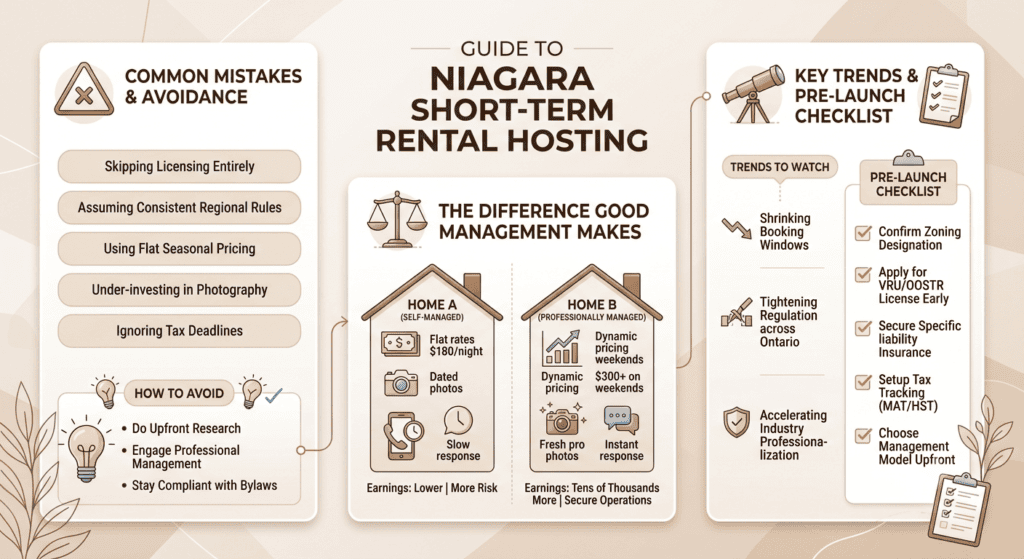
A few mistakes show up again and again among new hosts in this market. Skipping licensing entirely, assuming rules from one Niagara municipality apply everywhere in the region, using flat seasonal pricing instead of dynamic rates, under-investing in professional photography, and ignoring the Municipal Accommodation Tax filing deadlines all lead to lost income or, worse, fines. Most of these are entirely avoidable with either a bit of upfront research or the right management partner handling the details.
A Quick Example of What Good Management Changes
Picture two nearly identical three-bedroom homes near Clifton Hill, both licensed VRUs. The first owner sets a flat $180 nightly rate year-round, updates photos once every couple of years, and answers guest messages whenever they get to their phone. The second property is run with dynamic pricing that pushes rates above $300 on festival weekends and drops them strategically to fill gap nights in February, uses professional photography refreshed each season, and responds to guests within minutes at any hour.
Both properties sit in the same neighbourhood, cost roughly the same to own, and see similar guest demand. But the second one routinely earns tens of thousands of dollars more per year, simply because every operational lever – pricing, presentation, and responsiveness – is being pulled correctly instead of left on autopilot. That gap is the entire business case for professional short-term rental management in Niagara.
The Future of Short-Term Rental Management in Niagara: Trends to Watch
A few shifts are already reshaping this market heading into the rest of 2026 and beyond. Booking windows keep shrinking, meaning guests commit closer to their arrival date than ever, which puts pressure on hosts to react to demand signals in real time rather than planning six weeks out. Regulation continues to tighten across most Ontario municipalities, not loosen, so staying current on local bylaws is only becoming more important. And professionalization is accelerating industry-wide – more owners are shifting from solo self-management toward hybrid models or full-service companies, simply because the operational bar for competing on major platforms keeps rising.
For owners, the takeaway is simple: short-term rental management in Niagara now rewards preparation, compliance, and consistent execution far more than it rewards luck or a great location alone.
A Pre-Launch Checklist for New Niagara Hosts
Before your first guest ever checks in, it helps to work through a short list rather than trying to remember every requirement from memory. Confirm your property’s zoning designation with the city before you invest in furnishing or renovations, since a beautiful setup means nothing if the address can’t legally hold a license. Apply for your VRU or OOSTR license early, since processing can take several weeks, especially during busy application periods. Line up liability insurance that specifically covers short-term rental use, not just standard homeowner coverage. Set up a system for tracking your Municipal Accommodation Tax and HST filing deadlines so nothing slips through the cracks during a busy season. And finally, decide upfront whether you’re self-managing, co-hosting, or handing off to full management, since retrofitting that decision after your first messy summer season is far more disruptive than deciding it before you ever list.
Turn Your Niagara Property Into a Stress-Free Income Stream
Running a short-term rental in Niagara can absolutely be a strong, steady income stream – but only if the licensing, pricing, and day-to-day operations are handled correctly. The gap between a listing that just gets by and one that consistently outperforms its neighbours almost always comes down to execution, not location.
That’s exactly where The HAH Developments comes in. As a premium property management company based right here in Niagara Falls, we handle every piece of short-term rental management in Niagara for our owners – licensing and compliance, dynamic pricing, guest communication, professional cleaning, and maintenance – so you get the income without the 2 a.m. phone calls.
Whether you already own a property and feel buried in the day-to-day, or you’re still weighing whether Niagara is the right market to invest in at all, the underlying math doesn’t change: a property that’s priced right, cleaned well, communicated about quickly, and kept fully compliant will consistently outperform one that isn’t, no matter how good the location looks on paper. Getting those fundamentals right, and keeping them right through every season, is the actual job of short-term rental management in Niagara – and it’s one we handle daily so our owners don’t have to.
If you’re ready to find out what your property could actually be earning, reach out to The HAH Developments today for a free rental assessment.
Frequently Asked Questions
Is Airbnb legal in Niagara Falls? Yes, but only with a valid license. Entire-home rentals need a Vacation Rental Unit license and must sit within an approved commercial or tourist zone, while owner-occupied rentals fall under the separate OOSTR pilot program.
How much does short-term rental management cost in Niagara? Most companies charge between 15% and 30% of gross booking revenue, depending on how much is included, such as cleaning, guest messaging, and dynamic pricing. Ask exactly what falls inside that percentage before comparing quotes, since a lower fee that excludes cleaning or maintenance can end up costing more overall.
Do I need a license to rent my Niagara property short-term? In nearly every Niagara municipality, yes. Niagara Falls, Niagara-on-the-Lake, and St. Catharines each require some form of short-term rental license, and the specific rules, fees, and renewal timelines vary by city, so always confirm directly with your local municipality rather than assuming.
What’s the difference between a VRU and an OOSTR in Niagara Falls? A Vacation Rental Unit license covers entire-home rentals in commercial zones where the owner doesn’t need to live on-site. An Owner-Occupied Short-Term Rental license covers a unit within or attached to the owner’s own principal residence, requires the owner to be present during stays, and is currently capped under a pilot program set to be reviewed by city council after September 2026.
Can I run an Airbnb in a Niagara Falls residential zone? Generally no for entire-home rentals, since VRUs are restricted to Tourist Commercial, General Commercial, and Central Business zones. Owner-occupied arrangements in residential zones are only permitted through the capped OOSTR pilot program, and even then, specific conditions around parking and bedroom count apply.
How much can I earn from a short-term rental in Niagara? Recent market data shows median annual revenue near CA$39,000 per listing, with an average daily rate around CA$198 and occupancy near 52%. Top-performing, professionally managed properties earn considerably more, often clearing $300+ nightly rates during peak season with occupancy above 75%.