

If you own a rental property in the Niagara Region right now, the ground under you has shifted. Vacancy rates just hit a decade-high. New tenancy laws kicked in this summer. And if you’re renting short-term in Niagara Falls, the licensing rules have gotten stricter, not looser.
None of that means owning rental property here is a bad idea. It means the margin for error has gotten smaller. A landlord who prices a unit the way they did in 2022, skips a required notice, or misses a licensing renewal isn’t just losing a little money anymore – in a softer market, those mistakes show up as empty units, LTB fines, or a listing pulled offline.
This is exactly the gap that good property managers in Niagara are built to close. Whether you own a single condo in St. Catharines, a long-term rental in Welland, or a short-term vacation property near Clifton Hill, the right property manager keeps you compliant, keeps your unit rented, and protects the return you bought the property for in the first place.
This guide walks through what’s actually changed in the Niagara rental market this year, what a professional property manager does day to day, what it costs, and how to choose one you can trust. If you’re weighing whether to keep self-managing or bring in help, you’ll have a clear answer by the end.
Why Niagara’s Rental Market Is Different in 2026
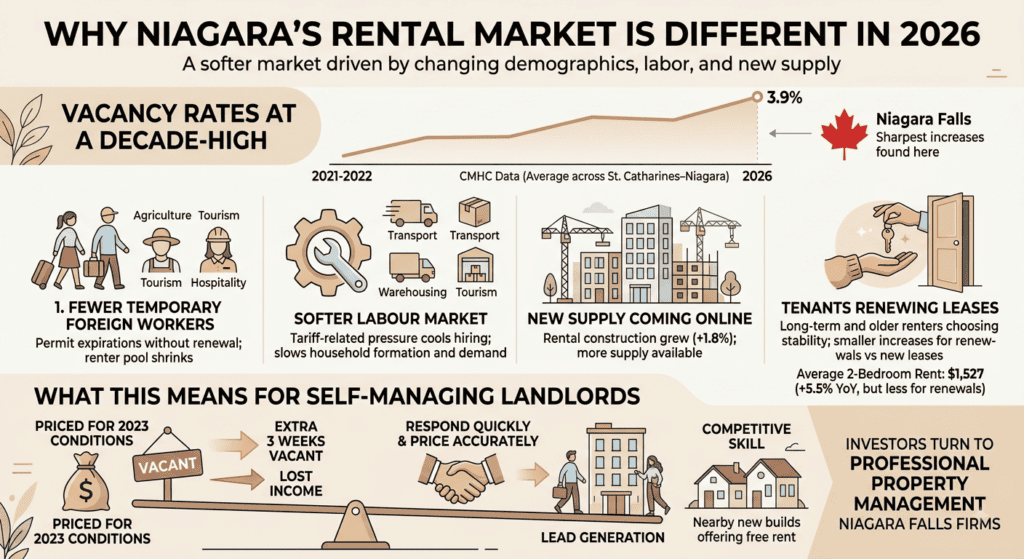
Niagara isn’t behaving like it did two or three years ago, and the numbers explain why landlords are rethinking their approach.
Vacancy Rates Are at a Decade-High
According to CMHC’s most recent rental market data, the average vacancy rate across the St. Catharines–Niagara census area held at 3.9% – a more-than-decade high, and well above where the region sat during the tight-market years of 2021 and 2022. Niagara Falls specifically posted the sharpest increases within the region.
A few forces are driving this:
- Fewer temporary foreign workers. Niagara’s agriculture, tourism, and hospitality sectors lean heavily on temporary foreign worker permits. A wave of permit expirations without renewal pulled renters out of the local pool.
- A softer labour market. Tariff-related pressure on transportation, warehousing, and tourism jobs has cooled hiring, which cools household formation and rental demand together.
- New supply coming online. Rental construction across the region grew, adding roughly 1.8% more supply into a market with slower demand growth to absorb it.
The average two-bedroom purpose-built rent in the region landed around $1,527, up roughly 5.5% year over year – but that number hides an important detail: tenants who renewed their lease saw smaller increases than the rent being asked on newly vacated units. Long-term tenants, especially older renters, are choosing to stay and accept modest increases rather than risk moving into a pricier new lease.
What This Means If You’re Self-Managing
A softer market rewards landlords who respond quickly and price accurately, and it punishes landlords who don’t. If a unit sits vacant for an extra three weeks because it was priced for 2023 conditions, that’s real income gone – and in a market where nearby newly built buildings are offering one to two months of free rent to attract tenants, an overpriced listing can sit for a long time.
This is one of the clearest reasons investors are turning to professional property management Niagara Falls firms right now: pricing decisions that used to be simple guesswork have become a genuine competitive skill.
Rental Market Snapshot: City by City Across Niagara
Niagara isn’t one uniform market – conditions shift noticeably depending on which municipality your property sits in, and that affects both pricing strategy and which management services matter most.
- Niagara Falls. The region’s highest vacancy increase in 2025 came from here, driven by the drop in temporary foreign worker permits and softness in tourism-related employment. It’s also the region’s short-term rental hub, with the most active – and most tightly regulated – VRU licensing regime in Niagara.
- St. Catharines. The largest urban centre in the region and the anchor of the CMHC “St. Catharines–Niagara” reporting area. Long-term tenants here have been more likely to renew rather than move, which has kept turnover – and turnover rents – relatively steady even as vacancy climbed.
- Welland and Thorold. Both sit within a short drive of Brock University and Niagara College, and rents here typically run 12% to 18% below St. Catharines. Student demand gives these markets a seasonal rhythm that differs from the family-rental pattern elsewhere in the region.
- Niagara-on-the-Lake. One of the strongest short-term rental markets in the region thanks to wineries and steady tourist traffic, but also one of the most strictly enforced when it comes to short-term rental bylaws – a market where professional compliance support matters most.
The practical implication: a pricing or leasing strategy that works in Welland won’t necessarily translate to Niagara Falls or Niagara-on-the-Lake. Local, sub-market knowledge – not just regional averages – is what separates a property manager who fills your unit quickly from one who’s guessing.
Common Mistakes Landlords Make Without a Property Manager
Most of the costly mistakes self-managing landlords make in Niagara aren’t dramatic – they’re small, repeated oversights that add up over a year.
- Serving the wrong notice, or the right notice with the wrong details. An N4, N12, or N13 filled out incorrectly can be dismissed at the LTB, forcing the landlord to restart the process from scratch – often adding months to an already-slow timeline.
- Under-pricing or over-pricing a vacant unit. Without current comparable data, landlords tend to anchor to what they charged last year, which either leaves money on the table or leads to a listing that sits unrented while nearby buildings offer move-in incentives.
- Skipping documentation on routine communication. Verbal agreements about repairs, entry, or payment plans are hard to defend at a hearing. The LTB expects a paper trail, and landlords who don’t keep one are at a real disadvantage if a dispute arises.
- Missing a short-term rental renewal or inspection window. In Niagara Falls, a lapsed VRU licence can mean a delisted property and lost bookings until it’s resolved – a mistake that’s entirely avoidable with a compliance calendar.
- Underestimating how fast rules change. Between Bill 60, Bill 97, and shifting municipal short-term rental bylaws, a landlord who set their process up two years ago may already be operating on outdated assumptions.
Each of these is manageable on its own. Together, across a full year of ownership, they’re exactly the kind of gaps that professional property managers in Niagara are built to close.
What Property Managers in Niagara Actually Do
“Property management” gets used loosely, so it’s worth breaking down what a full-service Niagara property manager is actually responsible for day to day.
Tenant Screening & Placement
This is where a good manager earns their fee before a tenant ever moves in. A thorough screening process typically includes:
- Credit checks and income verification (usually 3x rent as a minimum threshold)
- Employment and reference confirmation
- Landlord and tenant board (LTB) history checks
- Professional listing photography and marketing across major rental platforms
Weak screening is one of the most common causes of costly tenancies – late payments, property damage, or disputes that end up at the LTB. A property manager who screens properly is protecting your cash flow, not just filling a vacancy.
It’s also worth noting how screening standards have to adapt in a market like this one. When vacancy is low and demand is high, landlords can afford to be highly selective. When vacancy sits at a decade high and applicant pools shrink, a good manager still holds the line on screening standards rather than lowering the bar just to fill a unit fast – because a bad tenancy is far more expensive than a few extra weeks of vacancy.
Rent Collection & Financial Reporting
Property managers handle monthly rent collection, automated payment reminders, late-fee enforcement where applicable, and – critically – provide owners with clear monthly or quarterly financial statements. If you’ve ever tried to reconcile a year of rental income and expenses from memory and a shoebox of receipts at tax time, this alone is worth the fee.
Maintenance & Emergency Repairs
Most management agreements include:
- Routine seasonal inspections (commonly spring and fall)
- A vetted network of contractors for repairs
- 24/7 emergency maintenance response
- Move-in and move-out condition reports
Fast maintenance response matters more than most owners expect. Slow repairs are one of the top reasons good tenants choose not to renew – and in a market where vacancy is already elevated, tenant retention has become far more valuable than it was a few years ago.
There’s a financial angle here too. A tenant who renews costs nothing in leasing or vacancy expense. A tenant who leaves because a leaking faucet took three weeks to fix costs an owner a full turnover cycle – cleaning, marketing, screening, and often a stretch of lost rent. Preventive maintenance, handled proactively rather than reactively, is one of the highest-return activities a property manager performs, even though it rarely shows up as a line item owners think about.
Legal Compliance & LTB Representation
This is arguably the highest-value part of professional management in 2026. Ontario’s rules around notices, rent increases, and evictions are detailed, and getting a form wrong can set an eviction back months. A property manager who works inside these rules daily can:
- Serve the correct notices (N4, N12, N13, and others) with the right timelines
- Represent the owner at Landlord and Tenant Board hearings
- Keep the documentation trail – communications, entry notices, repair records – that the LTB expects to see if a dispute arises
Short-Term Rental & Airbnb Management
For owners running vacation rentals rather than long-term leases, management extends further: guest communication, cleaning turnover coordination, dynamic pricing, municipal licensing compliance, and tax remittance. Airbnb management Niagara Falls has become its own specialized service line, distinct from long-term residential management, because the regulatory and operational demands are so different.
How Much Do Property Managers in Niagara Charge?
Ontario property management pricing follows a fairly consistent pattern, though the exact number depends on your city, property type, and service scope.
- Percentage-based fees: Most Ontario property managers charge 6% to 12% of monthly rent collected, with 8% to 10% being the most common range outside the GTA core. Niagara typically sits closer to the middle of this range rather than the Toronto premium end.
- Flat-fee pricing: Some firms charge a flat monthly rate instead, often between $130 and $280 per unit, which can work out cheaper on lower-rent properties but more expensive on higher-rent ones since it doesn’t scale down.
- Tenant placement fees: Usually charged separately when a new tenant is placed, commonly 50% to 100% of one month’s rent.
- Lease renewal fees: Often $100 to $300, though some full-service packages bundle this into the monthly rate.
What’s Usually Included vs Extra
A management fee typically covers day-to-day operations: rent collection, tenant communication, routine maintenance coordination, and general oversight. It usually does not include:
- Leasing or tenant placement fees for a new tenant
- The cost of actual repairs and materials (you pay for the repair; the manager coordinates it)
- Eviction or LTB representation fees, in some contracts
- Vacancy-period marketing costs
A quick worked example makes this concrete. On a Niagara rental collecting $1,800 a month, a management fee of 9% works out to $162 a month, or roughly $1,944 a year before HST. Add a tenant placement fee of one month’s rent if the unit turns over – $1,800 – and a $200 lease renewal fee in a year without turnover, and the true annual cost swings anywhere from roughly $2,150 to $3,750 depending on what happens with the tenancy that year. None of this is unusual; it’s simply what a full-service scope typically costs, and it’s worth knowing before you compare two quotes that look different on paper but cover very different ground.
The practical takeaway: don’t compare quotes on the headline percentage alone. A company advertising 7% that excludes half these services can end up costing more than a company charging 9% with a fully bundled scope. Ask for a full, itemized service schedule before you sign anything, and remember that property management fees Ontario landlords pay are tax-deductible against rental income, which softens the real cost.
Ontario’s 2026 Rental Law Changes Every Niagara Landlord Must Know
This is the section most self-managing landlords are behind on, and it’s where professional management pays for itself fastest.
Two major legislative waves are reshaping the Residential Tenancies Act this year: Bill 60, the Fighting Delays, Building Faster Act, 2025, and carryover provisions from Bill 97, the Helping Homebuyers, Protecting Tenants Act, 2023. Changes are rolling out on two key dates – July 1, 2026, and September 21, 2026.
Bill 60 – Fighting Delays, Building Faster Act
- Faster non-payment timelines. Landlords can now issue an N4 and begin the eviction process after just 7 days of unpaid rent, down from the previous window – but tenants also gained the option to formalize payment agreements, which landlords should document carefully.
- Air conditioning rights. As of July 1, 2026, tenants can install their own air conditioning units even in buildings where the landlord doesn’t provide cooling, subject to reasonable conditions the landlord can set.
- Shorter LTB review windows. The deadline to request a review of an LTB order shrank from 30 days to 15 days – landlords need to act on adverse rulings much faster than before.
- Steeper fines. Maximum individual fines for RTA offences rose from $50,000 to $100,000, and corporate maximum fines rose from $250,000 to $500,000. If your property is held in a corporation, that exposure just doubled.
Bill 97 Carryover Provisions
Bill 97 provisions continue phasing in alongside Bill 60, touching N12 (landlord’s own-use) and N13 (renovation) eviction notices. Both remain legitimate tools, but the LTB is scrutinizing bad-faith use more closely – an N12 still has to reflect a genuine own-use intention, and landlords using it improperly face real financial consequences under the new fine structure.
Why This Raises the Stakes for DIY Landlords
None of these changes make landlording impossible. But they do make paperwork, timelines, and documentation far less forgiving than they used to be. A single incorrect notice can now cost months of delay, and a pattern of non-compliance can cost tens of thousands of dollars under the new fine caps. This is precisely the kind of regulatory complexity that professional property managers in Niagara are trained to navigate on your behalf, keeping clean records of every notice, entry, and communication in case a dispute ever reaches the board.
Short-Term Rental & Airbnb Rules in Niagara Falls
If your Niagara property is a vacation rental rather than a long-term lease, a separate – and increasingly strict – set of municipal rules applies.
VRU Licensing Requirements
Every short-term rental in Niagara Falls needs a Vacation Rental Unit (VRU) licence from the city. Key requirements include:
- An initial licence fee of $500, with a $250 annual renewal
- Short-term rentals permitted only in designated tourist and commercial zones – most residential neighbourhoods are off-limits
- Fire Department, Niagara Region Health, and ESA electrical inspections before licensing
- A designated “responsible person” available 24/7 who can reach the property within one hour
- Booking records retained for at least three years
Operating without a valid VRU licence carries fines up to $50,000 for a first offence and $100,000 for repeat violations – and the city enforces a three-strike system, where three violations trigger licence revocation with a six-month wait before you can reapply.
Municipal Accommodation Tax
Short-term rental guests in Niagara Falls pay a Municipal Accommodation Tax, which shifted in 2026 from a flat per-night fee toward a structure tied to the property’s star rating. HST applies on top of the MAT, and licensed operators must remit the tax to the city on a quarterly basis if it isn’t already collected automatically by the booking platform.
The Owner-Occupied Pilot Program
The city is also running a capped, 14-month Owner Occupied Short-Term Rental (OOSTR) pilot, limited to 100 licences and running through the end of September 2026. It allows owners to rent out a secondary dwelling unit on their principal-residence property, provided the owner lives on-site during every guest stay. Council will decide after the pilot ends whether to make the program permanent.
For owners juggling zoning checks, inspections, tax remittance, and renewal deadlines on top of actually running the rental, this is where short-term rental management Niagara services earn their keep – a missed renewal date or failed inspection can shut a listing down entirely, and that lost income adds up fast.
How to Choose the Right Property Manager in Niagara
Not all property managers offer the same value, and a bad choice can cost more than self-managing would have. Here’s how to evaluate one properly.
Questions to Ask Before You Sign
- What’s included in the base management fee, and what’s billed separately?
- How do you screen tenants, and what are your minimum income and credit standards?
- What’s your average time-to-lease for a vacant unit in this market?
- How do you handle LTB filings and hearings – is that included or extra?
- Can you provide references from current Niagara-area clients?
- What technology do you use for owner reporting and rent collection?
- What’s your emergency maintenance response time?
Red Flags to Watch For
- Vague or verbal-only fee structures instead of a written, itemized agreement
- No local presence or experience specific to Niagara Region rules
- Reluctance to share client references or online reviews
- No clear process for LTB compliance or notice documentation
- Pressure to sign a long-term contract before you’ve seen a sample report
A trustworthy manager will happily walk you through their process, put every fee in writing, and show you exactly how they’d have handled a recent scenario – a maintenance emergency, a late-paying tenant, or a lease renewal.
DIY vs. Professional Property Management: What the 2026 Market Data Shows
Self-managing made more sense when vacancy was near zero and almost any listing rented within days. That’s not the market landlords are in right now.
With regional vacancy sitting at a decade-high and new buildings offering free-rent incentives to attract tenants, pricing and marketing skill has become a real differentiator between a property that rents in two weeks and one that sits empty for two months. A professional manager brings comparable-market data, multi-platform marketing, and screening infrastructure that most individual landlords can’t easily replicate.
The compliance side tips the scale further. Between the new RTA fine structure, tighter LTB review windows, and – for short-term rentals – an increasingly strict municipal licensing regime, the cost of a single mistake has grown. For a landlord with one property and plenty of time, self-management can still work. For anyone with more than one unit, a demanding job, or a short-term rental subject to inspections and licensing, professional management has become less of a convenience and more of a risk-management decision tied directly to rental property investment Niagara returns.
Best Practices for Maximizing Rental Income in a Softening Market
Whether you self-manage or hire out, these habits matter more in the current market than they did a few years ago.
- Price to the current market, not last year’s. Pull recent comparable listings before renewing or re-listing a unit, not just once a year. In a market where new buildings are offering free-rent incentives to attract tenants, a listing priced against outdated comparables can sit vacant for weeks longer than it should.
- Compete on move-in incentives where needed. A modest incentive – a small rent credit, a waived application fee, or included parking – can beat a lower asking rent while protecting your long-term rent roll and avoiding a rent-control reset that a lower base rent would lock in.
- Invest in tenant retention. Fast maintenance response and clear, proactive communication cost far less than a vacancy and re-leasing cycle. A tenant who feels heard is a tenant who renews.
- Stay ahead of documentation. Keep every notice, repair record, and communication organized in one place – the new, shorter LTB review windows leave no room to scramble for evidence after the fact.
- Reassess your rental strategy annually. With vacancy elevated and new supply still coming online through 2026 and into 2027, what worked as a pricing or leasing strategy last year may already be outdated. Build in a yearly review of rent, comparables, and lease terms rather than letting a tenancy run on autopilot.
- Separate long-term and short-term strategy decisions. In a softening long-term rental market, some owners consider converting to short-term use, or vice versa. That decision should be based on zoning eligibility, licensing cost, and realistic occupancy data for your specific neighbourhood – not on a single strong tourist season.
Conclusion
Niagara’s rental market in 2026 rewards landlords who adapt and quietly punishes the ones who don’t. Vacancy rates are at a decade high, tenancy law just got a lot less forgiving, and short-term rental rules in Niagara Falls keep tightening. None of that has to be a threat to your rental income – it just means the bar for good management has gone up.
That’s exactly where The HAH Developments comes in. We manage long-term rentals, short-term vacation properties, and everything in between across the Niagara Region, and we stay ahead of every regulatory change so you don’t have to. From tenant screening and rent collection to LTB compliance and Airbnb licensing, our team handles the details that protect your income and your investment.
Ready to stop chasing rent, paperwork, and permit renewals on your own? Contact The HAH Developments today for a free property assessment and see exactly how much stress-free, professional property management could add back to your bottom line.
Frequently Asked Questions
How much do property managers in Niagara typically charge? Most Niagara property managers charge between 6% and 12% of monthly rent collected, with 8% to 10% being the most common range for residential properties outside the downtown Toronto core. Tenant placement and lease renewal are usually billed as separate fees.
Do I need a licence to run a short-term rental in Niagara Falls? Yes. Every short-term rental in Niagara Falls requires a Vacation Rental Unit (VRU) licence, an initial $500 fee, a $250 annual renewal, and mandatory fire, health, and electrical inspections. Short-term rentals are only permitted in designated tourist and commercial zones.
What changed under Ontario’s Bill 60 in 2026? Bill 60 shortened the timeline for issuing an N4 non-payment notice to 7 days, cut the LTB order review window from 30 days to 15 days, gave tenants the right to install their own air conditioning, and roughly doubled maximum fines for RTA offences.
Is a property manager worth it if I only own one rental unit? It depends on your time, experience, and risk tolerance. In today’s softer market with more complex compliance requirements, even single-property owners are finding that professional management pays for itself through faster leasing and fewer costly legal mistakes – but a hands-on owner with time to spare can still self-manage successfully.
Can I write off property management fees on my taxes? Yes. Property management fees are considered a deductible expense against rental income in Canada, which reduces their effective cost.
What’s the difference between long-term and short-term rental management in Niagara? Long-term rental management focuses on tenant screening, lease compliance, and RTA obligations under a standard lease. Short-term rental management adds municipal licensing, guest turnover coordination, dynamic pricing, and Municipal Accommodation Tax remittance – a fundamentally different operational workload.