

Niagara Falls pulls in roughly 12 million visitors a year, and the wider Niagara Region welcomes closer to 14 million. That’s an enormous amount of demand pouring into a market where a lot of owners still don’t know how to run a rental the right way Vacation Rental Management.
If you own a property here, or you’re thinking about buying one, you’ve probably noticed that short-term rentals look easy from the outside. List it, collect bookings, cash the cheque. In reality, running vacation rental management in Niagara well means juggling licensing, tax collection, dynamic pricing, guest communication, cleaning turnovers, and constant regulatory changes – sometimes all in the same week.
This guide breaks down exactly what’s involved, what’s changed in 2026, and how owners in Niagara Falls, Niagara-on-the-Lake, and St. Catharines are handling it. Whether you’re managing your first Airbnb or thinking about bringing in a professional team, you’ll walk away with a clear picture of what it actually takes to run a profitable, compliant rental in this region.
Why Niagara Is One of Canada’s Strongest Vacation Rental Markets
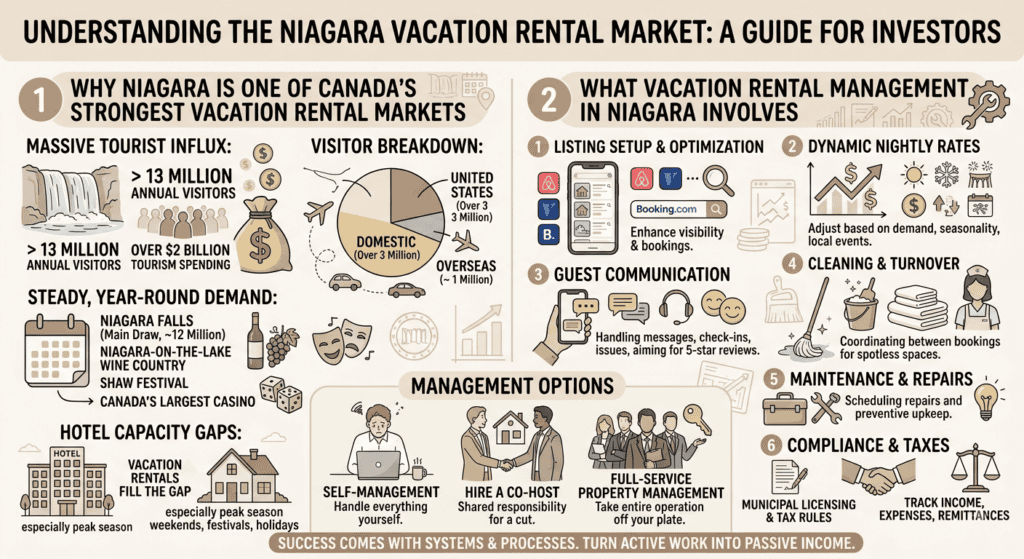
Before getting into the operational side, it helps to understand why so many investors are drawn to this region in the first place.
The Niagara Region attracts more than 13 million tourists a year across its attractions, wineries, and festivals, generating over $2 billion in annual tourism spending. Most of those visitors are domestic, but over 3 million come from the United States and roughly 1 million arrive from overseas.
Niagara Falls itself is the main draw, pulling in around 12 million of those visitors annually. Add in Niagara-on-the-Lake’s wine country appeal, the Shaw Festival, and Canada’s largest casino, and you get a region where tourism demand runs almost year-round, not just during a short summer window.
That kind of steady visitor traffic is exactly what makes a short-term rental strategy work. Hotels alone can’t absorb that volume, especially during peak season weekends, festivals, and holidays. Vacation rentals fill the gap – but only for owners who understand the rules and run their properties professionally.
What Vacation Rental Management in Niagara Actually Involves
Vacation rental management in Niagara covers everything that happens between the moment a guest books and the moment they check out satisfied, leaving a five-star review behind. That includes:
- Setting up and optimizing listings across Airbnb, Vrbo, and Booking.com
- Adjusting nightly rates based on demand, seasonality, and local events
- Handling guest messages, check-ins, and any issues that come up mid-stay
- Coordinating cleaning and turnover between bookings
- Scheduling repairs and preventive maintenance
- Staying compliant with municipal licensing and tax rules
- Tracking income, expenses, and remittances for tax season
Some owners handle all of this themselves. Others hire a co-host for a cut of each booking. Many turn to a full-service property management company that takes the entire operation off their plate. We’ll walk through the trade-offs of each approach later in this guide.
For now, the important thing to understand is that vacation rental management in Niagara isn’t a passive income stream by default. It becomes one once the systems and processes are in place – and that’s where most owners either succeed or burn out.
Niagara Falls Short-Term Rental Rules: What Changed in 2026
If your property is in Niagara Falls, this section matters more than almost anything else in this guide. The city enforces one of the stricter short-term rental frameworks in the region, and the rules shifted significantly this year.
VRU vs. OOSTR: The Two License Types
Niagara Falls recognizes short-term rentals as any stay of 28 consecutive days or less, and every operator needs one of two license types before listing a property.
A Vacation Rental Unit (VRU) license is for investment properties that don’t need to be the owner’s primary residence. VRUs are only permitted in three zones: Tourist Commercial, General Commercial, and Central Business. That rules out most standard residential neighbourhoods entirely, so confirming your zoning before you buy or list is non-negotiable.
An Owner Occupied Short-Term Rental (OOSTR) license applies when the host lives on the property full-time. This category runs as a pilot program capped at 100 licenses citywide, with applications open through September 2026, after which council will decide whether to continue it.
Both license types cost $500 to apply and $250 annually to renew, and both require proof of ownership, a site plan, a floor plan, and a fire safety inspection.
The New Municipal Accommodation Tax Structure
This is the change that catches the most owners off guard. As of April 1, 2026, Niagara Falls replaced its old flat-fee Municipal Accommodation Tax with a percentage-based structure. The MAT is now 4% of the total room rate, and it’s scheduled to rise to 5% on April 1, 2027.
This tax applies on top of the standard 13% HST already charged on rental income, so owners need to build both into their pricing math. The city has retained the Ontario Restaurant Hotel & Motel Association to administer collection, and VRU and OOSTR operators remit quarterly, at the end of April, July, October, and January.
If a booking platform like Airbnb collects the tax automatically on your behalf, you’re still responsible for making sure the remittance is accurate. Don’t assume the platform has it fully handled – spot-check your statements each quarter.
Insurance, Occupancy, and Safety Requirements
Every licensed operator needs a minimum of $2 million in liability insurance, with proof required at both licensing and renewal. Maximum occupancy follows Ontario Building Code and fire safety standards, generally capped at two adults per bedroom.
Properties are also subject to periodic and unannounced inspections, so it’s worth treating fire code compliance, smoke detectors, and carbon monoxide alarms as an ongoing responsibility, not a one-time checklist item.
Penalties for Operating Without a License
Niagara Falls doesn’t treat unlicensed operation lightly. Fines for a first offence can reach $50,000, and repeat violations can climb as high as $100,000. Unpaid fines get added directly to the property tax bill, and the city can suspend or revoke a license entirely for repeated infractions.
Given the size of those penalties, the $750 combined cost of a first-year VRU license is a rounding error by comparison. There’s no version of this where skipping the license makes financial sense.
Rules Beyond Niagara Falls: NOTL and St. Catharines
Niagara Falls isn’t the only municipality with rental rules, and the framework changes as soon as you cross a city line.
Niagara-on-the-Lake is one of the strongest short-term rental markets in the region, thanks to its wineries, charm, and steady visitor traffic – but the town enforces its bylaw strictly, and owners there need to check current zoning and licensing requirements before listing.
St. Catharines is still moving toward a formal licensing model and doesn’t yet have the same structured framework as Niagara Falls or NOTL. The city applies a Municipal Accommodation Tax on stays under 30 days and generally restricts non-owner-occupied short-term rentals in residential zones.
Smaller municipalities like Welland, Fort Erie, and Grimsby each maintain their own separate rules. None of this should discourage you from investing across the region – it just means the due diligence has to happen at the municipal level, every single time, rather than assuming one city’s rules apply everywhere.
Self-Managing, Co-Hosting, or Hiring a Property Manager
Once you understand the compliance side, the next decision is who actually runs the property day to day. There are three realistic paths, and each one suits a different kind of owner.
Self-Management
This is where most owners start. You handle listing creation, pricing, guest messages, cleaning coordination, and maintenance calls yourself, and it costs nothing in management fees.
The catch is time. If you’re spending 15 hours a week managing a single property and your time is worth even $50 an hour, that’s close to $39,000 a year in opportunity cost – before accounting for the mistakes that come from being stretched too thin.
Co-Hosting
A co-host typically takes 10% to 15% of gross booking revenue in exchange for handling messaging, turnover coordination, and guest issues, while you keep the listing, the reviews, and control of the account. Airbnb’s own co-host marketplace has matured into a real hiring channel, with verified profiles and in-platform payments.
This model tends to work best for owners who live within an hour or two of their property and want a lighter-touch partnership rather than handing over full control.
Full-Service Vacation Rental Management
A dedicated property management company takes over the entire operation: pricing, guest communication, cleaning, maintenance, and compliance. Fees typically run in the 15% to 28% range of gross revenue depending on the provider and the level of service.
For owners who live far from Niagara, own multiple units, or simply want the entire operation off their plate, this is usually the path that makes the most sense – especially once you factor in how much a licensing mistake or a bad guest review can cost.
What a Professional Vacation Rental Manager Actually Does
“Property management” can mean very different things depending on who you ask, so here’s what a competent team should actually be doing on your behalf.
Dynamic Pricing, Not Guesswork
Flat nightly rates leave money on the table almost every week of the year. Dynamic pricing tools adjust rates based on demand, seasonality, local events, and competitor pricing, and studies from industry platforms suggest this approach can generate 10% to 40% more revenue compared to static pricing.
In a market like Niagara Falls, where demand spikes around festivals, holiday weekends, and peak summer travel, that pricing flexibility is often the single biggest lever for revenue growth. A property that’s underpriced on a long weekend isn’t just losing a little money – it’s leaving hundreds of dollars on the table for a single stay.
Guest Communication That Protects Your Rating
Fast, clear communication is one of the biggest drivers of five-star reviews, and reviews directly affect how often your listing gets shown to new guests. Professional teams handle inquiries, check-in instructions, and mid-stay issues quickly, often within minutes rather than hours.
Cleaning and Turnover Coordination
Industry surveys consistently show that finding reliable, consistent cleaning teams is one of the hardest operational problems hosts face – cited by roughly two-thirds of hosts as a top challenge. A same-day turnover between a checkout and a new check-in leaves zero room for error, and a missed cleaning slot can mean a cancelled booking and a damaging review.
Preventive Maintenance
Small issues – a slow drain, a flickering light, a thermostat acting up – turn into guest complaints fast when nobody’s catching them early. Scheduled inspections and a responsive maintenance system protect both the guest experience and the long-term value of the property itself.
Ongoing Regulatory Compliance
Given how often Niagara Falls has changed its rules this year alone, staying current on licensing renewals, tax remittance deadlines, and zoning updates is a full-time responsibility on its own. A management team that’s already tracking these changes protects you from fines that can run into the tens of thousands of dollars.
Multi-Platform Distribution
Relying on a single booking platform caps how much visibility a listing gets. Professional teams typically list properties across Airbnb, Vrbo, and Booking.com simultaneously, syncing calendars in real time to avoid double bookings while capturing demand from guests who search different platforms.
More hosts are also building direct booking channels to reduce how much revenue gets eaten up by platform commissions. This works best once a property has built up a base of repeat guests and positive reviews, so it tends to be a longer-term strategy rather than a starting point.
Technology Trends Reshaping Vacation Rental Management in 2026
The tools available to hosts and managers have evolved quickly, and a few trends are worth knowing about even if you never touch the software yourself.
AI-powered guest messaging is now handling a large share of routine guest questions – check-in instructions, Wi-Fi passwords, restaurant recommendations – cutting response times down to seconds rather than hours. This matters because response speed is one of the factors platforms use to rank listings in search results.
Predictive maintenance is starting to show up in higher-end vacation rental operations, where IoT sensors flag issues like a failing water heater or an HVAC system running inefficiently before they turn into a guest complaint or an emergency repair call.
Regulatory technology is also becoming more common, with automated tools tracking licensing renewal dates, tax remittance deadlines, and zoning changes across multiple municipalities – genuinely useful in a region like Niagara, where the rules shift from one city to the next.
None of this replaces good, hands-on local management. But it does mean the gap between a well-run rental and a poorly-run one keeps widening, since the tools to run a property well are more accessible than ever.
What Professional Management Can Look Like in Practice
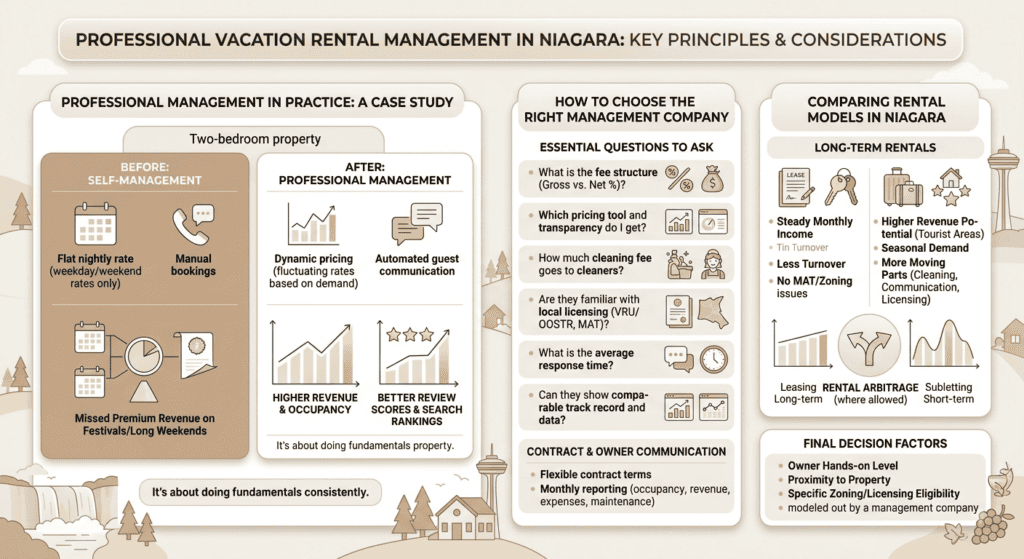
Consider a two-bedroom property in a Niagara Falls Tourist Commercial zone, self-managed with a flat nightly rate and manual booking calendar. Without dynamic pricing, the owner sets one rate for weekdays and one for weekends, missing the premium that festival weekends or long weekends could command.
Bring in dynamic pricing and active calendar management, and that same property can often see occupancy and revenue both improve – not because the property changed, but because the pricing finally reflects real demand instead of a guess. Layer in faster guest response times, consistent cleaning turnovers, and a stronger review score, and the listing starts ranking higher in platform search results too, creating a compounding effect over a full season.
This is the practical argument for professional vacation rental management in Niagara: it’s rarely about doing something exotic. It’s about doing the fundamentals – pricing, communication, cleaning, compliance – consistently, every single week, in a market that rewards consistency.
How to Choose the Right Vacation Rental Management Company in Niagara
Not every property manager operates the same way, so it’s worth asking a few direct questions before signing anything.
- What’s the actual fee structure? Ask whether the percentage is calculated on gross revenue or net revenue – the difference can be significant over a year.
- Which pricing tool do they use, and do you get visibility into it? You should be able to see how your rates are being set, not just the results.
- How much of the cleaning fee goes to the cleaner? This affects both cleaner reliability and your margins.
- Are they familiar with local licensing requirements? A manager unfamiliar with the VRU/OOSTR distinction, MAT remittance schedule, or zoning restrictions is a liability, not an asset.
- What’s their average response time to guest messages? Slow responses cost bookings and reviews.
- Can they show real occupancy and revenue data from comparable Niagara properties? Vague promises aren’t the same as a track record.
A management company that answers these questions clearly and confidently is usually one that’s actually built the systems to back it up.
It’s also worth asking about contract length and exit terms. A company confident in its results shouldn’t need to lock you into a long-term agreement with steep penalties for leaving. Flexible terms are usually a sign that a manager expects to earn your business every month, not just at signing.
Finally, ask how they handle communication with you as the owner. Monthly reporting on occupancy, revenue, expenses, and upcoming maintenance needs should be standard, not something you have to chase down. Transparency here tends to reflect how the rest of the operation is run.
Long-Term Rentals vs. Short-Term Rentals in Niagara
Not every property in Niagara is a good fit for the short-term rental model, and it’s worth weighing the alternative before committing to the VRU licensing process.
Long-term rental management trades the higher revenue ceiling of short-term stays for predictability. A tenant on a lease means steady monthly income, no turnover coordination between guests, and none of the municipal accommodation tax or zoning restrictions that apply to short-term operators.
Short-term rentals generally produce more revenue per property in tourist-heavy areas like Niagara Falls and Niagara-on-the-Lake, but that revenue comes with more moving parts: licensing, seasonal demand swings, cleaning logistics, and ongoing guest communication.
Some owners split the difference with rental arbitrage, leasing a property long-term and then subletting it as a short-term rental where local rules and the head lease allow it. This can lower the upfront capital needed to get started, though it depends entirely on finding a landlord and a municipality that both permit the arrangement.
The right choice usually comes down to how hands-on you want to be, how close you live to the property, and whether your specific zone even qualifies for a VRU license in the first place. A property management company that offers both short-term and long-term services can help model out which approach actually produces the stronger return for your specific property.
Maximizing Revenue: Seasonal Trends Worth Planning Around
Niagara’s tourism calendar isn’t flat, and pricing strategy should reflect that. The region’s busiest tourism seasons run from July through September, with a second strong window from April through June, followed by a quieter but still active fall and a slower winter stretch from January through March.
That doesn’t mean winter bookings are dead. Niagara Falls draws steady visitor traffic year-round thanks to the falls themselves, the casino, and indoor attractions, so a well-managed listing can still perform reasonably well even in the off-season with the right pricing adjustments.
Smart owners build their pricing calendar around known demand spikes: major festivals, holiday weekends, wine country events in Niagara-on-the-Lake, and school breaks. Removing an artificial price ceiling and letting a dynamic pricing tool respond to genuine demand spikes is one of the simplest ways to capture revenue that flat pricing would otherwise miss entirely.
Common Mistakes Niagara Rental Owners Make
A few patterns show up again and again among owners who struggle to turn a profit:
Buying in the wrong zone. Purchasing a property outside the Tourist Commercial, General Commercial, or Central Business zones and only discovering the VRU restriction after closing is one of the costliest mistakes an investor can make.
Underestimating the new tax structure. Pricing a listing without accounting for the 4% MAT plus 13% HST leads to margins that look better on paper than they actually are.
Treating cleaning as an afterthought. A missed or rushed turnover is one of the fastest ways to tank a listing’s rating.
Setting flat rates year-round. Ignoring seasonality and local events means leaving revenue on the table during Niagara’s busiest weekends.
Skipping the license entirely. With fines reaching $50,000 for a first offence, this is the single most expensive shortcut an owner can take.
Going it alone with multiple properties. Self-management works reasonably well for one unit. It becomes unsustainable fast once an owner scales to two or three, especially without local support on the ground.
Ignoring insurance requirements. Standard homeowner’s insurance rarely covers short-term rental activity. Beyond the city’s $2 million liability minimum, owners need to confirm their policy actually covers guest stays, not just long-term tenancy.
Assuming the rules won’t change again. The MAT structure changed twice in the last two years alone, and the OOSTR pilot itself is set to be reevaluated after September 2026. Owners who build their numbers around today’s rules without checking for updates risk getting caught off guard.
Why Local Expertise Matters in This Market
Niagara isn’t a market where generic, one-size-fits-all advice holds up. The rules differ from one municipality to the next, the tax structure just changed, and the licensing framework in Niagara Falls alone has two distinct categories with different requirements.
This is exactly why The HAH Developments focuses specifically on the Niagara Region rather than trying to manage properties everywhere. Local, hands-on management means staying current on every bylaw change as it happens, understanding which zones actually support a VRU application, and knowing how Niagara’s seasonal demand patterns should shape a pricing calendar throughout the year.
For owners who’d rather focus on the investment side and let a dedicated team handle licensing, guest communication, cleaning coordination, and compliance, that local knowledge is often the difference between a property that merely breaks even and one that consistently performs.
Frequently Asked Questions
Do I need a license to run an Airbnb in Niagara Falls? Yes. Every short-term rental in Niagara Falls needs either a Vacation Rental Unit (VRU) license or an Owner Occupied Short-Term Rental (OOSTR) license before it can legally be listed on any booking platform. Operating without one risks fines of up to $50,000 for a first offence.
How much is the Municipal Accommodation Tax in Niagara Falls? As of April 1, 2026, the MAT is 4% of the total room rate, rising to 5% on April 1, 2027. It’s charged on top of the standard 13% HST and applies to hotels, motels, bed and breakfasts, VRUs, and OOSTRs alike.
Can I run a short-term rental anywhere in Niagara Falls? Not if you’re applying for a standard VRU license. Those are restricted to Tourist Commercial, General Commercial, and Central Business zones. An OOSTR license, which requires the property to be your principal residence, follows a separate pilot program with its own cap.
Is it worth hiring a property manager instead of self-managing? It depends on how much time you have and how many properties you own. Self-management can work for a single unit close to home, but once you factor in the time cost of guest messaging, turnover coordination, and staying current on licensing rules, many owners find that a co-host or full-service manager pays for itself through both time savings and stronger revenue performance.
What’s the difference between a VRU and an OOSTR license? A VRU is for investment properties that don’t need to be the owner’s primary residence, but it’s restricted to specific commercial zones. An OOSTR requires the host to live on-site and is currently capped at 100 licenses citywide under a pilot program running through September 2026.
Do short-term rental rules apply outside Niagara Falls too? Yes, and they vary by municipality. Niagara-on-the-Lake enforces its own strict bylaw, St. Catharines is moving toward formal licensing, and smaller towns like Welland, Fort Erie, and Grimsby each set their own rules. Always confirm the current bylaw for the specific municipality before listing a property.
Does Niagara Falls limit how many nights a year I can rent my property? There’s currently no citywide annual night cap for VRUs in Niagara Falls, unlike some other Ontario cities that impose a limit. OOSTR licenses, tied to the pilot program, follow their own separate operating conditions, so it’s worth confirming current terms directly with the city before finalizing your plans.
What insurance do I need for a short-term rental in Niagara? At minimum, the city requires proof of $2 million in liability insurance for licensing. Most standard homeowner’s policies don’t automatically cover short-term guest stays, so it’s worth speaking with an insurance provider that specializes in vacation rental coverage before you start hosting.
The Bottom Line
Niagara’s tourism numbers make a strong case for short-term rentals: over 13 million visitors a year, steady demand across most seasons, and a region that draws travellers from across Canada, the United States, and overseas. But the operational side has gotten more complex, not less, with the 2026 shift to a percentage-based accommodation tax and an ongoing pilot program reshaping how owner-occupied rentals get licensed.
Vacation rental management in Niagara rewards owners who treat it like a real business: proper licensing, accurate tax remittance, responsive guest communication, and pricing that actually reflects demand. Get those pieces right, and a Niagara property can be one of the more resilient income streams available in Ontario real estate right now.
If you’d rather hand off the licensing paperwork, pricing strategy, guest messaging, and cleaning coordination to a team that already knows this market inside out, The HAH Developments manages short-term and long-term rental properties throughout the Niagara Region. Reach out today to find out what your property could be earning with the right management behind it.