

Most landlords don’t fully understand the job until something goes wrong.
Maybe it’s a tenant who stops answering calls after rent is three days late. Maybe it’s a burst pipe at 11 p.m. while you’re two provinces away at a family wedding. Or maybe it’s an LTB notice form that needs to be filled out exactly right, or the whole process starts over from scratch.
This is the part nobody mentions when they say “just buy a rental property, it’s basically passive income.” Owning a rental and running a rental are two very different jobs. The first one takes a down payment. The second one takes your evenings, your weekends, and sometimes your patience.
Here’s what usually happens. A new landlord lists their property, finds a tenant, and things feel fine for a few months. Then a maintenance request comes in. Then another. Then rent is late, and they’re not sure what they’re legally allowed to do about it. Then a renewal is coming up and they realize they never actually wrote down the rules for that. None of this is because the landlord did anything wrong – it’s just that owning property and managing tenants are two completely different skill sets, and most owners only ever expected to need the first one.
This is exactly the gap a property management company fills.
It’s worth pausing on why this gap exists in the first place. Most landlords get into rental property because the math made sense – a mortgage that’s mostly covered by rent, an asset that appreciates over time, maybe a long-term retirement plan built around it. Nobody buys a duplex because they’re excited about filing N1 rent increase forms or learning the difference between an N4 and an N12 notice. The financial side of owning property is the part people plan for. The operational side – tenants, maintenance, paperwork, disputes – is the part that quietly takes over once the keys are in hand.
And it adds up faster than most people expect. A maintenance call here, a late rent payment there, a tenant question about parking, a lease renewal that needs to be sent out on time. None of these tasks is individually overwhelming. But stacked together, week after week, they turn what was supposed to be a passive investment into something closer to an unpaid second job – one with no fixed hours and no real days off.
In this guide, we’re breaking down exactly what a property manager does, day to day and stage by stage, what they don’t do, and how to tell whether bringing one on board actually makes sense for your situation. Whether you’re renting out your first unit, juggling a growing portfolio, or managing a property from another city entirely, you’ll walk away with a clear picture of what professional management really looks like.
And if you’re a property owner in Niagara Falls or the surrounding region, this is also exactly the kind of work our team at HAH Developments handles every single day – so consider this both an explainer and a behind-the-scenes look at what we do.
What Is a Property Management Company?
A property management company is a business that takes over the day-to-day operations of a rental property on behalf of the owner. Instead of the landlord handling tenants, rent, repairs, and paperwork directly, a property manager acts as the go-between – representing the owner’s interests while dealing with everything that comes up on the ground.
That includes marketing the unit, screening applicants, collecting rent, coordinating repairs, communicating with tenants, and making sure the whole arrangement stays within the law.
Who Hires a Property Management Company?
A wide range of owners turn to professional management, including:
- First-time landlords who don’t yet have systems in place
- Real estate investors with more than one property
- Owners who live far away from their rental property
- People who inherited a property and don’t want to become full-time landlords
- Busy professionals who don’t have the time to handle tenant calls
- Owners who tried self-managing and got burned by a bad experience
Residential vs. Commercial Property Management
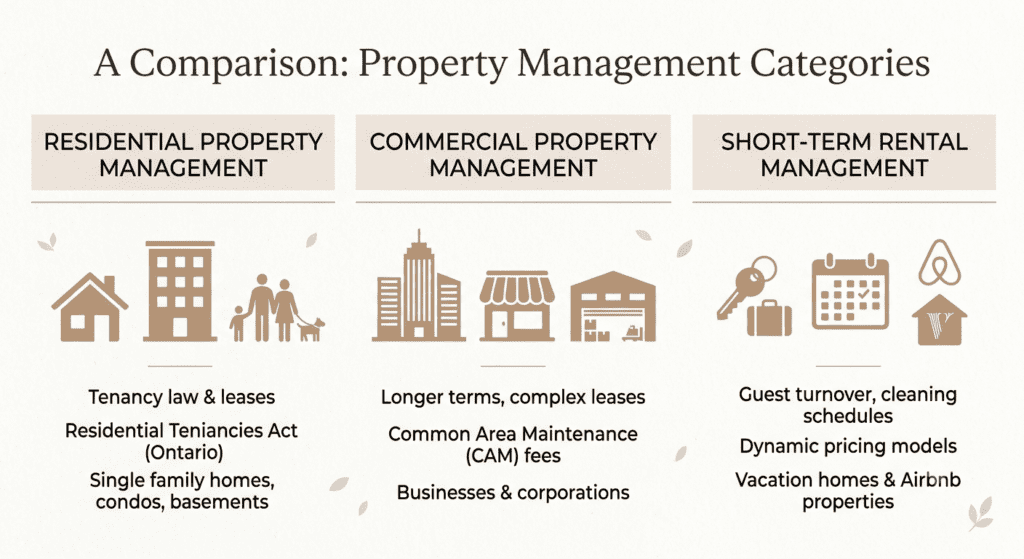
These two are often lumped together, but they’re not quite the same job.
Residential property management deals with houses, apartments, condos, and basement units rented out to individuals or families. The relationship is governed by tenancy law, lease agreements, and (in Ontario) the Residential Tenancies Act.
Commercial property management deals with office space, retail units, and industrial buildings rented to businesses. These contracts typically involve longer terms, more complex lease structures, and things like common area maintenance (CAM) fees.
There’s also a third category that’s become increasingly common: short-term rental management – think Airbnb and Vrbo properties – which involves a completely different rhythm of guest turnover, cleaning schedules, and dynamic pricing rather than long-term tenancy. If you’re weighing long-term tenants against short-term guests, our short-term and long-term rental management page breaks down how each model works.
Who Benefits Most?
Property management tends to deliver the most value for:
- New landlords with no existing processes for screening, leasing, or maintenance
- Owners juggling multiple units who can’t realistically be hands-on with all of them
- Anyone who doesn’t live close enough to respond quickly to a maintenance emergency
- Investors who want their property to run like a business, not a side project
What Does a Property Management Company Actually Do?
Instead of listing services in a random order, it helps to think of property management as a cycle that repeats throughout the life of a tenancy – from finding a tenant, to keeping them happy, to eventually finding the next one. Here’s what that actually looks like, stage by stage.
Finding Qualified Tenants
This is where everything starts, and it’s also where a lot of self-managing landlords lose the most time and money. An empty unit earns nothing, so filling vacancies quickly – with the right tenant, not just any tenant – is one of the first jobs a property manager takes on.
That usually involves:
- Marketing vacancies across multiple rental platforms and local channels, not just one listing site
- Professional photography that makes the unit look its best (a phone photo in bad lighting genuinely costs landlords applicants)
- Writing property listings that highlight the right details and filter for serious renters
- Scheduling showings at times that work for prospective tenants, including evenings and weekends
- Responding to inquiries quickly, since the fastest-responding listings are usually the ones that get filled first
Response speed matters more than most owners realize. A unit that sits empty for an extra two weeks because nobody called back fast enough is a real, calculable loss – not just an inconvenience.
Tenant Screening
Finding interest in a property is one thing. Finding the right tenant is another. This step is where a property manager protects the owner from the kind of headache that can drag on for months.
A proper screening process typically covers:
- Employment verification to confirm the applicant actually has the income they claim
- Credit checks to assess financial reliability
- Background checks for any red flags
- Rental history review to see how they’ve treated previous units
- Reference checks with past landlords, who will often tell you things a credit report never will
This part of the process has gotten more important in recent years, not less. Rental application fraud – falsified pay stubs, fake landlord references, doctored ID – has been a growing problem across the industry, which is why screening today increasingly means verifying documents against real data sources rather than just reading what’s submitted at face value.
Think about what’s actually at stake here. A bad tenant doesn’t just mean late rent once in a while. It can mean months of missed payments, property damage that costs thousands to repair, and a legal process to remove them that can stretch on for weeks. A good screening process is, in a very real sense, an owner’s first and best line of defense – long before any lease is signed or any legal notice is ever needed.
This is also where a property manager’s experience tends to show. Someone who’s screened hundreds of applicants develops an eye for the small inconsistencies that don’t always show up clearly on paper – a reference who sounds hesitant, an income figure that doesn’t quite line up with the stated job, a rental history with one too many “previous landlord unavailable” excuses. None of that replaces hard data like credit and background checks, but it’s a layer of judgment that comes from doing this work consistently, not occasionally.
Lease Preparation & Move-In
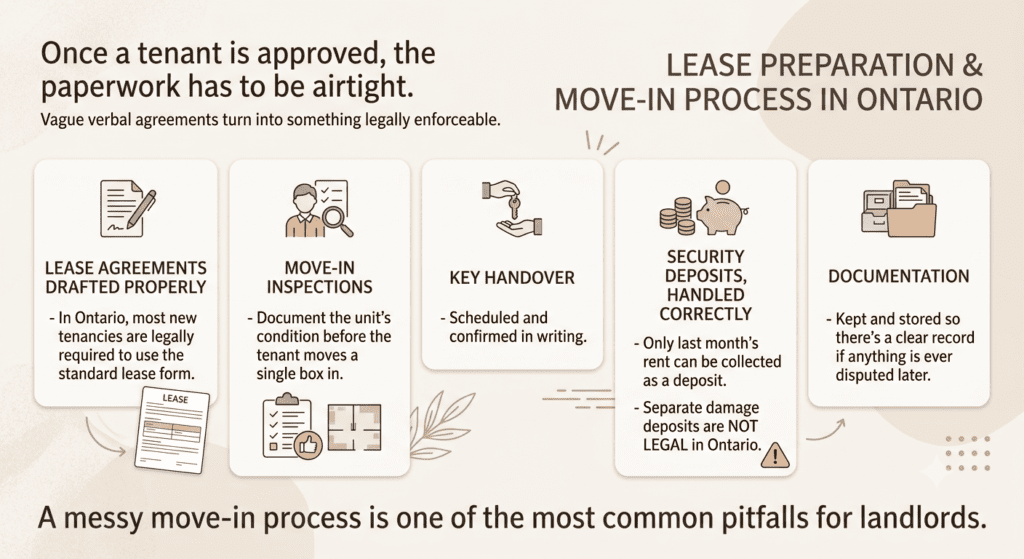
Once a tenant is approved, the paperwork has to be airtight. This is the stage where vague verbal agreements turn into something legally enforceable.
This includes:
- Lease agreements drafted properly – in Ontario, most new tenancies are legally required to use the standard lease form
- Move-in inspections that document the unit’s condition before the tenant moves a single box in
- Key handover, scheduled and confirmed in writing
- Security deposits, handled correctly – worth noting that in Ontario, landlords can only collect last month’s rent as a deposit; separate damage deposits aren’t legal here, which trips up a surprising number of new landlords
- Documentation, kept and stored so there’s a clear record if anything is ever disputed later
A messy move-in process is one of the most common sources of disputes down the line, simply because nobody wrote anything down at the start.
Rent Collection & Financial Management
This is the part most people think property management is – and it’s a real part of the job, but it’s far from the whole picture.
- Online payment systems that make rent easy to pay and easy to track
- Late payment follow-ups, handled promptly and professionally, following the correct legal notice process
- Owner statements that show exactly what came in and went out each month
- Expense tracking for repairs, supplies, and any other costs tied to the property
- Monthly reports that give owners a clear financial snapshot without digging through spreadsheets themselves
Good financial reporting isn’t just bookkeeping – it’s what lets an owner actually evaluate whether their property is performing the way they expect it to.
Property Maintenance
Maintenance is where the difference between a good property manager and a mediocre one becomes obvious fastest. Reactive maintenance is expensive. Proactive maintenance is what actually protects the asset.
- Routine maintenance, scheduled rather than left until something breaks
- Emergency repairs, handled quickly through an established network of contractors
- Vendor coordination, so the owner isn’t the one calling five different plumbers trying to find someone available
- Seasonal inspections – particularly important in a region like Niagara, where freeze-thaw cycles can quietly damage eavestroughs, foundations, and exterior fixtures if nobody’s checking
- Preventive maintenance, which catches small issues before they become five-figure repairs
This is increasingly recognized across the industry as one of the clearest ways property managers prove their value to owners – preventing the kind of costly emergency that eats an entire month’s rent in repair bills.
There’s also a shift happening in how maintenance gets handled day to day. More property managers now track resident response times as an actual performance metric, not just a vague goal – because how quickly a maintenance request gets acknowledged and resolved has a direct, measurable effect on whether a good tenant renews their lease or starts looking elsewhere. A leaky faucet that gets fixed within 48 hours barely registers as an inconvenience. The same leak ignored for two weeks becomes the reason a tenant decides not to renew.
For owners, this preventive approach also has a quieter financial benefit that’s easy to overlook: insurance. With property insurance costs rising across the board, insurers increasingly favor well-maintained properties with documented maintenance histories. A property manager who keeps thorough records of inspections and repairs isn’t just protecting the building – they’re often protecting the owner’s insurance position too.
Handling Tenant Communication
Every tenancy generates communication, and a lot of it isn’t pleasant. A property manager becomes the buffer so the owner isn’t fielding every call personally.
- Complaints, addressed before they escalate into something bigger
- Maintenance requests, logged and followed through to completion
- Lease renewals, discussed and negotiated ahead of the expiry date
- Disputes, between tenants or between tenant and landlord, handled with a level head
- Questions, the everyday kind – about parking, garbage day, who to call for what
This buffer matters more than it sounds. A tenant who feels heard and responded to quickly tends to stay longer and take better care of the unit. A tenant who feels ignored tends to do the opposite.
Property Inspections
Inspections happen at multiple points throughout a tenancy, not just once.
- Move-in inspections, documenting the starting condition of the unit
- Routine inspections, checking in periodically to catch issues early
- Move-out inspections, comparing the unit’s condition against the move-in report
- Damage reporting, with photos and documentation that hold up if a deposit dispute ever needs to go to the Landlord and Tenant Board
Without consistent inspections, “who caused this damage” becomes a guessing game. With them, it’s a documented fact.
Legal Compliance
This is the part that scares a lot of self-managing landlords the most, and for good reason – getting it wrong can be expensive and slow to fix.
- Local rental regulations, which vary by province and sometimes by municipality
- Notices, served using the correct forms at the correct time
- Documentation, kept thoroughly in case a dispute ever lands at the Landlord and Tenant Board
- Lease compliance, making sure both sides are actually following what was signed
- Evictions, handled only when legally necessary, and only through the proper legal process
In Ontario specifically, this area has shifted meaningfully over the past year. Bill 60 introduced real changes to the eviction timeline – for example, the notice period on an N4 (non-payment of rent) dropped from 14 days to 7 days for most tenancies. The rules around N12 notices, used when a landlord or family member intends to move into the unit, have also changed. None of this changes the basic principle, though: a landlord can never simply change the locks or ask a tenant to leave. Every eviction in Ontario has to go through the Landlord and Tenant Board, with the correct notice form, the correct waiting period, and – if the tenant doesn’t leave voluntarily – enforcement through the Sheriff, not the landlord.
This is also where a lot of self-managed evictions go sideways. One wrong form, one miscalculated date, and an application can get delayed or dismissed outright, costing the owner months of lost rent. A property manager who knows the current forms and timelines is, frankly, one of the best insurance policies an owner can have.
Compliance isn’t only about evictions, either. It covers the quieter, everyday rules too – like the fact that landlords in Ontario must give at least 24 hours’ written notice before entering a unit for anything other than an emergency, and entry is only permitted between 8 a.m. and 8 p.m. It covers rent increases, which can only happen once every 12 months, require 90 days’ written notice on the correct form, and are capped by a provincial guideline that actually came down for 2026 – set at 2.1%, the lowest it’s been in four years. Get any of these details wrong, even with good intentions, and a landlord can end up on the losing side of a dispute they never meant to start.
This is precisely why so many owners decide the legal side alone is worth outsourcing. It’s not that the rules are impossible to learn. It’s that they change often enough, and the cost of getting them wrong is high enough, that staying on top of them becomes its own ongoing responsibility – one a property manager is already keeping current on as part of the job.
What Doesn’t a Property Management Company Do?
This part rarely gets covered, but it matters just as much as the list above. Knowing the limits of the relationship up front avoids awkward conversations later.
A property management company generally does not:
- Handle major renovations – unless it’s been specifically discussed and agreed to as a separate project
- Sell the property – that’s a real estate agent’s job, not a property manager’s
- Give personal financial or tax advice – a property manager can hand over clean financial records, but they’re not your accountant
- Stage the home for resale – staging for sale is a different service entirely from managing a tenancy
- Provide legal representation beyond their scope – a property manager files the correct LTB forms and follows procedure, but they’re not your lawyer in a contested legal dispute
Being upfront about these boundaries is, honestly, a sign of a trustworthy management company. The ones who claim they can do absolutely everything are usually the ones to be cautious about.
A Day in the Life of a Property Manager
It’s one thing to read a list of responsibilities. It’s another to see what an actual day looks like. Here’s a realistic snapshot:
8:00 AM – Start the day by checking overnight maintenance requests and replying to anything urgent.
9:30 AM – Call contractors to schedule visits for the repairs that came in, confirming times that work for tenants.
11:00 AM – Drive out for a routine property inspection, checking on a unit that’s coming up for lease renewal.
1:00 PM – Process the day’s rent payments, follow up on one late account, and update the owner ledger.
3:00 PM – Show a vacant unit to two prospective tenants who booked viewings earlier in the week.
5:00 PM – Send owner updates for the week, respond to a tenant’s question about a lease clause, and close out the day’s paperwork.
None of this shows up in a listing photo. None of it gets mentioned when someone says “rental income is basically passive.” But it’s the actual, unglamorous work that keeps a property running smoothly – and it’s exactly what owners are paying to hand off when they bring in professional management.
Why Property Owners Choose Professional Management
Once owners understand the full scope of the job, the reasons for hiring help tend to become obvious. The most common ones include:
- Saves time – hours per week that would otherwise go to tenant calls, showings, and paperwork
- Reduces vacancies – faster marketing and showings mean less time with an empty unit
- Better tenants – proper screening filters out the applicants who’d otherwise become a headache
- Faster maintenance – established vendor relationships mean repairs get done quicker, not weeks later
- Improved tenant retention – responsive communication keeps good tenants from looking elsewhere
- Less stress – not getting the 2 a.m. call yourself is, for a lot of owners, worth the fee on its own
- Legal peace of mind – knowing notices and procedures are being handled correctly
- Better long-term property value – consistent maintenance protects the asset instead of letting small issues snowball
There’s a pattern worth noticing in this list: almost every one of these benefits compounds over time. A vacancy filled two weeks faster isn’t just two weeks of extra rent – it’s the difference between a property that’s consistently occupied and one that bleeds income every time a tenant leaves. A tenant who renews instead of moving out isn’t just one less showing to schedule – it’s avoided turnover costs, avoided cleaning and repainting, and avoided risk of an extended vacancy. None of these benefits show up as a single dramatic win. They show up as a property that simply performs better, year over year, than one being run reactively.
Is Hiring a Property Management Company Worth It?
This comes down to a simple trade-off: time and risk versus cost. Management fees are real, and they typically run as a percentage of monthly rent, but they’re paying for coverage across a long list of tasks an owner would otherwise have to do personally – or risk getting wrong.
Here’s a side-by-side look at what’s actually covered:
| Task | Self-Managing | Professional Management |
| Tenant screening | ✗ | ✓ |
| Rent collection | ✗ | ✓ |
| Maintenance coordination | ✗ | ✓ |
| Legal compliance | ✗ | ✓ |
| Emergency support (24/7) | ✗ | ✓ |
| Owner reporting | ✗ | ✓ |
To be fair, self-managing isn’t automatically the wrong choice. Some owners genuinely have the time, the local presence, and the temperament for it – particularly with a single property close to home. But the more units someone owns, or the farther they live from the property, the more that math tends to shift toward professional management.
It also helps to think about what self-managing actually costs, even when no fee is being paid. Every hour spent screening applicants, chasing a late payment, or driving out for a repair is an hour not spent at work, with family, or simply resting. Some owners are happy to make that trade. Others realize, often after a particularly bad month, that the time and stress they’re spending isn’t actually free – it just doesn’t show up on an invoice the way a management fee does.
Who Should Hire a Property Management Company?
Professional management tends to make the most sense for:
- First-time landlords who don’t yet have systems, contacts, or experience in place
- Busy professionals whose schedules don’t leave room for tenant calls during the workday
- Real estate investors scaling beyond one or two properties
- Out-of-town owners who can’t realistically respond to a maintenance issue in person
- Owners with multiple rental properties, where the time cost of self-managing multiplies with every additional unit
If more than one of these describes your situation, it’s worth at least having the conversation.
Questions to Ask Before Hiring a Property Management Company
Not all property managers operate the same way, so it’s worth asking a few direct questions before signing anything:
- What services are included in the fee, and what costs extra?
- How are maintenance requests and emergencies handled, and how fast is the response time?
- How often will I receive financial reports, and what do they include?
- What are your management fees, and are there any hidden costs?
- How do you screen tenants?
- Who handles emergencies, and is support available outside business hours?
- What happens if a tenant needs to be evicted – how is that process handled, and by whom?
A management company that answers these clearly and specifically, without vague language, is usually one worth trusting.
Conclusion
A property management company does a lot more than collect a cheque every month.
It markets vacancies and screens tenants. It writes leases and documents move-ins. It collects rent and tracks every dollar. It coordinates maintenance before small problems become expensive ones. It handles the daily back-and-forth with tenants. It keeps a property legally compliant in a landscape that keeps changing. And when something does go wrong, it’s the one making sure every step is handled correctly – not just quickly.
For property owners, that adds up to something simple: more time back, fewer surprises, and a property that’s actually protected as the long-term asset it’s meant to be.
If you own a rental property in Niagara Falls or anywhere in the surrounding region and you’re trying to figure out whether professional management makes sense for you, we’d genuinely love to talk it through. Get in touch with HAH Developments today, and let’s discuss what hands-off, well-managed property ownership could actually look like for you.
Frequently Asked Questions
A property manager is often an individual handling a small number of properties directly. A property management company is a larger, structured business with a team covering marketing, screening, maintenance, accounting, and legal compliance – built to manage a portfolio at scale rather than just a handful of units.
Fees are typically charged as a percentage of monthly rent, with additional fees sometimes applied for leasing a new tenant or handling a renewal. Exact rates vary by company and the scope of services included, so it’s worth comparing what’s covered, not just the headline percentage.
A property management company can handle the process – serving the correct notice, filing the right application, and representing the owner’s interests – but the actual eviction order can only come from the Landlord and Tenant Board. No landlord or property manager can remove a tenant without going through that process.
Not necessarily. A single property close to home, with a reliable tenant, is manageable for some owners on their own. But even one property can become a serious time commitment fast if something goes wrong – a difficult tenant, an emergency repair, or a legal notice that needs to be filed correctly.
In Ontario, this starts with serving the correct legal notice (an N4 for non-payment of rent), followed by an application to the Landlord and Tenant Board if the issue isn’t resolved within the notice period. Recent changes under Bill 60 shortened some of these timelines, which makes getting the paperwork right the first time even more important.
Yes, though it’s a different service than long-term rental management. Short-term rental management involves guest communication, cleaning turnover, dynamic pricing, and platform optimization rather than leases and tenant screening. Some companies, including ours, manage both long-term and short-term properties depending on what an owner needs.