

It’s 1 a.m. and your phone is buzzing. A pipe burst in unit 2B. You’re three hours from the property, you have a 7 a.m. meeting, and the tenant wants to know what you’re going to do about it right now.
This is the part of being a landlord nobody mentions in the YouTube videos about “passive income.”
Most people get into rental property because they want extra cash flow and long-term equity growth, not a second job. But somewhere between screening applicants, chasing late rent, and figuring out which form you’re supposed to use to raise rent legally, the “passive” part disappears. What’s left is a part-time job with legal liability attached.
Ontario doesn’t make this easier. Rental rules change almost every year, the Landlord and Tenant Board is still working through a serious backlog, and one missed deadline on a notice can set your case back months. For landlords in Niagara Falls and across the region, the market itself has shifted too – more new units are coming online, vacancy rates are climbing in some areas, and pricing a property correctly now takes more than a guess.
This is exactly why so many landlords are choosing to hire a property manager instead of handling everything solo. Below are ten real, practical reasons this decision pays off – plus how to know if it’s the right move for your situation and what to look for in a property management company.
Why Hiring a Property Manager Is a Smart Investment
A lot of landlords look at a management fee and think of it as money lost. That’s the wrong way to look at it.
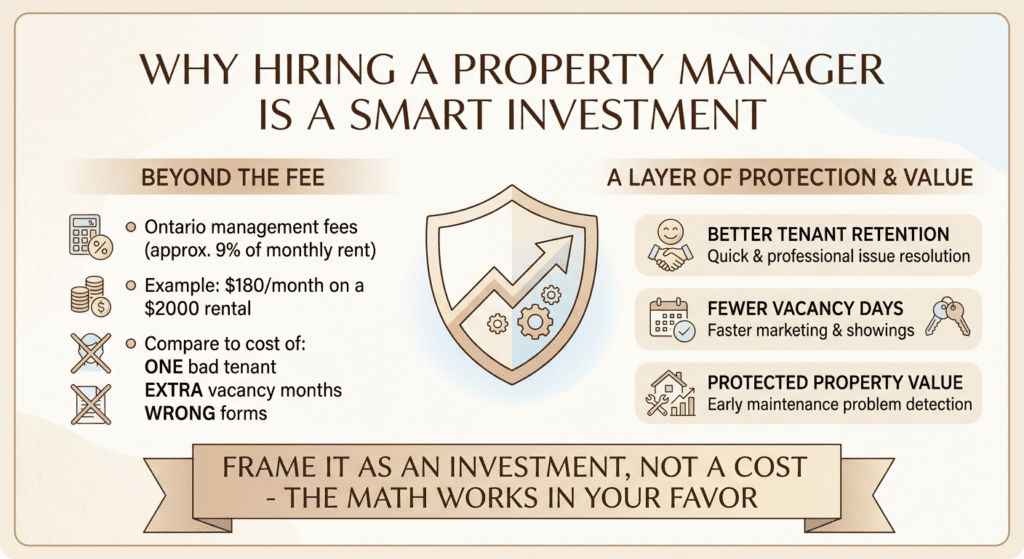
Property management fees in Ontario typically run somewhere between 6% and 12% of monthly rent, with most landlords paying around 9% for full-service management. On a $2,000/month rental, that’s roughly $180 a month. Now compare that to the cost of a single bad tenant placement, two extra months of vacancy, or a rent increase notice that gets thrown out because it used the wrong form.
A property manager isn’t an expense sitting on top of your rental income – it’s a layer of protection around it. Professional management tends to mean:
- Better tenant retention, because issues get handled quickly and professionally
- Fewer vacancy days, because marketing and showings happen faster
- Protected property value, because maintenance problems get caught early instead of festering
When you frame it as an investment rather than a cost, the math usually works in your favor. Here’s exactly why.
10 Reasons Every Landlord Should Hire a Property Manager
1. Find High-Quality Tenants Faster
Filling a vacancy isn’t just about posting a listing and hoping for the best. A property manager typically has access to wider listing exposure than a single landlord – MLS syndication, rental platforms, and local marketing channels that get a unit in front of more eligible renters in less time.
That wider reach translates into faster occupancy. The longer a unit sits empty, the more it costs you, so speed matters here. It also means better tenant matching, because an experienced manager has seen enough applicants to know which ones are a strong fit for a specific property and which ones are likely to cause problems six months down the road.
2. Thorough Tenant Screening Reduces Risk
This is one of the most overlooked parts of self-managing a rental. A proper tenant screening process should include several layers:
- Credit checks to assess financial reliability
- Employment verification to confirm income is real and stable
- Rental history, including contact with previous landlords
- Background checks where appropriate
Skipping any of these steps is how landlords end up with a tenant who looks great on paper but stops paying rent in month three. A property manager runs this process consistently, every time, which significantly lowers the chance you’ll end up dealing with an eviction down the line.
3. Maximize Rental Income with Accurate Pricing
Pricing a rental isn’t guesswork – or at least, it shouldn’t be. A property manager pulls local market analysis to set a rate that’s competitive for the current Niagara Falls rental market, not what the unit was worth two years ago.
This matters more now than it used to. Vacancy rates across the Niagara region have been climbing as new rental supply comes online, which means overpriced units are sitting empty for weeks while accurately priced ones rent in days. A property manager tracks these shifts so your listing doesn’t lose money sitting vacant. The result is shorter vacancy periods and stronger long-term returns, because the rent you actually collect matters more than the number you wish you could charge.
4. Timely Rent Collection Without Awkward Conversations
Chasing rent is one of the most uncomfortable parts of being a landlord, especially if you know the tenant personally or live in the same building. Property managers remove you from that conversation entirely through:
- Automated payment systems that make paying on time easier
- Structured late-payment follow-ups that stay professional and consistent
- Predictable monthly cash flow you can actually plan around
- Financial reporting that shows exactly what came in and what didn’t
You get the rental income; the manager handles the friction of collecting it.
5. 24/7 Maintenance Coordination Saves Time and Money
That midnight burst-pipe scenario? A property manager has a system for it. That typically includes:
- Emergency repair response outside business hours
- Preventive maintenance schedules that catch small issues before they become expensive ones
- A trusted contractor network built over years of working relationships
- Cost-effective repairs, since established managers often get better rates than an individual landlord calling a random tradesperson
This alone is often worth the management fee for landlords who don’t want to be on call around the clock.
6. Stay Compliant with Landlord-Tenant Laws
Ontario’s rental rules are not static, and the consequences of getting them wrong are getting steeper, not lighter. A property manager keeps your lease agreements, notices, and procedures aligned with current Ontario landlord-tenant laws, including:
- Properly drafted leases using the Ontario Standard Lease
- Correct legal documentation for notices, rent increases, and terminations
- Awareness of provincial regulation changes as they happen
- Reduced exposure to disputes that could otherwise end up at the Landlord and Tenant Board
- An eviction process handled correctly from the first notice to the final step, when one is genuinely unavoidable
What Happens If You Get the Paperwork Wrong?
Here’s the part that catches a lot of self-managing landlords off guard: the Landlord and Tenant Board is still working through a significant case backlog, and recent legislative changes have actually tightened some of the timelines landlords need to follow. A single error – a wrong date, an incorrectly served notice, a missing signature – can get an application dismissed outright. When that happens, you don’t just lose time. You go back to the start of the line, and depending on the type of case, that line can run from a few months to the better part of a year.
A property manager who handles these filings regularly is far less likely to make the kind of small mistake that turns into a months-long delay.
7. Lower Vacancy Rates Through Professional Marketing
Beyond pricing, how a unit is presented matters more than most landlords expect. Property managers typically invest in:
- Professional photography that makes a unit look its best
- Property listings placed across multiple platforms, not just one
- Quick response time to inquiries, which matters in a market where serious tenants move fast
- Efficient tenant turnover, so the gap between one tenant moving out and the next moving in stays as short as possible
In a market where new rental supply keeps arriving, presentation is often the difference between a unit that rents in a week and one that sits for a month.
8. Save Valuable Time and Reduce Stress
This is the reason most landlords give when you ask them directly why they made the switch. Hiring a property manager means:
- No more late-night maintenance calls
- No more personally scheduling and supervising repairs
- Significantly less paperwork
- Rental income that actually feels passive, instead of like an unpaid second job
If you got into real estate investing for the income and the long-term equity, not to become an unpaid maintenance coordinator, this reason alone can justify the decision.
9. Protect Your Property with Regular Inspections
A rental property is also a financial asset, and assets need upkeep to hold their value. Property managers typically build in:
- Routine inspections on a set schedule
- Early damage detection before small problems become expensive ones
- Lease compliance checks, catching unauthorized pets, occupants, or subletting before they become bigger issues
- Prevention of the kind of expensive repairs that come from problems left unaddressed for too long
Catching a slow leak during a routine inspection costs a few hundred dollars. Catching it six months later, after it’s spread through the subfloor, costs a great deal more.
10. Scale Your Rental Portfolio with Confidence
If you only own one property, self-managing is demanding but possible. If you’re trying to build a real rental property investment portfolio, it becomes close to impossible to do well on your own.
A property manager makes it realistic to:
- Own and operate multiple properties without burning out
- Focus your time on financing and acquiring new properties instead of daily operations
- Build a stronger foundation for long-term portfolio growth
This is the difference between owning rentals and running a rental business. One scales. The other doesn’t.
When Should You Hire a Property Manager?
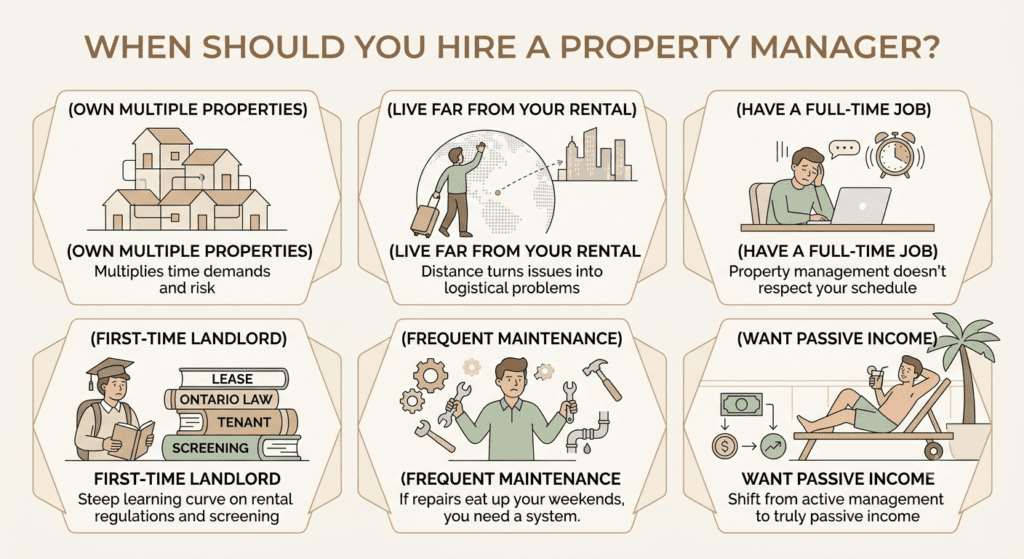
Not every landlord needs to outsource everything immediately. But certain situations make the case for it especially strong.
You own multiple rental properties. Once you’re past one or two units, the time demands multiply fast, and so does the risk of something slipping through the cracks.
You live far from your rental. Distance turns every small issue into a logistical problem. A local property manager closes that gap.
You have a full-time job. Property management runs on its own schedule, not around your work calendar. Tenant emergencies don’t wait until after your shift ends.
You’re a first-time landlord. The learning curve on Ontario rental law, lease terms, and tenant screening is steep. A property manager flattens it considerably.
You frequently deal with maintenance issues. If repairs are eating up your weekends, that’s usually a sign you need a contractor network and a coordination system, not more personal effort.
You want passive income instead of active management. This is the core reason most people invest in rental property in the first place. A property manager is what actually makes that possible.
What Services Does a Property Manager Typically Provide?
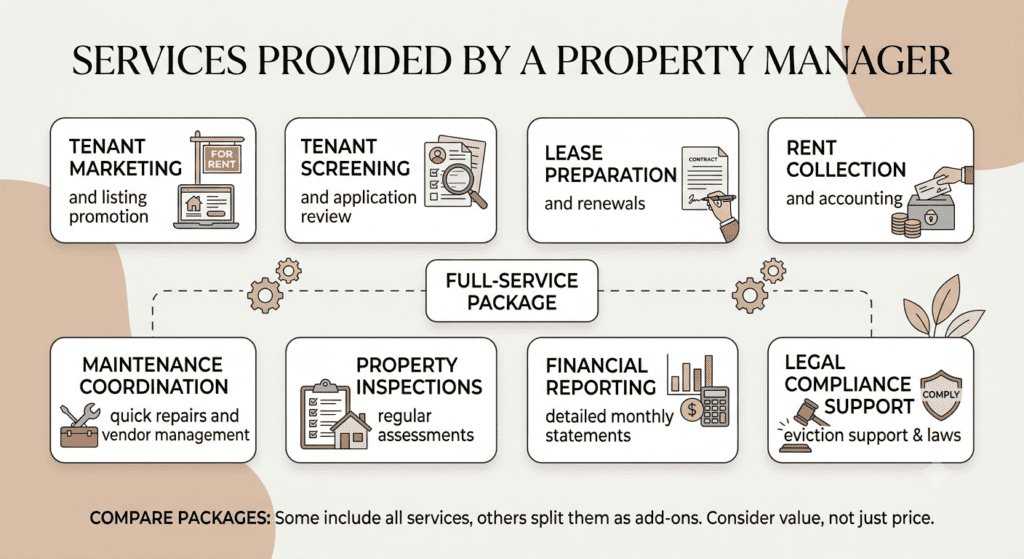
A full-service property management company generally covers:
- Tenant marketing and listing promotion
- Tenant screening and application review
- Lease preparation and renewals
- Rent collection and accounting
- Maintenance coordination
- Property inspections
- Financial reporting
- Legal compliance support
- Tenant communication
- Move-in and move-out management
Some companies offer all of this as one package; others split services into add-ons. It’s worth asking exactly what’s included before comparing prices, since a “cheaper” rate that excludes half these services can end up costing more overall.
Is Hiring a Property Manager Worth the Cost?
This usually comes down to what your time and peace of mind are worth, alongside the actual dollar comparison. Here’s how the two approaches stack up side by side:
| Self-Managing | Hiring a Property Manager |
| Time-consuming | Saves hours every month |
| Higher vacancy risk | Faster tenant placement |
| DIY maintenance | Professional contractor network |
| Legal mistakes possible | Compliance support |
| Inconsistent rent collection | Reliable cash flow |
| Stressful tenant communication | Professional handling |
For landlords with one property and plenty of free time, self-managing can work. For almost everyone else, the time saved and risk avoided tend to outweigh the management fee fairly quickly.
How to Choose the Right Property Management Company
Not all property managers operate the same way, and the cheapest option on paper isn’t always the best value. Look for:
Experience in the local market. A manager who knows the Niagara Falls rental market specifically will price and market your unit more accurately than one working from generic, region-wide assumptions.
Transparent pricing. Ask exactly what’s included in the management fee and what gets billed separately, including markups on contractor invoices.
Positive client reviews. Look for consistent feedback from other landlords, not just polished testimonials on a website.
Maintenance network. A manager with established contractor relationships will respond faster and likely pay less for repairs than one starting from scratch.
Communication process. Find out how and how often they’ll update you, and what their response time looks like for both you and your tenants.
Reporting system. You should be able to see clear financial reports without having to ask for them every month.
Licensing and insurance. Confirm the company carries proper insurance and operates within all relevant regulatory requirements.
Tenant screening process. Ask specifically what their screening process includes – credit, income, references, and rental history should all be standard.
The Bottom Line
Being a landlord doesn’t have to mean being on call every hour of every day. The right property manager handles the tenant screening, the maintenance calls, the legal paperwork, and the day-to-day stress – so your rental property can actually function as the passive income source you originally wanted it to be.
If you’re managing a rental in Niagara Falls and you’re ready to stop chasing rent payments and start actually enjoying the returns, The HAH Developments can help. From tenant placement and screening to maintenance coordination and full legal compliance, our team handles the details so you don’t have to.
Frequently Asked Questions
For most landlords managing more than one property, living far from their rental, or working a full-time job, yes. The time saved and risk reduced typically outweigh the management fee, especially once you factor in fewer vacancy days and fewer costly legal mistakes.
In Ontario, property management fees generally range from about 6% to 12% of monthly rent, with many landlords paying close to 9% for full-service management. Some companies use flat monthly fees instead, and tenant placement is sometimes billed separately.
Yes. Property managers regularly handle communication around lease violations, late payments, and other disputes, and many can represent landlords through the formal notice and resolution process when a disagreement can’t be settled directly.
Yes. Rent collection is one of the core services included in most management agreements, typically through an online payment system with automated reminders and structured follow-up for late payments.
Look at their experience in your specific local market, how transparent their pricing is, what their maintenance network looks like, and how thorough their tenant screening process is. Ask for references from current landlord clients before signing anything.