

Every landlord hits this moment eventually. Maybe it’s 11 p.m. and a tenant just texted about a leaking pipe. Maybe you’re trying to collect rent from three different units while juggling a full-time job. At some point, you ask the question that brings most property owners to this page: how much does property management actually cost?
It’s a fair question, and it deserves a straight answer.
Hiring a property manager isn’t free, and it shouldn’t be. You’re paying for someone to handle the tenant calls, the late-night emergencies, the lease paperwork, and the small fires that turn into big ones if nobody puts them out. The real question isn’t whether the fee is worth paying. It’s whether the value you get back is worth more than the fee itself.
In 2026, property management costs across Canada typically fall between 6% and 12% of monthly rent, or somewhere in the $100 to $300 per month range for flat-fee arrangements. That’s the short version. The longer, more useful version depends on your city, your property type, and exactly what services are bundled into that fee.
This guide breaks down everything a Canadian landlord needs to know in 2026:
- What property managers actually charge, and why the number isn’t as simple as one flat percentage
- How fee structures differ between cities like Toronto, Vancouver, Calgary, and Montreal
- Which services are usually included, and which ones show up as a surprise charge later
- How to tell whether hiring a property manager is genuinely worth it for your situation
- The exact questions to ask before you sign any management agreement
By the end, you’ll be able to look at any quote from a property management company and know whether it’s fair, what it’s missing, and how it stacks up against the rest of the Canadian market.
Average Property Management Costs in Canada
If you ask ten landlords what they pay for property management, you’ll probably get ten different answers. That’s not because anyone’s being shady. It’s because property management cost in Canada depends on a handful of moving parts: the city, the property type, the size of your portfolio, and how a company structures its fees.
That said, some clear national patterns have emerged heading into 2026.
National Average Management Fees
Across the country, most full-service residential property managers charge somewhere between 6% and 12% of the monthly rent collected, with the national average sitting close to 8% to 10%. On a $2,200/month rental, that works out to roughly $132 to $264 per month, or about $1,600 to $3,200 a year, just for core management.
That number climbs once you add in tenant placement fees, lease renewals, and any extras. We’ll get into those shortly.
Percentage-Based Pricing
This is the most common model in Canada, and for good reason. The property manager’s fee scales with your rent, which means their income rises and falls along with yours. If your unit sits empty, most percentage-based managers don’t collect anything that month either, which gives them a real incentive to fill vacancies quickly.
Flat-Fee Pricing
Some companies charge a fixed dollar amount every month, regardless of what your unit rents for. This is more common with higher-end properties, where a flat fee of $150 to $350 a month often works out cheaper than a percentage cut. It’s also popular with landlords who want predictable, easy-to-budget costs.
Monthly vs. Annual Costs
Most management fees are billed monthly, deducted directly from the rent before it’s deposited into your account. Annually, a single rental unit typically costs $1,600 to $3,800 in pure management fees, before factoring in tenant placement, which can add another $1,200 to $2,500 depending on turnover.
Comparison Table: Fee Type, Cost, and Trade-Offs
| Fee Type | Average Cost | Best For | Pros | Cons |
| Percentage-Based | 6%–12% of monthly rent | Standard residential rentals, single-family homes | Aligns manager’s income with yours; lower cost during vacancy | Costs rise as rent rises; less predictable budgeting |
| Flat Monthly Fee | $100–$350/month | High-rent units, condos, landlords who want fixed costs | Predictable; doesn’t scale up with rent increases | Can feel expensive on lower-rent units; scope is often narrower |
| Hybrid Model | Small base fee + 3%–6% | Multi-unit owners, landlords wanting balance | Combines predictability with shared incentive | Slightly more complex to compare across providers |
| Performance-Based | Bonus tied to occupancy/rent goals | Investors focused on ROI and portfolio growth | Rewards strong results; motivates proactive management | Less common; harder to find providers offering it |
How Property Management Companies Charge Their Fees
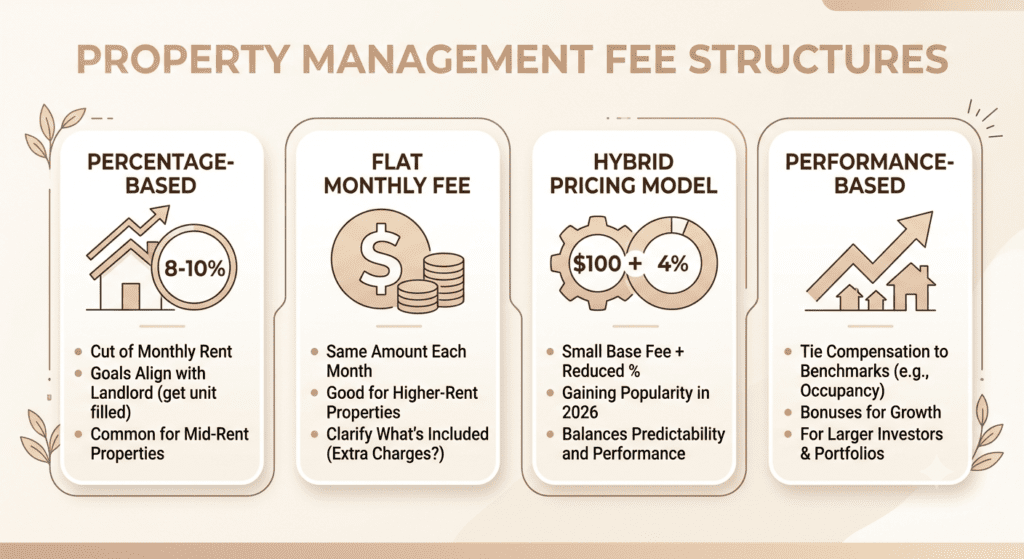
Understanding the fee structure itself matters just as much as knowing the dollar amount. Two companies quoting the same headline number can deliver very different value depending on how their pricing model actually works.
Percentage-Based Management Fees
This is the industry default for a reason. The property manager takes a cut, typically 8% to 10%, of whatever rent comes in that month. If the unit is vacant, most companies waive the fee entirely, which keeps their goals lined up with yours: get the unit filled, keep the tenant happy, keep the rent flowing.
This model makes the most sense for landlords with mid-to-average rent properties where the percentage translates into a fair, proportionate fee. It’s also the easiest structure to compare across multiple quotes, since you’re working with one number.
Flat Monthly Fees
A flat fee charges the same dollar amount every month no matter what the property rents for. This tends to favour landlords with higher-rent properties, since a $200 flat fee on a $4,000/month unit works out to just 5%, far below the typical percentage rate.
The trade-off is that flat-fee providers often draw tighter lines around what’s included. Ask exactly what triggers an extra charge before assuming “flat fee” means “all-inclusive.”
Hybrid Pricing Models
Hybrid pricing blends a smaller base fee with a reduced percentage rate, something like a $100 monthly base plus 4% of rent. This structure is becoming more common in 2026, particularly in smaller or mid-size markets, because it balances predictability with a shared incentive to perform well.
Hybrid models work well for landlords who own a few units and want some budgeting certainty without losing the performance alignment that comes with percentage pricing.
Performance-Based Pricing
Less common, but worth knowing about. Some property managers, particularly those working with larger investors or multi-property portfolios, build in bonuses tied to occupancy rates, rent growth, or other performance benchmarks. This model rewards a manager who actively works to raise your returns rather than just keeping the lights on.
It’s the right fit for investors managing several properties who want their property manager’s compensation tied directly to portfolio performance, not just monthly upkeep.
What Services Are Usually Included?
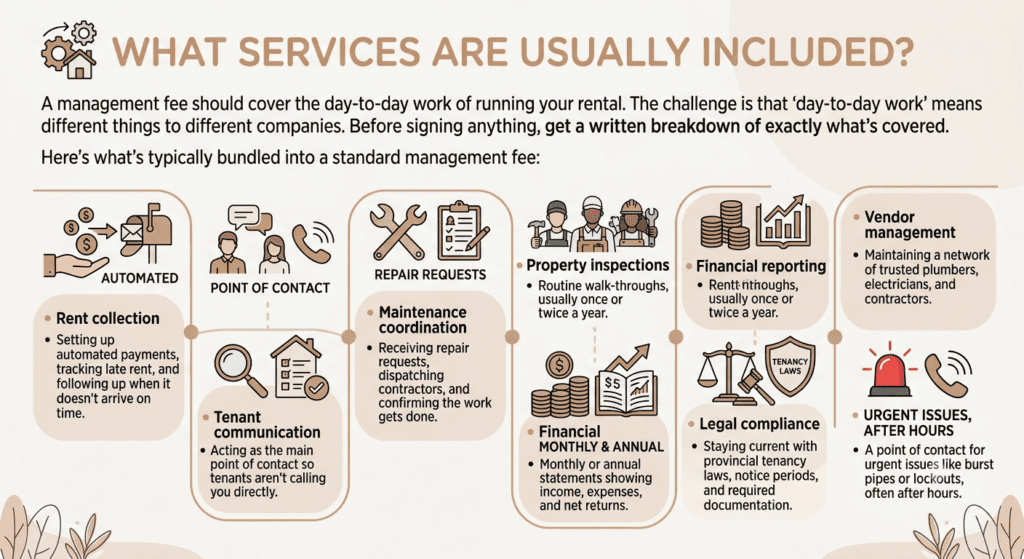
A management fee should cover the day-to-day work of running your rental. The challenge is that “day-to-day work” means different things to different companies. Before signing anything, get a written breakdown of exactly what’s covered.
Here’s what’s typically bundled into a standard management fee:
- Rent collection – Setting up automated payments, tracking late rent, and following up when it doesn’t arrive on time
- Tenant communication – Acting as the main point of contact so tenants aren’t calling you directly
- Maintenance coordination – Receiving repair requests, dispatching contractors, and confirming the work gets done
- Vendor management – Maintaining a network of trusted plumbers, electricians, and contractors
- Property inspections – Routine walk-throughs, usually once or twice a year
- Financial reporting – Monthly or annual statements showing income, expenses, and net returns
- Legal compliance – Staying current with provincial tenancy laws, notice periods, and required documentation
- Emergency support – A point of contact for urgent issues like burst pipes or lockouts, often after hours
Checklist Table: Included vs. Usually Extra
| Service | Typically Included | Usually an Extra Charge |
| Rent collection | ✅ | |
| Routine tenant communication | ✅ | |
| Maintenance request coordination | ✅ | |
| Annual/semi-annual property inspections | ✅ | |
| Monthly financial statements | ✅ | |
| Tenant placement / leasing a new tenant | ✅ | |
| Lease renewal processing | ✅ | |
| Move-in / move-out detailed inspection reports | ✅ | |
| Eviction or legal proceedings | ✅ | |
| Emergency repairs after hours | Sometimes | Sometimes |
| Markup on contractor invoices | ✅ (5%–15% common) |
The biggest mistake landlords make is comparing two quotes by their headline percentage alone. A company charging 7% with five add-on fees can easily cost more over a year than a company charging 10% with everything bundled in. Always ask for the full service schedule, not just the management rate.
Additional Fees You May Have to Pay
Beyond the base management fee, most Canadian property management companies charge for specific, one-off services. None of these are inherently unfair. The problem only comes up when they’re not disclosed upfront.
Tenant Placement Fees Charged when a property manager finds and places a new tenant. Typically 50% to 100% of one month’s rent, covering advertising, showings, screening, and lease preparation. On a $2,400/month unit, that’s $1,200 to $2,400 every time the unit turns over.
Lease Renewal Fees A smaller charge, often $100 to $300, for processing a lease renewal with an existing tenant. Less work than placing a brand-new tenant, so the fee should reflect that.
Property Inspection Fees Routine inspections are usually included, but detailed move-in or move-out reports often cost extra, sometimes $75 to $150 per visit.
Maintenance Coordination Charges Many companies add a markup of 5% to 15% on repair and maintenance invoices to cover the time spent getting quotes and overseeing the work.
Eviction Assistance If a tenancy goes sideways and legal action becomes necessary, expect an additional fee to cover the paperwork, hearings, and time involved, separate from any legal fees themselves.
Vacancy Management Some companies charge a reduced flat fee while a unit sits empty, to cover the cost of marketing and showings during that period.
Administrative Fees Smaller recurring charges for things like account setup, postage, or processing online payments.
Setup Fees A one-time onboarding charge, often $300 to $500, for your initial property assessment and file setup. Some companies waive this for multi-property owners.
Emergency Service Charges After-hours emergency calls sometimes carry a separate dispatch fee, even if the underlying repair cost is billed separately.
⚠️ Always ask for a complete fee schedule before signing. A low headline percentage can hide a long list of add-ons that make the real cost much higher than it first appears. Request every fee in writing, not just a verbal summary, before you commit to any property management agreement.
Property Management Fees by Major Canadian Cities
Where your property is located has a real effect on what you’ll pay. Local competition, licensing requirements, and cost of living all shape the going rate.
| City | Average Monthly % | Flat Fee Range | Typical Tenant Placement Fee |
| Toronto | 6%–10% | $150–$280/month | 50%–100% of one month’s rent |
| Vancouver | 6%–12% | $180–$300/month | 50%–100% of one month’s rent |
| Calgary | 6%–9% | $150–$225/month | One month’s rent (common flat rate) |
| Edmonton | 6%–10% | $150–$250/month | 50%–100% of one month’s rent |
| Ottawa | 6%–10% | $150–$250/month | 50%–100% of one month’s rent |
| Montreal | 6%–9% | $130–$220/month | 50%–75% of one month’s rent |
| Halifax | 7%–9% | $100 base + 4% hybrid common | 50%–100% of one month’s rent |
A few patterns worth noting. Toronto’s large pool of competing property management companies actually keeps percentage rates a bit lower than you might expect for Canada’s biggest rental market, though high rents mean the dollar amounts still add up. Vancouver sits at the top end nationally, driven by strict provincial licensing rules under the BC Financial Services Authority and a persistently competitive rental market. Calgary and Edmonton benefit from a more balanced supply-demand picture, which keeps fees moderate. Montreal and Halifax tend to run slightly below the national average, though hybrid pricing is increasingly common in Atlantic Canada.
One BC-specific note for 2026: a new 7% Provincial Sales Tax on property management fees took effect for commercial and non-residential properties. Residential landlords in BC are not affected by this change, so if you own a standard residential rental in Vancouver or elsewhere in the province, your fee structure stays the same.
What Factors Affect Property Management Costs?
The city you’re in sets the baseline, but several other factors push your specific quote up or down.
Property location Even within the same city, fees can shift between neighbourhoods based on demand, tenant turnover patterns, and how competitive the local market is for management services.
Single-family vs. multi-family Multi-unit properties often get a lower per-unit percentage since the property manager is handling several doors under one roof, which is more efficient for them.
Condo vs. detached home Condos sometimes come with a slightly lower management fee since the condo corporation already handles exterior maintenance and common areas. Detached homes require more coordination for things like landscaping, snow removal, and standalone systems.
Rental income Higher-rent properties often favour flat-fee structures, since a percentage-based fee scales upward with no added work for the manager.
Number of units Landlords with multiple properties frequently negotiate volume discounts, sometimes a percentage point or two lower per unit.
Property age Older properties tend to need more frequent maintenance coordination, which can mean higher repair markups even if the base management fee stays the same.
Maintenance requirements A property that needs constant attention costs more to manage than a newly built unit with few issues, even under the same percentage rate.
Luxury properties High-end rentals often come with specialized services, like concierge-style tenant communication or premium marketing, that justify a higher flat fee or added service tier.
Short-term vs. long-term rentals Short-term and Airbnb-style management runs on a completely different pricing model, often 15% to 30% of nightly revenue, because of the much higher turnover, cleaning coordination, and guest communication involved.
Is Hiring a Property Manager Worth the Cost?
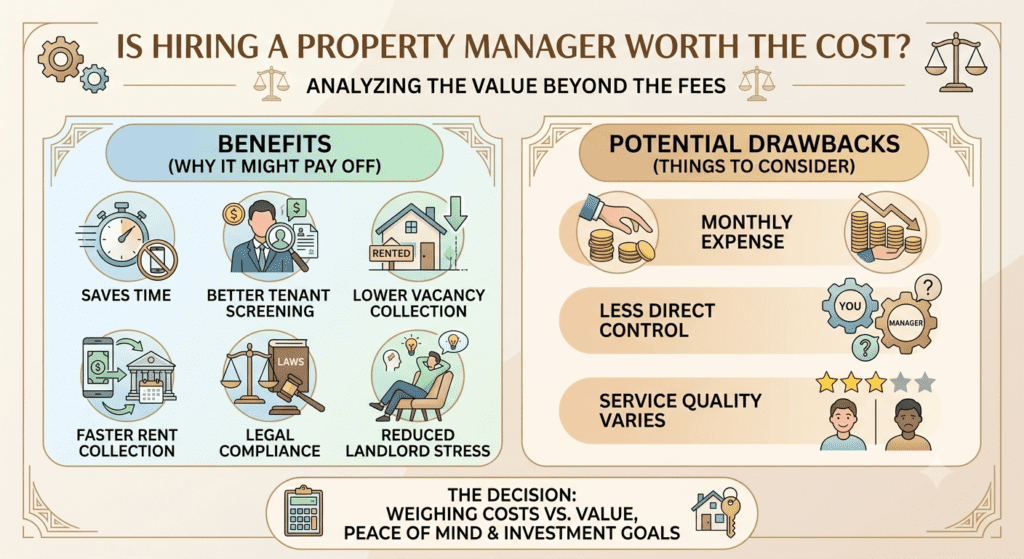
This is really the question underneath the question. Once you know what property management costs, the next step is figuring out whether that cost actually pays for itself.
Benefits
- Saves time – No more fielding maintenance calls during dinner or showings on your day off
- Better tenant screening – Professional managers run credit checks, verify employment, and check references thoroughly
- Lower vacancy – Faster marketing and showings mean less time between tenants
- Faster rent collection – Automated systems and consistent follow-up reduce late payments
- Legal compliance – Provincial tenancy laws change, and a good manager stays current so you don’t get caught off guard
- Reduced landlord stress – Hard to put a number on this one, but it’s often the biggest reason landlords make the switch
Potential Drawbacks
- Monthly expense – It’s a real cost that cuts into your net rental income
- Less direct control – You’re trusting someone else to make day-to-day decisions about your property
- Service quality varies – Not every company delivers the same level of care, so the wrong choice can leave you worse off than self-managing
Cost vs. Value: A Simple Comparison
| Factor | Self-Managing | Professional Management |
| Monthly cost | $0 in fees | 6%–12% of rent |
| Time investment | High (calls, showings, paperwork) | Low |
| Risk of legal missteps | Higher, especially for new landlords | Lower, with professional oversight |
| Vacancy turnaround | Depends on your availability | Usually faster |
| Stress level | Higher, particularly during emergencies | Lower |
For landlords with one easy-to-manage property nearby and plenty of free time, self-managing can make financial sense. For landlords with multiple units, properties in a different city, or simply no appetite for late-night maintenance calls, the fee usually pays for itself in time saved and problems avoided.
DIY Management vs. Hiring a Property Manager
| Category | DIY Management | Professional Property Manager |
| Monthly Cost | $0 (your time instead) | 6%–12% of rent |
| Time Commitment | 5–15+ hours/month | Minimal, occasional check-ins |
| Legal Knowledge Required | High; you’re responsible for compliance | Handled by the manager |
| Tenant Management | You handle screening, complaints, communication | Delegated to the manager |
| Maintenance | You coordinate contractors directly | Manager dispatches and oversees vendors |
| Emergency Handling | You’re the first call, anytime | Manager fields it, often with 24/7 support |
| Best Choice For | One property, local landlord, time available | Multiple properties, remote owners, busy schedules |
How to Choose the Right Property Management Company
Not all property managers are created equal, and the cheapest quote isn’t always the best deal. Run through this checklist before signing anything:
- Licensing – Confirm they’re properly licensed under your province’s regulatory body
- Experience – Ask how long they’ve operated in your specific city or neighbourhood
- Reviews – Look for consistent feedback from current and past clients, not just a handful of five-star reviews
- Fee transparency – A trustworthy company will hand you a full fee schedule without hesitation
- Services included – Get a detailed list of what’s covered under the base fee
- Communication process – Ask how quickly they respond to landlord questions and tenant issues
- Maintenance network – A strong list of reliable, vetted contractors saves you money and headaches
- Reporting system – Look for clear, accessible monthly statements, ideally through an online portal
- Contract terms – Understand the length of commitment and any automatic renewal clauses
- Termination policy – Know exactly how much notice you need to give if you want to end the agreement
Questions to Ask Before Signing a Property Management Agreement
A good property manager will welcome these questions. If they get defensive or vague, treat that as a red flag.
- Are there any hidden fees not listed in this quote?
- What services are included in the base management fee?
- How are maintenance requests handled, and is there a markup on repairs?
- Do you charge a fee during vacancy periods?
- How often will I receive financial reports, and what do they include?
- Can I cancel the contract early, and what’s the notice period?
- How do you screen tenants? What checks are included?
- What happens in an emergency, and who handles after-hours calls?
Tips to Reduce Property Management Costs
- Compare multiple quotes – Get at least three written quotes before deciding, and compare the full service list, not just the percentage
- Bundle multiple properties – If you own more than one rental, ask about portfolio discounts
- Understand every fee – Read the agreement line by line so nothing catches you off guard later
- Negotiate long-term agreements – Companies often reduce rates for landlords who commit to a longer contract
- Keep your property well maintained – Fewer repair calls mean fewer maintenance markups over the year
- Choose full-service plans wisely – Sometimes a slightly higher all-inclusive rate beats a lower rate with constant add-ons
Conclusion
Property management costs in Canada generally land between 6% and 12% of monthly rent, with flat-fee options typically running $100 to $350 a month. The exact number depends on where your property sits, what kind of rental it is, and how much service comes bundled into the fee.
The factors that move that number the most: your city, your property type, your portfolio size, and how transparent the management company is about additional charges like tenant placement and maintenance markups.
The smartest move isn’t chasing the lowest percentage on the page. It’s comparing the full service list behind each quote and figuring out which company actually delivers the most value for what you’re paying. A 10% fee that includes thorough tenant screening, fast repairs, and clear monthly reporting is often a far better deal than a 6% fee riddled with extra charges every time something needs to get done.
If you’re weighing whether to hire a property manager at all, remember what you’re really buying: time back, fewer legal risks, and a lot less stress every time the phone rings. For many landlords across Canada, that trade is worth every percentage point.
Looking for property management you can actually trust with your investment? The HAH Developments helps landlords across Niagara Falls and the surrounding region manage long-term rentals, short-term rentals, and Airbnb properties with full transparency on fees and services. Whether you own one property or a growing portfolio, our team handles the day-to-day so you can enjoy the income without the stress. Contact The HAH Developments today for a custom property management quote built around your property’s needs.
Frequently Asked Questions
Most Canadian property managers charge between 6% and 12% of monthly rent, with the national average landing around 8% to 10%. Flat-fee arrangements typically run $100 to $350 per month depending on the city and property type.
Yes. Property management fees are a fully deductible rental expense in Canada. You report them on Form T776, Statement of Real Estate Rentals, alongside other current expenses like advertising and insurance. Keep your invoices and management agreement on file in case the CRA requests documentation.
Routine maintenance coordination is usually included, but the actual repair costs are billed separately, often with a markup of 5% to 15% on the invoice. Always confirm whether this markup applies and how it’s calculated.
Often, yes. Landlords with multiple properties, long-term commitments, or higher-rent units have the most leverage. It never hurts to ask, especially if you have competing quotes in hand.
Most percentage-based managers don’t charge their management fee during a vacancy, since there’s no rent to collect a percentage from. Some companies do charge a smaller flat fee to cover marketing and showings while the unit sits empty, so ask directly.
Tenant placement fees typically run 50% to 100% of one month’s rent, covering advertising, showings, screening, and lease preparation. On higher-rent units, some companies switch to a flat dollar amount instead.
For landlords with multiple properties, full-time jobs, or properties located far from where they live, the time and stress saved usually outweighs the fee. For a single, easy-to-manage local property, self-management can still make sense if you have the time and legal knowledge to do it well.
Yes, and this trips people up often. Condo fees (paid to the condo corporation for building upkeep) are completely separate from property management fees (paid to a company managing your unit as a rental). If you own a rental condo, you may be paying both at the same time.