

If you’ve ever spent a Saturday morning scrubbing carpet stains left behind by a tenant who “definitely didn’t have pets,” you already know why this guide exists of Reliable Tenants in Canada.
Finding the right tenant isn’t just about filling a vacancy fast. It’s about protecting your property, your income, and your peace of mind for the length of the lease – and often long after it ends. A tenant who pays late every month, damages the unit, or drags you into a legal dispute can cost you far more than a few weeks of extra vacancy ever would.
Think about it this way. Missed rent adds up fast, especially if you’re covering a mortgage on the property. Property damage can run into the thousands. Legal disputes eat your time and money. And if things go really wrong, an eviction process in Ontario or any other province can take months, all while you’re still on the hook for the mortgage, taxes, and utilities.
The good news? None of this is left to chance. There’s a proven, repeatable process that helps landlords across Canada find tenants who pay on time, respect the property, and stick around. This guide walks you through that process from start to finish – not just a quick screening checklist, but a complete framework for choosing the right person to hand your keys to.
What Makes a Tenant “Reliable”?
Before you can screen for a reliable tenant, it helps to know exactly what you’re looking for. “Reliable” isn’t just a gut feeling – it’s a specific set of habits and circumstances that make someone a low-risk, high-value renter.
Here’s what reliable tenants in Canada typically have in common:
- They pay rent consistently. Not just on time occasionally, but every single month, without needing reminders.
- They have stable employment or income. A steady paycheque or a dependable income source (even non-traditional ones like pensions or freelance work) gives you confidence they can keep up with rent.
- They have a positive rental history. Previous landlords have good things to say about how they treated the unit and paid their bills.
- They’re honest during the application process. Their documents match their story, and nothing feels rushed or inconsistent.
- They communicate well. They respond to messages, ask questions when something’s unclear, and let you know early if there’s a problem.
- They take care of the property. Small things – like reporting a leak right away instead of letting it turn into water damage – say a lot.
- They respect lease terms. From pet policies to quiet hours, they stick to what they agreed to.
Reliable Doesn’t Always Mean “Perfect Credit”
Here’s something a lot of screening guides miss: a high credit score doesn’t automatically mean a great tenant, and a mid-range score doesn’t automatically mean a risky one.
A tenant with a 620 credit score who went through a medical hardship two years ago – and has paid every bill on time since – can be a far safer bet than a tenant with a 720 score but almost no rental history and a thin credit file. The number matters, but so does the story behind it. Keep this in mind as you move through the rest of the screening process.
Start with a Strong Rental Listing
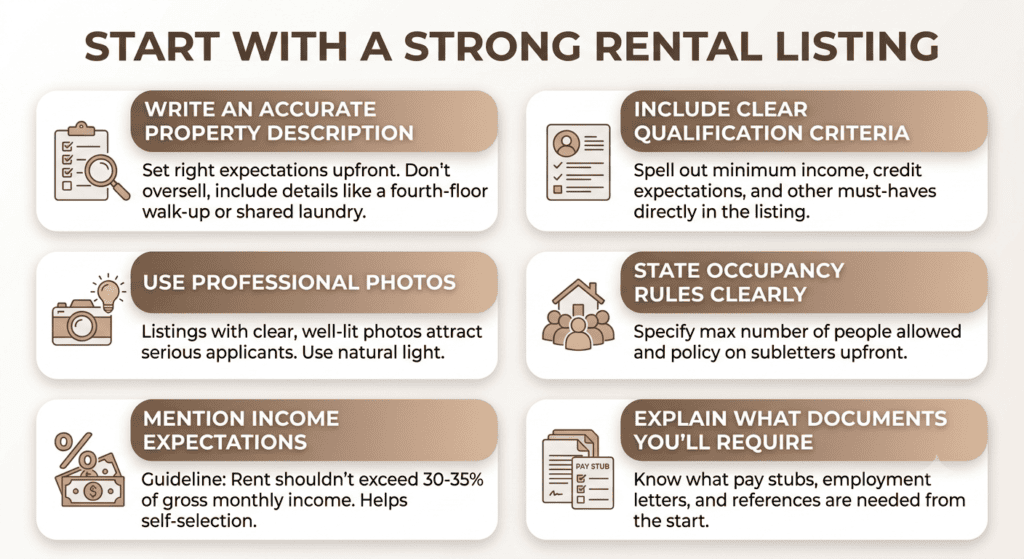
Most landlords treat the listing as a formality. That’s a mistake. A well-written listing is your first – and most powerful – screening tool, because it filters out unqualified applicants before they even reach out.
Write an accurate property description. Don’t oversell the unit or leave out details that matter, like a fourth-floor walk-up or shared laundry. Setting the right expectations upfront means fewer surprises (and fewer disappointed applicants) later.
Include clear qualification criteria. Spell out your minimum income requirement, credit expectations, and any other must-haves right in the listing. This alone will discourage applicants who know they don’t meet the bar.
Use professional photos. Listings with clear, well-lit photos attract more serious applicants and fewer time-wasters. You don’t need a professional photographer – natural light and a tidy space go a long way.
State occupancy rules clearly. How many people can live in the unit? Are subletters allowed? Say so upfront.
Mention income expectations. Many landlords use a general guideline where monthly rent shouldn’t exceed roughly 30 to 35% of an applicant’s gross monthly income. Stating this in your listing helps applicants self-select before they apply.
Explain what documents you’ll require. If applicants know upfront they’ll need a pay stub, employment letter, and references, the people who aren’t prepared to provide those will often move on to an easier listing.
Pro Tip: A detailed, transparent listing does a lot of your screening for you. Vague listings attract vague applications – and that means more of your time spent chasing down basic information later.
Pre-Screen Applicants Before Scheduling Viewings
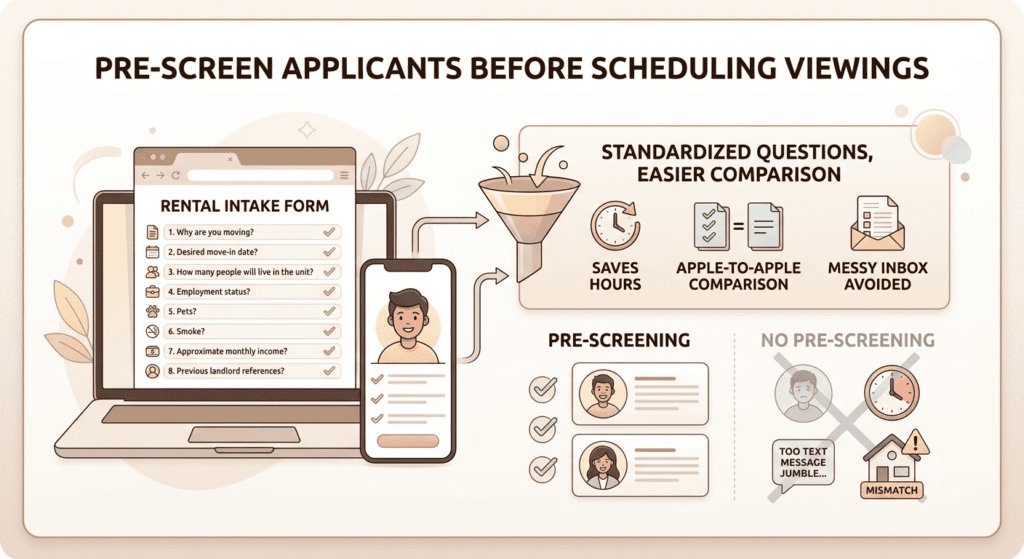
Once inquiries start rolling in, resist the urge to book every showing that comes your way. A quick pre-screening conversation – by phone, email, or a short online form – saves you hours of wasted viewings.
Ask a handful of simple but revealing questions:
- Why are you moving?
- What’s your desired move-in date?
- How many people will be living in the unit?
- What’s your current employment status?
- Do you have any pets?
- Do you or anyone in your household smoke?
- What’s your approximate monthly income?
- Can you provide references from a previous landlord?
The answers won’t tell you everything, but they’ll quickly surface mismatches – like someone needing to move in tomorrow when your unit isn’t ready for three weeks, or a household size that doesn’t fit your occupancy limits.
More landlords are now building this step into a short online intake form rather than juggling texts, emails, and phone calls. It’s a small shift, but it matters: when every applicant answers the same questions in the same format, you’re comparing apples to apples instead of piecing together mismatched information from a messy inbox.
Verify Employment and Income Carefully
Once an applicant clears pre-screening and views the unit, it’s time to dig into the financial details. This step protects you from the single most common reason tenancies fall apart: an applicant who simply can’t afford the rent.
Ask for:
- An employment letter confirming job title, salary, and length of employment.
- Recent pay stubs, ideally from the last two to three pay periods.
- Documentation for self-employed applicants, such as bank statements or a Notice of Assessment from the CRA, since they won’t have a typical employer letter.
- Proof of income consistency – a few months of steady deposits tells you more than a single pay stub ever could.
The Rent-to-Income Guideline
A commonly used benchmark is that housing costs should generally stay at or below roughly 30 to 35% of an applicant’s gross monthly income. It’s a useful starting point, but treat it as a guideline, not a strict rule.
Someone with a lower income but no debt and strong savings might be a safer bet than someone earning more but carrying significant financial obligations elsewhere. Look at the full financial picture rather than leaning on a single ratio to make your decision.
Run a Tenant Credit Check in Canada – Legally
A credit check is one of the most useful tools in your screening toolkit, but it needs to be done correctly. Getting this step wrong is one of the fastest ways for a landlord to end up on the wrong side of Canadian privacy law.
Here’s what a credit report actually tells you:
- Payment history – has this person consistently paid their bills on time?
- Collections – are there unpaid debts that went to collections?
- Bankruptcies – has the applicant filed for bankruptcy, and if so, how long ago?
- Debt load – how much existing debt is this person managing relative to their income?
Remember: credit score isn’t everything. Context matters just as much as the number itself.
Written Consent Is Non-Negotiable
You cannot legally pull a tenant’s credit report without their written consent. This applies across Canada, though the specific legislation depends on where your property is located.
In most provinces, including Ontario, the federal Personal Information Protection and Electronic Documents Act (PIPEDA) governs how you can collect and use an applicant’s personal information. British Columbia and Alberta have their own provincial privacy legislation (PIPA), and Quebec operates under Law 25 – currently the strictest private-sector privacy law in the country.
It’s also worth knowing that federal privacy law itself is evolving. Parliament has been working through Bill C-27, which would replace PIPEDA with a new Consumer Privacy Protection Act. As of early 2026, that bill hadn’t received Royal Assent yet, but landlords should expect privacy obligations to become more detailed over time, not less. Building a solid consent process now will save you headaches down the road.
In practice, this means:
- Use a written application form that clearly states you’ll be running a credit check.
- Get the applicant’s signature (physical or digital) before pulling any report.
- Use a recognized provider, such as Equifax Canada or TransUnion Canada.
Apply the Same Credit Threshold to Every Applicant
Here’s the part landlords often overlook: the legal risk usually isn’t the credit check itself – it’s applying your criteria inconsistently. If you require a 650 credit score from one applicant but waive that requirement for another without a documented reason, you’ve opened the door to a discrimination complaint.
Set your criteria in advance, write them down, and apply them the same way for every single applicant, every time.
Check Previous Landlord References the Right Way
A credit report tells you how someone handles debt. A landlord reference tells you how someone handles a home. Both matter, but many landlords skip this step or rush through it – and that’s a mistake.
When you call a previous landlord, ask specific, direct questions:
- Did they pay rent on time, every time?
- Were there any lease violations during their tenancy?
- What condition was the property in when they moved out?
- Would you rent to this person again?
- Did they give proper notice before leaving?
Expert Tip: Whenever possible, call the previous landlord, not just the most recent one. A current landlord dealing with a problem tenant might give a glowing reference just to move that tenant along to someone else’s property. A previous landlord, with nothing to gain, is usually more candid.
It’s also becoming more common for landlords to cross-check rental tribunal records for past eviction orders or unpaid rent judgments, in addition to calling personal references. This extra step can surface issues a phone reference might miss entirely.
Watch for Common Tenant Application Red Flags
Even with a solid screening process, it helps to know what to watch for. These are the warning signs that should make you slow down and dig deeper before approving an application:
- Inconsistent information between the application, employment documents, and what the applicant tells you directly.
- Fake or altered employment documents – mismatched fonts, odd formatting, or numbers that don’t add up.
- Rushed move-in requests, especially when paired with pressure to skip standard screening steps.
- Refusal to authorize screening, such as declining to sign a credit check consent form.
- Income that doesn’t reasonably support the rent, even after accounting for other income sources.
- Poor communication during the application process, like unanswered questions or vague responses.
- Missing or unreachable references.
Digital-Era Red Flags Worth Watching in 2026
As more of the rental process moves online, a few newer red flags have emerged. Be cautious of applicants who send a screenshot of a credit score instead of a full report – screenshots are easy to edit and don’t show the full financial picture. Similarly, watch for identity documents that don’t quite match up across different parts of the application; with more transactions happening digitally, verifying that the applicant, the lease signer, and the payment source are all the same person has become a bigger part of responsible screening.
Stay Compliant with Canadian Tenant Screening Laws

Tenant screening in Canada operates inside a fairly detailed legal framework, and it’s worth understanding the basics so you can screen confidently and fairly. This is where tenant screening Canada rules get specific – and where a lot of well-meaning landlords accidentally cross a line.
Three layers of law typically apply:
Privacy legislation governs how you collect, use, and store an applicant’s personal information. This is PIPEDA in most provinces, provincial PIPA legislation in British Columbia and Alberta, and Quebec’s Law 25.
Human rights codes prohibit discrimination based on protected grounds, which vary somewhat by province but generally include race, religion, sex, disability, family status, and more. Notably, Ontario is one of the few provinces that explicitly protects source of income as a ground – meaning a landlord cannot refuse an applicant simply because their income comes from a government support program like ODSP or Ontario Works.
Provincial tenancy legislation, such as Ontario’s Residential Tenancies Act, sets out the broader rules for how landlords and tenants interact, including how screening fits into the bigger picture of a tenancy.
Apply the Same Criteria to Every Applicant
This point is worth repeating because it’s the single biggest compliance safeguard available to you. Document your screening criteria – minimum income, credit score threshold, required references – and apply that exact standard to every applicant, no exceptions. Consistency is what protects you if a decision is ever questioned.
A Note on Social Media Screening
It might be tempting to look up an applicant on social media, but this comes with real risk. Browsing a profile can expose you to information about someone’s religion, family status, or other protected characteristics – information you can’t simply “unsee.” If a rejected applicant later raises a human rights complaint, it becomes much harder to prove that information played no role in your decision. The safest approach is a written policy that social media isn’t part of your screening process, applied consistently across the board.
Build a Consistent Tenant Screening Checklist
A checklist keeps your process consistent, which protects both you and your applicants. Here’s a landlord tenant screening checklist you can adapt for your own rental:
- ☐ Completed rental application
- ☐ ID verification
- ☐ Employment verification
- ☐ Income verification (pay stubs, NOA, or bank statements)
- ☐ Credit check (with signed written consent)
- ☐ Reference checks with at least two previous landlords
- ☐ Rental history and tribunal record review
- ☐ Interview notes
- ☐ Lease review with the approved applicant
- ☐ Final approval and documentation
Keep Records for at Least One Year
Once you’ve made a decision, don’t just delete the file. Best practice is to retain your screening records – consent forms, credit reports, notes – for at least one year after the tenancy decision is made. This protects you if a decision is ever questioned later and supports your privacy law obligations around proper documentation.
2026 Rental Market Snapshot: Why Screening Matters More Than Ever
The rental landscape has shifted meaningfully over the past year, and it changes how landlords should think about screening.
Across much of Ontario, vacancy rates have been climbing. Forecasts point to a broadly balanced market in 2026, with vacancy rates in the range of 3 to 5% in many areas, as new rental supply continues to come online while population growth and demand have cooled somewhat. In parts of the Greater Toronto and Hamilton Area, vacancy in newer rental buildings has climbed to its highest level in five years, driven by a wave of newly completed condo units entering the rental pool alongside purpose-built stock.
What does this mean for you as a landlord? More choice among applicants – but also more competition for good tenants, since renters now have more options and more negotiating power than they did just a couple of years ago. Some landlords are responding with incentives like reduced deposits or a discounted first month to attract quality tenants faster.
At the same time, Ontario’s 2026 rent increase guideline sits at 2.1%, a modest cap on how much you can raise rent for existing tenants without board approval. That makes getting the right tenant in at signing more valuable than ever – a long-term, reliable tenant protects your cash flow far more effectively than chasing a higher rent on turnover.
It’s also worth noting that rental markets don’t move in lockstep across the country. Headlines about Toronto or Vancouver vacancy trends don’t necessarily reflect what’s happening in smaller or secondary markets, including here in Niagara Falls. Local demand drivers – tourism, cross-border proximity, and a strong short-term rental sector – mean this region often behaves differently than the big-city numbers suggest. That’s exactly why a screening process tailored to your specific market, not a generic national template, matters so much.
One more shift worth mentioning: more of the rental process – applications, screening reports, digital leases, online rent payments – has moved online. That’s good for speed and organization, but it also raises the bar on consent, documentation, and identity verification. A rushed, informal process is far riskier today than it was even a few years ago.
Why Many Canadian Landlords Hire a Property Management Company

By now, it’s probably clear that thorough tenant screening takes real time and attention to detail. That’s exactly why a growing number of Canadian landlords choose to bring in a property management company rather than handling it all solo.
Here’s what a good property manager brings to the table:
- Faster tenant placement, thanks to established marketing channels and a steady pipeline of qualified applicants.
- Professional screening infrastructure, including established relationships with credit bureaus and screening services.
- Built-in legal compliance, since experienced property managers already know the privacy and human rights obligations in your province inside and out.
- Consistent reference verification, done the same way for every applicant, every time.
- Lease preparation that reflects current provincial requirements.
- Reduced vacancy periods, since qualified applicants are identified and moved through the process quickly.
- Lower long-term risk, from fewer late payments to fewer costly disputes.
How The HAH Developments Handles Tenant Screening For You
At The HAH Developments, we’ve built our long-term rental management process around exactly the framework outlined in this guide – strong listings, thorough pre-screening, verified income and employment, legally compliant credit checks, and genuine reference conversations with previous landlords.
We’re based right here in Niagara Falls, Ontario, and we understand this market’s particular rhythms – from seasonal tourism demand to the mix of long-term renters and short-term guests that shapes local property values. Whether you own a single rental property or a growing portfolio, our team handles the entire tenant placement and property management process so you don’t have to chase down pay stubs, verify references, or worry about privacy law compliance yourself.
Common Mistakes Landlords Make When Screening Tenants
Even experienced landlords fall into a few predictable traps. Knowing them ahead of time can save you a lot of trouble.
Skipping steps when a listing gets a lot of interest. When you’re fielding a dozen inquiries in the first day, it’s tempting to shortcut the process for an applicant who “seems great.” Resist this. The applicants who apply pressure to skip screening are often the ones who most need to be screened.
Trusting a single reference. One glowing reference doesn’t tell you the whole story, especially if it comes from a landlord eager to move a tenant along. Always try to speak with at least two previous landlords when possible.
Treating the credit score as the only factor. A number on its own doesn’t capture context. Pair it with income verification, references, and your own conversation with the applicant.
Being inconsistent between applicants. This is the single most common compliance mistake. If you ask one applicant for three pay stubs and another for one, or you waive your credit threshold for someone you simply liked more, you’ve created real legal exposure. Write your criteria down and follow it exactly, every time.
Not documenting the decision. Even a rejection needs a paper trail. A short note explaining why an applicant wasn’t approved – tied to your documented criteria – protects you if that decision is ever questioned later.
Letting urgency override diligence. A vacant unit costs money every day it sits empty, and that pressure is real. But approving the wrong tenant to fill a vacancy quickly almost always costs more in the long run than a few extra days of screening ever will.
Conclusion
Finding reliable tenants in Canada isn’t about luck. It’s about following a consistent, legally sound process every single time – from the moment you write your listing to the day you hand over the keys.
A strong listing filters out the wrong applicants before they even reach out. Pre-screening saves you from wasted showings. Verified income and a properly consented credit check tell you whether someone can actually afford the rent. Genuine landlord references tell you how they’ll actually treat your property. And applying the same criteria to everyone, every time, keeps you compliant and fair.
Investing this extra time upfront pays for itself many times over – in fewer missed payments, fewer disputes, less turnover, and a property that holds its value because it’s being cared for by someone who respects it.
Ready to stop guessing and start screening like a pro? Reach out to The HAH Developments for a free consultation on our tenant placement and long-term rental management services. We’ll help you find tenants who pay on time, treat your property right, and stay for the long haul.
Interested in stress-free property management in Niagara Falls and beyond? Contact The HAH Developments today to learn how our tenant screening and long-term rental management services can protect your investment.
Frequently Asked Questions
Landlords verify tenants through a combination of a completed rental application, ID verification, employment and income documentation (like pay stubs or an employment letter), a credit check with written consent, and reference checks with previous landlords. Many also cross-check rental tribunal records for past disputes or evictions.
Yes, credit checks are legal across Canada as long as the landlord gets the applicant’s written consent first. The specific privacy law that applies depends on the province – PIPEDA in most of the country, provincial PIPA legislation in British Columbia and Alberta, and Law 25 in Quebec.
There’s no single official cutoff, but many landlords look for a credit score in the range of 650 or higher as a positive sign of reliable payment history. That said, the full picture – payment consistency, debt load, and any documented circumstances behind a lower score – matters more than the number alone.
Typical documents include a completed rental application, government-issued photo ID, an employment letter, recent pay stubs (or a Notice of Assessment and bank statements for self-employed applicants), and contact information for previous landlord references.
A thorough screening process typically takes anywhere from a few days to about a week, depending on how quickly the applicant provides documents and how fast references respond. Credit checks are usually the fastest step, often returning results within minutes once consent is signed. The slowest part is usually waiting to hear back from a previous landlord, especially if they’re busy or hard to reach. Using a standardized online application with all your required documents listed upfront can speed the whole process up considerably, since applicants know exactly what to submit from day one instead of trickling in documents over several days.
Yes, a landlord can decline an applicant based on legitimate screening results, such as insufficient income, a poor rental history, or an unfavourable credit report – as long as the decision isn’t based on a protected human rights ground and the same criteria were applied consistently to every applicant. It’s good practice to keep a brief written note explaining the reason for the decision, tied directly to your documented screening criteria, in case that decision is ever reviewed later.