

Rent didn’t show up this month. You checked your bank account twice, maybe three times, hoping you missed a transfer somewhere. You didn’t.
If you’re a landlord, this moment feels personal even though it rarely is. Your mortgage payment is still due on the same date. Your property taxes don’t pause. Neither does your insurance premium or the plumber’s invoice from last month’s repair. When a tenant stopped paying rent, the bills attached to that property keep arriving exactly on schedule, and now there’s a gap between what’s coming in and what’s going out.
This is happening to more Ontario landlords than it used to. Rising interest rates over the past few years pushed many mortgage holders closer to the edge of their monthly budgets, which means even a single missed rent payment can turn a comfortable investment into a stressful one. At the same time, tenants are dealing with their own version of the same squeeze – higher grocery bills, higher utility costs, and wages that haven’t kept pace.
The financial ripple effect of unpaid rent goes beyond the missing cheque. A landlord carrying a mortgage on the property still owes the bank every month, whether or not the tenant pays. Property tax bills, home insurance premiums, condo fees, and routine maintenance costs don’t get a grace period just because your renter is short on cash. Multiply one missed month across a few units, or stretch it out for the months it can take to resolve through Ontario’s tribunal system, and the financial strain becomes very real very fast.
It’s also an emotional experience, not just a financial one. Landlords often go through a predictable cycle: confusion, then frustration, then anger, and sometimes guilt, especially if they know the tenant personally or empathize with a rough patch. That mix of emotions is exactly what leads to bad decisions – angry texts, changed locks, or utility shutoffs that can turn a fixable situation into a legal mess that costs far more time and money to unwind.
The good news is that there’s a proven, methodical way to handle this. This guide walks through exactly what to do, in order, from the moment you notice a missed payment through to prevention strategies that reduce your odds of ever being in this position again. We’ll also cover when handing the problem to a professional property manager makes more financial sense than handling it yourself.
Why Tenants Stop Paying Rent
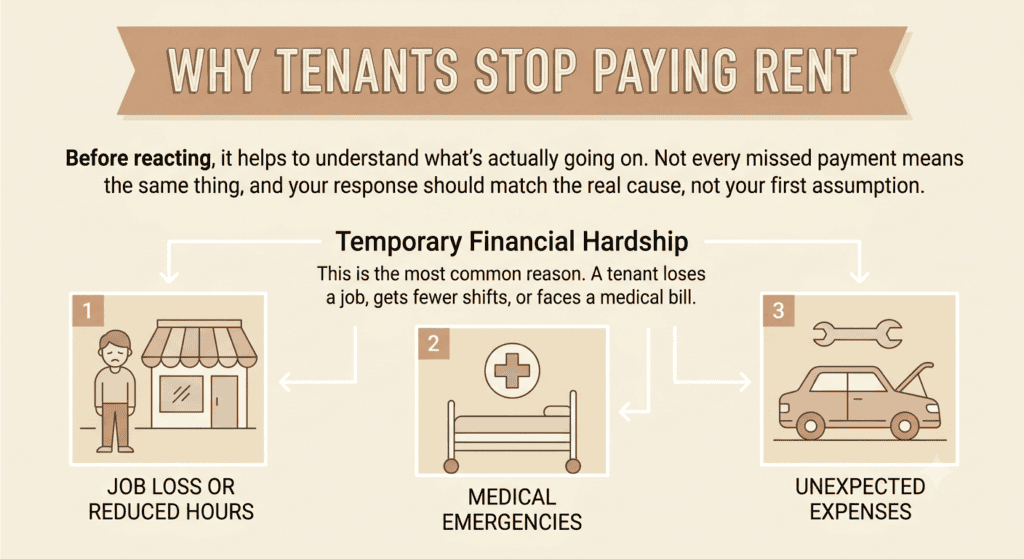
Before reacting, it helps to understand what’s actually going on. Not every missed payment means the same thing, and your response should match the real cause, not your first assumption.
Temporary Financial Hardship
This is the most common reason, by far. A tenant loses a job, gets fewer shifts, or faces a medical bill that wipes out their cushion. These tenants often have a solid payment history up until the missed month, and they usually respond quickly and honestly when contacted.
Common triggers include:
- Job loss or reduced hours – layoffs, seasonal work ending, or an employer cutting back
- Medical emergencies – an unexpected diagnosis, a hospital stay, or a family member’s care needs
- Unexpected expenses – a car repair, a family emergency, or a one-time bill that collided with rent day
Communication Breakdown
Sometimes the money is there, but the process broke down somewhere. A tenant might be avoiding an awkward conversation because they’re embarrassed, or there’s a genuine misunderstanding about due dates, payment methods, or an increase that wasn’t communicated clearly.
- Tenants avoiding difficult conversations out of embarrassment or fear
- Misunderstandings about the due date (especially with mid-month move-ins)
- Confusion after switching payment methods, such as moving from cheques to e-transfer
Intentional Non-Payment
This is the smallest category but the one landlords fear most. Some tenants – often referred to as “professional tenants” – understand exactly how long the Ontario eviction process takes and use that timeline to live rent-free for months while shopping for their next unit.
- Professional tenants who exploit slow tribunal timelines
- Repeated lease violations paired with non-payment
- General financial irresponsibility rather than hardship
Knowing which category you’re likely dealing with shapes everything that follows. A tenant going through a layoff deserves a different first conversation than a tenant who has ignored three previous reminders.
Step 1 – Confirm the Situation Before Reacting
Before you send a single message, make sure the problem is actually what it looks like.
- Double-check your payment records. Bank delays, especially with e-transfers or cheques deposited near a long weekend, can take a day or two to clear. Confirm the rent genuinely hasn’t arrived before assuming the worst.
- Verify bank transfer delays. E-transfers occasionally sit unclaimed if the tenant used the wrong email or the auto-deposit wasn’t set up correctly.
- Review the lease terms. Check the exact due date, any agreed grace period, and how rent is supposed to be paid. A tenant who pays on the 3rd instead of the 1st might simply be following what the lease actually says.
- Rule out an administrative mistake on your end. If you manage several units, it’s worth confirming you haven’t misapplied a payment to the wrong tenant file or missed a manual deposit.
This step takes ten minutes and can save you from an awkward, credibility-damaging conversation where you accuse a tenant who actually paid on time.
Step 2 – Contact Your Tenant Professionally
Once you’ve confirmed rent truly wasn’t paid, reach out immediately – but calmly.
- Contact them the same day or the next business day. Waiting a week sends the message that missed rent isn’t a big deal, and it eats into any legal notice period you might need later.
- Use written communication. Email or text creates a timestamped record. A phone call is fine as a first touch, but always follow up in writing summarizing what was discussed.
- Ask questions instead of making accusations. “I noticed rent hasn’t come through yet – is everything okay?” opens a conversation. “You didn’t pay again” closes one.
- Document every exchange. Save texts, emails, and notes from phone calls, including the date, time, and what was agreed to.
Pro Tip: Professional, documented communication resolves the majority of late-rent situations before legal action ever becomes necessary. Most tenants who are genuinely struggling will respond to a respectful first message far better than a threatening one.
Step 3 – Understand Your Local Landlord-Tenant Laws
This is where many landlords get into trouble, usually by acting on instinct instead of the actual rules that apply where the property is located.
In Ontario, the rules are set out in the Residential Tenancies Act and enforced by the Landlord and Tenant Board (LTB). A few things every Ontario landlord should know heading into 2026:
- Notice requirements. If rent isn’t paid in full, landlords can serve a Form N4 (Notice to End a Tenancy Early for Non-Payment of Rent) starting the day after rent was due – not on the due date itself. Tenants who pay monthly must be given at least 14 days to pay in full or move out; tenants who pay daily or weekly get at least 7 days.
- The notice is voidable. If the tenant pays every dollar owed – including any new rent that came due during the notice period – before the termination date, the N4 is automatically cancelled and the tenancy continues.
- What can and can’t go on the notice. Only actual rent arrears can be claimed on an N4. Late fees, NSF charges, or utility bills the tenant pays directly cannot be included, and doing so can invalidate the entire notice.
- Legal documentation matters enormously. A single wrong date, a misspelled name, or an incorrect arrears calculation is enough for the Board to dismiss your application and send you back to square one.
- Every province and jurisdiction has different rules. Notice periods, required forms, and tenant protections vary widely across Canada and the U.S. Never rely on advice from a landlord friend in a different province; confirm the specific rules for where your property sits.
- Mistakes landlords should never make:
- Serving the notice too early (before the day after rent was due)
- Filing the follow-up application before the termination date has passed
- Leaving out required details like unit numbers or full legal names
- Assuming the notice itself is an eviction order – it isn’t; only the Board can order an eviction
It’s also worth knowing that Ontario recently updated some of the procedural rules around rent arrears hearings. As of late 2025, tenants who want to raise separate complaints – like maintenance issues – at the same hearing as a rent arrears case generally need to give advance written notice and may need to pay a portion of the claimed arrears before those issues get heard together. This doesn’t eliminate a tenant’s right to raise legitimate concerns, but it does mean landlords who’ve let maintenance requests pile up should address them honestly rather than assuming they’ll simply go away.
Step 4 – Explore Payment Solutions Before Escalating
Legal notices are sometimes necessary, but they’re also slow, and a tenant who leaves owing money and with damage to the unit costs you far more than a tenant who catches up and stays.
Reasonable options to consider before escalating:
- A structured payment plan. Spreading the missed amount across two or three future rent cycles, in writing, with clear dates.
- Partial payments. Accepting what the tenant can pay now while documenting the remaining balance – note that in Ontario, you’re generally required to accept partial payment, though doing so doesn’t automatically cancel a notice already served.
- A temporary payment arrangement. A short-term adjustment, such as splitting one month’s rent into two smaller payments around different pay dates.
- Rent assistance programs. Many Ontario municipalities run rent bank programs that provide interest-free loans or grants to tenants facing arrears, aimed at preventing eviction. Directing a tenant toward one of these programs can get you paid faster than a months-long tribunal process ever will.
Flexibility makes financial sense when the tenant has a track record of paying on time, is transparent about what happened, and proposes a realistic plan. It makes far less sense with a tenant who has broken previous promises or gone silent.
Step 5 – Serve the Proper Legal Notice
If communication and payment solutions haven’t worked, it’s time to formalize things.
- When notices become necessary. Once a tenant has missed a full rent payment and hasn’t responded with a workable plan, most landlords move to a formal notice rather than waiting indefinitely.
- Required documentation. In Ontario, this means completing the N4 form precisely – correct tenant names, correct unit address, and an accurate arrears table showing exactly how the amount owed was calculated.
- Deadlines. The termination date on the notice must respect the minimum notice period (14 days for monthly tenancies, 7 days for daily/weekly). Count the days correctly; the day you serve the notice doesn’t count toward the total.
- Record keeping. After serving the notice, complete a Certificate of Service showing exactly how and when it was delivered. This document becomes essential if the matter proceeds further, since the method and timing of service directly affects your case.
A note on following local regulations carefully: this single step is responsible for more dismissed applications than almost any other part of the process. A landlord who serves the notice a day too early, miscounts the notice period, or forgets to name every tenant on a joint lease can end up starting the entire process over – losing weeks or months in the process.
Step 6 – Prepare for the Eviction Process (If Necessary)
If the termination date passes and the tenant hasn’t paid in full or moved out, the next stage begins.
- When eviction becomes the only option. This is typically the case when a tenant ignores the notice entirely, stops responding, or has clearly shown they don’t intend to pay.
- Required paperwork. In Ontario, this means filing an L1 Application (Application to Evict a Tenant for Non-payment of Rent and to Collect Rent the Tenant Owes) with the Landlord and Tenant Board, along with a copy of the N4 and the Certificate of Service.
- Timeline expectations. This is the part that surprises most first-time landlords. Ontario’s tribunal system has faced a significant backlog in recent years, and while non-payment applications are generally prioritized over other case types, landlords are still commonly looking at roughly three to six months between filing and getting a hearing date – sometimes longer, especially if a hearing gets adjourned. It’s wise to plan your finances assuming the slower end of that range rather than the faster one.
- Costs landlords should anticipate. Filing fees, potential lost rent during the waiting period, and possibly legal or paralegal fees if the case is contested. Many of these costs can be included in what you’re claiming from the tenant, but recovering money from a tenant who has already left is a separate and often difficult process.
- Importance of legal compliance. Every step – from the original notice to the final enforcement – must follow the process exactly. Only the Sheriff’s office can physically enforce an eviction order in Ontario; a landlord can never remove a tenant, their belongings, or change the locks without that court-backed order.
Given how long and procedurally strict this stage can be, many landlords choose to bring in a paralegal or property manager experienced with tribunal filings once a case reaches this point, purely to avoid a paperwork error costing another few months.
Common Mistakes Landlords Make
Frustration leads good landlords to bad decisions. These mistakes are common, and every one of them can turn a straightforward arrears case into a legal liability for the landlord instead of the tenant.
- Changing locks. This is illegal in Ontario regardless of how much rent is owed, and it can expose the landlord to serious penalties.
- Shutting off utilities. Cutting off heat, water, or electricity to force a tenant out is treated as illegal self-help eviction, not a legitimate collection tactic.
- Threatening tenants. Verbal threats, intimidation, or aggressive visits can be used against the landlord at a hearing and may trigger a harassment claim.
- Accepting verbal promises only. “I’ll have it to you Friday” means nothing without a paper trail. Get every commitment in writing.
- Failing to document communication. Landlords who rely on memory instead of saved texts and emails struggle to prove their case months later.
- Waiting too long to act. Giving a tenant “one more month” repeatedly, without a written agreement, often just delays the inevitable and adds to the arrears.
How to Protect Yourself from Future Rent Problems
The best defense against a non-paying tenant is never having one in the first place. That starts long before the lease is signed.
Tenant Screening
A consistent, well-documented screening process is your single best protection.
- Credit checks. Ontario landlords can request a credit check with the applicant’s written consent, but a lack of credit history – common among newcomers and young renters – cannot legally be held against an applicant on its own.
- Employment verification. Confirm income through pay stubs, an employment letter, or a Notice of Assessment for self-employed applicants.
- Income verification. Under Ontario’s Human Rights Code, income can only be considered together with credit and rental history – not as a standalone cutoff, and blanket rent-to-income rules (like a strict “30% of income” rule) aren’t legally permitted.
- Reference checks. Contact previous landlords, not just the current one, since a current landlord sometimes has an incentive to give a glowing reference just to move a problem tenant along.
Strong Lease Agreements
A clear, well-written lease sets expectations from day one – due dates, accepted payment methods, and what happens if rent is late – reducing the odds of a “misunderstanding” excuse down the road.
Automated Rent Collection
Setting up automatic e-transfers or a rent collection platform removes the friction that sometimes causes late payments in the first place, and it creates a clean, time-stamped payment history if a dispute ever arises.
Routine Communication
A quick, friendly check-in a few months into a new tenancy – not just when something’s wrong – builds the kind of relationship where a tenant facing hardship is more likely to reach out early instead of avoiding you.
Emergency Reserve Fund
Every landlord should keep a reserve covering at least a few months of mortgage and expenses per property. Given how long a contested eviction can take, this reserve isn’t optional – it’s what keeps one bad tenant from becoming a financial crisis.
When Hiring a Property Manager Is the Better Financial Decision
At some point, most landlords ask themselves whether they should really be the one handling all of this personally – the late-night worry, the paperwork, the tribunal filings, the awkward conversations. For many owners, especially those with more than one property or a full-time job outside of real estate, the answer is no.
A professional property management team handles the parts of this process that eat up the most time and carry the most legal risk:
- Rent collection – consistent systems and follow-up that reduce how often payments are missed in the first place
- Tenant communication – a buffer that keeps interactions professional and removes the emotional charge from difficult conversations
- Legal notices – correctly prepared and served notices that hold up if a case moves forward
- Documentation – organized records of every payment, message, and notice, ready if a dispute ever reaches the Board
- Lease enforcement – consistent application of lease terms across every tenant, reducing discrimination risk and disputes
- Eviction coordination – experienced handling of L1 filings and tribunal timelines, so paperwork errors don’t cost you months
- Reducing vacancy losses – faster re-leasing after a tenant leaves, minimizing the gap between paying tenants
The value here isn’t just convenience. It’s risk reduction. A single defective notice or a missed procedural step can cost a landlord months of lost rent and legal fees that would have more than covered a year of professional management. For owners of short-term rentals, long-term units, or a mixed portfolio across Niagara Falls and the surrounding region, having a team that already knows the current rules – and updates its process every time those rules change – is often the difference between a manageable hiccup and a genuinely costly year.
Conclusion
A tenant who stops paying rent is stressful, but it’s rarely a crisis if you handle it methodically. Stay calm instead of reacting in the moment. Act quickly, because notice periods and documentation windows matter from day one. Follow the law exactly, since even small errors can send you back to square one. Document everything, from the first missed payment to the last message exchanged. Communicate professionally, because most situations resolve faster with a calm conversation than an aggressive one. And when the process becomes too time-consuming, too legally complex, or simply too stressful to manage alone, bring in professional property management support.
Your rental property is one of your largest financial investments. Protecting the income it generates – and the long-term value it holds – deserves more than a reactive, one-off response every time something goes wrong.
If you’re an Ontario property owner tired of chasing rent, drafting notices, or wondering whether your paperwork will hold up at a hearing, The HAH Developments can take that entire process off your plate. From tenant screening and rent collection to lease enforcement and eviction coordination, our team manages the details so your investment stays protected and your income stays consistent. Contact The HAH Developments today to talk about stress-free property management for your Niagara Falls rental.
Frequently Asked Questions
How long does it take to evict a tenant for non-payment of rent in Ontario?
It varies, but landlords should currently expect roughly three to six months between filing an L1 application and getting a hearing date, sometimes longer if a hearing is adjourned. Add the initial 14-day N4 notice period on top of that, and the full process from missed rent to a resolved hearing can easily stretch past six months.
Can I change the locks if my tenant won’t pay rent?
No. Changing locks, removing a tenant’s belongings, or shutting off utilities to force someone out is illegal in Ontario, regardless of how much is owed. Only a Sheriff’s office can enforce a Board-issued eviction order.
What is an N4 notice, and does it mean my tenant has to move out immediately?
An N4 is the formal notice Ontario landlords must serve before applying to the Landlord and Tenant Board over unpaid rent. It is not an eviction order. If the tenant pays everything owed before the termination date listed on the notice, it’s automatically voided and the tenancy continues.
Should I accept a partial rent payment from a struggling tenant?
Generally, yes – Ontario landlords are expected to accept partial payments. Just make sure the remaining balance is documented in writing, and understand that accepting a partial payment doesn’t automatically cancel a notice you’ve already served.
What if my tenant has a legitimate complaint about repairs when I try to collect rent? Unresolved maintenance issues can be raised as a defense at a rent arrears hearing and may reduce what a tenant owes. As of late 2025, Ontario added some procedural steps tenants must follow to raise these issues at the same hearing, but ignoring legitimate repair requests is still a real risk to any non-payment case you file.
Is it worth hiring a property manager just to deal with one late-paying tenant?
If it’s a single, one-time hiccup with an otherwise reliable tenant, probably not. But if you’re dealing with recurring late payments, a tenant who has stopped responding, or you simply don’t have the time to manage notices and filings correctly, professional management often pays for itself by preventing costly procedural mistakes and reducing vacancy time.