

It’s 2 a.m. and your phone is buzzing. A pipe has burst in a second-floor unit, water is dripping into the apartment below, and your tenant has no idea who to call. What happens in the next 30 minutes can be the difference between a $500 repair and a $30,000 restoration bill Emergency maintenance for rental properties.
This is the reality of owning rental property in Ontario. Furnaces fail on the coldest night of the year. Basements flood after a summer downpour. Locks jam, pipes crack, and roofs give out – usually at the worst possible time. Emergency maintenance for rental properties isn’t a “someday” problem you can plan for later. It’s an operational reality that every landlord, from a first-time investor with a single condo to a portfolio owner with a dozen doors, needs a real plan for.
The good news is that most rental property emergencies are predictable in type, even if they’re unpredictable in timing. With the right preparation, you can respond faster, protect your tenants, limit damage, and avoid the legal and financial fallout that comes from being caught off guard. This guide walks through exactly what qualifies as an emergency, what the law expects from you as an Ontario landlord, and how to build a system that keeps small problems from becoming expensive disasters.
What Qualifies as an Emergency Maintenance Issue?
Not every maintenance request is an emergency, and knowing the difference matters – both for your response time and for your budget. Routine maintenance covers things like a dripping faucet, a squeaky door hinge, or a chipped countertop. These are real issues that deserve attention, but they can typically wait a few days or weeks without putting anyone’s safety at risk.
Emergency maintenance for rental properties is different. These are situations where a delay could threaten a tenant’s safety, make the unit unlivable, or cause serious damage to the building itself. Common examples include:
- Burst water pipes or major plumbing leaks
- Furnace failure during winter months
- Gas leaks or the smell of gas anywhere on the property
- Electrical hazards, such as sparking outlets or exposed wiring
- Sewage backups
- Fire or smoke damage
- Roof leaks during storms
- Broken exterior doors or locks that compromise security
- Flooding caused by heavy rainfall or overland water
In general, if an issue involves tenant safety, makes a unit unfit to live in, or risks major structural or water damage if left untouched overnight, it counts as an emergency. A cracked tile is a work order. A gas smell is a call-everyone-immediately situation. Landlords who train themselves – and their tenants – to recognize this distinction avoid both dangerous delays and unnecessary after-hours callouts for non-urgent problems.
It’s also worth knowing where the law draws this line. Under Ontario’s Residential Tenancies Act, landlords are required to keep rental units in a good state of repair and fit for habitation, regardless of what a tenant is paying in rent or what the lease says. For genuine emergencies, such as a total loss of heat in winter or a major leak, the expectation is that landlords fix the problem within 24 to 48 hours, while non-emergency repairs are generally given a more flexible window of one to four weeks after written notice. That narrow window for emergencies is exactly why a plan needs to exist before the emergency happens, not after.
Emergency vs. Routine: A Quick Gut Check
When a maintenance request comes in and you’re not sure which category it falls into, ask yourself three questions. Could waiting a few days put anyone’s health or safety at risk? Could the unit become unlivable if this isn’t fixed today? Could delaying make the damage – and the eventual bill – significantly worse? If the answer to any of those is yes, treat it as an emergency and move immediately. If the answer to all three is no, it can go into the regular maintenance queue. Training yourself, your property manager, and your tenants to use this same quick filter keeps everyone on the same page and prevents the two most common failure modes: emergencies that get treated too casually, and routine requests that eat up your emergency line.
Why Every Landlord Needs an Emergency Maintenance Plan
A written emergency maintenance plan sounds like paperwork until the night your water heater bursts and you’re scrambling to find a plumber’s number. Landlords who prepare in advance consistently come out ahead in five ways.
Faster Response Times
When you already know which contractor to call, you’re not searching Google at midnight while water spreads across a hardwood floor. A pre-built plan turns a panicked scramble into a five-minute phone call.
Reduced Property Damage
Water and fire damage compound by the hour. A leak that’s caught and stopped within an hour might mean drying out a small section of drywall. The same leak left overnight can mean torn-up flooring, mould remediation, and a multi-week repair project.
Lower Long-Term Repair Costs
Restoration professionals estimate that minor water incidents affecting a small area can run $1,200 to $3,500, while moderate single-room flooding often lands between $4,000 and $7,500 – and severe cases involving contaminated water can climb past $10,000. The gap between those numbers is almost always response time. A landlord who calls a trusted restoration company within an hour of discovering a leak is working with the low end of that range. One who doesn’t find out until a tenant calls three days later, after mould has already started growing behind the baseboards, is working with the high end.
Better Tenant Satisfaction
Tenants remember how a landlord handles a crisis far more than they remember a smooth month of rent payments. A calm, competent response to an emergency builds trust and often turns into a longer, more stable tenancy. A slow or confused response does the opposite – it’s one of the fastest ways to lose a good tenant or invite a Landlord and Tenant Board complaint.
Legal Compliance
As already noted, Ontario law expects emergency repairs to be handled within a day or two. Falling short of that isn’t just a customer service issue – it opens the door to formal complaints. Tenants who feel ignored can file a T6 maintenance application with the Landlord and Tenant Board, and while the filing fee is modest, the process can drag the landlord into a hearing that takes months to schedule. A documented, fast response is your best protection against that outcome.
Beyond these five points, an emergency plan also protects your reputation. Word travels fast among tenants, especially in smaller communities like Niagara Falls, and a landlord known for responding quickly during a crisis attracts better tenants and retains them longer. It also reduces your own stress. Knowing you have a system in place – rather than hoping nothing goes wrong – makes property ownership feel far less overwhelming.
Consider two landlords who both discover a failed furnace on a January morning. The first has a plan: they call their HVAC contractor from a saved list, the technician arrives within a few hours, and the tenant spends one uncomfortable morning under a space heater before the system is running again. The second landlord doesn’t have a contractor on standby, spends half a day calling around for anyone available, and ends up paying a rush premium to a technician who’s never worked on the property before. Both landlords technically “handled” landlord emergency repairs, but only one of them did it efficiently, affordably, and in a way that kept their tenant confident in their ability to manage the property.
Essential Items Every Landlord Should Have Ready
Before an emergency happens, every landlord should build a resource list they can access instantly – ideally saved in your phone, printed on your fridge, and shared with anyone who helps manage the property.
Emergency Contractor List
This is the backbone of your plan. At minimum, you need:
- A licensed plumber who offers 24/7 emergency service, not just a general handyman
- A licensed electrician for anything involving sparks, outages, or exposed wiring
- An HVAC technician who can respond quickly during heating or cooling failures
- A roofing contractor for storm damage and active leaks
- A restoration company that specializes in water, fire, and smoke damage cleanup
- A locksmith for lockouts or compromised entry points
Insurance and Utility Contacts
Keep your insurance broker’s claims line, your policy number, and the emergency numbers for your gas and electricity providers somewhere you can find them in seconds. During an active emergency is not the time to be digging through email for a policy document.
Property Management Contacts
If you work with a property manager or plan to, their emergency line should be at the top of the list, not the bottom.
Having these relationships established before you need them matters more than most landlords realize. A contractor who already knows your property, has worked there before, and trusts that you pay promptly will prioritize your call over a stranger’s. Building those relationships now – even with a small maintenance job – pays off the day something goes seriously wrong.
Build a 24/7 Tenant Emergency Reporting System
Your emergency plan is only as good as your tenants’ ability to reach you when something goes wrong. This means setting up a clear, simple reporting system and making sure every tenant understands it from day one.
At a minimum, tenants should have:
- A dedicated emergency phone number that’s monitored around the clock, or clearly routes to an answering service after hours
- A maintenance request portal or app for non-urgent issues, so your emergency line doesn’t get clogged with routine requests
- An email backup in case a tenant can’t reach anyone by phone
- A clear after-hours process, including who to call if the property manager doesn’t answer within a set time
Just as important as the reporting channel is setting expectations. Tenants should know, in writing, what counts as an emergency worth calling about immediately – no heat, active flooding, gas smell, no working smoke or CO alarm, broken entry locks – versus what can wait for a regular business-hours request, like a slow drain or a loose cabinet handle. This kind of clarity prevents two problems at once: tenants who sit on a genuine emergency because they’re not sure it’s “bad enough” to call, and tenants who treat every minor annoyance as a 2 a.m. emergency. A short welcome package or lease addendum explaining this system removes the guesswork for everyone.
Preventive Maintenance Reduces Emergencies
The single most effective emergency maintenance strategy isn’t a fast response – it’s preventing the emergency from happening at all. Seasonal inspections catch small problems while they’re still cheap to fix.
A solid preventive schedule includes:
- HVAC servicing each spring and fall, before the systems face their heaviest workload
- Roof inspections after major storms and at least once annually
- Plumbing inspections, especially in older properties where pipes are more prone to failure
- Gutter cleaning to prevent water backup that leads to roof and foundation damage
- Smoke detector testing on a monthly basis, with battery changes at least once a year
- Carbon monoxide detector testing, following the same schedule as smoke detectors
- Water heater inspections to catch corrosion or pressure issues before a tank fails
- Sump pump testing, particularly before spring thaw and heavy rain seasons
- Foundation inspections to catch early signs of water intrusion or cracking
This is also where Ontario landlords need to pay close attention to a recent regulatory shift. As of January 1, 2026, Ontario expanded its carbon monoxide alarm requirements so that every residential unit needs CO alarms, regardless of building type or mechanical systems – a significant broadening of rules that previously only applied to homes with fuel-burning appliances, attached garages, or similar risk factors. If your property hasn’t been checked against this updated standard, that’s a preventive maintenance item that belongs at the top of your list.
Preventive maintenance also has a direct financial upside. A furnace that gets serviced twice a year rarely fails during a January cold snap. A roof that’s inspected after every major storm rarely develops the kind of hidden leak that turns into a mould problem six weeks later. Spending a few hundred dollars a year on inspections is consistently cheaper than spending thousands on emergency repairs – and it dramatically reduces how often you’ll need to use your emergency contractor list in the first place.
Create an Emergency Budget Before You Need It
Even the best-maintained property will eventually face an unexpected repair. Planning for that financially – before it happens – keeps a single bad month from turning into a real financial setback.
Start with these building blocks:
- Maintenance reserves: A common rule of thumb is setting aside 1% to 4% of your property’s value each year specifically for repairs and upkeep.
- Annual maintenance budgeting: Separate your predictable annual costs (inspections, servicing) from your unpredictable emergency fund.
- Insurance deductibles: Know your deductible amount in advance so you’re not caught off guard by how much you’ll pay out of pocket before coverage kicks in.
- Emergency repair fund: A dedicated, liquid savings buffer – separate from your regular operating account – that exists solely for urgent repairs.
- Unexpected contractor costs: Emergency and after-hours service calls almost always cost more than a scheduled appointment, so budget accordingly.
This planning matters more now than it did even a few years ago. Canadian home insurance premiums climbed 45% between December 2019 and December 2025, driven largely by extreme weather claims. In Ontario specifically, premiums rose roughly 2% to 5% in 2026 after a sharper 7.15% jump the year before, and insurers are responding to the pattern by raising deductibles and, in some cases, pulling back on certain types of coverage. That means the gap between what your insurance pays and what comes out of your own pocket is widening. An emergency fund isn’t a nice-to-have anymore – it’s a core part of protecting your investment.
Common Emergency Maintenance Mistakes Landlords Make
Even well-intentioned landlords fall into predictable traps that turn manageable situations into expensive ones. Watch for these patterns:
- Waiting too long to respond. Every hour a leak or heating failure goes unaddressed adds to the eventual repair bill.
- Hiring unlicensed contractors to save money, which often leads to work that doesn’t meet code, voids insurance coverage, or has to be redone properly later.
- Poor documentation of repairs, communications, and inspections, which weakens your position if a dispute ever reaches the Landlord and Tenant Board.
- No emergency contact list, forcing a scramble to find help during the exact moment speed matters most.
- Ignoring small maintenance issues, like a minor drip or a flickering light, that quietly turn into major failures.
- Poor communication with tenants, leaving them unsure of what’s happening or when help is coming.
- Skipping annual inspections because the property “seems fine,” even though many failures are invisible until they’re serious.
- Not understanding insurance coverage, including what’s excluded, until a claim is denied.
Avoiding these mistakes doesn’t require a big budget or a large portfolio. It requires consistency – sticking to your inspection schedule, keeping your contact list current, and treating every tenant report seriously, even the small ones.
Many of these mistakes share a common root cause: treating maintenance as something to react to rather than something to manage proactively. A landlord who only thinks about their furnace when it stops working is always one bad night away from an emergency. A landlord who has it serviced every spring and fall rarely finds themselves in that position at all. The shift from reactive to proactive thinking is often the single biggest change a growing landlord can make, and it tends to pay for itself many times over across the life of a property.
It’s also worth acknowledging that some of these mistakes come from good intentions. A landlord trying to save a tenant money by delaying a repair, or trying to save themselves money by skipping a licensed contractor, usually believes they’re making a reasonable trade-off. In practice, both choices tend to cost more in the long run – either through a larger repair bill down the line or through a legal and insurance headache that could have been avoided entirely.
Emergency Maintenance for Airbnb and Short-Term Rentals
Short-term rental hosts face a version of this problem that’s even more time-sensitive. A furnace failure in a long-term rental gives you a day or two of legal breathing room. A furnace failure in an Airbnb with guests checking in at 4 p.m. gives you a few hours before you’re issuing a refund, fielding a bad review, or scrambling to rebook the guest into another unit.
General rental property maintenance principles still apply – you still need vetted contractors, a fast reporting system, and a preventive schedule – but short-term rental hosts need to layer in a few extra considerations:
- Same-day contractor availability, since a guest can’t simply wait a week for a fix the way a long-term tenant sometimes can
- A guest-facing emergency contact that’s separate from your regular booking communication, so urgent issues don’t get buried in message threads
- A backup accommodation plan for situations where a unit becomes genuinely unlivable mid-stay
- Faster turnaround expectations, since an unresolved issue affects not just one tenancy but your review score and future bookings
Landlord maintenance responsibilities don’t disappear just because a rental is short-term – if anything, the margin for error shrinks. Hosts managing multiple units or juggling a full-time job alongside their Airbnb often find this is the exact point where doing everything solo stops being sustainable.
How Professional Property Management Makes Emergency Maintenance Easier
For many landlords, especially those managing property remotely, holding a full-time job, or growing a portfolio beyond a unit or two, handling emergency maintenance alone becomes unsustainable. This is where a company like The HAH Developments changes the equation.
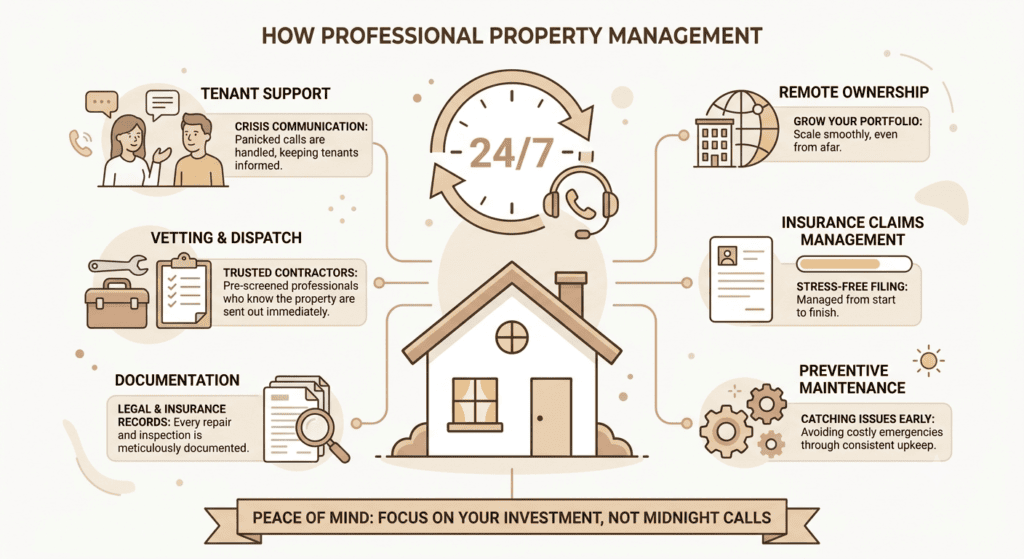
Professional property management supports landlords by:
- Coordinating 24/7 emergency response so no call goes unanswered, regardless of the hour
- Dispatching trusted, vetted contractors who already know the property
- Communicating directly with tenants during a crisis, so landlords aren’t fielding panicked calls themselves
- Documenting every repair, inspection, and communication for legal and insurance purposes
- Managing insurance claims from start to finish
- Scheduling preventive maintenance so small issues get caught before they escalate
- Protecting long-term rental property value through consistent upkeep
- Giving landlords genuine peace of mind, whether they own one property or a growing portfolio
This kind of support is especially valuable for owners of short-term rentals and Airbnb properties, where a maintenance emergency can also mean lost bookings, refund requests, and guest safety concerns on top of the repair itself. A property manager who already has systems in place for emergency maintenance, tenant communication, and vendor coordination removes an enormous amount of risk and stress from property ownership – letting landlords focus on growing their investment instead of fielding midnight phone calls.
Genuine 24/7 property management is difficult to replicate as a solo landlord juggling a day job, a family, and a growing list of tenant requests. It’s one thing to promise round-the-clock availability; it’s another to actually have a team structured to deliver it every single night of the year. As more owners expand their portfolios across the country, professional property management Canada relies on is increasingly the difference between a rental property that runs smoothly and one that quietly drains an owner’s time and patience.
Emergency Maintenance Checklist for Landlords
Think of this emergency repair checklist as the practical companion to everything above – a fast way to gauge how prepared your property really is, and the first document that should live inside any written property maintenance plan you build for your portfolio.
- [ ] Emergency vendor contacts updated and easily accessible
- [ ] Insurance policy reviewed, including deductible and coverage exclusions
- [ ] Tenant emergency instructions shared in writing
- [ ] Maintenance reserve fund established and funded
- [ ] Smoke and CO detectors tested and compliant with current Ontario Fire Code requirements
- [ ] HVAC system inspected within the last six months
- [ ] Plumbing checked for leaks, corrosion, or pressure issues
- [ ] Roof inspected, especially after major storms
- [ ] Electrical systems tested for hazards
- [ ] Annual property inspection completed and documented
If you can’t check every box right now, that’s normal – but it’s also a clear starting point. Work through the list one item at a time, starting with anything related to tenant safety.
Conclusion
Emergencies can’t always be prevented, but they can absolutely be managed well. The landlords who come out ahead aren’t the ones who never face a burst pipe or a failed furnace – they’re the ones who already know exactly who to call, how fast they need to move, and how they’ll pay for it when it happens. Investing in preventive maintenance, building real relationships with reliable contractors, and putting a clear emergency response plan in writing turns a potential disaster into a manageable Tuesday.
If you’d rather not carry that responsibility alone, The HAH Developments offers professional property management with 24/7 emergency maintenance coordination built in. From dispatching trusted contractors to handling tenant communication and insurance claims, our team helps protect your investment and your tenants – so you can enjoy the returns of rental property ownership without the 2 a.m. phone calls.
Whether you own a single condo in Niagara Falls, a growing portfolio of long-term rentals, or a short-term Airbnb you’re trying to scale, the underlying lesson is the same: the landlords who sleep best are the ones who prepared before disaster struck, not the ones scrambling after it did. Reach out to The HAH Developments today to see how stress-free property management can look for you.
Frequently Asked Questions
What counts as an emergency repair for a rental property in Ontario?
An emergency repair is any issue that threatens a tenant’s safety, makes the unit unlivable, or risks serious property damage if not addressed quickly. This includes burst pipes, gas leaks, no heat in winter, electrical hazards, sewage backups, and broken exterior locks.
How fast does a landlord have to respond to an emergency repair?
Ontario landlords are generally expected to address genuine emergencies, such as a total heat loss or a major leak, within 24 to 48 hours. Non-emergency repairs have more flexibility, typically one to four weeks after written notice.
What happens if a landlord doesn’t fix an emergency repair quickly enough?
A tenant can file a T6 maintenance application with the Landlord and Tenant Board. While the process itself can take months to reach a hearing, a documented pattern of slow emergency response weakens a landlord’s position significantly and can result in rent abatements or other penalties.
Are carbon monoxide alarms required in every Ontario rental unit now?
Yes. As of January 1, 2026, Ontario expanded its requirements so that carbon monoxide alarms are now mandatory in every residential unit, not just those with fuel-burning appliances, fireplaces, or attached garages. Landlords should confirm their properties meet the updated standard.
How much should a landlord budget for emergency repairs each year?
A common guideline is setting aside 1% to 4% of the property’s value annually for maintenance and repairs, with a separate emergency fund kept liquid for urgent, unplanned costs.
Should landlords hire a property management company for emergency maintenance?
For landlords who can’t guarantee a fast, hands-on response at any hour, professional property management offers real value – 24/7 coordination, vetted contractors, tenant communication, and documentation that protects both the property and the landlord’s legal standing.