

Buying a property is the easy part. Turning it into a short-term rental that actually pays you back every month, without eating your weekends or landing you a bylaw fine, is where most new investors get stuck.
Niagara Falls draws more than 12 million visitors a year, which makes it one of Ontario’s few markets where investment properties can still legally operate as vacation rentals, and where Airbnb hosting Niagara Falls investors can genuinely build a portfolio around, not just a single side-income unit. But the rules have changed sharply in 2026, the tax structure is new, and the competition is getting sharper. If you’re buying, or already own, a rental property in the region, you need a plan that covers licensing, pricing, guest experience, and day-to-day operations all at once.
This guide walks through everything a property owner needs to know about short-term rental management in 2026: what it actually involves, what it costs, how Niagara Falls rules differ from the rest of the region, and how to decide whether to run it yourself or hand it to a professional team.
Whether you’re evaluating your first purchase or trying to get more consistent returns out of a property you already own, the goal is the same: a system that runs smoothly whether or not you’re the one checking your phone every hour.
What Does Managing a Vacation Rental Actually Involve?
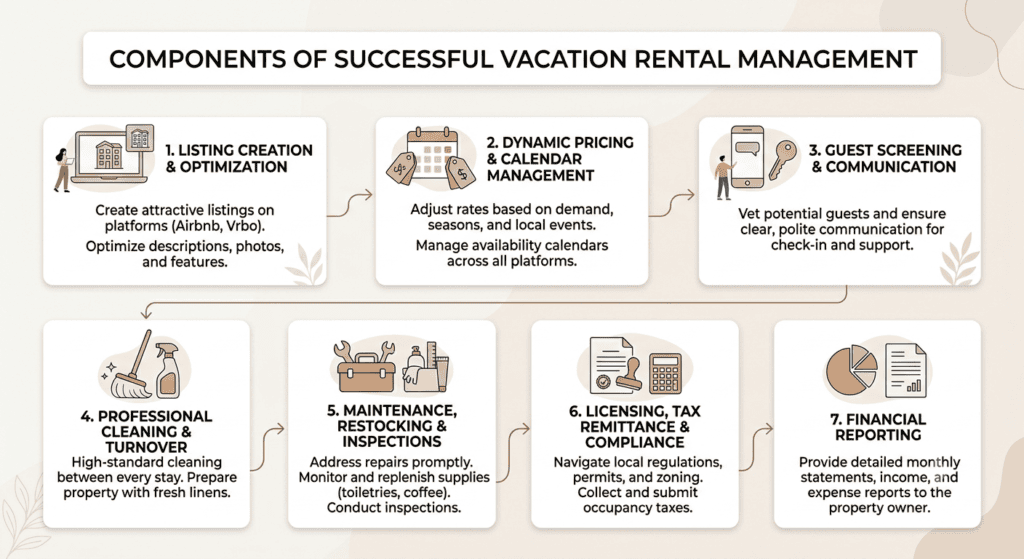
Short-term rental management is the day-to-day work of running a property that’s rented out for stays of 28 days or less, usually through platforms like Airbnb or Vrbo. It covers far more than answering messages and unlocking a door.
A well-run operation typically includes:
- Listing creation and optimization across booking platforms
- Dynamic pricing and calendar management
- Guest screening, check-in, and communication
- Professional cleaning and turnover between stays
- Maintenance, restocking, and property inspections
- Licensing, tax remittance, and regulatory compliance
- Financial reporting for the owner
Done well, this kind of management turns a property into a source of genuinely passive income real estate investors can rely on. Done poorly, it turns into a second job with unpredictable hours and constant small fires to put out.
The distinction matters because short-term rental management isn’t a single task you can knock off a to-do list. It’s an ongoing system, and every piece of that system affects your bottom line, from how fast you respond to a booking inquiry to how quickly your cleaner turns over the unit before the next guest arrives.
Why Niagara Falls Investors Are Betting on Short-Term Rentals in 2026
The Numbers Behind the Opportunity
Niagara Falls currently has roughly 1,100 to 2,000 active short-term rental listings, depending on which data source you check, with a median annual revenue around $39,000 and an average daily rate near $198. Occupancy sits at roughly 52%, which puts Niagara Falls in the top 40% of Canadian markets for short-term rental yield.
That performance compares well against other Ontario cities. Toronto listings average around $13,800 to $19,000 a year, but face far tighter rules: only principal residences can legally operate as short-term rentals there. Ottawa averages about $13,800 annually with 46% occupancy. Across Ontario as a whole, the best-performing towns average 40% occupancy, with Niagara-on-the-Lake posting the highest average monthly revenue in the province at roughly $3,182.
Niagara Falls stands out for a reason beyond tourism volume: it’s one of the few Ontario municipalities where an investment property, not just your primary home, can still be licensed as a short-term rental. That single rule is what makes the market attractive to out-of-town and multi-property investors who’ve been shut out of cities like Toronto and Mississauga.
Industry-wide, the picture is one of steady, not explosive, growth. Airbnb reported record global revenue of $17.1 billion in 2025, up 10% year over year, and analysts expect low double-digit growth to continue through 2026. Major international events, including World Cup matches hosted across Canada, the U.S., and Mexico, are also driving short-term demand spikes that savvy hosts are pricing around well in advance.
Short-Term vs. Long-Term Rentals: Which Wins in 2026?
Long-term rentals in Ontario are having a softer year. The province’s rent increase guideline for 2026 sits at 2.1%, the lowest in four years, and purpose-built rental vacancy rates have been climbing across most major markets as new supply comes online. The CMHC vacancy rate for the St. Catharines–Niagara region has settled around 3.9%, a more-than-decade high, meaning tenants have more choice and landlords have less pricing power than they did a few years ago.
Long-term landlords are also bound by the Residential Tenancies Act, which limits how much and how often rent can rise and sets out a formal process through the Landlord and Tenant Board for any dispute or above-guideline increase. That framework offers stability, but it caps your upside.
Short-term rentals don’t face rent control at all. Pricing adjusts nightly based on demand, and a well-managed unit in a tourist-heavy market like Niagara Falls can out-earn a comparable long-term lease by a wide margin, sometimes double, according to industry estimates. The tradeoff is higher operating involvement, more regulatory paperwork, and revenue that swings with the seasons and with tourism demand. For an investor with the right property and the right management system, that tradeoff is usually worth it.
Understanding Ontario’s Short-Term Rental Rules Before You Buy
Ontario has no province-wide short-term rental law. Every municipality sets its own licensing, zoning, and tax rules, which means a property in Niagara Falls can be subject to completely different requirements than one ten minutes away in Niagara-on-the-Lake or St. Catharines. Before you buy, or before you list an existing property, check the zoning and licensing rules for that specific address. Renovations won’t fix a property that sits in the wrong zone.
Niagara Falls Licensing: Two Paths, One Big Advantage
Niagara Falls regulates short-term rentals under By-law 2021-57, as amended in 2025, and offers two license types:
- Vacation Rental Unit (VRU): Lets you rent out an entire dwelling without living there. This is the license most investors need, and it’s only permitted in Tourist, General, or Commercially designated zones under the city’s zoning bylaws. You can rent up to three bedrooms per property under this license.
- Owner-Occupied Short-Term Rental (OOSTR): A pilot program capped at 100 total licenses, open only to hosts who live at the property at least 183 days a year and hold Canadian permanent residency. The pilot is scheduled to wrap up at the end of September 2026, after which City Council will decide whether to continue it.
The VRU license is what makes Niagara Falls unusual: it’s one of the only cities in the region, and one of the few in Ontario, that allows a non-owner-occupied investment property to legally operate as a short-term rental. Securing a vacation rental license Ontario investors can actually use for an investment property, rather than only a principal home, is a meaningful edge.
Licensing costs $500 for the initial application and $250 for annual renewal. Every listing must display its license number.
The New Accommodation Tax and Other Costs
As of April 1, 2026, Niagara Falls moved from a star-rating-based tax structure to a flat accommodation tax, commonly called the MAT, of 4% on the total room rate, with a scheduled increase to 5% starting April 1, 2027. The tax applies to hotels, motels, bed and breakfasts, VRUs, and OOSTRs alike, and must be disclosed to guests at the time of booking.
Since June 2026, remittance is handled through a new online portal administered by the Ontario Restaurant Hotel & Motel Association on the city’s behalf, rather than submitted directly to the city. Hosts must file a report for every quarter, even if the property had zero bookings.
Zoning, Safety, and Property Standards
Beyond the license itself, Niagara Falls expects hosts to meet a set of ongoing operating standards:
- Posted evacuation plans and fire escape floor plans inside the unit
- A local contact person available for emergencies
- Quiet hours from 9:00 p.m. to 7:00 a.m. on weekdays, and 9:00 p.m. to 9:00 a.m. on weekends
- A parking management plan for guests
- Compliance inspections covering fire code and structural safety
Failing to manage guest parking or noise complaints can trigger administrative penalties of up to $1,000 per day, and the city runs enforcement on a three-strike complaint system that can lead to license suspension.
Rules Change Across the Niagara Region
If your portfolio spans more than one Niagara municipality, treat each one as its own rulebook:
- Niagara-on-the-Lake: Requires a license for any stay of 28 days or less, regardless of platform. NOTL also enforces an eight-year occupancy rule and issues licenses on four-year terms, a structure unlike anything in Niagara Falls.
- St. Catharines: Uses a demerit-point enforcement system and, in most cases, requires the property to be the host’s principal residence for at least 183 days a year, closer to Toronto’s model than to Niagara Falls’ investor-friendly approach.
This patchwork is exactly why so many investors buying across the region choose to work with a local property management company Niagara Falls hosts already trust, one that tracks bylaw changes as they happen instead of relying on outdated blog posts.
Setting Up a Short-Term Rental That Performs
Choosing the Right Property
Location drives everything. Proximity to Clifton Hill, the Falls themselves, wineries, and the casino district consistently commands stronger nightly rates than properties further out. Within Niagara Falls, confirm the property sits inside a Tourist, General, or Commercial zone before you make an offer, since residential zoning will disqualify it from a VRU license entirely.
Bedroom count matters too. The city caps VRU listings at three rentable bedrooms, so a four- or five-bedroom home won’t get full use of its space under current rules, something worth factoring into your purchase price.
Furnishing, Design, and Guest Experience
Guests booking a Niagara Falls stay are usually there for a short, memorable trip, and they’ll pay a premium for a space that feels considered rather than generic. Durable, easy-to-clean furniture, blackout curtains, strong Wi-Fi, and a well-equipped kitchen consistently show up in guest reviews as the difference between a three-star and a five-star stay.
Small upgrades tend to pay for themselves quickly. Listings with a hot tub or pool routinely out-earn comparable properties without one, and professional photography alone can meaningfully lift booking conversion.
Safety and Smart Home Compliance
Smart locks simplify self-check-in and eliminate the cost of re-keying between guests. Noise-monitoring devices, which detect decibel levels without recording audio, help hosts stay ahead of the city’s quiet-hour rules and avoid complaint-driven penalties. Combine these with working smoke and carbon monoxide detectors, a fire extinguisher, and the posted evacuation plan the city requires, and you’ve covered both guest safety and license compliance in one pass.
Insurance and Legal Protection
Standard homeowner or landlord insurance policies almost never cover short-term rental activity, and a claim filed under the wrong policy type can be denied outright. Before you accept your first booking, confirm your policy explicitly covers short-term or vacation rental use, and consider a dedicated short-term rental insurance product that covers guest liability, property damage, and lost income if the unit becomes unrentable.
It’s also worth having a lawyer review your guest agreement and house rules, especially if you’re operating under a sublease-based model or a co-hosting arrangement, so the responsibilities between owner, host, and property manager are spelled out clearly from day one.
Step-by-Step: Launching Your Short-Term Rental
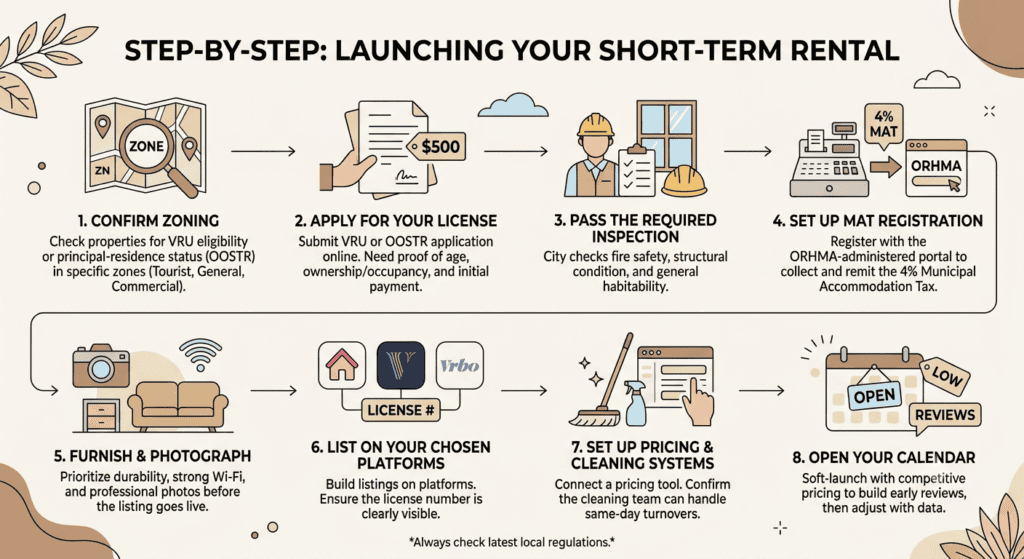
Getting from purchase to your first booking involves more moving pieces than most first-time hosts expect. Here’s the order that keeps you out of trouble:
- Confirm zoning before you commit. Pull the property’s zoning designation and cross-check it against Niagara Falls’ Tourist, General, and Commercial zones for VRU eligibility, or confirm principal-residence status for an OOSTR application.
- Apply for your license. Submit the VRU or OOSTR application online, along with proof of age, ownership or occupancy documentation, and payment of the $500 initial fee.
- Pass the required inspection. The city checks fire safety, structural condition, and general habitability before issuing the license.
- Set up MAT registration. Register with the ORHMA-administered portal so you’re ready to collect and remit the 4% MAT from your first guest onward.
- Furnish and photograph the property. Prioritize durability, strong Wi-Fi, and professional photography before your listing goes live.
- List on your chosen platforms. Build out your Airbnb and Vrbo listings with your license number clearly displayed, as required by bylaw.
- Set up pricing and cleaning systems. Connect a pricing tool and confirm your cleaning team can turn the property same-day when needed.
- Open your calendar. Start with a soft-launch price slightly below market to build early reviews, then let performance data guide your long-term pricing.
Management Strategies That Maximize Revenue
Dynamic Pricing and Revenue Optimization
Flat, set-it-and-forget-it pricing is one of the fastest ways to leave money on the table. Rates should move with demand: higher around Falls fireworks nights, wine festivals, and major sporting events, lower during predictable slow stretches in January and February.
Hosts using dedicated dynamic pricing software report meaningful gains, with some industry estimates putting the revenue lift as high as 10% to 40% compared with static pricing, largely because these tools react to booking pace, competitor rates, and local events faster than a human checking a spreadsheet once a week. For 2026 specifically, operators are being advised to lock in event pricing early, since occupancy around major tournaments and festivals can spike several times above baseline in participating markets.
Professional Cleaning and Turnover Standards
Cleanliness is the single biggest driver of review scores, and review scores drive future bookings. A same-day turnover, especially on a Sunday when back-to-back guests are common, needs a cleaning team that can move fast without cutting corners: fresh linens, restocked essentials, and a documented checklist for every visit.
Guest Communication and Review Management
Fast responses convert more inquiries into bookings, and platforms reward hosts who reply quickly with better search placement. A simple system, whether that’s templated messages, an automated check-in guide, or a dedicated guest communication tool, keeps response times low without requiring you to be glued to your phone.
Balancing Direct Bookings and OTA Channels
Relying on a single platform is risky. More operators are building direct booking capability alongside their Airbnb and Vrbo listings, and it’s paying off: in a recent industry survey, over a third of short-term rental operators reported higher direct bookings than the year before, with those direct reservations averaging notably longer stays and longer booking windows than platform-driven ones. A mix of channels reduces platform-fee costs and builds a base of repeat guests you actually own the relationship with.
A Realistic Revenue Example
Numbers land better with an example. Take a two-bedroom condo near Clifton Hill, licensed as a VRU, priced at the market average daily rate of roughly $198 a night.
At the market’s typical 52% occupancy, that property books around 190 nights a year, generating roughly $37,600 in gross booking revenue, close to the market’s reported median. From there, subtract platform fees (typically 3% to 5%), the 4% MAT, cleaning costs per turnover, utilities, and either your own time or a management fee in the 15% to 30% range.
A disciplined operator using dynamic pricing to capture peak dates around festivals and holidays, rather than charging a flat rate year-round, can often push occupancy and average daily rate high enough to add several thousand dollars in annual revenue without adding a single extra booking. That’s the practical value of active pricing management over a “set it and forget it” approach.
Compare that to a long-term lease on the same unit. At current St. Catharines–Niagara market rents and the 2.1% guideline cap on increases, a comparable two-bedroom would likely bring in $24,000 to $28,000 a year before expenses, with far less flexibility to adjust for demand. The short-term model carries more operational work and regulatory overhead, but for a well-located, well-managed property, the revenue gap is usually significant enough to justify it.
DIY Hosting vs. Hiring a Property Manager
What a Property Management Company Actually Does
A full-service manager typically takes over listing optimization, pricing, guest messaging, cleaning coordination, maintenance calls, license renewals, and MAT remittance, essentially every recurring task on the list above. For an out-of-town investor, or anyone holding more than one property, that hands-off structure is often the only realistic way to scale.
What Professional Management Costs
Commission structures vary, but most full-service short-term rental managers charge somewhere between 15% and 30% of booking revenue, depending on the scope of services and how hands-on the owner wants to stay. It’s worth comparing that fee against the time cost of doing it yourself and against the revenue lift that professional pricing and marketing typically deliver.
Signs It’s Time to Outsource
- You’re missing bookings because messages go unanswered for hours
- Turnover cleaning is inconsistent or unreliable
- You’ve had a compliance issue, missed renewal, or bylaw complaint
- You own or plan to own more than one short-term rental
- You live outside the Niagara region
Alternative Investment Models: Co-Hosting and Leasing to Sublet
Not every investor wants to buy a property outright. Rental arbitrage, where you lease a property long-term and then legally sublet it as a short-term rental with the landlord’s permission, lets you enter the market with a fraction of the capital a purchase would require. It works best in flexible zones and requires a landlord who’s comfortable with the arrangement in writing.
Co-hosting services offer a lighter-touch alternative for property owners who already hold a license but don’t want to manage day-to-day operations themselves. A co-host typically handles guest communication, cleaning coordination, and pricing in exchange for a percentage of revenue, while the owner keeps the license and final say over the property.
Common Mistakes Short-Term Rental Investors Make
- Skipping the zoning check before buying. A beautiful house in a residential zone still can’t get a VRU license in Niagara Falls, no matter how close it sits to the Falls.
- Underpricing out of caution. Discounting too early in the booking window, before demand data comes in, routinely costs hosts revenue they’d have earned by waiting.
- Treating the license as a one-time task. Renewals, MAT filings, and bylaw updates are ongoing obligations, not a box you check once.
- Ignoring the parking and noise rules. These generate more complaint-driven penalties than almost any other issue in tourist-heavy neighborhoods.
- Running every property the same way across municipalities. A compliance approach that works in Niagara Falls won’t automatically satisfy Niagara-on-the-Lake or St. Catharines rules.
- Using homeowner insurance for a short-term rental. Standard policies typically exclude short-term guest activity, which means a damage claim or liability issue could go entirely unpaid at the exact moment you need coverage most.
- Neglecting reviews after a slow month. A string of late responses or missed cleaning standards during a quiet stretch can tank a listing’s ranking for months afterward, even after service quality improves.
Most of these mistakes share a common thread: they come from treating short-term rental management as something you set up once and revisit occasionally, rather than a business that needs ongoing attention to pricing, compliance, and guest experience.
2026 Trends Shaping Short-Term Rental Investing
AI and Automation Are Becoming Standard
Roughly three-quarters of hosts now use some form of property management software, and a majority report using AI tools somewhere in their operations, from automated guest messaging to pricing recommendations that flag demand shifts in real time. The trend isn’t about replacing hosts; it’s about clearing the repetitive work off their plate so pricing and guest experience get more attention.
Event-Driven Demand Is Growing
Major international events are reshaping booking calendars well beyond the host cities themselves. Markets near World Cup venues and other large-scale events have seen bookings jump sharply in the months leading up to them, and analysts expect this pattern to keep showing up around future Niagara Region festivals, concerts, and sporting events too.
The Market Is Getting More Professional
Supply is growing faster than demand in many Canadian markets, which means average occupancy is holding flat or dipping slightly even as travel demand stays healthy. The hosts pulling ahead are the ones treating this as a real business: professional photography, responsive pricing, and consistent guest experience, not the ones hoping tourism alone will carry an average listing.
This shift matters most for booking conversion. It’s no longer enough to simply list a property and wait; the operators winning bookings in 2026 are optimizing titles, descriptions, and photos specifically to improve how often a search turns into a reservation, since that conversion rate, more than any single amenity, now separates the top-performing listings from the average ones.
Fraud Prevention Is a Growing Priority
As short-term rentals attract more attention, so do scams targeting both guests and hosts. Security researchers have flagged a sharp rise in AI-generated fake booking confirmations, manipulated listing photos, and phishing attempts aimed at vacation rental guests. Hosts who verify guest identities, use platform-native messaging instead of off-platform contact, and avoid sharing payment details outside official channels protect both their guests and their own listing reputation.
Let The HAH Developments Handle It
The HAH Developments manages short-term and long-term rental properties across the Niagara Region, from licensing and MAT remittance to dynamic pricing, guest communication, and professional cleaning. If you’re ready to turn your property into dependable income without the day-to-day workload, reach out to The HAH Developments team for a free consultation and see what your property could actually earn.
Final Thoughts
Short-term rental management in Niagara Falls rewards investors who treat it as a real operation, not a side hustle. The market fundamentals are strong: high tourism volume, investor-friendly licensing compared to most of Ontario, and revenue potential that outpaces long-term leasing in the same neighborhoods. But the compliance side, from zoning to the new tax structure, has gotten more detailed, and the operational side, from dynamic pricing to guest experience, has gotten more competitive.
Whether you’re licensing your first Vacation Rental Unit or trying to scale a portfolio across the Niagara Region, the properties that win in 2026 are the ones backed by consistent pricing strategy, spotless turnovers, and someone watching the compliance calendar closely.
Frequently Asked Questions
Is short-term rental management profitable in Niagara Falls? Yes, for most well-located, properly licensed properties. Median revenue sits around $39,000 a year with occupancy near 52%, putting Niagara Falls among the stronger short-term rental markets in Ontario, though returns depend heavily on property location, condition, and how actively the listing is managed.
Can I run an investment property as an Airbnb in Niagara Falls? Yes, with a Vacation Rental Unit license. Niagara Falls is one of the few Ontario municipalities that permits non-owner-occupied investment properties to operate as short-term rentals, unlike Toronto or St. Catharines, which generally require the host to live there.
How much does a short-term rental license cost in Niagara Falls? The VRU and OOSTR licenses both cost $500 for the initial application, with a $250 annual renewal after that.
What is the MAT, and who pays it? The Municipal Accommodation Tax is a tax on short-term accommodation, currently 4% of the total room rate as of April 2026, rising to 5% in 2027. Guests pay it as part of their booking, and hosts are responsible for collecting and remitting it through the city’s designated portal.
Should I manage my short-term rental myself or hire a company? It depends on your time, location, and portfolio size. Self-management works for one nearby property with an owner who has time to handle guest messages and cleaning logistics. Multiple properties, an out-of-town owner, or a history of missed compliance deadlines are all strong signals to bring in professional management.
Do the rules differ if I own property in more than one Niagara municipality? Yes, significantly. Niagara Falls, Niagara-on-the-Lake, and St. Catharines each set their own licensing terms, occupancy requirements, and enforcement systems, so a compliance plan built for one city won’t automatically cover a property in another.