

If you own a short-term rental anywhere near the Falls, in Niagara-on-the-Lake, or across the wider Niagara Region, you already know the market has changed. Licensing rules tightened. The tax structure was rewritten this spring. Guest expectations climbed, and Airbnb’s own algorithm now leans harder on AI than it did even a year ago. Staying profitable isn’t about listing a spare property and waiting for bookings anymore.
That shift is exactly why so many property owners are turning to professional Airbnb management Niagara hosts can actually rely on, instead of trying to keep up with zoning bylaws, tax remittance deadlines, and pricing algorithms on their own. Whether you’re a first-time host with one condo near Clifton Hill or an investor building a small portfolio across the region, this guide walks through everything you need to know in 2026: the rules, the numbers, the services, and the trends shaping what comes next.
What Airbnb Management in Niagara Actually Involves
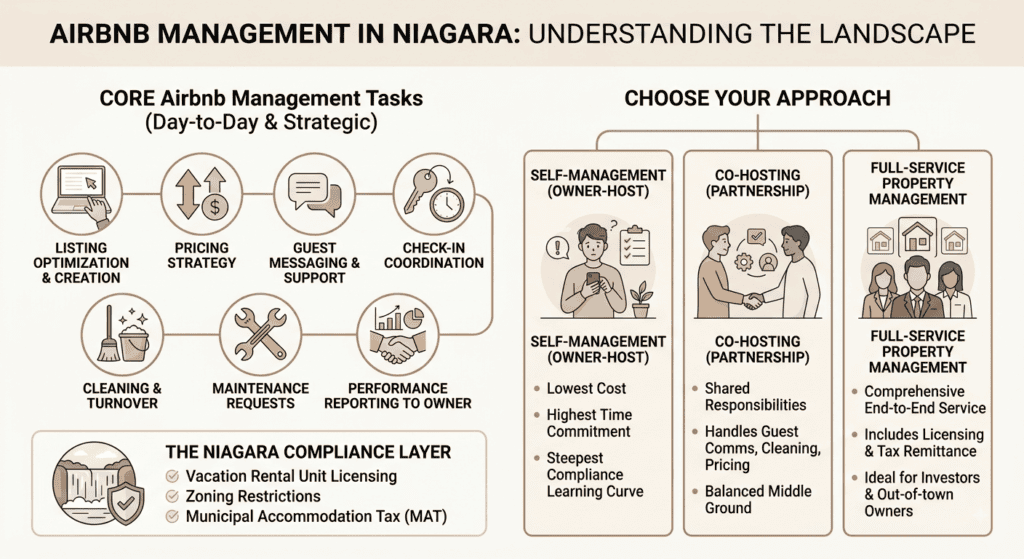
At its core, Airbnb management is the day-to-day and strategic work of running a short-term rental so it stays booked, compliant, and profitable. That covers far more ground than most new hosts expect. A manager typically handles listing creation and optimization, pricing strategy, guest messaging, check-in coordination, cleaning and turnover logistics, maintenance requests, and reporting back to the owner on performance.
In Niagara specifically, management also means tracking a layer of local rules that doesn’t exist in most Canadian cities. Between Vacation Rental Unit licensing, zoning restrictions, and a Municipal Accommodation Tax that just changed structure in April 2026, a host managing their own property needs to wear the hats of hotelier, bookkeeper, and compliance officer all at once. A management company or co-host absorbs that workload.
Full-Service vs Co-Hosting vs Self-Management
Owners generally choose between three approaches:
- Self-management – you handle everything yourself, from pricing to guest texts at midnight. Lowest cost, highest time commitment, and the steepest learning curve for local compliance.
- Co-hosting – a local partner manages guest communication, cleaning coordination, and pricing, while you stay involved in bigger decisions. A popular middle ground for owners who live nearby but don’t want the daily grind.
- Full-service property management – a company runs the listing end-to-end, including licensing paperwork, tax remittance, maintenance, and owner reporting. Best suited to investors, out-of-town owners, or anyone running multiple units.
There’s no universally “correct” model. The right one depends on how many properties you own, how close you live to them, and how much of your time you actually want to spend on hosting instead of collecting the income from it.
Understanding Niagara Falls Short-Term Rental Rules (2026 Update)
Regulation is the single biggest reason self-managed hosts get into trouble, so it’s worth walking through the current framework in detail. Rules vary by municipality across the Niagara Region, but Niagara Falls has the most developed – and most strictly enforced – system.
VRU vs OOSTR Licensing
Any short-term rental in Niagara Falls needs one of two license types. A Vacation Rental Unit (VRU) licence applies to a dedicated short-term rental property, while an Owner Occupied Short-Term Rental (OOSTR) licence covers a secondary unit on a property where the owner also lives. The OOSTR category is currently running as a pilot program capped at 100 licences, scheduled to wrap up at the end of September 2026, after which city council will decide whether to keep it going.
Both licence types carry an initial application fee of $500, plus a $250 annual renewal. Stays are capped at 28 consecutive nights or fewer to qualify as short-term; anything longer falls under Ontario’s standard tenancy rules instead.
Zoning Restrictions
This trips up more new investors than any other rule. VRUs are only permitted in Tourist Commercial, General Commercial, and Central Business zones – not in standard residential neighbourhoods. Before making an offer on a property with short-term rental income in mind, confirm its zoning designation directly with the city. A beautiful house in the wrong zone simply cannot be licensed as a short-term rental, no matter how strong the projected numbers look.
Municipal Accommodation Tax Changes
This is the update every existing host needs to know about. As of April 1, 2026, Niagara Falls moved away from its old flat-fee accommodation tax and now charges a Municipal Accommodation Tax of 4% on the total room rate, applied on top of the standard 13% HST. That rate is scheduled to rise again to 5% on April 1, 2027. The city has also brought in the Ontario Restaurant Hotel & Motel Association to administer collection through a new online portal, and VRU and OOSTR operators remit quarterly rather than monthly. Getting this wrong isn’t a small paperwork slip – late remittances attract an ongoing monthly penalty, and accounts that stay overdue can be escalated to property tax collection.
Penalties for Non-Compliance
Niagara Falls enforces its short-term rental bylaw through a three-strike system: three valid violations or convictions trigger an automatic licence revocation, with a mandatory six-month wait before reapplying. Operating entirely without a licence is treated even more seriously, with fines that can reach $50,000 for a first offence and $100,000 for repeat violations. Inspections from the fire department, Niagara Region Public Health, and an ESA electrical certification are all required before a licence is issued, and the city does conduct unannounced follow-up inspections afterward.
Rules differ once you cross into neighbouring municipalities. Niagara-on-the-Lake runs its own licensing system with a separate accommodation tax that has already moved from 3% to 4%, and enforcement there is known for being just as strict as Niagara Falls, if not more so in residential areas. The town also requires certified floor plans, site and parking maps, an ESA electrical inspection every four years, and liability insurance that names the town as an additional insured – a noticeably more document-heavy process than a standard VRU application in Niagara Falls. St. Catharines is still building out a formal licensing framework and currently leans on its own accommodation tax alongside general restrictions on non-owner-occupied rentals in residential zones. Smaller municipalities across the region, including Welland, Fort Erie, and Grimsby, each maintain their own separate rules as well, so a bylaw that applies in one town cannot be assumed to carry over into the next.
If you’re investing across more than one Niagara municipality, treat each bylaw as its own separate compliance project – assuming rules carry over from one town to the next is one of the fastest ways to end up with a fine. This is also one of the clearest arguments for working with a manager who already operates across multiple Niagara municipalities, since they’ve typically built out the licensing checklist for each one already rather than learning it for the first time on your property.
How Niagara’s Airbnb Market Performs in 2026
Regulation only matters if the underlying market makes hosting worthwhile – and in Niagara, it generally still does, even with rising competition.
Occupancy Rates and ADR
Across the wider Niagara Region, a typical short-term rental books around 200 nights a year, translating to a median occupancy rate in the mid-50% range and an average daily rate hovering near $150 to $170. Within Niagara Falls itself, market trackers put median occupancy closer to 50%, with average annual host revenue landing around $30,000 to $39,000 depending on the data source and time period measured. Performance spreads out considerably by property tier: entry-level listings often earn under $100 a night, while top-performing properties in the market command well over $200, and the strongest 10% of listings push past $300 a night.
That spread is the clearest argument for professional management. The gap between an average listing and a top-tier one usually comes down to photography, pricing strategy, amenities, and responsiveness – all things a dedicated manager actively works on rather than sets once and forgets.
Seasonal Demand Patterns
Niagara’s short-term rental market is heavily seasonal. Demand and average daily rates climb through the spring, peak around July and August, and drop off noticeably in the winter months, with February typically marking the slowest stretch of the year. Hosts who rely on static, year-round pricing tend to leave money on the table during peak season and sit with costly vacancies in the off-season. This seasonality is a major reason dynamic pricing has become close to mandatory for anyone serious about maximizing income.
Niagara Falls vs Niagara-on-the-Lake vs St. Catharines
Niagara Falls draws the highest volume of tourist traffic thanks to the falls themselves, which supports strong occupancy but also means more listings competing for the same guests. Niagara-on-the-Lake trades on wine country charm and a quieter, more upscale guest base, with correspondingly strong performance for well-presented properties, though the town enforces its bylaw tightly. St. Catharines sits somewhere in between – less tourist saturation, a growing licensing framework, and opportunities for hosts willing to target a slightly different guest profile than the classic Falls tourist.
Why Professional Airbnb Management Niagara Hosts Trust Pays Off
Given the regulatory complexity and seasonal swings above, it’s worth being direct about what a professional manager actually changes for an owner’s bottom line and daily life.
Time Savings
A well-performing short-term rental generates a constant stream of small, time-sensitive tasks: guest questions, check-in coordination, same-day cleaning turnovers, and maintenance requests that can’t wait until the weekend. For an owner working a full-time job or managing more than one property, that workload adds up to a second part-time job. Handing it off frees up real hours every week.
Revenue Optimization
Professional managers actively adjust pricing rather than letting a listing run on autopilot. Industry estimates from platforms like PriceLabs and Beyond Pricing suggest dynamic, actively managed pricing can generate meaningfully more revenue than flat-rate approaches over a full year – particularly in a seasonal market like Niagara, where the difference between a July rate and a February rate should never be small.
Compliance Protection
Licensing renewals, MAT remittance deadlines, zoning verification, and inspection scheduling are all easy to lose track of when you’re also handling guest turnover and day-to-day maintenance. A management company builds compliance into its standard operating process, which matters enormously given how steep Niagara Falls’ penalties for lapses have become.
Guest Experience & Reviews
Response time, cleanliness consistency, and how quickly issues get resolved during a stay all feed directly into guest reviews – and reviews increasingly drive how visible a listing is inside Airbnb’s own search and AI-powered recommendation tools. A manager with dedicated staff and standardized cleaning checklists tends to produce more consistent five-star outcomes than an owner juggling hosting around a day job.
Core Services Offered by Airbnb Management Companies
Not every management company offers the same scope of service, so it helps to know what a genuinely full-service provider should cover.
Listing Optimization & Photography
Professional photography, keyword-rich descriptions, and accurate amenity tagging all influence how a listing ranks in Airbnb search. As the platform leans further into AI-driven search and side-by-side property comparisons, structured, accurate data in a listing matters as much as compelling writing – the algorithm reads amenity fields and photo content, not just prose.
Dynamic Pricing
Rather than setting one nightly rate and hoping for the best, managers use dynamic pricing tools that adjust rates based on demand, local events, seasonality, and competitor activity in real time. This is one of the clearest, most measurable ways professional management pays for itself.
Guest Communication & Screening
From pre-booking questions through checkout, fast and professional communication reduces cancellations, prevents disputes, and protects a property from problem guests. Many managers now use AI-assisted messaging tools to handle routine questions instantly while still escalating anything unusual to a human.
Cleaning & Turnover
Same-day turnovers are one of the most operationally demanding parts of short-term rental hosting, especially during peak summer weekends when back-to-back bookings leave only a few hours between guests. A management company typically maintains a dedicated cleaning team and standardized checklists rather than relying on ad hoc contractors.
Maintenance Coordination
Burst pipes, broken appliances, and HVAC issues don’t wait for a convenient time. Professional managers keep a network of trusted local contractors on call, which matters enormously for owners who don’t live near their investment property.
2026 Trends Shaping Airbnb Hosting in Niagara
The short-term rental industry is moving quickly, and a few 2026-specific shifts are worth building into any hosting strategy right now.
AI-Powered Pricing and Listing Optimization
Airbnb’s search experience is increasingly AI-driven, including natural-language search and side-by-side comparisons that highlight specific property attributes to guests. That makes accurate, detailed listing data more important than ever – vague descriptions and thin amenity lists put a property at a real disadvantage against competitors with fully optimized listings.
Dynamic Cancellation Policies
Hosts are increasingly pairing stricter cancellation terms with peak-demand dates while staying flexible during slower periods, a strategy aimed at protecting revenue without sacrificing bookings during quieter stretches of the calendar.
Direct Booking Growth
As platform fees and competition rise, more established hosts and management companies are investing in direct booking channels alongside Airbnb, reducing reliance on any single platform’s algorithm and fee structure.
Self-Managing vs Hiring a Manager: What It Actually Costs
It’s worth being honest about the real trade-off, since “save on management fees” only tells half the story. A typical management fee in Niagara runs 15% to 30% of booking revenue. On a property earning $30,000 a year, that’s roughly $4,500 to $9,000 annually – a real cost that shouldn’t be dismissed.
But self-management has costs too, they’re just less visible on a spreadsheet. Time spent on guest messaging, cleaning coordination, and after-hours emergency calls is real time that could go toward a day job, a second property, or simply not being on call every weekend of the summer. Add in the revenue typically left on the table from static rather than dynamic pricing, the risk of a compliance fine from a missed renewal or a misunderstood zoning rule, and the reputational cost of a slow guest response dragging down a listing’s review score, and the gap between the management fee and the true cost of self-managing often narrows considerably – or disappears entirely for owners who don’t live near their property.
The right way to evaluate this isn’t “can I do this myself,” since almost any owner technically can. It’s “will professional management generate enough additional revenue and avoided risk to outweigh the fee” – and for most owners managing a property they don’t live next to, or juggling more than one listing, the answer tends to be yes.
How to Choose the Right Airbnb Property Manager in Niagara
Not all management companies deliver the same value, so it’s worth vetting carefully before signing a contract.
Questions to Ask
- How many properties do you currently manage in this specific municipality?
- Do you handle VRU or OOSTR licence applications and renewals directly?
- What pricing approach or software do you use to adjust rates?
- How do you handle maintenance emergencies outside business hours?
- Can I see sample owner reports and current occupancy data?
Red Flags to Avoid
Be cautious of any manager who can’t clearly explain local zoning and MAT obligations, who won’t share references from current owners, or whose contract locks you in for an unusually long term with no performance benchmarks. A manager confident in their results should be comfortable being measured against them.
Fee Structures Explained
Most Niagara-area management companies charge a percentage of booking revenue, typically somewhere between 15% and 30% depending on the scope of service included. Full-service packages that include cleaning coordination, guest communication, and compliance handling generally sit at the higher end of that range, while lighter co-hosting arrangements sit lower. Always confirm whether cleaning fees, supplies, and maintenance costs are included in the management fee or billed separately.
Maximizing ROI on Your Niagara Short-Term Rental
Strong management amplifies a property’s potential – but the underlying asset and setup still matter enormously to overall vacation rental ROI.
Property Selection
Proximity to major attractions, walkability, and parking availability all influence booking demand. Properties within easy reach of the falls, wineries, or the historic Niagara-on-the-Lake core tend to command stronger rates than comparable properties farther out, though they also face steeper competition.
Amenities That Boost Bookings
Hot tubs, dedicated workspaces, fast Wi-Fi, and well-equipped kitchens consistently correlate with higher booking rates and stronger reviews in vacation rental markets. Smaller touches – quality linens, blackout curtains, and clear self-check-in instructions – reduce guest friction and support better ratings, which in turn feed the platform’s visibility algorithm.
Balancing Short-Term and Long-Term Rental Strategy
Given Niagara’s strong seasonality, some investors run a hybrid strategy: short-term rental pricing through the peak summer season, shifting to a longer-term tenant or extended-stay guest during the slower winter months. This can smooth out cash flow considerably compared to chasing short-term bookings through a slow February.
Insurance and Risk Management for Niagara Short-Term Rentals
Standard homeowner’s insurance almost never covers short-term rental activity, and this is one of the most overlooked compliance gaps among new hosts. Niagara Falls requires commercial insurance with a minimum of $2 million in liability coverage as part of the VRU application, and skipping this step – or assuming a personal policy is enough – leaves an owner exposed to catastrophic financial risk if a guest is injured or a property is damaged.
Beyond the licensing requirement, it’s worth budgeting for a policy that specifically covers short-term rental use, including loss of income during repairs, guest liability, and damage caused by paying guests rather than long-term tenants. Some management companies negotiate group insurance rates across their portfolio, which can meaningfully reduce this cost for individual owners compared to shopping for a policy independently. It’s also worth asking a prospective manager whether they carry their own liability coverage for the services they perform on your property, separate from your own policy.
Security deposits and damage protection are a related piece of the puzzle. Airbnb’s built-in AirCover offers some protection, but many experienced hosts and managers layer on third-party damage protection or require a refundable security deposit for higher-value properties, particularly ones with pools, hot tubs, or premium furnishings that are expensive to replace.
Getting Started: How to Prepare Your Property for Professional Management
If you’re moving from self-management to a professional service – or listing a property for the first time – a bit of preparation up front makes the transition smoother and speeds up how quickly a manager can get your listing performing well.
Confirm zoning and licensing eligibility first. Before investing in furnishings or photography, verify with the city that your property’s zoning actually permits a VRU or OOSTR licence. This single step prevents the most expensive mistake a new investor can make.
Gather your documentation. Proof of ownership, insurance details, floor plans, and any existing inspection records speed up the licensing process considerably when a management company takes over.
Invest in guest-ready furnishing before launch. Properties that start strong with quality furnishings, reliable Wi-Fi, and thoughtful amenities tend to earn better early reviews, which then compound into stronger search visibility over the following months.
Set realistic income expectations. Ask any prospective manager for a data-backed revenue projection based on comparable properties in your specific neighbourhood and zone, rather than city-wide averages, since performance can vary significantly block by block, especially near high-traffic tourist corridors versus quieter side streets.
Plan for the off-season from day one. Given how sharply demand drops in Niagara’s winter months, build a slower-season plan into your budget from the start – whether that’s a hybrid short-term and extended-stay strategy, a seasonal maintenance schedule, or simply a realistic cash flow forecast that doesn’t assume July-level bookings year-round.
Common Mistakes Airbnb Hosts Make in Niagara
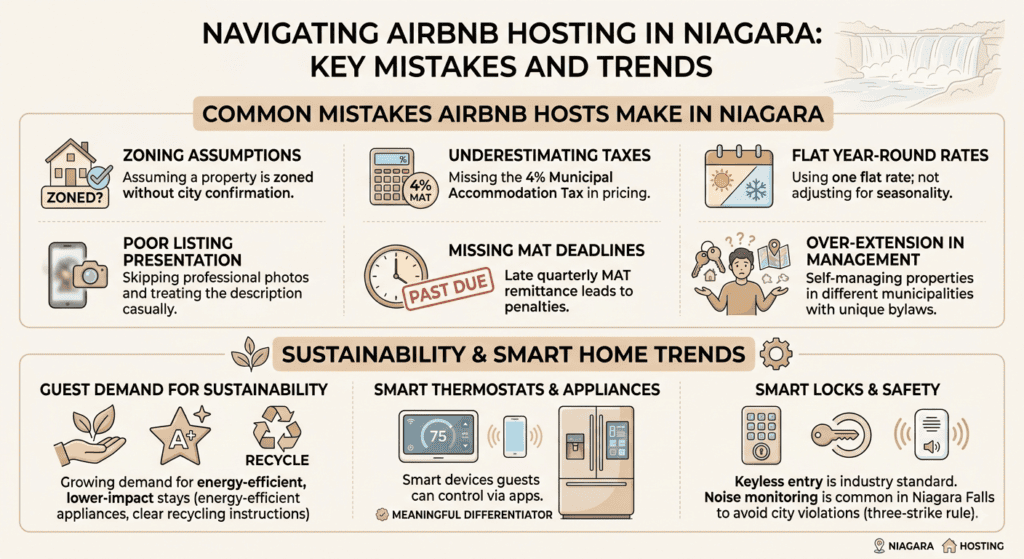
- Assuming a property is zoned for short-term rental without confirming with the city first
- Underestimating the new 4% Municipal Accommodation Tax when building a pricing model
- Setting one flat nightly rate year-round instead of adjusting for Niagara’s strong seasonality
- Skipping professional photography and treating the listing description as an afterthought
- Missing quarterly MAT remittance deadlines and accumulating avoidable penalties
- Trying to self-manage multiple properties across different municipalities with different bylaws
Sustainability and Smart Home Trends Worth Watching
A smaller but growing trend among Niagara hosts is guest demand for energy-efficient and lower-impact stays – smart thermostats that guests can control from an app, energy-efficient appliances, and clear recycling instructions all show up increasingly often in guest reviews and pre-booking questions. None of this replaces the fundamentals of location, price, and cleanliness, but it’s becoming a meaningful differentiator in a crowded market, particularly among younger travellers and international guests who make up a notable share of Niagara’s visitor base.
Smart locks and keyless entry have moved from a nice-to-have to close to an industry standard, both for guest convenience and for the operational efficiency they give a management team handling same-day turnovers across a portfolio. Noise monitoring devices, which detect elevated decibel levels without recording audio, have also become common in Niagara Falls specifically, given how seriously the city treats noise and nuisance complaints under its three-strike enforcement system. For a host trying to avoid a licence violation, a $150 noise sensor is a small price against the risk of a costly strike on your record.
Conclusion
Niagara’s short-term rental market still offers real opportunity in 2026, but the margin for error has shrunk. Between updated zoning enforcement, the new 4% Municipal Accommodation Tax, and an Airbnb algorithm that increasingly rewards data-rich, well-optimized listings, running a profitable, compliant property has become a genuine operational discipline rather than a side project.
That’s exactly the gap The HAH Developments was built to close. From VRU and OOSTR licensing support to dynamic pricing, guest communication, and full property care across the Niagara Region, our team handles the details so your rental income doesn’t depend on you having spare time every week. If you’re ready to turn your Niagara property into a stress-free, professionally managed investment, reach out to The HAH Developments today for a free consultation.
Frequently Asked Questions
Is Airbnb hosting still profitable in Niagara Falls in 2026? Yes, though margins are tighter than a few years ago. With median occupancy in the 50% range and average daily rates well above $150 for well-positioned properties, hosting remains profitable – but the gap between average and top-performing listings has widened, which is exactly where professional management makes the biggest difference.
How long does it take to get a VRU or OOSTR licence approved? Timelines vary depending on inspection scheduling, but owners should generally budget several weeks from application to approval once fire, health, and electrical inspections are booked. Applying well ahead of your intended launch date, rather than immediately before a peak-season booking, gives enough buffer for any paperwork issues to get sorted out without losing early revenue.
Do I need a licence to run a short-term rental in Niagara Falls? Yes. Every short-term rental in the city needs either a VRU or OOSTR licence, with a $500 initial fee and $250 annual renewal, and operating without one risks fines that can reach tens of thousands of dollars.
How much is the Municipal Accommodation Tax in Niagara Falls right now? As of April 1, 2026, it’s 4% of the total room rate, charged on top of HST, and it’s scheduled to increase to 5% on April 1, 2027.
What’s the difference between Airbnb co-hosting and full property management? Co-hosting typically covers guest communication and pricing support while the owner stays involved in bigger decisions, whereas full property management handles everything end-to-end, including licensing, compliance, and maintenance, with minimal owner involvement day to day.
Can I run a short-term rental anywhere in Niagara Falls, or only certain areas? Only in properties zoned Tourist Commercial, General Commercial, or Central Business. Standard residential zones are not eligible for a standard VRU licence, so zoning needs to be confirmed before purchasing or listing a property.
How do management fees typically work in the Niagara market? Most companies charge a percentage of booking revenue, generally in the 15% to 30% range, with the exact figure depending on how much of the workload – cleaning, compliance, guest communication – is included in the service.