
If you own a short-term rental anywhere near the Falls, you’ve probably had this exact 2 a.m. moment: a guest can’t figure out the lockbox, the cleaner cancelled last-minute before a same-day turnover, and your phone won’t stop buzzing. This is the moment most Niagara hosts start typing “Airbnb co-host Niagara” into Google.
Co-hosting has quietly become one of the fastest-growing corners of the short-term rental industry, and Niagara Falls is a particularly interesting place to watch it happen. The region pulls in roughly 14 million visitors a year, hosting rules have tightened considerably over the past twelve months, and Airbnb itself just finished overhauling how it charges hosts. Put those three things together and you get a market where the right co-host doesn’t just save you time – they can be the difference between a licensed, profitable rental and a costly compliance headache.
This guide walks through exactly what an Airbnb co-host does, what they cost in 2026, how Niagara Falls’ short-term rental bylaws affect the partnership, and how to decide whether hiring one makes sense for your property. Whether you’re a first-time host with one condo near Clifton Hill or an investor building a small portfolio across the Niagara Region, you’ll leave with a clear picture of how co-hosting actually works here.
What Does an Airbnb Co-Host Actually Do?
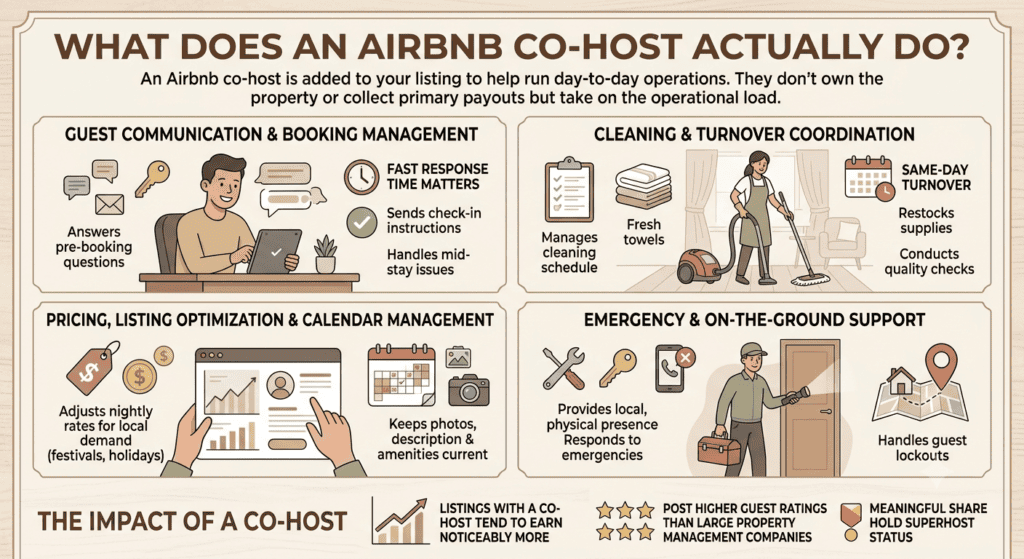
An Airbnb co-host is someone you add to your listing through Airbnb’s official co-hosting feature to help run the day-to-day operations of your rental. They don’t own the property and they don’t collect the payouts directly – those still flow to you – but they take on the operational load that otherwise eats up your evenings and weekends.
Airbnb’s own co-host program data is worth paying attention to here: listings managed with a co-host tend to earn noticeably more than similar listings without one, and co-hosts as a group post guest ratings that edge out large property management companies. A meaningful share of active co-hosts also hold Superhost status, which tells you something about the caliber of people doing this work professionally rather than as a side favor for a friend.
In practice, the job breaks down into four core areas.
Guest Communication and Booking Management
This is the piece most owners hand off first. A co-host answers pre-booking questions, sends check-in instructions, handles the inevitable “is parking included” messages, and deals with anything that goes wrong mid-stay – a broken air conditioner, a noisy neighbour complaint, a guest who locked themselves out at midnight. Response time matters enormously to Airbnb’s algorithm, so having someone dedicated to the inbox protects both your ranking and your reviews.
Cleaning and Turnover Coordination
Niagara’s tourist season creates brutal same-day turnover pressure, especially on summer weekends when back-to-back bookings are common. A good co-host manages the cleaning schedule, handles last-minute cleaner cancellations, restocks supplies, and does quality checks so you’re not the one driving over to fix a missed bathroom before a 4 p.m. check-in.
Pricing, Listing Optimization, and Calendar Management
Co-hosts who know the local market adjust nightly rates around festivals, holidays, and seasonal demand swings – something that matters a lot in a destination as event-driven as Niagara Falls. They also keep your listing photos, description, and amenities current, which directly affects how often you show up in search results.
Emergency and On-the-Ground Support
If you don’t live near your property, this is often the single biggest reason to bring on a co-host. Someone local can physically go to the unit for a maintenance emergency, a lockout, or a fire alarm issue – something you simply can’t do from three provinces or two countries away.
Why Niagara Falls Is a Unique Market for Co-Hosting
Not every short-term rental market behaves the same way, and Niagara’s combination of tourism volume, seasonality, and evolving bylaws makes local knowledge genuinely valuable.
Tourism Numbers That Matter to Hosts
The Niagara Region welcomes close to 14 million visitors annually, with the city of Niagara Falls itself accounting for roughly 12 million of those trips. Tourism spending across the region runs above $2 billion a year, and the sector directly supports around 40,000 local jobs. That’s an enormous, steady stream of potential guests – but it also means competition among listings is real, and standing out requires active management rather than a “set it and forget it” approach.
There’s a wrinkle worth knowing about heading into the back half of 2026: cross-border travel patterns have shifted noticeably, with Canadian visits into the US side down sharply and international arrivals from Europe and Asia picking up some of the slack on the Ontario side. A co-host who’s watching these trends can help you adjust pricing and marketing rather than getting caught off guard by a slower month.
Seasonal Demand Swings You Need a Plan For
Niagara Falls has genuine peak and shoulder seasons. Summer (roughly July through September) and the run-up to major festivals like the Winter Festival of Lights draw the heaviest demand, while January through March is noticeably quieter. Managing occupancy and rate strategy across that swing is exactly the kind of ongoing work that benefits from a dedicated co-host rather than a one-time listing setup.
Average nightly rates in the city tend to sit somewhere between $175 and $275 depending on property size and location, with premium units pushing past $500 a night during peak weekends and major events like the Grape and Wine Festival or New Year’s Eve. A co-host who tracks these swings closely can adjust your calendar week to week instead of leaving a flat rate in place year-round, which is one of the simplest ways to lift annual revenue without changing anything about the property itself.
How Niagara Falls Compares to Niagara-on-the-Lake and St. Catharines
Owners researching co-hosting often assume every municipality in the region plays by the same rules, and that assumption can get expensive. Niagara-on-the-Lake runs its own licensing system with an annual renewal fee and its own enforcement priorities, and the town is known for taking bylaw compliance seriously. St. Catharines is still moving toward a formal licensing framework and currently limits non-owner-occupied short-term rentals in residential zones. Smaller municipalities nearby, including Welland, Fort Erie, and Grimsby, each maintain their own separate rules. A co-host or property manager who only understands Niagara Falls’ bylaw isn’t automatically qualified to manage a listing twenty minutes away in NOTL, so if you own property in more than one municipality, confirm your co-host actually has experience with each specific jurisdiction.
How Much Does an Airbnb Co-Host Cost in Niagara?
This is usually the first question owners ask, and the honest answer is: it depends on scope, but there are clear industry benchmarks to work from.
Percentage-Based Fees
Most co-hosts charge a percentage of gross booking revenue rather than a flat rate, and industry-wide that typically lands between 10% and 30%, with 15% to 20% being the most common range for full-service arrangements that include guest messaging, cleaning coordination, and pricing management. Lighter-touch arrangements – say, just guest communication with no on-site duties – tend to sit toward the lower end of that range, while hands-on, everything-included packages with in-person check-ins push toward 25% or higher.
Before you agree to a number, get absolute clarity on one thing: is the percentage calculated on gross booking revenue, or on your payout after Airbnb’s own fee comes out? On a property doing $70,000 a year, that distinction alone can be worth well over a couple thousand dollars, so it needs to be written into your agreement in plain language.
Flat-Fee and Hybrid Models
Some co-hosts, particularly newer AI-assisted services, charge a flat monthly fee instead of a percentage. This gives you predictable costs regardless of how many bookings come in, which can be appealing for owners who want to budget precisely. Hybrid models – a lower base percentage plus a flat fee for specific tasks like in-person turnovers – are also becoming more common.
Co-Host vs. Full-Service Property Manager
It’s worth understanding the difference, because the terms get used loosely. A co-host operates inside your own Airbnb account: you keep ownership of the listing, the reviews, and the payout history. A full-service property manager, by contrast, often runs the listing under their own business account and charges considerably more – typically 20% to 28% of gross revenue, sometimes higher, and often with additional markups on cleaning or maintenance. For an owner who wants to retain control of their listing’s reputation and data, a co-host arrangement is usually the more cost-effective and flexible path.
The New Airbnb Host Fee Structure and What It Means for You
Airbnb has spent the past year moving hosts off the old split-fee model – where hosts paid roughly 3% and guests paid a separate 14% to 16% service fee – onto a single host-only fee of 15.5% deducted directly from your payout before you see a dollar. Most professionally managed and software-connected listings had already made this switch earlier in the year, and the remaining independent hosts are being migrated in waves through September and October 2026.
Why does this matter for co-hosting specifically? Because your co-host’s percentage and Airbnb’s 15.5% cut are both usually calculated on the same booking subtotal, and they stack. If you don’t adjust your nightly rate to account for the higher Airbnb fee, your effective take-home shrinks even though your co-host’s cut stays the same. This is exactly the kind of detail an experienced local co-host or property manager should be actively managing on your behalf, rather than leaving you to discover it in a smaller-than-expected payout.
Common Mistakes Owners Make When Hiring a Co-Host
Even well-intentioned owners run into the same handful of problems when they bring on help for the first time. Recognizing these early can save you months of frustration.
Hiring based on price alone. The cheapest quote often means the least coverage. A co-host charging well below the typical 10% to 25% range is usually cutting corners somewhere – slower response times, no on-site presence, or minimal pricing management.
Skipping the written agreement. A verbal understanding with a friend or family member feels low-risk at first, but disputes over fees, responsibilities, or account access become far harder to resolve without something in writing to point back to.
Not clarifying who pays for what. Cleaning supplies, guest amenities, minor repairs, and software subscriptions all need an owner. If your agreement doesn’t specify this up front, you’ll find out the hard way when an invoice shows up you weren’t expecting.
Assuming licensing is the co-host’s problem. As covered above, the legal responsibility for holding a valid VRU licence or OOSTR licence sits with the property owner, not the co-host. Owners who assume otherwise sometimes discover the gap only after a bylaw officer shows up.
Underestimating the value of local knowledge. A co-host based outside the region, even a highly rated one elsewhere, won’t know Niagara Falls’ zoning map, MAT structure, or seasonal event calendar the way a local operator will. That knowledge gap shows up in missed pricing opportunities and, occasionally, in compliance mistakes.
Tools and Technology That Make Co-Hosting Easier
Whether you’re managing solo or working alongside a co-host, a handful of technology categories consistently improve how smoothly a Niagara short-term rental runs.
Channel and calendar management software syncs your listing across Airbnb, Vrbo, and Booking.com so you never risk a double booking. This matters more in Niagara than in many markets, since serious hosts frequently list across multiple platforms to capture both leisure travellers and the region’s steady wedding and conference traffic.
Dynamic pricing tools adjust your nightly rate automatically based on demand signals like local events, day of week, and booking lead time – useful given how sharply Niagara Falls swings between a quiet Tuesday in February and a sold-out weekend during the Winter Festival of Lights.
Guest verification and messaging platforms help confirm guest identity before check-in and keep every conversation in one place, which speeds up response time and reduces the odds of a policy violation slipping through unnoticed.
Compliance tracking spreadsheets or software keep licence renewal dates, insurance expiry, and MAT filing deadlines visible in one place – a small habit that prevents the kind of paperwork lapse that leads to fines.
None of these tools replace a co-host’s judgment, but in combination with a knowledgeable local operator, they meaningfully cut down the day-to-day workload.
Niagara Falls Short-Term Rental Rules Every Co-Host Must Know
This is where local expertise stops being a nice-to-have and becomes essential. Niagara Falls has one of the more structured short-term rental licensing systems in the region, and getting it wrong is expensive.
VRU Licensing Requirements
Any whole-property short-term rental of 28 consecutive days or less in Niagara Falls needs a Vacation Rental Unit (VRU) licence. These are only permitted in specific commercial zones – Tourist Commercial, General Commercial, and Central Business – not in typical residential neighbourhoods. The initial licensing fee is $500, with a $250 annual renewal, and operators need to submit proof of property ownership, a detailed site plan showing on-site parking, fire safety confirmation, and proof of at least $2 million in commercial liability insurance. Operating without a valid licence carries serious financial risk, with fines that can run into the tens of thousands of dollars for repeat or first-time violations.
Owner-Occupied Short-Term Rental Pilot Program
If you live on the property yourself, there’s a separate path. The city launched a 14-month Owner Occupied Short-Term Rental (OOSTR) pilot running from August 2025 through September 2026, capped at 100 licences citywide. This lets homeowners rent out a secondary dwelling unit on their property while remaining on-site, similar in spirit to a bed and breakfast arrangement. Council will decide after the pilot ends whether to make the program permanent, so anyone considering this route should watch for updates closely.
Municipal Accommodation Tax and HST
Niagara Falls applies a Municipal Accommodation Tax (MAT) to every short-term stay, and the structure has changed more than once recently – moving from a flat per-night charge toward a percentage-based model tied to the total room rate. On top of MAT, HST applies once your rental income crosses the federal registration threshold. Airbnb typically collects and remits these automatically on bookings made through the platform, but hosts remain legally responsible for accurate reporting, and rates should always be confirmed directly with the city before you build out your pricing.
Insurance, Fire Code, and Safety Requirements
As of January 1, 2026, Ontario’s Fire Code requires carbon monoxide alarms in every home used as a short-term rental, installed near sleeping areas and on every floor – not just floors with bedrooms. Combine that with the existing smoke detector, fire extinguisher, and clear-evacuation-plan requirements, and it’s easy to see why so many hosts lean on a co-host or property manager to keep a running compliance checklist rather than trying to track every update themselves.
How to Find and Hire the Right Airbnb Co-Host in Niagara
Once you’ve decided co-hosting makes sense, the search itself deserves real diligence – this person will represent your brand to every guest who walks through your door.
Questions to Ask Before You Sign
Before agreeing to any arrangement, ask exactly which of the core responsibilities – guest messaging, turnovers, pricing, and maintenance – are covered under the fee, and which are billed separately. Ask about guaranteed response times, who holds the platform login credentials, whether they’re familiar with Niagara Falls’ VRU licensing process specifically, and what the exit process looks like if the partnership doesn’t work out. A co-host who can speak fluently about local bylaws, MAT remittance, and seasonal pricing strategy is showing you real market knowledge, not just general hosting experience.
Red Flags to Watch For
Be cautious of anyone unwilling to put fee structure and responsibilities in writing, anyone who won’t explain whether their percentage is based on gross revenue or net payout, and anyone who can’t speak to Niagara Falls’ specific zoning and licensing requirements. A written co-host agreement covering fees, responsibilities, account access, and termination terms should be non-negotiable.
DIY Co-Hosting vs. Hiring a Professional: Which Is Right for You?
If you own a single property, live nearby, and genuinely enjoy the hands-on side of hosting, managing it yourself can work well, especially with the help of scheduling and messaging tools to reduce the manual workload. Where owners typically hit a wall is scale (managing more than one or two units solo becomes unsustainable fast), distance (you don’t live near the property), or simply time – a full-time job and a rental that demands same-day responses don’t mix well long term.
A professional co-host or property manager earns their fee back through fewer missed messages, faster turnovers, better review scores, and – critically in a market like Niagara Falls – confidence that your licensing and tax obligations are actually being handled correctly.
Signs It’s Time to Bring on Help
A few patterns tend to show up right before owners decide to hire a co-host: guest messages are going unanswered for hours instead of minutes, cleaning turnovers are becoming a source of stress rather than routine, occupancy has plateaued because pricing hasn’t been touched in months, or the owner has simply stopped enjoying a role that used to feel manageable. None of these are signs of failure – they’re normal growing pains for a rental that’s succeeding enough to need more structure around it.
Making the Transition Smoothly
If you decide to move from self-managing to working with a co-host, plan for a short overlap period rather than handing everything off overnight. Walk your co-host through your property in person, introduce them to your cleaning team and any maintenance contacts, and stay closely involved in guest communication for the first few bookings so you can see how they handle real situations before stepping back fully. Most successful partnerships settle into a rhythm within the first one to two months.
How The HAH Developments Approaches Airbnb Co-Hosting in Niagara
At The HAH Developments, Airbnb co-hosting in Niagara is built around one idea: your listing should perform like a professionally run hospitality business, not a side project you’re managing between everything else in your life. Our team handles guest communication around the clock, coordinates cleaning and turnovers across the Niagara Region’s tightest peak-season windows, and keeps pricing responsive to festivals, holidays, and shifting tourism patterns.
Just as importantly, we stay directly on top of Niagara Falls’ VRU licensing requirements, the OOSTR pilot program, MAT remittance, and Ontario’s evolving fire code rules – so property owners aren’t left trying to interpret bylaw updates on their own. For owners who’d rather step back from the percentage-split co-hosting model entirely, we also offer full-service short-term rental management, long-term rental management, and rental arbitrage solutions, all built specifically around what Niagara property owners need to stay compliant, occupied, and profitable.
What a Realistic First Year Looks Like
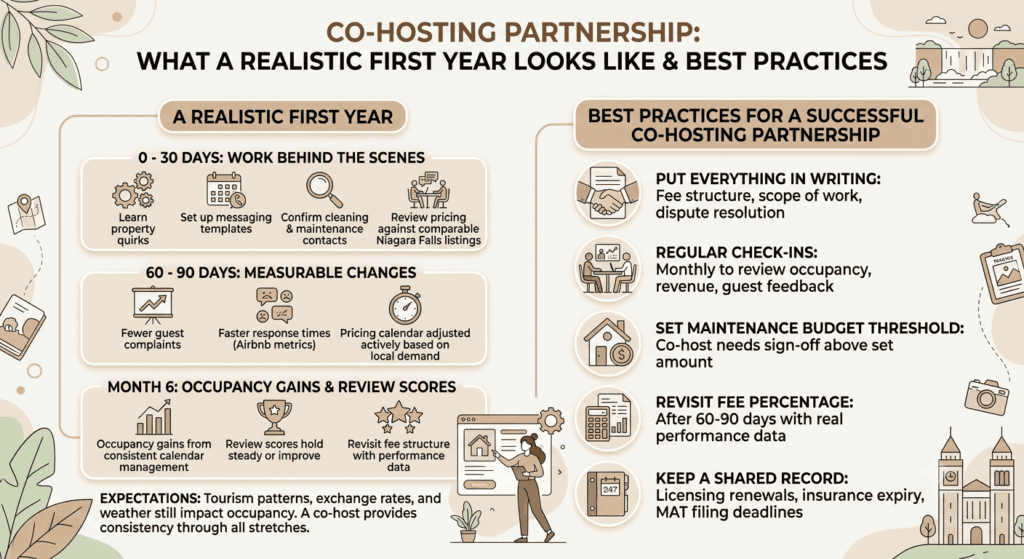
It helps to know what to actually expect once a co-hosting partnership starts, rather than assuming results will be instant. In the first 30 days, most of the work is behind the scenes: your co-host learns the property’s quirks, sets up messaging templates, confirms cleaning and maintenance contacts, and reviews your current pricing against comparable Niagara Falls listings. By the 60- to 90-day mark, you should start seeing measurable changes – fewer guest complaints, faster response times reflected in your Airbnb performance metrics, and a pricing calendar that’s actively adjusted around local demand rather than left static.
By month six, many owners in Niagara see occupancy gains simply from more consistent calendar management around festivals and long weekends, along with review scores that hold steady or improve because guest issues are being caught and resolved quickly rather than piling up. This is also a natural point to revisit your fee structure together, using real performance data instead of guesswork from the initial conversation.
It’s worth setting expectations early that a co-host isn’t a guarantee against a slow month – tourism patterns, exchange rates, and even weather all move the needle in a destination market like this one. What a good co-host does provide is consistency: someone actively managing the listing through both busy and quiet stretches, rather than a rental that only gets attention when something goes wrong.
Best Practices for a Successful Co-Hosting Partnership
A few habits separate co-hosting relationships that thrive from ones that quietly fall apart within a season.
- Put everything in writing, including fee structure, scope of work, and how disputes get resolved.
- Set a regular check-in – monthly, at minimum – to review occupancy, revenue, and guest feedback together.
- Agree on a maintenance budget threshold above which your co-host needs your sign-off before spending.
- Revisit the fee percentage after the first 60 to 90 days once you both have real performance data to reference.
- Keep a shared record of licensing renewal dates, insurance expiry, and MAT filing deadlines so nothing slips through the cracks.
Final Thoughts
Co-hosting isn’t just a convenience anymore in a market like Niagara Falls – it’s increasingly a compliance strategy as much as an operational one. Between VRU licensing, the OOSTR pilot, MAT changes, updated fire code requirements, and Airbnb’s own restructured fee model, there’s a lot for any single owner to track while also trying to deliver a five-star guest experience.
If you’re weighing whether to bring on an Airbnb co-host in Niagara, The HAH Developments would be glad to walk through your specific property, your goals, and what a realistic fee structure and management plan would look like for you. Reach out to The HAH Developments today to talk through short-term rental management, co-hosting, or a full property management solution built for the Niagara market.
Frequently Asked Questions
What’s the difference between an Airbnb co-host and a property manager? A co-host operates inside your personal Airbnb account, so you retain ownership of the listing, reviews, and payout history. A property manager typically runs the listing through their own business account and charges a higher fee, generally in exchange for taking on more operational responsibility and liability.
How much should I expect to pay an Airbnb co-host in Niagara? Most arrangements fall between 10% and 25% of gross booking revenue, with 15% to 20% being typical for full-service co-hosting that covers guest messaging, turnovers, and pricing. Always clarify whether the percentage applies before or after Airbnb’s own host fee is deducted.
Do I still need a VRU licence if I hire a co-host? Yes. Licensing is tied to the property and the owner, not the person managing day-to-day operations. A knowledgeable co-host can help you navigate the application, but the legal responsibility for holding a valid licence stays with the property owner.
Can a co-host help with Niagara Falls’ Owner Occupied Short-Term Rental pilot program? Co-hosts can help with guest communication, cleaning coordination, and pricing under the OOSTR pilot, but the owner-occupancy requirement means the property owner must remain on-site during guest stays – that part of the program can’t be delegated.
Will Airbnb’s new 15.5% host fee affect my co-host’s percentage? Not directly, but it affects your total take-home. If your co-host’s fee and Airbnb’s 15.5% are both calculated on the same booking subtotal, you’ll want to review your pricing to make sure your net income still meets your goals.
Is it better to hire a local Niagara co-host or work with a national company? A locally based co-host or property manager, like The HAH Developments, brings direct familiarity with Niagara Falls zoning, MAT rates, and seasonal demand patterns – details that a national, generalized service is less likely to track closely.
How long does it typically take to see results after hiring a co-host? Most owners notice operational improvements, like faster guest response times and smoother turnovers, within the first 30 to 60 days. Occupancy and revenue gains tend to build over three to six months as pricing and marketing strategy catch up with the property’s full potential.