

If you own a rental property in Niagara Falls or anywhere in the Niagara Region, you’ve probably asked yourself this question at least once: should I manage it myself, or hand it over to a property manager?
On the surface, the answer seems obvious. Self-managing means no monthly management fee. That fee feels like money walking out the door every single month, so skipping it looks like the smart financial move.
But here’s the thing. The monthly fee is only one line item in a much bigger picture. Self-managing vs. hiring a property manager isn’t really a question of “fee or no fee.” It’s a question of where your money actually goes – visibly or invisibly – over the life of your investment.
Vacancies eat into your income quietly. A bad tenant placement can cost you thousands before you even notice the damage. One missed legal deadline with the Landlord and Tenant Board can turn into a paperwork nightmare that drags on for months. And then there’s your own time, which has a real dollar value whether you track it or not.
In this guide, we’re going to walk through both options honestly – no sugar-coating, no scare tactics. We’ll look at what each path actually costs in Ontario in 2026, what’s changed in the Niagara rental market this year, and how to figure out which choice protects your bottom line. By the end, you’ll have a clear framework for making this decision based on your specific property, your time, and your goals.
This question matters more right now than it did even a couple of years ago. Niagara’s rental landscape has shifted noticeably heading into 2026 – vacancy rates have climbed, new rental supply is coming online across St. Catharines and Niagara Falls, and tenants have more choice than they’ve had in over a decade. That changes the math on both sides of this decision. A self-managing landlord who could once rely on a tight market to fill a vacancy quickly may now find a unit sitting empty for weeks if it’s priced or marketed even slightly off. At the same time, a property manager’s ability to price accurately, market quickly, and retain good tenants becomes more valuable in a market where competition for renters has increased.
So this isn’t just a generic “DIY vs. hire it out” comparison. It’s a decision that should reflect where the Niagara rental market actually stands today, not where it stood five years ago.
What Does Self-Managing a Rental Property Actually Involve?
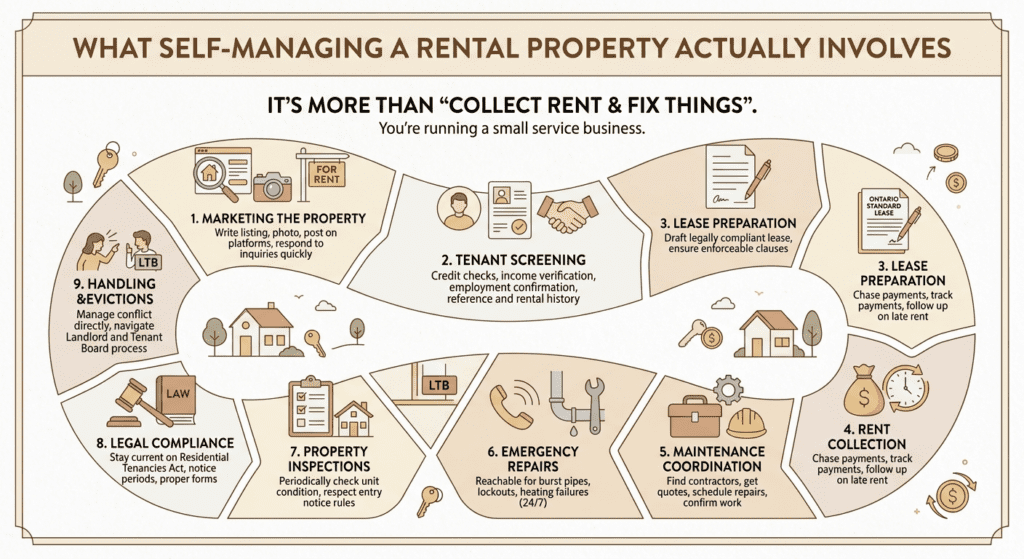
A lot of new landlords picture self-management as “collect the rent, fix things when they break.” In reality, you’re running a small service business, even if it’s just one unit.
The Day-to-Day Workload Landlords Underestimate
Here’s what self-managing actually covers, start to finish:
- Marketing the property – writing the listing, taking photos, posting on multiple platforms, and responding to inquiries, often within hours to stay competitive
- Tenant screening – credit checks, income verification, employment confirmation, references, and rental history checks
- Lease preparation – drafting a legally compliant Ontario Standard Lease and making sure every clause is enforceable
- Rent collection – chasing payments, tracking who’s paid, and following up on late rent
- Maintenance coordination – finding contractors, getting quotes, scheduling repairs, and confirming the work was done properly
- Emergency repairs – being reachable for burst pipes, lockouts, heating failures, and other issues that can’t wait until Monday
- Property inspections – checking on the condition of the unit periodically without violating entry notice rules
- Legal compliance – staying current on the Residential Tenancies Act, notice periods, and proper forms
- Handling disputes and evictions – managing conflict directly and, when needed, navigating the Landlord and Tenant Board process
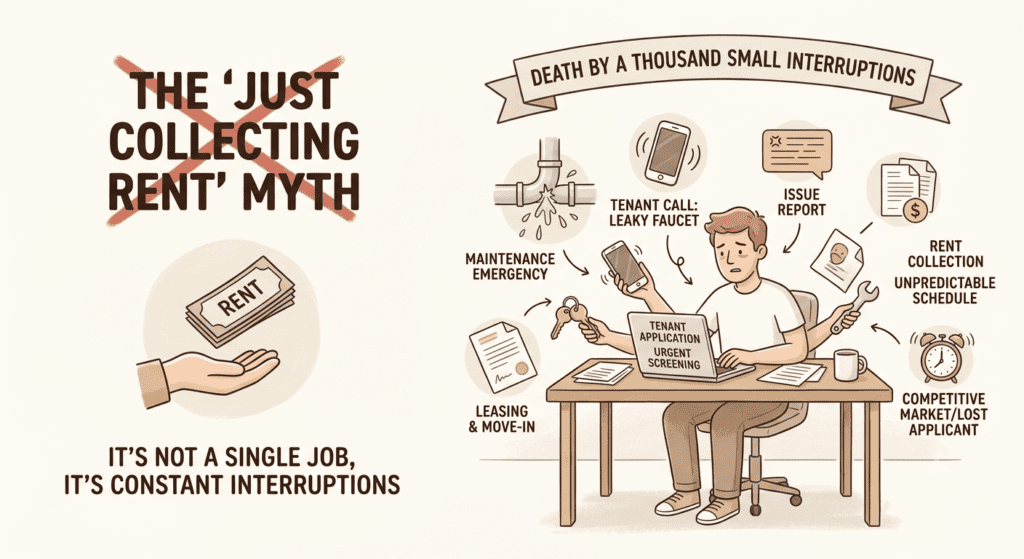
Why “Just Collecting Rent” Is a Myth
None of these tasks are difficult on their own. The challenge is that they’re unpredictable and they don’t respect your schedule. A maintenance emergency doesn’t wait until after your work shift. A tenant screening decision has to happen quickly in a competitive market, or you lose a good applicant to another listing.
Self-managing landlords often describe the workload as “death by a thousand small interruptions” rather than one big job. That’s the part that’s easy to underestimate when you’re only thinking about the management fee you’d be saving.
What Does a Property Manager Actually Do?
A professional property manager takes on the operational side of your rental so you’re not the one fielding every call, text, and maintenance request.
Core Services You’re Paying For
Most full-service property managers in Ontario handle:
- Tenant advertising across multiple rental platforms with professional photography
- Background, credit, and reference checks using established screening systems
- Lease agreements drafted to current Ontario Standard Lease requirements
- Rent collection, including automated reminders and late fee enforcement
- Maintenance scheduling and vendor management, often at preferred contractor rates
- Routine property inspections with documented reports
- Financial reporting so you always know where your money is going
- Ongoing compliance with the Residential Tenancies Act and Landlord and Tenant Board procedures
How This Differs in Niagara’s Short-Term vs. Long-Term Rental Market
Niagara Falls has a unique rental landscape compared to a typical Ontario city. Tourism drives strong demand for short-term and Airbnb rentals alongside the traditional long-term market, and each requires a different management approach.
Long-term rental management focuses on tenant retention, lease compliance, and steady monthly income. Short-term and Airbnb co-hosting, on the other hand, is about turnover speed, guest experience, dynamic pricing, and constant cleaning coordination. Trying to self-manage both models at once is significantly more demanding than managing a single long-term tenant, which is one reason many Niagara property owners bring in professional help specifically for the short-term side even if they’re comfortable self-managing a long-term unit.
The Real Cost of Self-Managing Your Property
This is where the math gets more honest. Self-managing isn’t free – it just shifts the cost from a visible monthly fee to less visible expenses that show up later.
Your Time Has a Dollar Value
Industry estimates put the time commitment for self-managing landlords at roughly 5 to 8 hours per unit per month when you factor in maintenance calls, tenant communication, and repair coordination. That includes:
- Hours spent each month on routine communication and admin
- Emergency calls that interrupt your evenings or weekends
- Weekend maintenance trips or coordination
- Ongoing tenant questions and conflict resolution
If your time is worth even $30 an hour, 6 hours a month works out to $180 a month, or roughly $2,160 a year, in time you’re spending instead of earning, resting, or doing something else entirely.
Consider a realistic example. Sarah owns a two-bedroom rental in Niagara Falls and works a full-time job with a fixed schedule. Over the course of a typical month, she spends about two hours fielding tenant texts and emails, an hour coordinating a plumbing repair, three hours dealing with a late-rent situation that required a phone call, a written notice, and a follow-up visit, and another hour handling general admin like tracking payments in a spreadsheet. That’s seven hours in a fairly ordinary month – before anything unusual happens, like a tenant turnover or an emergency repair after hours.
Multiply that across a year, and Sarah has spent roughly 84 hours managing one rental property. At $30 an hour, that’s $2,520 in time value alone, not counting the stress of being interruptible at any moment. For landlords who own two or three properties, that number multiplies quickly, and the time commitment starts to look a lot less like a side activity and more like a part-time job.
Hidden Costs You May Not Notice
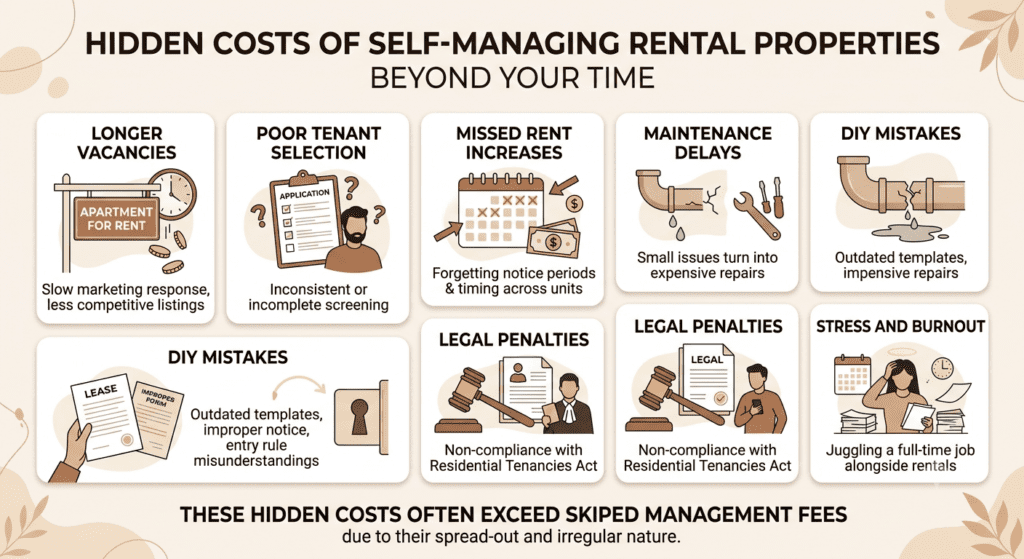
Beyond your time, self-managing landlords often run into costs that don’t show up until later:
- Longer vacancies from slower marketing response or less competitive listing presentation
- Poor tenant selection from inconsistent or incomplete screening
- Missed rent increases because tracking notice periods and timing across multiple units is easy to lose track of
- Maintenance delays that turn small issues into expensive repairs
- DIY mistakes – using outdated lease templates, giving improper notice, or misunderstanding entry rules
- Legal penalties from non-compliance with the Residential Tenancies Act
- Stress and burnout, especially for landlords juggling a full-time job alongside their rental
These costs often exceed what you’d save by skipping a management fee, but because they’re spread out and irregular, they’re much harder to notice in the moment.
The Legal Risk Factor Self-Managing Landlords Often Underestimate
Ontario’s rental rules are not optional guidelines – they’re enforceable law under the Residential Tenancies Act, and getting them wrong can be expensive.
A few facts every Niagara landlord should know going into 2026:
- The Ontario rent increase guideline for 2026 is 2.1%, the lowest cap in four years, down from 2.5% in both 2024 and 2025. This applies to units first occupied on or before November 15, 2018.
- Landlords must give tenants at least 90 days’ written notice using the official Form N1 before any rent increase takes effect, and rent can only be raised once every 12 months per tenant.
- Filing an L1 application with the Landlord and Tenant Board for unpaid rent currently costs $201, and the full process – from the first missed payment to an enforced eviction order – typically takes 5 to 12 months in many Ontario regions.
- A single avoidable Landlord and Tenant Board dispute, whether from an improper notice, a missed deadline, or an illegal rent increase, can cost a landlord roughly $2,000 to $5,000 once you factor in lost rent, filing fees, and the time involved.
None of this means self-managing landlords are doomed to make mistakes. Plenty manage successfully for years without issue. But it does mean the legal margin for error is small, and the Residential Tenancies Act rewards landlords who stay precisely on top of paperwork, timing, and proper notice.
What a Real Eviction Timeline Looks Like in 2026
It’s worth walking through what actually happens when a tenant stops paying rent, because the timeline surprises a lot of self-managing landlords. After a missed payment, a landlord typically waits a short period before filing an L1 application with the Landlord and Tenant Board. From there, the case moves into the hearing queue, which in many parts of Ontario currently takes several months. If the Board issues an eviction order and the tenant still doesn’t leave, a Sheriff has to enforce it, which can add several more weeks. From the first missed payment to the property actually being vacant again, the full process commonly takes anywhere from five months to nearly a year.
During that entire window, a self-managing landlord is typically not collecting rent, is responsible for every form and filing deadline, and often has to represent themselves at the hearing without legal training. A property manager who handles LTB filings and hearings regularly brings a level of familiarity with the process that most landlords only develop after going through it themselves – often the hard way, on their first attempt.
How Much Does Hiring a Property Manager Cost in Ontario in 2026?
If you’re going to compare self-managing against professional management honestly, you need real numbers – not vague estimates.
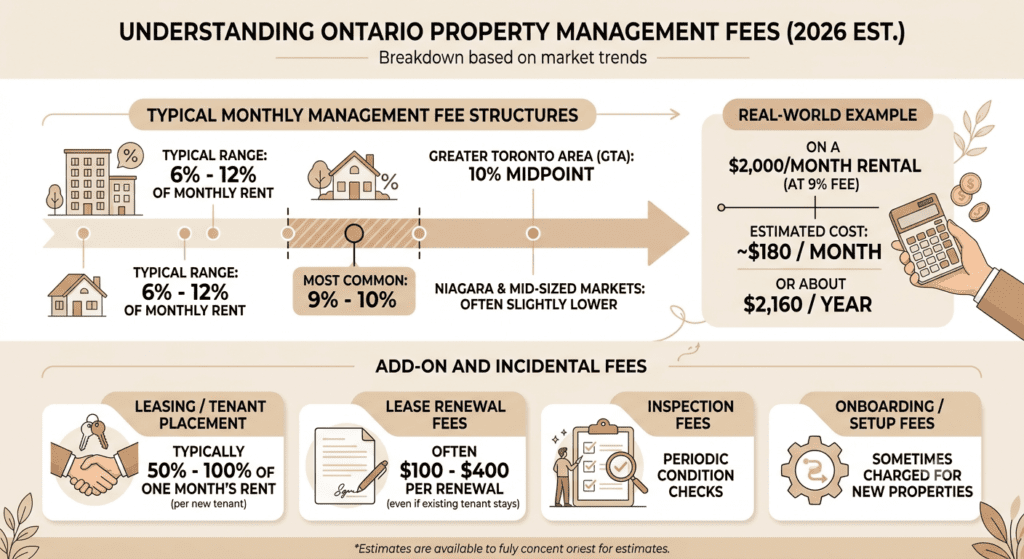
Typical Management Fee Structures in 2026
Across Ontario, property management fees typically fall between 6% and 12% of monthly rent collected, with most landlords paying somewhere around 9% to 10% for full-service residential management. In the Greater Toronto Area, 10% is the most common midpoint for single-unit residential properties. In smaller and mid-sized markets, including parts of the Niagara Region, rates often sit slightly below the GTA average.
To put that in real terms: on a $2,000-per-month rental at a 9% fee, you’d pay roughly $180 a month, or about $2,160 a year, for full-service management.
Leasing, Inspection, Renewal, and Other Add-On Fees
The monthly percentage is usually just the starting point. Most property managers also charge:
- Leasing or tenant placement fees – typically 50% to 100% of one month’s rent, charged each time a new tenant is placed
- Lease renewal fees – often $100 to $400 per renewal, even when the existing tenant stays
- Inspection fees – for periodic property condition checks beyond routine management
- Onboarding or setup fees – sometimes charged when a new property is brought under management
What’s Usually Included vs. Optional
This is where a lot of landlords get caught off guard. A company advertising a low monthly percentage may make up the difference with high leasing fees or limited included services. Before signing with any property manager, ask for a complete, itemized rate card in writing. A 9% all-inclusive fee can easily end up cheaper than a 6% fee that excludes tenant placement, inspections, and renewals as separate line items.
Self-Managing vs. Hiring a Property Manager: Side-by-Side Cost Comparison
When you put both options next to each other, the picture becomes clearer.
| Factor | Self-Managing | Hiring a Property Manager |
| Monthly Cost | Lower upfront | Management fee applies (typically 6–12% of rent) |
| Time Required | High (5–8 hrs/unit/month) | Low |
| Tenant Screening | DIY, inconsistent | Professional, standardized |
| Legal Compliance | Owner’s responsibility | Managed by experienced professionals |
| Maintenance | Coordinate yourself | Handled through vendor networks |
| Emergency Calls | 24/7 owner responsibility | Manager handles them |
| Vacancy Reduction | Depends on owner’s marketing skill | Often faster leasing through established channels |
| Stress Level | Higher | Lower |
| Scalability | Difficult past 1–2 units | Easier to grow a portfolio |
The pattern here is consistent: self-managing tends to save money on paper while costing more in time, risk, and missed opportunities. Hiring a property manager costs more on paper while reducing the unpredictable expenses that eat into returns.
A Real Annual Cost Comparison
Numbers make this easier to picture than a table alone. Take a $2,200-per-month rental in Niagara Falls.
Under professional management at a 9% rate, the annual management fee comes to roughly $2,376. Add a leasing fee of one month’s rent (about $2,200) on a year when the unit turns over, and the total comes to roughly $4,576 for that year – though in a year without turnover, the cost drops back down closer to $2,376.
Now compare that to self-managing the same property. There’s no management fee, but if the unit sits vacant for even three extra weeks because of slower marketing or pricing that’s slightly out of step with the current Niagara market, that’s roughly $1,500 in lost rent. Add 80 hours of the owner’s time at $30 an hour, and that’s another $2,400. Without even factoring in a maintenance mistake or a legal misstep, self-managing has already cost close to $3,900 in this scenario – and that’s before accounting for the stress of being on call for repairs and tenant issues all year.
The numbers won’t be identical for every property, but the exercise is worth doing for your own rental. Once you account honestly for vacancy risk and the value of your time, the gap between the two options is often much smaller than the management fee alone suggests – and in some cases, self-managing ends up costing more.
Why Niagara’s 2026 Rental Market Changes the Calculation
The Niagara rental market in 2026 looks different than it did even a year or two ago, and that shift directly affects whether self-managing still makes sense.
Rising Vacancy Rates and Why Pricing Precision Matters Now
The Niagara region’s vacancy rate has climbed to roughly 3.9%, a more-than-decade high, with Niagara Falls posting some of the largest increases within the region. That’s a meaningful shift from the extremely tight market Niagara landlords were used to. Across Ontario, newly built rental units are sitting at vacancy rates near 7%, and a large share of new buildings are now offering one to two months of free rent just to attract tenants.
What does that mean practically? A unit priced even slightly above current market rate can sit empty for weeks, and two weeks of vacancy often costs more than a full year of modest under-pricing. In a market like this, pricing accuracy and fast, professional marketing response matter more than ever – and that’s exactly where the gap between self-managing and professional management widens.
New Supply Coming to Niagara Falls – What It Means for Self-Managing Landlords
Niagara Falls exceeded 116% of its 2024 provincial housing target, and multiple new rental apartment projects are expected to break ground in the region through 2026. More supply means more competition for tenants, which raises the stakes on presentation, response time, and tenant retention – all areas where professional management tends to outperform a part-time, self-managing landlord.
When Self-Managing Makes Financial Sense
Self-managing isn’t the wrong choice for everyone. It tends to work well for landlords who:
- Own one property and live nearby
- Have a flexible schedule that allows for last-minute maintenance calls or showings
- Already understand Ontario’s landlord-tenant laws, or are willing to learn them thoroughly
- Genuinely enjoy hands-on property management
- Have trusted, reliable contractors already in place
If most or all of these apply to you, the time investment may be manageable, and the savings on management fees can be real.
When Hiring a Property Manager Saves More Money
On the other side, professional management tends to pay for itself for owners who:
- Own multiple rental properties
- Live far from the property, whether elsewhere in Ontario or out of province
- Work full-time and don’t have flexibility for emergency calls or weekend maintenance
- Want truly passive rental income rather than a second job
- Need help navigating legal compliance under the Residential Tenancies Act
- Want to minimize vacancy time in a market where pricing and presentation now matter more
- Prefer professional tenant screening and management over handling conflict directly
For Niagara owners managing Airbnb or short-term rental properties specifically, the case for professional management is often even stronger, since the operational demands of turnover, cleaning, and guest communication are constant rather than occasional.
How to Choose the Right Property Manager If You Decide to Hire One
If you land on hiring a property manager, the decision doesn’t stop there. Not all property managers deliver the same value, and choosing poorly can erase the benefits you were hoping to gain.
Ask for a Complete, Itemized Fee Schedule
Before signing anything, request every possible fee in writing – the monthly management percentage, leasing fees, renewal fees, inspection charges, and any maintenance markups. A company that’s reluctant to provide a full breakdown is usually telling you something important.
Check Their Track Record on Vacancy and Retention
Ask how long their properties typically sit vacant between tenants, and how long their average tenant stays. A manager who fills units quickly and keeps tenants longer is often worth a slightly higher fee, since both factors directly protect your income.
Confirm Local Niagara Market Knowledge
Property management in a tourist-driven market like Niagara Falls is different from managing a rental in a purely residential city. Ask specifically about their experience with both long-term tenancies and, if relevant to your property, short-term or Airbnb management in the region.
Review How They Handle Compliance and Disputes
Ask directly how they manage Landlord and Tenant Board filings, rent increase notices, and tenant disputes. A manager who can speak confidently and specifically about the Residential Tenancies Act is a strong signal of real experience, not just sales talk.
Get Everything in Writing
Verbal promises about service levels mean little if they’re not documented in your management agreement. Make sure the contract spells out exactly what’s included, what triggers extra charges, and how disputes between you and the manager would be handled.
Questions Every Landlord Should Ask Before Deciding
Before committing to either path, work through these questions honestly:
- How much is my own time actually worth per hour?
- Can I realistically respond to emergencies at any hour, including weekends?
- Am I confident I understand current Ontario rental regulations, including notice periods and rent increase rules?
- How far do I live from the property?
- Do I want passive income, or am I comfortable taking on what amounts to a second job?
- Am I planning to grow my rental portfolio, or is this a one-property situation?
Your honest answers to these questions will usually point you toward the right decision faster than any spreadsheet comparison.
Common Mistakes Landlords Make
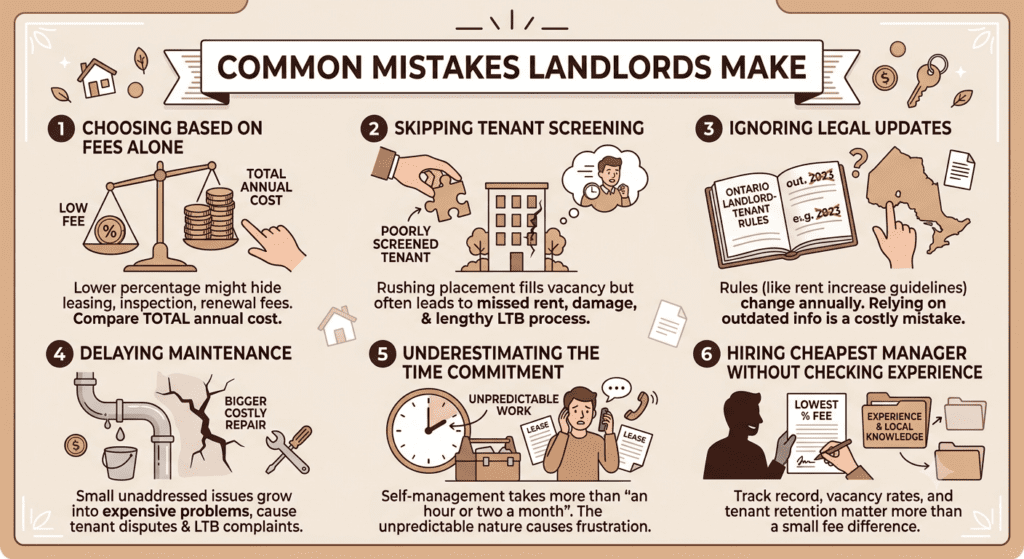
Whether you self-manage or hire help, these are the mistakes that tend to cause the most financial damage:
Choosing Based on Fees Alone
A lower management percentage that excludes leasing fees, inspections, and renewals can end up costing more than a higher all-inclusive rate. Always compare total annual cost, not just the headline number.
Skipping Tenant Screening
Rushing tenant placement to fill a vacancy faster is one of the most expensive shortcuts a landlord can take. A poorly screened tenant can lead to missed rent, property damage, or a lengthy Landlord and Tenant Board process.
Ignoring Legal Updates
Ontario’s rent increase guideline changes annually, and the rules around proper notice and exempt units are precise. Relying on outdated information, or assuming last year’s rules still apply, is a common and costly mistake.
Delaying Maintenance
Small maintenance issues left unaddressed tend to become larger, more expensive problems, and they’re also a common source of tenant disputes and Landlord and Tenant Board complaints.
Underestimating the Time Commitment
Many first-time landlords assume self-managing one unit will take an hour or two a month. In practice, the unpredictable nature of the work – not the total hours – is usually what causes the most frustration.
Hiring the Cheapest Manager Without Checking Experience
Choosing a property manager based purely on the lowest percentage fee, without reviewing their track record, vacancy rates, or tenant retention, often backfires. Experience and local market knowledge tend to matter more than the fee difference of a percentage point or two.
Final Verdict: Which Option Saves More Money?
The honest answer is: it depends on your specific situation. The right choice comes down to your portfolio size, the time you genuinely have available, your familiarity with Ontario’s rental laws, your distance from the property, your investment goals, and how hands-on you actually want to be.
Self-managing can reduce your direct, visible expenses, and for a single nearby property with a hands-on owner, that can be the right call. But professional management often improves long-term profitability in less visible ways – by reducing vacancy time, preventing costly legal mistakes, protecting tenant retention, and freeing up your time for the things that actually matter to you.
In a Niagara rental market where vacancy rates are rising and new supply is increasing competition for tenants, the value of fast, professional, well-priced management is becoming harder to ignore – especially for owners who aren’t able to be fully hands-on every single day.
If you’re weighing self-managing against hiring help for your Niagara Falls rental, you don’t have to figure it out alone. The HAH Developments specializes in long-term rental management, Airbnb co-hosting, and full-service property care across the Niagara Region – built to maximize your rental income while giving you your time back.
Reach out today for a free rental assessment, and let’s figure out together what actually makes sense for your property.
Frequently Asked Questions
For many landlords, yes – particularly those with multiple properties, limited time, or properties located far from where they live. The management fee is often offset by reduced vacancy time, fewer costly legal mistakes, and better tenant retention.
Most Ontario property managers charge between 6% and 12% of monthly rent, with many landlords paying around 9% to 10% for full-service management. Additional fees often apply for tenant placement, lease renewals, and inspections.
Sometimes, especially if you own one nearby property and have the time and legal knowledge to manage it well. However, hidden costs like vacancies, DIY mistakes, and the value of your own time often narrow or eliminate the savings.
The biggest hidden costs include longer vacancies, missed rent increases, maintenance delays, legal compliance mistakes under the Residential Tenancies Act, and the dollar value of the 5 to 8 hours per month many self-managing landlords spend on their property.
Generally, when you own multiple properties, live far from the rental, work full-time without flexibility for emergencies, or want genuinely passive income rather than a hands-on second job.
Yes, often significantly. Professional managers typically have established marketing channels, pricing expertise, and faster response times, which matter even more in a market like Niagara’s, where vacancy rates have risen and competition for tenants has increased.