

Owning a rental property in Ontario is one of the most reliable ways to build long-term wealth. It’s also a job with real legal weight attached to it. The moment you hand over a set of keys, you take on a long list of duties that go far beyond collecting rent on the first of the month for Landlord Responsibilities
Understanding your landlord responsibilities isn’t optional paperwork you can skim once and forget. It’s the foundation that keeps your property safe, your tenants happy, and your investment protected from costly disputes at the Landlord and Tenant Board.
Here’s the thing most new landlords don’t realize until it’s too late: Ontario’s Residential Tenancies Act doesn’t care if you’re a first-time owner with one basement apartment or a seasoned investor with a dozen units. The same rules apply, and ignorance of them won’t hold up as a defence.
The most common mistakes landlords make aren’t dramatic. They’re small, everyday slip-ups – entering a unit without proper notice, delaying a repair by a few weeks too long, forgetting to update a lease clause, or miscalculating a rent increase. Each of these can snowball into a formal complaint, a rent abatement order, or worse, a fine.
In this guide, you’ll learn exactly what Ontario law expects from you as a landlord in 2026, how to stay compliant without losing sleep over it, and how proactive property management protects both your tenants and your bottom line. Whether you self-manage a single condo or you’re weighing whether to bring in professional help, this article gives you a practical, up-to-date roadmap.
Why Landlord Responsibilities Matter More Than Ever
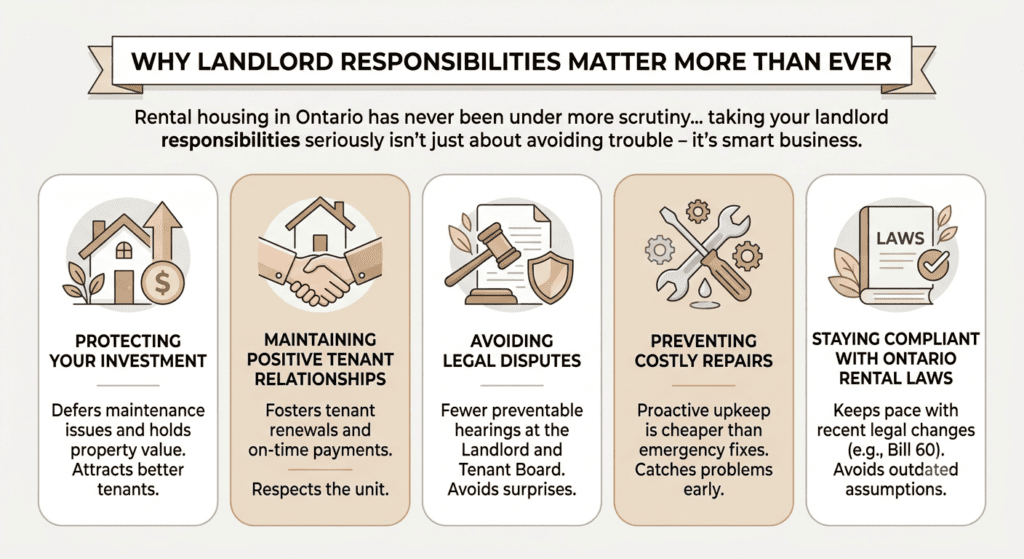
Rental housing in Ontario has never been under more scrutiny. Tenants are better informed about their rights, the Landlord and Tenant Board processes more applications than ever, and municipalities are tightening property standards bylaws. Against that backdrop, taking your landlord responsibilities seriously isn’t just about avoiding trouble – it’s smart business.
Protecting your investment. Your rental property is likely one of your largest assets. Deferred maintenance, code violations, and legal disputes chip away at its value and its income potential. A well-maintained, legally sound property holds its value and attracts better tenants.
Maintaining positive tenant relationships. Good tenants are hard to find and expensive to replace. When you meet your obligations consistently, tenants are more likely to renew, pay on time, and treat the unit with respect.
Avoiding legal disputes. Every year, thousands of landlord-tenant disputes land in front of the Landlord and Tenant Board. Many of them are preventable. Understanding your legal responsibilities upfront means fewer surprises and fewer hearings.
Preventing costly repairs. A small leak ignored for months becomes a mould problem. A furnace skipped during fall maintenance becomes an emergency call in January. Staying on top of your responsibilities is almost always cheaper than reacting to a crisis.
Staying compliant with Ontario rental laws. Ontario’s rental laws have shifted meaningfully over the past year, including changes introduced through Bill 60 (the Fighting Delays, Building Faster Act, 2025), which adjusted eviction timelines and lease renewal rules. Landlords who haven’t kept up risk relying on outdated assumptions.
Provide a Safe, Habitable Rental Property
At the core of every landlord’s legal duty is one simple idea: the unit has to be safe to live in. Section 20 of the Residential Tenancies Act requires landlords to keep the rental unit and the building in good repair, fit for habitation, and compliant with health, safety, housing, and maintenance standards – regardless of what the lease says or whether the tenant knew about a problem before moving in.
Meeting Health and Safety Standards
Ontario’s Maintenance Standards regulation sets the minimum bar. That includes pest-free premises, functioning plumbing, sound structure, and safe electrical systems. Municipalities often layer their own property standards bylaws on top of the provincial minimum, so it’s worth checking your local rules too.
Smoke and Carbon Monoxide Alarms
Fire safety is one area where Ontario does not leave room for interpretation. Every rental unit must have working smoke alarms on every storey, including areas without a bedroom, and outside all sleeping areas. If the unit has a fuel-burning appliance, a fireplace, or an attached garage, a carbon monoxide alarm is also required near the sleeping areas.
As the landlord, you’re responsible for installing these alarms, testing them annually, and replacing them according to the manufacturer’s schedule (typically every ten years). Tenants are required to report a malfunctioning alarm, but the legal duty to fix or replace it sits with you. Penalties for non-compliance under the Fire Protection and Prevention Act are steep – individual landlords can face fines up to $50,000, and corporations up to $100,000.
Electrical and Plumbing Safety
Faulty wiring, exposed outlets, and leaking pipes aren’t just inconvenient – they’re safety hazards that can trigger a maintenance complaint or a municipal inspection. Regular checks by a licensed electrician or plumber, especially in older properties, catch small issues before they become expensive ones.
Heating, Water, and Essential Services
Ontario law treats heat, water, and electricity as vital services that cannot be shut off for any reason, including unpaid rent. Rental units must be able to maintain a minimum indoor temperature during the colder months, so a functioning furnace isn’t optional – it’s a legal requirement.
Structural Integrity
Roofs, foundations, stairs, railings, and windows all fall under your responsibility to maintain. A wobbly railing or a cracked front step might seem minor until someone gets hurt, and liability for injuries on a poorly maintained property can be significant.
Keep the Property Properly Maintained
Providing a habitable unit on day one isn’t enough. Ontario law expects landlords to keep the property in good repair for the entire length of the tenancy – a duty that exists whether or not the tenant complains.
Routine Maintenance
This is the unglamorous, ongoing work: replacing furnace filters, checking caulking around windows, servicing appliances, and keeping common areas clean. It’s rarely urgent, which is exactly why it gets skipped – and exactly why skipping it causes problems later.
Emergency Repairs
No heat in January, a burst pipe, a gas smell, or a security issue like a broken lock all count as emergencies. These require a fast response, often within 24 hours, because they threaten health, safety, or the property itself.
Seasonal Inspections
A spring and fall walkthrough catches issues before they become emergencies. Spring inspections should focus on roofing, gutters, and exterior drainage after winter thaw. Fall inspections should confirm heating systems, weatherstripping, and insulation are ready for cold weather.
Preventive Maintenance Checklist
- Test smoke and CO alarms and log the results
- Service the furnace and HVAC system annually
- Inspect the roof and gutters twice a year
- Check for leaks under sinks and around toilets
- Test the water heater and check for corrosion
- Inspect caulking, weatherstripping, and window seals
- Clean or replace furnace filters seasonally
- Check exterior drainage and grading around the foundation
Exterior Maintenance Responsibilities
Landlords are generally responsible for structural exterior elements – the roof, siding, foundation, and any shared amenities. Depending on your lease terms, snow removal and lawn care may fall to you or be delegated to the tenant, but the underlying safety of walkways and driveways remains your responsibility if someone is injured.
Respect Tenant Privacy and Entry Rules
A tenant’s home is legally theirs to enjoy without unnecessary interference – even though you own the building. Getting entry rules wrong is one of the most common (and most costly) mistakes Ontario landlords make.
When Landlords Can Enter
Under the Residential Tenancies Act, you can enter a rental unit for specific reasons: to carry out a repair, to conduct an inspection related to the unit’s state of repair, to show the unit to a prospective tenant, purchaser, or insurer, or with the tenant’s consent given at the time of entry.
Required Notice Periods
For nearly all non-emergency entries, you must provide written notice at least 24 hours before the planned entry. That notice must state the reason for entry and specify a time between 8:00 a.m. and 8:00 p.m. The 24-hour clock means 24 full hours, not “the next business day” – the Landlord and Tenant Board has ruled against landlords who missed this by even an hour or two.
Verbal notice, a text message, or an email generally won’t count unless the tenant has agreed in writing to receive notices that way. It’s worth building an entry-notice clause into your lease that specifies how notices will be delivered, so there’s no ambiguity later.
Emergency Access
Genuine emergencies – a fire, a flood, a gas leak, or a credible safety concern – allow entry without notice. But the Landlord and Tenant Board has consistently pushed back on landlords who use “emergency” as a excuse for routine work. If it’s not truly urgent, it doesn’t qualify.
Best Practices for Inspections
Give more notice than the legal minimum when you can. Specify a tight time window rather than a broad one – the Board has penalized landlords for giving entry windows as wide as eight hours. Keep a written log of every notice you deliver, along with how and when it was delivered, in case a dispute ever comes up.
Understand Your Legal Responsibilities Under Ontario Law
Residential Tenancies Act Overview
The Residential Tenancies Act, 2006 is the legal backbone of nearly every private residential tenancy in Ontario. It governs leases, rent, repairs, entry, and the entire eviction process. Its protections apply automatically, even if you and your tenant never signed a formal lease.
Lease Agreements
Since 2018, most new tenancies in Ontario must use the government’s Standard Lease form. You’re required to give the tenant a signed copy within 21 days of signing. If you fail to provide it after a written request, the tenant may be entitled to withhold a month’s rent.
Rent Collection Rules
Rent is due on the date specified in the lease, and you’re required to provide a receipt if a tenant asks for one. You cannot demand post-dated cheques or automatic withdrawal as a condition of the lease, although a tenant can agree to it voluntarily.
Security Deposits
This trips up a surprising number of landlords: damage deposits and security deposits are illegal in Ontario. The only deposit you can collect is a last month’s rent deposit, capped at one month’s rent, which must be applied to the tenant’s final month. You’re also required to pay annual interest on that deposit, calculated at the current rent increase guideline rate.
Rent Increase Guidelines
Ontario sets an annual rent increase guideline based on the provincial Consumer Price Index. For 2026, that guideline is 2.1% – a decrease from 2.5% in 2025 and the lowest cap in four years. On a $2,000 monthly rent, that works out to a maximum increase of about $42.
To raise the rent, you must give the tenant at least 90 days’ written notice using the official Form N1, and at least 12 months must have passed since the tenancy began or the last increase took effect. Units first occupied for residential purposes after November 15, 2018 are generally exempt from the guideline, meaning you can set market rent for those units with proper notice. If your costs genuinely exceed the guideline – for example, due to a major capital expense like a new roof – you can apply to the Landlord and Tenant Board for an Above Guideline Increase using Form L5.
Proper Eviction Procedures
Evictions in Ontario must go through the Landlord and Tenant Board – you cannot remove a tenant or their belongings yourself, and only the Board (enforced by the Sheriff) can carry out an eviction. Recent changes under Bill 60, the Fighting Delays, Building Faster Act, passed in late 2025, shortened the notice period for non-payment of rent from 14 days to 7 days on the N4 form, and adjusted compensation requirements for landlords using N12 notices for personal use with 120 or more days of advance notice. Fixed-term leases also no longer automatically convert to month-to-month tenancies at the end of the term. If you’re planning an eviction for any reason, confirm you’re using the correct notice form and current timelines, since these rules have shifted meaningfully in the past year.
Maintain Accurate Property Documentation
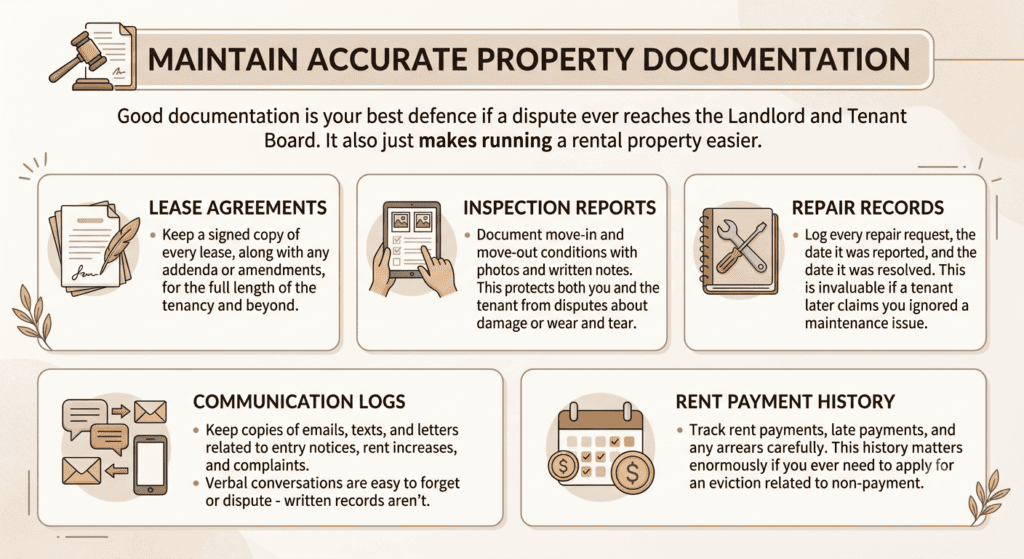
Good documentation is your best defence if a dispute ever reaches the Landlord and Tenant Board. It also just makes running a rental property easier.
Lease Agreements
Keep a signed copy of every lease, along with any addenda or amendments, for the full length of the tenancy and beyond.
Inspection Reports
Document move-in and move-out conditions with photos and written notes. This protects both you and the tenant from disputes about damage or wear and tear.
Repair Records
Log every repair request, the date it was reported, and the date it was resolved. This is invaluable if a tenant later claims you ignored a maintenance issue.
Communication Logs
Keep copies of emails, texts, and letters related to entry notices, rent increases, and complaints. Verbal conversations are easy to forget or dispute – written records aren’t.
Rent Payment History
Track rent payments, late payments, and any arrears carefully. This history matters enormously if you ever need to apply for an eviction related to non-payment.
Handle Repairs Quickly and Professionally
Emergency vs. Non-Emergency Repairs
Emergencies – no heat, no water, a security breach, a gas leak – need a response within hours, not days. Non-emergency repairs, like a dripping faucet or a squeaky door, still need to be addressed within a reasonable timeframe, generally within one to two weeks.
Repair Response Timelines
There’s no single fixed deadline written into the Act for every type of repair, but the Landlord and Tenant Board expects “reasonable” timelines based on severity. The longer a legitimate repair request sits unaddressed, the stronger the case a tenant has for a rent abatement or a formal complaint.
Working With Contractors
Build relationships with a small roster of trusted, licensed contractors – a plumber, an electrician, an HVAC technician, and a general handyman. Having people you can call on short notice saves time and money compared to scrambling during an emergency.
Keeping Tenants Informed
Even when a repair takes longer than expected, a quick update goes a long way. Tenants who feel informed are far less likely to escalate a maintenance issue into a formal LTB application.
Maintain Common Areas and Exterior Spaces
If you own a multi-unit property, common areas are entirely your responsibility, and even single-unit landlords usually retain responsibility for shared or exterior spaces unless the lease says otherwise.
Snow Removal
Walkways, steps, and parking areas need to be cleared promptly after snowfall. Slip-and-fall injuries on an unmaintained walkway can lead to significant liability.
Landscaping
Overgrown grass, dead trees, or hazardous branches aren’t just cosmetic issues – they can violate municipal property standards bylaws.
Parking Areas
Keep pavement in good repair and clearly marked, especially where multiple tenants share a lot.
Hallways
In multi-unit buildings, hallways, stairwells, and lobbies must be kept clean, well-lit, and free of fire hazards like stored furniture or garbage.
Shared Amenities
Laundry rooms, elevators, and recreational spaces need regular upkeep and prompt repair when something breaks.
Waste Management
Provide adequate garbage and recycling facilities, and stay current on municipal collection schedules and bylaws, particularly in areas with strict waste sorting rules.
Communicate Clearly With Your Tenants
Most tenant complaints don’t start as legal disputes – they start as frustration over feeling ignored.
Responding to Maintenance Requests
Acknowledge every request quickly, even if you can’t resolve it immediately. A same-day reply that says “I’ve received this and I’m scheduling a plumber for Thursday” prevents a lot of frustration.
Setting Expectations
Be upfront about how tenants should report issues, what counts as an emergency, and how quickly they can expect a response for non-urgent matters.
Handling Complaints Professionally
Stay calm and factual, even if a tenant is frustrated. Document the conversation and follow up in writing to confirm what was discussed and agreed upon.
Preventing Misunderstandings
Put everything in writing where possible. A quick text confirming “Repair scheduled for Thursday 10 a.m., electrician will call before arriving” avoids the “he said, she said” disputes that end up at the LTB.
Protect Your Rental Investment With Regular Inspections
Move-In Inspections
Document the condition of every room with photos and a written checklist, signed by both parties if possible. This is your baseline for any future damage disputes.
Seasonal Inspections
Beyond checking for maintenance issues, seasonal inspections (with proper 24-hour notice) let you verify smoke and CO alarms, check for pest issues, and confirm the unit is being maintained appropriately by the tenant.
Move-Out Inspections
Compare the unit’s condition against your move-in documentation to fairly assess any deductions from the last month’s rent deposit for damage beyond normal wear and tear.
Identifying Issues Early
Regular inspections catch small leaks, pest problems, and wear before they become expensive repairs or safety hazards.
Creating Inspection Reports
Standardize your inspection process with a checklist and dated photos every time. Consistency makes your documentation far more credible if a dispute ever arises.
Common Landlord Mistakes That Can Lead to Legal Problems
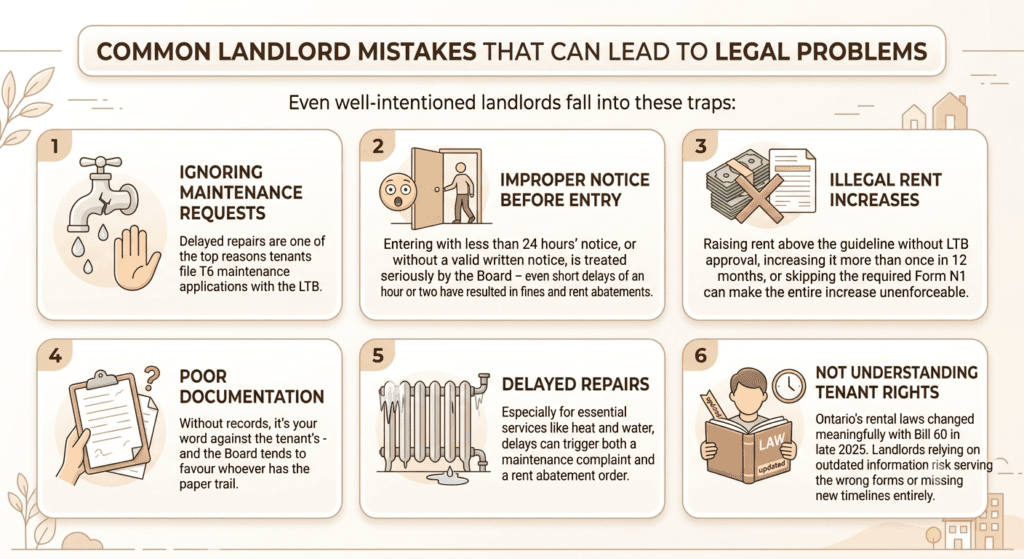
Even well-intentioned landlords fall into these traps:
- Ignoring maintenance requests. Delayed repairs are one of the top reasons tenants file T6 maintenance applications with the LTB.
- Improper notice before entry. Entering with less than 24 hours’ notice, or without a valid written notice, is treated seriously by the Board – even short delays of an hour or two have resulted in fines and rent abatements.
- Illegal rent increases. Raising rent above the guideline without LTB approval, increasing it more than once in 12 months, or skipping the required Form N1 can make the entire increase unenforceable.
- Poor documentation. Without records, it’s your word against the tenant’s – and the Board tends to favour whoever has the paper trail.
- Delayed repairs. Especially for essential services like heat and water, delays can trigger both a maintenance complaint and a rent abatement order.
- Not understanding tenant rights. Ontario’s rental laws changed meaningfully with Bill 60 in late 2025. Landlords relying on outdated information risk serving the wrong forms or missing new timelines entirely.
When Hiring a Property Management Company Makes Sense
At some point, many landlords realize that managing landlord responsibilities alone – especially across multiple properties – stretches them too thin. That’s when a professional property management company starts to make real financial sense.
Time Savings
Coordinating repairs, screening tenants, handling entry notices, and staying current on legislative changes is a part-time job in itself. A property manager takes that off your plate.
Legal Compliance
Rules around entry notices, rent increases, and eviction procedures shift more often than most landlords realize. A property management team stays current so you don’t have to track every legislative update yourself.
Tenant Communication
Professional managers handle maintenance requests, complaints, and day-to-day questions promptly and professionally, which keeps tenants satisfied and reduces turnover.
Maintenance Coordination
Established relationships with reliable contractors mean faster repairs, often at better rates than an individual landlord could negotiate alone.
Reduced Vacancy
Professional marketing, faster turnover between tenants, and consistent tenant screening all help minimize the time your unit sits empty.
Stress-Free Property Ownership
Ultimately, the biggest benefit is peace of mind. This is exactly where The HAH Developments comes in. Based in Niagara Falls and serving property owners across Ontario, The HAH Developments specializes in long-term rental management, short-term and Airbnb hosting, and full-service property maintenance – handling everything from tenant communication and compliance to repairs and inspections, so you can enjoy the returns on your investment without the day-to-day stress of managing it yourself.
Landlord Responsibilities Checklist
Use this quick-reference checklist to stay on top of your obligations year-round:
- ✅ Keep the property safe and structurally sound
- ✅ Complete repairs promptly, prioritizing emergencies
- ✅ Follow Ontario rental laws for rent increases and notices
- ✅ Respect tenant privacy with proper 24-hour entry notice
- ✅ Maintain common areas, exteriors, and shared amenities
- ✅ Document every inspection with photos and written notes
- ✅ Respond to tenant concerns quickly and professionally
- ✅ Schedule preventive maintenance every season
- ✅ Maintain essential services – heat, water, electricity – without interruption
- ✅ Keep accurate, organized records of leases, repairs, and payments
Conclusion
Being a landlord in Ontario means more than collecting rent – it means committing to safety, maintenance, fair communication, and full compliance with a legal framework that continues to evolve. Understanding your landlord responsibilities protects your tenants, but just as importantly, it protects the long-term value of your investment.
Being proactive rather than reactive is the difference between a rental property that generates steady, stress-free income and one that drains your time and money through avoidable disputes. Staying current with Ontario’s rental laws, documenting everything, and responding quickly to maintenance issues aren’t just legal checkboxes – they’re the habits that separate successful landlords from the ones constantly putting out fires.
If managing all of this feels like more than you want to take on alone, you don’t have to. The HAH Property Management helps Ontario landlords handle maintenance, legal compliance, tenant communication, and the day-to-day realities of rental ownership – so your property stays protected and your investment keeps working for you. Contact The HAH Developments today to find out how professional property management can make your rental ownership simpler and more profitable.
Frequently Asked Questions
What are a landlord’s legal responsibilities in Ontario?
Landlords must keep the rental unit in good repair, provide essential services like heat and water, install and maintain smoke and carbon monoxide alarms, respect tenant privacy with proper entry notice, follow rent increase guidelines, and use the correct legal process for any eviction. These duties come from the Residential Tenancies Act and apply regardless of what’s written in the lease.
Who is responsible for repairs in a rental property?
The landlord is responsible for keeping the unit and building in good repair for the duration of the tenancy, including structural, electrical, plumbing, and heating systems. Tenants are responsible for keeping the unit clean and reporting damage or malfunctioning safety equipment, but the legal duty to fix issues falls on the landlord.
Can a landlord enter a rental unit without notice?
Generally, no. Landlords must give at least 24 hours’ written notice before entering for repairs, inspections, or showings, and entry must occur between 8 a.m. and 8 p.m. The only exception is a genuine emergency, such as a fire, flood, or gas leak.
What maintenance is a landlord required to provide?
Landlords must maintain heating, plumbing, and electrical systems, ensure structural safety, install and test smoke and carbon monoxide alarms, and keep the unit free of pests and health hazards. Ontario also requires rental units to maintain a minimum indoor temperature during colder months.
What happens if a landlord doesn’t maintain a rental property?
Tenants can file a maintenance application (Form T6) with the Landlord and Tenant Board, which can order the landlord to complete repairs and may award a rent abatement to compensate the tenant for the period the unit was substandard. Serious fire code violations can also result in significant fines.
Should landlords conduct regular property inspections?
Yes. Regular inspections – with proper notice – help catch maintenance issues early, confirm safety equipment is functioning, and create documentation that protects both the landlord and tenant if a dispute ever arises.